2013 Edition
CIA World Factbook 2013 Archive (HTML)
Introduction
Background
Celtic tribes arrived on the island between 600 and 150 B.C. Invasions by Norsemen that began in the late 8th century were finally ended when King Brian BORU defeated the Danes in 1014. English invasions began in the 12th century and set off more than seven centuries of Anglo-Irish struggle marked by fierce rebellions and harsh repressions. A failed 1916 Easter Monday Rebellion touched off several years of guerrilla warfare that in 1921 resulted in independence from the UK for 26 southern counties; six northern (Ulster) counties remained part of the UK. In 1949, Ireland withdrew from the British Commonwealth; it joined the European Community in 1973. Irish governments have sought the peaceful unification of Ireland and have cooperated with Britain against terrorist groups. A peace settlement for Northern Ireland is gradually being implemented despite some difficulties. In 2006, the Irish and British governments developed and began to implement the St. Andrews Agreement, building on the Good Friday Agreement approved in 1998.
Geography
Area
- 70,273 sq km 68,883 sq km 1,390 sq km
- total
- 70,273 sq km
- water
- 1,390 sq km
Area - comparative
slightly larger than West Virginia
Climate
temperate maritime; modified by North Atlantic Current; mild winters, cool summers; consistently humid; overcast about half the time
Coastline
1,448 km
Elevation extremes
- Atlantic Ocean 0 m Carrauntoohil 1,041 m
- highest point
- Carrauntoohil 1,041 m
- lowest point
- Atlantic Ocean 0 m
Environment - current issues
water pollution, especially of lakes, from agricultural runoff
Environment - international agreements
- Air Pollution, Air Pollution-Nitrogen Oxides, Air Pollution-Sulfur 94, Biodiversity, Climate Change, Climate Change-Kyoto Protocol, Desertification, Endangered Species, Environmental Modification, Hazardous Wastes, Law of the Sea, Marine Dumping, Ozone Layer Protection, Ship Pollution, Tropical Timber 83, Tropical Timber 94, Wetlands, Whaling Air Pollution-Persistent Organic Pollutants, Marine Life Conservation
- party to
- Air Pollution, Air Pollution-Nitrogen Oxides, Air Pollution-Sulfur 94, Biodiversity, Climate Change, Climate Change-Kyoto Protocol, Desertification, Endangered Species, Environmental Modification, Hazardous Wastes, Law of the Sea, Marine Dumping, Ozone Layer Protection, Ship Pollution, Tropical Timber 83, Tropical Timber 94, Wetlands, Whaling
- signed, but not ratified
- Air Pollution-Persistent Organic Pollutants, Marine Life Conservation
Freshwater withdrawal (domestic/industrial/agricultural)
- 0.79 cu km/yr (94%/6%/0%) 226.9 cu m/yr (2007)
- per capita
- 226.9 cu m/yr (2007)
- total
- 0.79 cu km/yr (94%/6%/0%)
Geographic coordinates
53 00 N, 8 00 W
Geography - note
strategic location on major air and sea routes between North America and northern Europe; over 40% of the population resides within 100 km of Dublin
Irrigated land
11 sq km (2003)
Land boundaries
- 360 km UK 360 km
- border countries
- UK 360 km
- total
- 360 km
Land use
- 15.11% 0.01% 84.87% (2011)
- arable land
- 15.11%
- other
- 84.87% (2011)
- permanent crops
- 0.01%
Location
Western Europe, occupying five-sixths of the island of Ireland in the North Atlantic Ocean, west of Great Britain
Map references
Europe
Maritime claims
- 12 nm 200 nm
- exclusive fishing zone
- 200 nm
- territorial sea
- 12 nm
Natural hazards
NA
Natural resources
natural gas, peat, copper, lead, zinc, silver, barite, gypsum, limestone, dolomite
Terrain
mostly level to rolling interior plain surrounded by rugged hills and low mountains; sea cliffs on west coast
Total renewable water resources
52 cu km (2011)
People and Society
Age structure
- 21.4% (male 521,145/female 499,367) 12% (male 291,090/female 282,364) 44.4% (male 1,065,685/female 1,055,339) 10.1% (male 241,918/female 240,193) 12.1% (male 265,533/female 313,348) (2013 est.)
- 0-14 years
- 21.4% (male 521,145/female 499,367)
- 15-24 years
- 12% (male 291,090/female 282,364)
- 25-54 years
- 44.4% (male 1,065,685/female 1,055,339)
- 55-64 years
- 10.1% (male 241,918/female 240,193)
- 65 years and over
- 12.1% (male 265,533/female 313,348) (2013 est.)
Birth rate
15.5 births/1,000 population (2013 est.)
Contraceptive prevalence rate
64.8% percent of women aged 18-49 (2004/05)
Death rate
6.41 deaths/1,000 population (2013 est.)
Dependency ratios
- 50.8 % 32.6 % 18.2 % 5.5 (2013)
- elderly dependency ratio
- 18.2 %
- potential support ratio
- 5.5 (2013)
- total dependency ratio
- 50.8 %
- youth dependency ratio
- 32.6 %
Drinking water source
- urban: 100% of population rural: 100% of population total: 100% of population (2010 est.)
- rural
- 100% of population
- total
- 100% of population (2010 est.)
- urban
- 100% of population
Education expenditures
6.5% of GDP (2009)
Ethnic groups
Irish 87.4%, other white 7.5%, Asian 1.3%, black 1.1%, mixed 1.1%, unspecified 1.6% (2006 census)
Health expenditures
9.4% of GDP (2011)
HIV/AIDS - adult prevalence rate
0.2% (2009 est.)
HIV/AIDS - deaths
fewer than 100 (2009 est.)
HIV/AIDS - people living with HIV/AIDS
6,900 (2009 est.)
Hospital bed density
3.2 beds/1,000 population (2010)
Infant mortality rate
- 3.78 deaths/1,000 live births 4.16 deaths/1,000 live births 3.38 deaths/1,000 live births (2013 est.)
- female
- 3.38 deaths/1,000 live births (2013 est.)
- total
- 3.78 deaths/1,000 live births
Languages
English (official, the language generally used), Irish (Gaelic or Gaeilge) (official, spoken mainly in areas along the western coast)
Life expectancy at birth
- 80.44 years 78.18 years 82.83 years (2013 est.)
- female
- 82.83 years (2013 est.)
- total population
- 80.44 years
Literacy
- age 15 and over can read and write 99% 99% 99% (2003 est.)
- definition
- age 15 and over can read and write
- female
- 99% (2003 est.)
- male
- 99%
- total population
- 99%
Major urban areas - population
DUBLIN (capital) 1.084 million (2009)
Maternal mortality rate
6 deaths/100,000 live births (2010)
Median age
- 35.4 years 35.1 years 35.8 years (2013 est.)
- female
- 35.8 years (2013 est.)
- male
- 35.1 years
- total
- 35.4 years
Mother's mean age at first birth
29.8 (2011 est.)
Nationality
- Irishman(men), Irishwoman(women), Irish (collective plural) Irish
- adjective
- Irish
- noun
- Irishman(men), Irishwoman(women), Irish (collective plural)
Net migration rate
2.51 migrant(s)/1,000 population (2013 est.)
Obesity - adult prevalence rate
25.2% (2008)
Physicians density
3.19 physicians/1,000 population (2008)
Population
4,775,982 (July 2013 est.)
Population growth rate
1.16% (2013 est.)
Religions
Roman Catholic 87.4%, Church of Ireland 2.9%, other Christian 1.9%, other 2.1%, unspecified 1.5%, none 4.2% (2006 census)
Sanitation facility access
- urban: 100% of population rural: 98% of population total: 99% of population urban: 0% of population rural: 2% of population total: 1% of population (2010 est.)
- rural
- 2% of population
- total
- 1% of population (2010 est.)
- urban
- 0% of population
School life expectancy (primary to tertiary education)
- 19 years 19 years 19 years (2011)
- female
- 19 years (2011)
- male
- 19 years
- total
- 19 years
Sex ratio
- 1.06 male(s)/female 1.04 male(s)/female 1.03 male(s)/female 1.01 male(s)/female 1.01 male(s)/female 0.84 male(s)/female 1 male(s)/female (2013 est.)
- 0-14 years
- 1.04 male(s)/female
- 15-24 years
- 1.03 male(s)/female
- 25-54 years
- 1.01 male(s)/female
- 55-64 years
- 1.01 male(s)/female
- 65 years and over
- 0.84 male(s)/female
- at birth
- 1.06 male(s)/female
- total population
- 1 male(s)/female (2013 est.)
Total fertility rate
2.01 children born/woman (2013 est.)
Unemployment, youth ages 15-24
- 29.4% 35.3% 23.3% (2011)
- female
- 23.3% (2011)
- total
- 29.4%
Urbanization
- 62% of total population (2010) 1.8% annual rate of change (2010-15 est.)
- rate of urbanization
- 1.8% annual rate of change (2010-15 est.)
- urban population
- 62% of total population (2010)
Government
Administrative divisions
29 counties and 5 cities*; Carlow, Cavan, Clare, Cork, Cork*, Donegal, Dublin*, Dun Laoghaire-Rathdown, Fingal, Galway, Galway*, Kerry, Kildare, Kilkenny, Laois, Leitrim, Limerick, Limerick*, Longford, Louth, Mayo, Meath, Monaghan, North Tipperary, Offaly, Roscommon, Sligo, South Dublin, South Tipperary, Waterford, Waterford*, Westmeath, Wexford, Wicklow
Capital
- Dublin 53 19 N, 6 14 W UTC 0 (5 hours ahead of Washington, DC during Standard Time) +1hr, begins last Sunday in March; ends last Sunday in October
- daylight saving time
- +1hr, begins last Sunday in March; ends last Sunday in October
- geographic coordinates
- 53 19 N, 6 14 W
- name
- Dublin
- time difference
- UTC 0 (5 hours ahead of Washington, DC during Standard Time)
Constitution
previous 1922; latest drafted 14 June 1937, adopted by plebiscite 1 July 1937, effective 29 December 1937; amended many times, last in 2012 (2012)
Country name
- none Ireland none Eire
- conventional long form
- none
- conventional short form
- Ireland
- local long form
- none
- local short form
- Eire
Diplomatic representation from the US
- Ambassador (vacant); Charge d'Affaires Stuart DWYER (since 5 September 2013) 42 Elgin Road, Ballsbridge, Dublin 4 use embassy street address [353] (1) 668-8777 [353] (1) 668-9946
- chief of mission
- Ambassador (vacant); Charge d'Affaires Stuart DWYER (since 5 September 2013)
- embassy
- 42 Elgin Road, Ballsbridge, Dublin 4
- FAX
- [353] (1) 668-9946
- mailing address
- use embassy street address
- telephone
- [353] (1) 668-8777
Diplomatic representation in the US
- Ambassador Anne Colette ANDERSON (since 28 August 2013) 2234 Massachusetts Avenue NW, Washington, DC 20008 [1] (202) 462-3939 [1] (202) 232-5993 Atlanta, Boston, Chicago, New York, San Francisco
- chancery
- 2234 Massachusetts Avenue NW, Washington, DC 20008
- chief of mission
- Ambassador Anne Colette ANDERSON (since 28 August 2013)
- consulate(s) general
- Atlanta, Boston, Chicago, New York, San Francisco
- FAX
- [1] (202) 232-5993
- telephone
- [1] (202) 462-3939
Executive branch
- President Michael D. HIGGINS (since 29 October 2011) Taoiseach (Prime Minister) Enda KENNY (since 9 March 2011) Cabinet appointed by the president with previous nomination by the prime minister and approval of the lower house of Parliament president elected by popular vote for a seven-year term (eligible for a second term); election last held on 29 October 2011 (next to be held in October 2018); taoiseach (prime minister} nominated by the House of Representatives (Dail Eireann) and appointed by the president Michael D. HIGGINS elected president; percent of vote - Michael D. HIGGINS 39.6%, Sean GALLAGHER 28.5%, Martin MCGUINNESS 13.7%, Gay MITCHELL 6.4%, David NORRIS 6.2%, other 5.6%
- cabinet
- Cabinet appointed by the president with previous nomination by the prime minister and approval of the lower house of Parliament
- chief of state
- President Michael D. HIGGINS (since 29 October 2011)
- election results
- Michael D. HIGGINS elected president; percent of vote - Michael D. HIGGINS 39.6%, Sean GALLAGHER 28.5%, Martin MCGUINNESS 13.7%, Gay MITCHELL 6.4%, David NORRIS 6.2%, other 5.6%
- elections
- president elected by popular vote for a seven-year term (eligible for a second term); election last held on 29 October 2011 (next to be held in October 2018); taoiseach (prime minister} nominated by the House of Representatives (Dail Eireann) and appointed by the president
- head of government
- Taoiseach (Prime Minister) Enda KENNY (since 9 March 2011)
Flag description
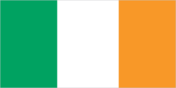
three equal vertical bands of green (hoist side), white, and orange; officially the flag colors have no meaning, but a common interpretation is that the green represents the Irish nationalist (Gaelic) tradition of Ireland; orange represents the Orange tradition (minority supporters of William of Orange); white symbolizes peace (or a lasting truce) between the green and the orange similar to the flag of Cote d'Ivoire, which is shorter and has the colors reversed - orange (hoist side), white, and green; also similar to the flag of Italy, which is shorter and has colors of green (hoist side), white, and red
Government type
republic, parliamentary democracy
Independence
6 December 1921 (from the UK by treaty)
International law organization participation
has not submitted an ICJ jurisdiction declaration; accepts ICCt jurisdiction
International organization participation
ADB (nonregional member), Australia Group, BIS, CD, CE, EAPC, EBRD, ECB, EIB, EMU, ESA, EU, FAO, FATF, IAEA, IBRD, ICAO, ICC (national committees), ICRM, IDA, IEA, IFAD, IFC, IFRCS, IGAD (partners), IHO, ILO, IMF, IMO, Interpol, IOC, IOM, IPU, ISO, ITSO, ITU, ITUC (NGOs), MIGA, MINURSO, MONUSCO, NEA, NSG, OAS (observer), OECD, OPCW, OSCE, Paris Club, PCA, PFP, UN, UNCTAD, UNESCO, UNHCR, UNIDO, UNIFIL, UNITAR, UNOCI, UNRWA, UNTSO, UPU, WCO, WHO, WIPO, WMO, WTO, ZC
Judicial branch
- Supreme Court or Court of Final Appeal (consists of the chief justice and 7 judges) judges nominated by the prime minister and Cabinet and appointed by the president; judges serve till age 70 High Court, Court of Criminal Appeal; circuit and district courts
- highest court(s)
- Supreme Court or Court of Final Appeal (consists of the chief justice and 7 judges)
- judge selection and term of office
- judges nominated by the prime minister and Cabinet and appointed by the president; judges serve till age 70
- subordinate courts
- High Court, Court of Criminal Appeal; circuit and district courts
Legal system
common law system based on the English model but substantially modified by customary law; judicial review of legislative acts in Supreme Court
Legislative branch
- bicameral Parliament or Oireachtas consists of the Senate or Seanad Eireann (60 seats; 49 members elected by the universities and from candidates put forward by five vocational panels, 11 are nominated by the prime minister; members serve five-year terms) and the lower house of Parliament or Dail Eireann (166 seats; members elected by popular vote on the basis of proportional representation to serve five-year terms) Senate - last held in 27 April 2011 (next to be held 2016); House of Representatives - last held on 25 February 2011 (next to be held probably in 2016) Senate - percent of vote by party - NA; seats by party - Fine Gael 19, Fianna Fail 14, Labor Party 12, Sinn Fein 3, independents 12; House of Representatives - percent of vote by party - Fine Gael 45.8%, Labor Party 22.3%, Fianna Fail 12.0%, Sinn Fein 8.4%, United Left Alliance 3.0%, New Vision 0.6%, independents 7.8%; seats by party - Fine Gael 76, Labor Party 37, Fianna Fail 20, Sinn Fein 14, United Left Alliance 5, New Vision 1, independents 13; note - after November 2009 disbandment of the Progressive Democrats, the two members of the Senate continued as independent DPs on 8 November 2008, delegates voted to disband the Progressive Democrats, and in November 2009 it officially stopped operating as a political party
- election results
- Senate - percent of vote by party - NA; seats by party - Fine Gael 19, Fianna Fail 14, Labor Party 12, Sinn Fein 3, independents 12; House of Representatives - percent of vote by party - Fine Gael 45.8%, Labor Party 22.3%, Fianna Fail 12.0%, Sinn Fein 8.4%, United Left Alliance 3.0%, New Vision 0.6%, independents 7.8%; seats by party - Fine Gael 76, Labor Party 37, Fianna Fail 20, Sinn Fein 14, United Left Alliance 5, New Vision 1, independents 13; note - after November 2009 disbandment of the Progressive Democrats, the two members of the Senate continued as independent DPs
- elections
- Senate - last held in 27 April 2011 (next to be held 2016); House of Representatives - last held on 25 February 2011 (next to be held probably in 2016)
National anthem
- "Amhran na bhFiann" (The Soldier's Song) Peadar KEARNEY [English], Liam O RINN [Irish]/Patrick HEENEY and Peadar KEARNEY adopted 1926; instead of "Amhran na bhFiann," the song "Ireland's Call" is often used in athletic events where citizens of the Republic of Ireland and Northern Ireland compete as a unified team
- lyrics/music
- Peadar KEARNEY [English], Liam O RINN [Irish]/Patrick HEENEY and Peadar KEARNEY
- name
- "Amhran na bhFiann" (The Soldier's Song)
National holiday
Saint Patrick's Day, 17 March
National symbol(s)
harp
Political parties and leaders
Fianna Fail [Michael MARTIN] Fine Gael [Enda KENNY] Green Party [Eamon RYAN] Labor Party [Eamon GILMORE] New Vision Sinn Fein [Gerry ADAMS] Socialist Party [Joe HIGGINS] The Workers' Party [Michael FINNEGAN] United Left Alliance
Political pressure groups and leaders
Families Acting for Innocent Relatives or FAIR [Brian MCCONNELL] (seek compensation for victims of violence); Families Against Intimidation and Terror or FAIT (oppose terrorism); Gaeltacht Civil Rights Campaign (Coiste Cearta Sibhialta na Gaeilge) or CCSG (encourages the use of the Irish language and campaigns for greater civil rights in Irish speaking areas); Iona Institute [David QUINN] (a conservative Catholic think tank); Irish Anti-War Movement [Richard BOYD BARRETT] (campaigns against wars around the world); Irish Republican Army or IRA (terrorist group); Keep Ireland Open (environmental group); Midland Railway Action Group or MRAG [Willie ALLEN] (transportation promoters); Peace and Neutrality Alliance [Roger COLE] (campaigns to protect Irish neutrality); Rail Users Ireland (formerly the Platform 11 - transportation promoters); 32 Country Sovereignty Movement or 32CSM (supports a fully sovereign Ireland); Ulster Defence Association or UDA (terrorist group)
Suffrage
18 years of age; universal
Economy
Agriculture - products
barley, potatoes, wheat; beef, dairy products
Budget
- $73 billion $88.79 billion (2012 est.)
- expenditures
- $88.79 billion (2012 est.)
- revenues
- $73 billion
Budget surplus (+) or deficit (-)
-7.6% of GDP (2012 est.)
Central bank discount rate
1.5% (31 December 2012) 1.75% (31 December 2010) this is the European Central Bank's rate on the marginal lending facility, which offers overnight credit to banks in the euro area
Commercial bank prime lending rate
3.55% (31 December 2012 est.) 3.81% (31 December 2011 est.)
Current account balance
$9.245 billion (2012 est.) $2.828 billion (2011 est.)
Debt - external
$2.163 trillion (31 December 2012) $2.213 trillion (31 December 2011)
Distribution of family income - Gini index
33.9 (2010) 35.9 (1987)
Economy - overview
Ireland is a small, modern, trade-dependent economy. Ireland was among the initial group of 12 EU nations that began circulating the euro on 1 January 2002. GDP growth averaged 6% in 1995-2007, but economic activity has dropped sharply since the onset of the world financial crisis, with GDP falling by over 3% in 2008, nearly 7% in 2009, and less than 1% in 2010. Ireland entered into a recession in 2008 for the first time in more than a decade, with the subsequent collapse of its domestic property and construction markets. Property prices rose more rapidly in Ireland in the decade up to 2007 than in any other developed economy. Since their 2007 peak, average house prices have fallen 47%. In the wake of the collapse of the construction sector and the downturn in consumer spending and business investment, the export sector, dominated by foreign multinationals, has become a key component of Ireland's economy. Agriculture, once the most important sector, is now dwarfed by industry and services. In 2008 the former COWEN government moved to guarantee all bank deposits, recapitalize the banking system, and establish partly-public venture capital funds in response to the country's economic downturn. In 2009, in continued efforts to stabilize the banking sector, the Irish Government established the National Asset Management Agency (NAMA) to acquire problem commercial property and development loans from Irish banks. Faced with sharply reduced revenues and a burgeoning budget deficit, the Irish Government introduced the first in a series of draconian budgets in 2009. In addition to across-the-board cuts in spending, the 2009 budget included wage reductions for all public servants. These measures were not sufficient. In 2010, the budget deficit reached 32.4% of GDP - the world's largest deficit, as a percentage of GDP - because of additional government support for the banking sector. In late 2010, the former COWEN government agreed to a $112 billion loan package from the EU and IMF to help Dublin further increase the capitalization of its banking sector and avoid defaulting on its sovereign debt. Since entering office in March 2011, the new KENNY government has intensified austerity measures to try to meet the deficit targets under Ireland's EU-IMF program. Ireland achieved moderate growth of 1.4% in 2011 and cut the budget deficit to 9.1% of GDP. Although the recovery slowed in 2012 because of weaker EU demand for Irish exports, Dublin managed to trim the deficit to about 8.5% of GDP.
Exchange rates
euros (EUR) per US dollar - 0.78 (2012 est.) 0.72 (2011 est.) 0.76 (2010 est.) 0.72 (2009 est.) 0.68 (2008 est.)
Exports
$119.3 billion (2012 est.) $127.5 billion (2011 est.)
Exports - commodities
machinery and equipment, computers, chemicals, medical devices, pharmaceuticals; food products, animal products
Exports - partners
US 17.9%, UK 17.3%, Belgium 15.6%, Germany 8.4%, Switzerland 5.8%, France 5% (2012)
Fiscal year
calendar year
GDP - composition, by end use
- 50.4% 15.3% 10.6% 0.3% 107.8% -84.6% (2012 est.)
- exports of goods and services
- 107.8%
- government consumption
- 15.3%
- household consumption
- 50.4%
- imports of goods and services
- -84.6%
- investment in fixed capital
- 10.6%
- investment in inventories
- 0.3%
GDP - composition, by sector of origin
- 1.6% 27.9% 70.5% (2012 est.)
- agriculture
- 1.6%
- industry
- 27.9%
- services
- 70.5% (2012 est.)
GDP - per capita (PPP)
$40,700 (2012 est.) $40,700 (2011 est.) $40,100 (2010 est.) data are in 2012 US dollars
GDP - real growth rate
0.2% (2012 est.) 2.2% (2011 est.) -1.1% (2010 est.)
GDP (official exchange rate)
$208 billion (2012 est.)
GDP (purchasing power parity)
$186.7 billion (2012 est.) $186.4 billion (2011 est.) $182.5 billion (2010 est.) data are in 2012 US dollars
Gross national saving
15.3% of GDP (2012 est.) 12.5% of GDP (2011 est.) 13% of GDP (2010 est.)
Household income or consumption by percentage share
- 2.9% 27.2% (2000)
- highest 10%
- 27.2% (2000)
- lowest 10%
- 2.9%
Imports
$63.63 billion (2012 est.) $67.2 billion (2011 est.)
Imports - commodities
data processing equipment, other machinery and equipment, chemicals, petroleum and petroleum products, textiles, clothing
Imports - partners
UK 39.8%, US 13.2%, Germany 7.6%, Netherlands 5.7% (2012)
Industrial production growth rate
-1.2% (2012 est.)
Industries
pharmaceuticals, chemicals, computer hardware and software, food products, beverages and brewing; medical devices
Inflation rate (consumer prices)
1.7% (2012 est.) 2.6% (2011 est.)
Labor force
2.154 million (2012 est.)
Labor force - by occupation
- 5% 19% 76% (2011 est.)
- agriculture
- 5%
- industry
- 19%
- services
- 76% (2011 est.)
Market value of publicly traded shares
$35.36 billion (31 December 2011) $33.72 billion (31 December 2010) $29.88 billion (31 December 2009)
Population below poverty line
5.5% (2009)
Public debt
117.6% of GDP (2012 est.) 106.4% of GDP (2011 est.) data cover general government debt, and includes debt instruments issued (or owned) by government entities other than the treasury; the data include treasury debt held by foreign entities; the data include debt issued by subnational entities, as well as intra-governmental debt; intra-governmental debt consists of treasury borrowings from surpluses in the social funds, such as for retirement, medical care, and unemployment; debt instruments for the social funds are not sold at public auctions
Reserves of foreign exchange and gold
$1.707 billion (31 December 2012 est.) $1.703 billion (31 December 2011 est.)
Stock of broad money
$291.1 billion (31 December 2011 est.) $260 billion (31 December 2010 est.)
Stock of direct foreign investment - abroad
$766 billion (31 December 2012 est.) $709.7 billion (31 December 2011 est.)
Stock of direct foreign investment - at home
$725.8 billion (31 December 2012 est.) $669.4 billion (31 December 2011 est.)
Stock of domestic credit
$433.1 billion (31 December 2012 est.) $456.8 billion (31 December 2011 est.)
Stock of narrow money
$122.3 billion (31 December 2012 est.) $118.3 billion (31 December 2011 est.) see entry for the European Union for money supply in the euro area; the European Central Bank (ECB) controls monetary policy for the 17 members of the Economic and Monetary Union (EMU); individual members of the EMU do not control the quantity of money circulating within their own borders
Taxes and other revenues
35.1% of GDP (2012 est.)
Unemployment rate
14.7% (2012 est.) 14.6% (2011 est.)
Energy
Carbon dioxide emissions from consumption of energy
36.57 million Mt (2011 est.)
Crude oil - exports
1,858 bbl/day (2010 est.)
Crude oil - imports
62,070 bbl/day (2010 est.)
Crude oil - production
725.6 bbl/day (2012 est.)
Crude oil - proved reserves
0 bbl (1 January 2013 es)
Electricity - consumption
26.1 billion kWh (2011 est.)
Electricity - exports
370 million kWh (2012 est.)
Electricity - from fossil fuels
76.2% of total installed capacity (2010 est.)
Electricity - from hydroelectric plants
2.9% of total installed capacity (2010 est.)
Electricity - from nuclear fuels
0% of total installed capacity (2010 est.)
Electricity - from other renewable sources
17.4% of total installed capacity (2010 est.)
Electricity - imports
724 million kWh (2012 est.)
Electricity - installed generating capacity
8.316 million kW (2010 est.)
Electricity - production
26.04 billion kWh (2011 est.)
Natural gas - consumption
5.506 billion cu m (2010 est.)
Natural gas - exports
0 cu m (2011 est.)
Natural gas - imports
4.522 billion cu m (2012 est.)
Natural gas - production
373 million cu m (2012 est.)
Natural gas - proved reserves
9.911 billion cu m (1 January 2013 es)
Refined petroleum products - consumption
144,000 bbl/day (2011 est.)
Refined petroleum products - exports
26,120 bbl/day (2010 est.)
Refined petroleum products - imports
166,000 bbl/day (2010 est.)
Refined petroleum products - production
59,630 bbl/day (2010 est.)
Communications
Broadcast media
publicly owned broadcaster Radio Telefis Eireann (RTE) operates 2 TV stations; commercial TV stations are available; about 75% of households utilize multi-channel satellite and TV services that provide access to a wide range of stations; RTE operates 4 national radio stations and has launched digital audio broadcasts on several stations; a number of commercial broadcast stations operate at the national, regional, and local levels (2007)
Internet country code
.ie
Internet hosts
1.387 million (2012)
Internet users
3.042 million (2009)
Telephone system
- modern digital system using cable and microwave radio relay system privatized but dominated by former state monopoly operator; increasing levels of broadband access particularly in urban areas country code - 353; landing point for the Hibernia-Atlantic submarine cable with links to the US, Canada, and UK; satellite earth station - 1 Intelsat (Atlantic Ocean) (2011)
- domestic
- system privatized but dominated by former state monopoly operator; increasing levels of broadband access particularly in urban areas
- general assessment
- modern digital system using cable and microwave radio relay
- international
- country code - 353; landing point for the Hibernia-Atlantic submarine cable with links to the US, Canada, and UK; satellite earth station - 1 Intelsat (Atlantic Ocean) (2011)
Telephones - main lines in use
2.007 million (2012)
Telephones - mobile cellular
4.906 million (2012)
Transportation
Airports
40 (2013)
Airports - with paved runways
- 5 (2013)
- 1,524 to 2,437 m
- 4
- 2,438 to 3,047 m
- 1
- 914 to 1,523 m
- 5
- over 3,047 m
- 1
- total
- 16
- under 914 m
- 5 (2013)
Airports - with unpaved runways
- 21 (2013)
- 2,438 to 3,047 m
- 1
- 914 to 1,523 m
- 2
- total
- 24
Merchant marine
- cargo 28, chemical tanker 2, container 1 5 (France 2, Spain 1, US 2) 33 (Bahamas 3, Bermuda 1, Cambodia 1, Cyprus 3, Isle of Man 1, Kazakhstan 1, Malta 4, Marshall Islands 6, Netherlands 8, Panama 1, Russia 1, Slovakia 1, Sweden 1, UK 1) (2010)
- foreign-owned
- 5 (France 2, Spain 1, US 2)
- registered in other countries
- 33 (Bahamas 3, Bermuda 1, Cambodia 1, Cyprus 3, Isle of Man 1, Kazakhstan 1, Malta 4, Marshall Islands 6, Netherlands 8, Panama 1, Russia 1, Slovakia 1, Sweden 1, UK 1) (2010)
- total
- 31
Pipelines
gas 2,147 km (2013)
Ports and terminals
Cork, Dublin, Shannon Foynes, Waterford
Railways
- 3,237 km 1,872 km 1.600-m gauge (37 km electrified) 1,365 km 0.914-m gauge (operated by the Irish Peat Board to transport peat to power stations and briquetting plants) (2008)
- narrow gauge
- 1,365 km 0.914-m gauge (operated by the Irish Peat Board to transport peat to power stations and briquetting plants) (2008)
- total
- 3,237 km
Roadways
- 96,036 km 96,036 km (includes 1,224 km of expressways) (2010)
- total
- 96,036 km
Waterways
956 km (pleasure craft only) (2010)
Military and Security
Manpower available for military service
- 1,179,125 1,163,728 (2010 est.)
- females age 16-49
- 1,163,728 (2010 est.)
- males age 16-49
- 1,179,125
Manpower fit for military service
- 977,631 965,900 (2010 est.)
- females age 16-49
- 965,900 (2010 est.)
- males age 16-49
- 977,631
Manpower reaching militarily significant age annually
- 28,564 27,197 (2010 est.)
- female
- 27,197 (2010 est.)
- male
- 28,564
Military branches
- Irish Defense Forces (Oglaigh na h-Eireannn), Permanent Defence Force: Army, Naval Service, Air Corps (2012)
- Irish Defense Forces (Oglaigh na h-Eireannn), Permanent Defence Force
- Army, Naval Service, Air Corps (2012)
Military expenditures
0.9% of GDP (2005 est.)
Military service age and obligation
17-25 years of age for male and female voluntary military service (17-27 years of age for the Naval Service); enlistees 16 years of age can be recruited for apprentice specialist positions; 17-35 years of age for the Reserve Defense Forces (RDF); maximum obligation 12 years (5 years IDF, 7 years RDF); EU citizenship or 5-year residence in Ireland required (2012)
Transnational Issues
Disputes - international
Ireland, Iceland, and the UK dispute Denmark's claim that the Faroe Islands' continental shelf extends beyond 200 nm
Illicit drugs
transshipment point for and consumer of hashish from North Africa to the UK and Netherlands and of European-produced synthetic drugs; increasing consumption of South American cocaine; minor transshipment point for heroin and cocaine destined for Western Europe; despite recent legislation, narcotics-related money laundering - using bureaux de change, trusts, and shell companies involving the offshore financial community - remains a concern
Refugees and internally displaced persons
- 73 (2012)
- stateless persons
- 73 (2012)