1996 Edition
CIA World Factbook 1996 (Project Gutenberg)
Introduction
Description
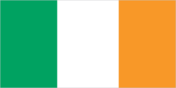
three equal vertical bands of green (hoist side), white, and orange; similar to the flag of Cote d'Ivoire, which is shorter and has the colors reversed - orange (hoist side), white, and green; also similar to the flag of Italy, which is shorter and has colors of green (hoist side), white, and red
Location
53 00 N, 8 00 W -- Western Europe, occupying five-sixths of the island of Ireland in the North Atlantic Ocean, west of Great Britain Flag ----
Geography
Area
- comparative area
- slightly larger than West Virginia
- land area
- 68,890 sq km
- total area
- 70,280 sq km
Climate
temperate maritime; modified by North Atlantic Current; mild winters, cool summers; consistently humid; overcast about half the time
Coastline
1,448 km
Environment
- current issues
- water pollution, especially of lakes, from agricultural runoff
- international agreements
- party to - Air Pollution, Air Pollution-Nitrogen Oxides, Climate Change, Environmental Modification, Hazardous Wastes, Marine Dumping, Nuclear Test Ban, Ozone Layer Protection, Tropical Timber 83, Wetlands, Whaling; signed, but not ratified - Air Pollution-Sulphur 94, Biodiversity, Desertification, Endangered Species, Law of the Sea, Marine Life Conservation
- natural hazards
- NA
Geographic coordinates
53 00 N, 8 00 W
Geographic note
strategic location on major air and sea routes between North America and northern Europe; over 40% of the population resides within 60 miles of Dublin
International disputes
Northern Ireland question with the UK; Rockall continental shelf dispute involving Denmark, Iceland, and the UK (Ireland and the UK have signed a boundary agreement in the Rockall area)
Irrigated land
NA sq km
Land boundaries
- border country
- UK 360 km
- total
- 360 km
Land use
- arable land
- 14%
- forest and woodland
- 5%
- meadows and pastures
- 71%
- other
- 10%
- permanent crops
- 0%
Location
Western Europe, occupying five-sixths of the island of Ireland in the North Atlantic Ocean, west of Great Britain
Map references
Europe
Maritime claims
- continental shelf
- not specified
- exclusive fishing zone
- 200 nm
- territorial sea
- 12 nm
Natural resources
zinc, lead, natural gas, petroleum, barite, copper, gypsum, limestone, dolomite, peat, silver
Terrain
- mostly level to rolling interior plain surrounded by rugged hills and low mountains; sea cliffs on west coast
- highest point
- Carrauntoohill 1,041 m
- lowest point
- Atlantic Ocean 0 m
People and Society
Age structure
0-14 years: 23% (male 424,558; female 402,062) 15-64 years: 65% (male 1,175,383; female 1,157,960) 65 years and over: 12% (male 173,150; female 233,720) (July 1996 est.)
Birth rate
13.22 births/1,000 population (1996 est.)
Death rate
8.93 deaths/1,000 population (1996 est.)
Ethnic divisions
Celtic, English
Infant mortality rate
6.4 deaths/1,000 live births (1996 est.)
Languages
Irish (Gaelic), spoken mainly in areas located along the western seaboard, English is the language generally used
Life expectancy at birth
- female
- 78.46 years (1996 est.)
- male
- 72.88 years
- total population
- 75.58 years
Literacy
- age 15 and over can read and write (1981 est.)
- female
- NA%
- male
- NA%
- total population
- 98%
Nationality
- adjective
- Irish
- noun
- Irishman(men), Irishwoman(men), Irish (collective plural)
Net migration rate
-6.46 migrant(s)/1,000 population (1996 est.)
Population
3,566,833 (July 1996 est.)
Population growth rate
-0.22% (1996 est.)
Religions
Roman Catholic 93%, Anglican 3%, none 1%, unknown 2%, other 1% (1981)
Sex ratio
- all ages
- 0.99 male(s)/female (1996 est.)
- at birth
- 1.07 male(s)/female
- under 15 years
- 1.06 male(s)/female 15-64 years: 1.02 male(s)/female 65 years and over: 0.74 male(s)/female
Total fertility rate
1.83 children born/woman (1996 est.)
Government
Administrative divisions
26 counties; Carlow, Cavan, Clare, Cork, Donegal, Dublin, Galway, Kerry, Kildare, Kilkenny, Laois, Leitrim, Limerick, Longford, Louth, Mayo, Meath, Monaghan, Offaly, Roscommon, Sligo, Tipperary, Waterford, Westmeath, Wexford, Wicklow
Capital
Dublin
Constitution
29 December 1937; adopted 1 July 1937 by plebiscite
Data code
EI
Diplomatic representation in US
- chancery
- 2234 Massachusetts Avenue NW, Washington, DC 20008
- chief of mission
- Ambassador Dermot A. GALLAGHER
- consulate(s) general
- Boston, Chicago, New York, and San Francisco
- telephone
- [1] (202) 462-3939
Executive branch
- cabinet
- Cabinet was appointed by president with previous nomination of the prime minister and approval of the House of Representatives
- chief of state
- President Mary Bourke ROBINSON (since 9 November 1990) was elected for a seven-year term by popular vote; election last held 9 November 1990 (next to be held NA November 1997); results - Mary Bourke ROBINSON 52.8%, Brian LENIHAN 47.2%
- head of government
- Prime Minister John BRUTON (since 15 December 1994) was nominated by the House of Representatives and appointed by the president
FAX
[353] (1) 6689946
Flag
three equal vertical bands of green (hoist side), white, and orange; similar to the flag of Cote d'Ivoire, which is shorter and has the colors reversed - orange (hoist side), white, and green; also similar to the flag of Italy, which is shorter and has colors of green (hoist side), white, and red
House of Representatives (Dail Eireann)
elections last held 25 November 1992 (next to be held by NA November 1997); results - Fianna Fail 39.1%, Fine Gael 24.5%, Labor Party 19.3%, Progressive Democrats 4.7%, Democratic Left 2.8%, Sinn Fein 1.6%, Workers' Party 0.7%, independents 5.9%; seats - (166 total) Fianna Fail 68, Fine Gael 45, Labor Party 33, Progressive Democrats 10, Democratic Left 4, Greens 1, independents 5
Independence
6 December 1921 (from UK)
International organization participation
Australia Group, BIS, CCC, CE, EBRD, ECE, EIB, ESA, EU, FAO, IAEA, IBRD, ICAO, ICC, ICRM, IDA, IEA, IFAD, IFC, IFRCS, ILO, IMF, IMO, Intelsat, Interpol, IOC, ISO, ITU, MINURSO, MTCR, NEA, NSG, OECD, OSCE, UN, UNCRO, UNCTAD, UNESCO, UNFICYP, UNIDO, UNIFIL, UNIKOM, UNMIH, UNPREDEP, UNPROFOR, UNTSO, UPU, WEU (observer), WHO, WIPO, WMO, WTrO, ZC
Judicial branch
Supreme Court, judges appointed by the president on the advice of the government (prime minister and cabinet)
Legal system
based on English common law, substantially modified by indigenous concepts; judicial review of legislative acts in Supreme Court; has not accepted compulsory ICJ jurisdiction
Legislative branch
bicameral Parliament (Oireachtas)
Name of country
- conventional long form
- none
- conventional short form
- Ireland
National holiday
Saint Patrick's Day, 17 March
Political parties and leaders
- Democratic Left, Proinsias DE ROSSA; Fianna Fail, Bertie AHERN; Labor Party, Richard SPRING; Fine Gael, John BRUTON; Communist Party of Ireland, Michael O'RIORDAN; Sinn Fein, Gerry ADAMS; Progressive Democrats, Mary HARNEY; The Workers' Party, Marion DONNELLY; Green Alliance, Bronwen MAHER
- note
- Prime Minister BRUTON heads a three-party coalition consisting of the Fine Gael, the Labor Party, and the Democratic Left
Senate (Seanad Eireann)
elections last held NA February 1992 (next to be held NA February 1997); results - percent of vote by party NA; seats - (60 total, 49 elected) Fianna Fail 26, Fine Gael 16, Labor 9, Progressive Democrats 2, Democratic Left 1, independents 6
Suffrage
18 years of age; universal
Type of government
republic
US diplomatic representation
- chief of mission
- Ambassador Jean Kennedy SMITH
- embassy
- 42 Elgin Road, Ballsbridge, Dublin
- mailing address
- use embassy street address
- telephone
- [353] (1) 6688777
Economy
Agriculture
turnips, barley, potatoes, sugar beets, wheat; meat and dairy products
Budget
- expenditures
- $20.3 billion, including capital expenditures of $3.6 billion (1994)
- revenues
- $19.3 billion
Currency
1 Irish pound (LIr) = 100 pence
Economic aid
- donor
- ODA, $81 million (1993)
Economic overview
The economy is small and trade dependent. Agriculture, once the most important sector, is now dwarfed by industry, which accounts for 38% of GDP, about 80% of exports, and employs 28% of the labor force. Although exports remain the primary engine for Ireland's robust growth, the economy is also benefiting from a rise in consumer spending and recovery in both construction and business investment. Ireland has substantially reduced its external debt since 1987, to 40% of GDP in 1994. Over the same period, inflation has fallen sharply and chronic trade deficits have been transformed into annual surpluses. Unemployment remains a serious problem, however, and job creation is the main focus of government policy. To ease unemployment, Dublin aggressively courts foreign investors and recently created a new industrial development agency to aid small indigenous firms. Government assistance is constrained by Dublin's continuing deficit reduction measures.
Electricity
- capacity
- 3,930,000 kW
- consumption per capita
- 3,938 kWh (1993)
- production
- 14.9 billion kWh
Exchange rates
Irish pounds (LIr) per US$1 - 0.6315 (January 1996), 0.6235 (1995), 0.6676 (1994), 0.6816 (1993), 0.5864 (1992), 0.6190 (1991)
Exports
- $29.9 billion (f.o.b., 1994)
- commodities
- chemicals, data processing equipment, industrial machinery, live animals, animal products
- partners
- EU 73% (UK 27%, Germany 14%, France 9%), US 9%
External debt
$19.5 billion (1994 est.)
Fiscal year
calendar year
GDP
purchasing power parity - $54.6 billion (1995 est.)
GDP composition by sector
- agriculture
- 6.8%
- industry
- 35.3%
- services
- 57.9% (1994)
GDP per capita
$15,400 (1995 est.)
GDP real growth rate
7% (1995 est.)
Illicit drugs
transshipment point for hashish from North Africa to the UK and Netherlands
Imports
- $25.3 billion (c.i.f., 1994)
- commodities
- food, animal feed, data processing equipment, petroleum and petroleum products, machinery, textiles, clothing
- partners
- EU 58% (UK 36%, Germany 7%, France 4%), US 18%
Industrial production growth rate
8.9% (1995 est.)
Industries
food products, brewing, textiles, clothing, chemicals, pharmaceuticals, machinery, transportation equipment, glass and crystal
Inflation rate (consumer prices)
2.8% (1995 est.)
Labor force
- 1.37 million
- by occupation
- services 57.0%, manufacturing and construction 28%, agriculture, forestry, and fishing 13.5%, energy and mining 1.5% (1992)
Unemployment rate
13.5% (1995 est.)
Communications
Branches
Army (includes Naval Service and Air Corps), National Police (Garda Siochana)
Defense expenditures
exchange rate conversion - $618 million, 1.3% of GDP (1994)
Manpower availability
- males age 15-49
- 939,237
- males fit for military service
- 761,048
- males reach military age (17) annually
- 35,904 (1996 est.)
Radio broadcast stations
AM 9, FM 45, shortwave 0
Radios
2.2 million (1991 est.)
Telephone system
- modern digital system using cable and microwave radio relay
- domestic
- microwave radio relay
- international
- satellite earth station - 1 Intelsat (Atlantic Ocean)
Telephones
900,000 (1987 est.)
Television broadcast stations
86 (1987 est.)
Televisions
1.025 million (1990 est.) Defense
Transportation
Airports
- total
- 40
- with paved runways 1 524 to 2 437 m
- 3
- with paved runways 2 438 to 3 047 m
- 1
- with paved runways 914 to 1 523 m
- 3
- with paved runways over 3 047 m
- 1
- with paved runways under 914 m
- 29
- with unpaved runways 914 to 1 523 m
- 3 (1995 est.)
Highways
- paved
- 86,787 km (including 32 km of expressways)
- total
- 92,327 km
- unpaved
- 5,540 km (1992 est.)
Merchant marine
- ships by type
- bulk 4, cargo 27, chemical tanker 1, container 3, oil tanker 2, short-sea passenger 3, specialized tanker 2 (1995 est.)
- total
- 42 ships (1,000 GRT or over) totaling 129,027 GRT/155,371 DWT
Pipelines
natural gas 225 km
Ports
Arklow, Cork, Drogheda, Dublin, Foynes, Galway, Limerick, New Ross, Waterford
Railways
- broad gauge
- 1,944 km 1.600-m gauge (37 km electrified; 485 km double track) (1995)
- total
- 1,944 km
Waterways
limited for commercial traffic