2014 Edition
CIA World Factbook 2014 Archive (HTML)
Introduction
Background
Formerly part of the Ottoman Empire, Iraq was occupied by Britain during the course of World War I; in 1920, it was declared a League of Nations mandate under UK administration. In stages over the next dozen years, Iraq attained its independence as a kingdom in 1932. A "republic" was proclaimed in 1958, but in actuality a series of strongmen ruled the country until 2003. The last was SADDAM Husayn. Territorial disputes with Iran led to an inconclusive and costly eight-year war (1980-88). In August 1990, Iraq seized Kuwait but was expelled by US-led, UN coalition forces during the Gulf War of January-February 1991. Following Kuwait's liberation, the UN Security Council (UNSC) required Iraq to scrap all weapons of mass destruction and long-range missiles and to allow UN verification inspections. Continued Iraqi noncompliance with UNSC resolutions over a period of 12 years led to the US-led invasion of Iraq in March 2003 and the ouster of the SADDAM Husayn regime. US forces remained in Iraq under a UNSC mandate through 2009 and under a bilateral security agreement thereafter, helping to provide security and to train and mentor Iraqi security forces. In October 2005, Iraqis approved a constitution in a national referendum and, pursuant to this document, elected a 275-member Council of Representatives (COR) in December 2005. The COR approved most cabinet ministers in May 2006, marking the transition to Iraq's first constitutional government in nearly a half century. In January 2009 and April 2013, Iraq held elections for provincial councils in all governorates except for the three governorates comprising the Kurdistan Regional Government and Kirkuk Governorate. Iraq held a national legislative election in March 2010 - choosing 325 legislators in an expanded COR - and, after nine months of deadlock the COR approved the new government in December 2010. Nearly nine years after the start of the Second Gulf War in Iraq, US military operations there ended in mid-December 2011.
Geography
Area
- 438,317 sq km 437,367 sq km 950 sq km
- total
- 438,317 sq km
- water
- 950 sq km
Area - comparative
Area comparison map:
Climate
mostly desert; mild to cool winters with dry, hot, cloudless summers; northern mountainous regions along Iranian and Turkish borders experience cold winters with occasionally heavy snows that melt in early spring, sometimes causing extensive flooding in central and southern Iraq
Coastline
58 km
Elevation extremes
- Persian Gulf 0 m Cheekha Dar (Kurdish for "Black Tent"); 3,611 m
- highest point
- Cheekha Dar (Kurdish for "Black Tent"); 3,611 m
- lowest point
- Persian Gulf 0 m
Environment - current issues
government water control projects have drained most of the inhabited marsh areas east of An Nasiriyah by drying up or diverting the feeder streams and rivers; a once sizable population of Marsh Arabs, who inhabited these areas for thousands of years, has been displaced; furthermore, the destruction of the natural habitat poses serious threats to the area's wildlife populations; inadequate supplies of potable water; development of the Tigris and Euphrates rivers system contingent upon agreements with upstream riparian Turkey; air and water pollution; soil degradation (salination) and erosion; desertification
Environment - international agreements
- Biodiversity, Law of the Sea, Ozone Layer Protection Environmental Modification
- party to
- Biodiversity, Law of the Sea, Ozone Layer Protection
- signed, but not ratified
- Environmental Modification
Freshwater withdrawal (domestic/industrial/agricultural)
- 66 cu km/yr (7%/15%/79%) 2,616 cu m/yr (2000)
- per capita
- 2,616 cu m/yr (2000)
- total
- 66 cu km/yr (7%/15%/79%)
Geographic coordinates
33 00 N, 44 00 E
Geography - note
strategic location on Shatt al Arab waterway and at the head of the Persian Gulf
Irrigated land
35,250 sq km (2003)
Land boundaries
- 3,809 km Iran 1,599 km, Jordan 179 km, Kuwait 254 km, Saudi Arabia 811 km, Syria 599 km, Turkey 367 km
- border countries
- Iran 1,599 km, Jordan 179 km, Kuwait 254 km, Saudi Arabia 811 km, Syria 599 km, Turkey 367 km
- total
- 3,809 km
Land use
- 9.19% 0.48% 90.33% (2011)
- arable land
- 9.19%
- other
- 90.33% (2011)
- permanent crops
- 0.48%
Location
Middle East, bordering the Persian Gulf, between Iran and Kuwait
Map references
Middle East
Maritime claims
- 12 nm not specified
- continental shelf
- not specified
- territorial sea
- 12 nm
Natural hazards
dust storms; sandstorms; floods
Natural resources
petroleum, natural gas, phosphates, sulfur
Terrain
mostly broad plains; reedy marshes along Iranian border in south with large flooded areas; mountains along borders with Iran and Turkey
Total renewable water resources
89.86 cu km (2011)
People and Society
Age structure
- 36.7% (male 6,093,069/female 5,878,590) 19.6% (male 3,237,212/female 3,142,202) 36.3% (male 6,032,379/female 5,785,967) 4.2% (male 652,973/female 713,662) 3.2% (male 487,841/female 561,797) (2014 est.)
- 0-14 years
- 36.7% (male 6,093,069/female 5,878,590)
- 15-24 years
- 19.6% (male 3,237,212/female 3,142,202)
- 25-54 years
- 36.3% (male 6,032,379/female 5,785,967)
- 55-64 years
- 4.2% (male 652,973/female 713,662)
- 65 years and over
- 3.2% (male 487,841/female 561,797) (2014 est.)
Birth rate
26.85 births/1,000 population (2014 est.)
Child labor - children ages 5-14
- 715,737 11 % (2006 est.)
- percentage
- 11 % (2006 est.)
- total number
- 715,737
Children under the age of 5 years underweight
7.1% (2006)
Contraceptive prevalence rate
51.2% (2011)
Death rate
4.57 deaths/1,000 population (2014 est.)
Dependency ratios
- 74.9 % 69.3 % 5.5 % 18.1 (2014 est.)
- elderly dependency ratio
- 5.5 %
- potential support ratio
- 18.1 (2014 est.)
- total dependency ratio
- 74.9 %
- youth dependency ratio
- 69.3 %
Drinking water source
- urban: 93.9% of population rural: 68.5% of population total: 85.4% of population urban: 6.1% of population rural: 31.5% of population total: 14.6% of population (2012 est.)
- rural
- 31.5% of population
- total
- 14.6% of population (2012 est.)
- urban
- 6.1% of population
Education expenditures
NA
Ethnic groups
Arab 75%-80%, Kurdish 15%-20%, Turkoman, Assyrian, or other 5%
Health expenditures
8.3% of GDP (2011)
HIV/AIDS - adult prevalence rate
less than 0.1% (2001 est.)
HIV/AIDS - deaths
NA
HIV/AIDS - people living with HIV/AIDS
fewer than 500 (2003 est.)
Hospital bed density
1.3 beds/1,000 population (2010)
Infant mortality rate
- 37.53 deaths/1,000 live births 41.57 deaths/1,000 live births 33.28 deaths/1,000 live births (2014 est.)
- female
- 33.28 deaths/1,000 live births (2014 est.)
- total
- 37.53 deaths/1,000 live births
Languages
Arabic (official), Kurdish (official), Turkmen (a Turkish dialect) and Assyrian (Neo-Aramaic) are official in areas where they constitute a majority of the population), Armenian
Life expectancy at birth
- 71.42 years 69.93 years 72.99 years (2014 est.)
- female
- 72.99 years (2014 est.)
- total population
- 71.42 years
Literacy
- age 15 and over can read and write 78.5% 86% 71.2% (2011 est.)
- definition
- age 15 and over can read and write
- female
- 71.2% (2011 est.)
- male
- 86%
- total population
- 78.5%
Major infectious diseases
- intermediate bacterial diarrhea, hepatitis A, and typhoid fever highly pathogenic H5N1 avian influenza has been identified in this country; it poses a negligible risk with extremely rare cases possible among US citizens who have close contact with birds (2013)
- degree of risk
- intermediate
- food or waterborne diseases
- bacterial diarrhea, hepatitis A, and typhoid fever
Major urban areas - population
BAGHDAD (capital) 6.036 million; Mosul 1.494 million; Erbil 1.039 million; Basra 942,000; As Sulaymaniyah 867,000; Najaf 779,000 (2011)
Maternal mortality rate
63 deaths/100,000 live births (2010)
Median age
- 21.5 years 21.4 years 21.6 years (2014 est.)
- female
- 21.6 years (2014 est.)
- male
- 21.4 years
- total
- 21.5 years
Nationality
- Iraqi(s) Iraqi
- adjective
- Iraqi
- noun
- Iraqi(s)
Net migration rate
0 migrant(s)/1,000 population (2014 est.)
Obesity - adult prevalence rate
27% (2008)
Physicians density
0.61 physicians/1,000 population (2010)
Population
32,585,692 (July 2014 est.)
Population growth rate
2.23% (2014 est.)
Religions
Muslim (official) 99% (Shia 60%-65%, Sunni 32%-37%), Christian 0.8%, Hindu while there has been voluntary relocation of many Christian families to northern Iraq, recent reporting indicates that the overall Christian population may have dropped by as much as 50 percent since the fall of the Saddam HUSSEIN regime in 2003, with many fleeing to Syria, Jordan, and Lebanon (2010 est.)
Sanitation facility access
- urban: 86.2% of population rural: 81.8% of population total: 84.7% of population urban: 13.8% of population rural: 18.2% of population total: 15.3% of population (2012 est.)
- rural
- 18.2% of population
- total
- 15.3% of population (2012 est.)
- urban
- 13.8% of population
School life expectancy (primary to tertiary education)
- 10 years 11 years 9 years (2004)
- female
- 9 years (2004)
- male
- 11 years
- total
- 10 years
Sex ratio
- 1.05 male(s)/female 1.04 male(s)/female 1.03 male(s)/female 1.04 male(s)/female 1.03 male(s)/female 0.87 male(s)/female 1.03 male(s)/female (2014 est.)
- 0-14 years
- 1.04 male(s)/female
- 15-24 years
- 1.03 male(s)/female
- 25-54 years
- 1.04 male(s)/female
- 55-64 years
- 1.03 male(s)/female
- 65 years and over
- 0.87 male(s)/female
- at birth
- 1.05 male(s)/female
- total population
- 1.03 male(s)/female (2014 est.)
Total fertility rate
3.41 children born/woman (2014 est.)
Urbanization
- 66.5% of total population (2011) 3.05% annual rate of change (2010-15 est.)
- rate of urbanization
- 3.05% annual rate of change (2010-15 est.)
- urban population
- 66.5% of total population (2011)
Government
Administrative divisions
18 governorates (muhafazat, singular - muhafazah (Arabic); parezgakan, singular - parezga (Kurdish)) and 1 region*; Al Anbar; Al Basrah; Al Muthanna; Al Qadisiyah (Ad Diwaniyah); An Najaf; Arbil (Erbil) (Arabic), Hewler (Kurdish); As Sulaymaniyah (Arabic), Slemani (Kurdish); Babil; Baghdad; Dahuk (Arabic), Dihok (Kurdish); Dhi Qar; Diyala; Karbala'; Kirkuk; Kurdistan Regional Government*; Maysan; Ninawa; Salah ad Din; Wasit
Capital
- Baghdad 33 20 N, 44 24 E UTC+3 (8 hours ahead of Washington, DC, during Standard Time)
- geographic coordinates
- 33 20 N, 44 24 E
- name
- Baghdad
- time difference
- UTC+3 (8 hours ahead of Washington, DC, during Standard Time)
Constitution
several previous; latest adopted by referendum 15 October 2005 (2013)
Country name
- Republic of Iraq Iraq Jumhuriyat al-Iraq/Komar-i Eraq Al Iraq/Eraq
- conventional long form
- Republic of Iraq
- conventional short form
- Iraq
- local long form
- Jumhuriyat al-Iraq/Komar-i Eraq
- local short form
- Al Iraq/Eraq
Diplomatic representation from the US
- Ambassador Robert Stephen BEECROFT (since 9 October 2012) Al-Kindi Street, International Zone, Baghdad APO AE 09316 0760-030-3000 NA
- chief of mission
- Ambassador Robert Stephen BEECROFT (since 9 October 2012)
- embassy
- Al-Kindi Street, International Zone, Baghdad
- FAX
- NA
- mailing address
- APO AE 09316
- telephone
- 0760-030-3000
Diplomatic representation in the US
- Ambassador Luqman Abd al-Rahim FAYLI (since 31 May 2013) 3421 Massachusetts Ave, NW, Washington, DC 20007 [1] (202) 742-1600 [1] (202) 333-1129 Chicago, Houston, Los Angeles, New York, San Francisco
- chancery
- 3421 Massachusetts Ave, NW, Washington, DC 20007
- chief of mission
- Ambassador Luqman Abd al-Rahim FAYLI (since 31 May 2013)
- consulate(s) general
- Chicago, Houston, Los Angeles, New York, San Francisco
- FAX
- [1] (202) 333-1129
- telephone
- [1] (202) 742-1600
Executive branch
- President Jalal TALABANI (since 6 April 2005) Prime Minister Nuri al-MALIKI (since 20 May 2006) The Council of Ministers consists of the prime minister and cabinet ministers the prime minister proposes; approved by an absolute majority vote by the Council of Representatives president elected by Council of Representatives (parliament) to serve a four-year term (eligible for a second term); presidential election in parliament last held on 11 November 2010 (next to be held on 30 April 2014) President Jalal TALABANI reelected on 11 November 2010; Council of Representatives vote count on second ballot - 195 votes; Nuri al-MALIKI reelected prime minister
- cabinet
- The Council of Ministers consists of the prime minister and cabinet ministers the prime minister proposes; approved by an absolute majority vote by the Council of Representatives
- chief of state
- President Jalal TALABANI (since 6 April 2005)
- election results
- President Jalal TALABANI reelected on 11 November 2010; Council of Representatives vote count on second ballot - 195 votes; Nuri al-MALIKI reelected prime minister
- elections
- president elected by Council of Representatives (parliament) to serve a four-year term (eligible for a second term); presidential election in parliament last held on 11 November 2010 (next to be held on 30 April 2014)
- head of government
- Prime Minister Nuri al-MALIKI (since 20 May 2006)
Flag description
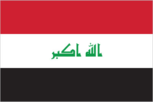
three equal horizontal bands of red (top), white, and black; the Takbir (Arabic expression meaning "God is great") in green Arabic script is centered in the white band; the band colors derive from the Arab Liberation flag and represent oppression (black), overcome through bloody struggle (red), to be replaced by a bright future (white); the Council of Representatives approved this flag in 2008 as a compromise temporary replacement for the Ba'athist Saddam-era flag similar to the flag of Syria, which has two stars but no script, Yemen, which has a plain white band, and that of Egypt, which has a gold Eagle of Saladin centered in the white band
Government type
parliamentary democracy
Independence
3 October 1932 (from League of Nations mandate under British administration); note - on 28 June 2004 the Coalition Provisional Authority transferred sovereignty to the Iraqi Interim Government
International law organization participation
has not submitted an ICJ jurisdiction declaration; non-party state to the ICCt
International organization participation
ABEDA, AFESD, AMF, CAEU, CICA, EITI (candidate country), FAO, G-77, IAEA, IBRD, ICAO, ICRM, IDA, IDB, IFAD, IFC, IFRCS, ILO, IMF, IMO, IMSO, Interpol, IOC, IPU, ISO, ITSO, ITU, LAS, MIGA, NAM, OAPEC, OIC, OPCW, OPEC, PCA, UN, UNCTAD, UNESCO, UNIDO, UNWTO, UPU, WCO, WFTU (NGOs), WHO, WIPO, WMO, WTO (observer)
Judicial branch
- Federal Supreme Court or FSC (consists of 9 judges); note - court jurisdiction limited to constitutional issues); Court of Cassation (consists of a court president, 5 vice-presidents, and at least 24 judges) Federal Supreme Court and Court of Cassation judges appointed by the Higher Juridical Council, a 26-member independent committee of judicial officials; FSC members appointed for life ; Court of Cassation judges appointed for 1-year probationary period and upon satisfactory performance may be confirmed for permanent tenure until retirement at age 63 Courts of Appeal (governorate level); courts of first instance; personal status, labor, criminal, juvenile, and religious courts
- highest court(s)
- Federal Supreme Court or FSC (consists of 9 judges); note - court jurisdiction limited to constitutional issues); Court of Cassation (consists of a court president, 5 vice-presidents, and at least 24 judges)
- judge selection and term of office
- Federal Supreme Court and Court of Cassation judges appointed by the Higher Juridical Council, a 26-member independent committee of judicial officials; FSC members appointed for life ; Court of Cassation judges appointed for 1-year probationary period and upon satisfactory performance may be confirmed for permanent tenure until retirement at age 63
- subordinate courts
- Courts of Appeal (governorate level); courts of first instance; personal status, labor, criminal, juvenile, and religious courts
Legal system
mixed legal system of civil and Islamic law
Legislative branch
- unicameral Council of Representatives (325 seats consisting of 317 members elected by an optional open-list and representing a specific governorate, proportional representation system and 8 seats reserved for minorities; members serve 4-year terms); note - Iraq's Constitution calls for the establishment of an upper house, the Federation Council last held on 7 March 2010 (next to be held on 30 April 2014 for an enlarged 328-seat parliament) Council of Representatives - percent of vote by coalition - Iraqi National Movement 25.9%, State of Law coalition 25.8%, Iraqi National Alliance 19.4%, Kurdistan Alliance 15.3%, Goran (Change) List 4.4%, Tawafuq Front 2.7%, Iraqi Unity Alliance 2.9%, Kurdistan Islamic Union 2.3%, Kurdistan Islamic Group 1.4%; seats by coalition - NA
- election results
- Council of Representatives - percent of vote by coalition - Iraqi National Movement 25.9%, State of Law coalition 25.8%, Iraqi National Alliance 19.4%, Kurdistan Alliance 15.3%, Goran (Change) List 4.4%, Tawafuq Front 2.7%, Iraqi Unity Alliance 2.9%, Kurdistan Islamic Union 2.3%, Kurdistan Islamic Group 1.4%; seats by coalition - NA
- elections
- last held on 7 March 2010 (next to be held on 30 April 2014 for an enlarged 328-seat parliament)
National anthem
- "Mawtini" (My Homeland) Ibrahim TOUQAN/Mohammad FLAYFEL adopted 2004; following the ousting of Saddam HUSSEIN, Iraq adopted "Mawtini," a popular folk song throughout the Arab world, which also serves as an unofficial anthem of the Palestinian people
- lyrics/music
- Ibrahim TOUQAN/Mohammad FLAYFEL
- name
- "Mawtini" (My Homeland)
National holiday
Republic Day, July 14 (1958); note - the Government of Iraq has yet to declare an official national holiday but still observes Republic Day
National symbol(s)
golden eagle
Political parties and leaders
Badr Organization [Hadi al-AMIRI] Da'wa Party (Islamic) [Prime Minister Nuri al-MALIKI] Da'wa Tanzim [Hashim al-MUSAWI branch] Da-wa Tanzim [Abd al-Karim al-ANZI branch] Fadilah Party [Hasan al-SHAMMARI and Ammar TUAMA] Goran (Change) List (also known as the Movement for Change) [Nushirwan MUSTAFA] Iraqi Covenant Gathering [Ahmad Abd al-Ghafur al-SAMARRAI] Iraqi Constitutional Party [Jawad al-BULANI] Iraqi Front for National Dialogue [Deputy Prime Minister Salih al-MUTLAQ] Iraqi Islamic Party or IIP [Usama al-TIKRITI] Iraqi Justice and Reform Movement [Shaykh Abdallah al-YAWR] Iraqi National Accord or INA [Ayad ALLAWI] Iraqi National Alliance [Ibrahim al-JAFARI] Iraqi National Congress or INC [Ahmad CHALABI] Iraqi National Movement (see Iraqi National Accord) Iraqi Unity Alliance [Nauaf Saud ZAID] Islamic Supreme Council of Iraq or ISCI [Ammar al-HAKIM] Kurdistan Alliance Kurdistan Democratic Party or KDP [Kurdistan Regional Government President Masud BARZANI] Kurdistan Islamic Group (also called Islamic Group of Kurdistan) [Ali BAPIR] Kurdistan Islamic Union [ Mohammed FARAI] Future National Gathering [Finance Minister Rafi al-ISSAWI] National Iraqiyun Gathering [Usama al-NUJAYFI] National Movement for Reform and Development [Jamal al-KARBULI] National Reform Trend (part of the National Iraqi Alliance) [former Prime Minister Ibrahim al-JAFARI] Patriotic Union of Kurdistan or PUK [President Jalal TALABANI] Sadrist Trend [Muqtada al-SADR] Sahawa al-Iraq [Ahmad al-RISHAWI] State of Law Coalition [Nouri al-MALIKI] United Coalition [Usama al-NUJAYFI] numerous smaller local, tribal, and minority parties
Political pressure groups and leaders
Sunni militias Shia militias, some associated with political parties
Suffrage
18 years of age; universal
Economy
Agriculture - products
wheat, barley, rice, vegetables, dates, cotton; cattle, sheep, poultry
Budget
- $99.52 billion $97.42 billion (2013 est.)
- expenditures
- $97.42 billion (2013 est.)
- revenues
- $99.52 billion
Budget surplus (+) or deficit (-)
0.9% of GDP (2013 est.)
Central bank discount rate
6% (December 2012) 6% (December 2011)
Commercial bank prime lending rate
6% (31 December 2013 est.) 6% (31 December 2012 est.)
Current account balance
$12.85 billion (2013 est.) $29.54 billion (2012 est.)
Debt - external
$59.49 billion (31 December 2013 est.) $60.2 billion (31 December 2012 est.)
Economy - overview
An improving security environment and foreign investment are helping to spur economic activity, particularly in the energy, construction, and retail sectors. Broader economic development, long-term fiscal health, and sustained improvements in the overall standard of living still depend on the central government passing major policy reforms. Iraq's largely state-run economy is dominated by the oil sector, which provides more than 90% of government revenue and 80% of foreign exchange earnings. Iraq in 2012 boosted oil exports to a 30-year high of 2.6 million barrels per day, a significant increase from Iraq's average of 2.2 million in 2011. Government revenues increased as global oil prices remained persistently high for much of 2012. Iraq's contracts with major oil companies have the potential to further expand oil exports and revenues, but Iraq will need to make significant upgrades to its oil processing, pipeline, and export infrastructure to enable these deals to reach their economic potential. The Iraqi Kurdistan Region's (IKR) autonomous Kurdistan Regional Government (KRG) passed its own oil law in 2007, and has directly signed about 50 contracts to develop IKR energy reserves. The federal government has disputed the legal authority of the KRG to conclude most of these contracts, some of which are also in areas with unresolved administrative boundaries in dispute between the federal and regional government. Iraq is making slow progress enacting laws and developing the institutions needed to implement economic policy, and political reforms are still needed to assuage investors' concerns regarding the uncertain business climate, which may have been harmed by the November 2012 standoff between Baghdad and Erbil and the removal of the Central Bank Governor in October 2012. The government of Iraq is eager to attract additional foreign direct investment, but it faces a number of obstacles including a tenuous political system and concerns about security and societal stability. Rampant corruption, outdated infrastructure, insufficient essential services, skilled labor shortages, and antiquated commercial laws stifle investment and continue to constrain growth of private, nonoil sectors. Iraq is considering a package of laws to establish a modern legal framework for the oil sector and a mechanism to equitably divide oil revenues within the nation, although these reforms are still under contentious and sporadic negotiation. Under the Iraqi Constitution, some competencies relevant to the overall investment climate are either shared by the federal government and the regions or are devolved entirely to the regions. Investment in the IKR operates within the framework of the Kurdistan Region Investment Law (Law 4 of 2006) and the Kurdistan Board of Investment, which is designed to provide incentives to help economic development in areas under the authority of the KRG. Inflation has remained under control since 2006 as security improved. However, Iraqi leaders remain hard pressed to translate macroeconomic gains into an improved standard of living for the Iraqi populace. Unemployment remains a problem throughout the country despite a bloated public sector. Encouraging private enterprise through deregulation would make it easier for Iraqi citizens and foreign investors to start new businesses. Rooting out corruption and implementing reforms - such as restructuring banks and developing the private sector - would be important steps in this direction.
Exchange rates
Iraqi dinars (IQD) per US dollar - 1,166 (2013 est.) 1,166.17 (2012 est.) 1,170 (2010 est.) 1,170 (2009) 1,176 (2008)
Exports
$91.99 billion (2013 est.) $94.21 billion (2012 est.)
Exports - commodities
crude oil 84%, crude materials excluding fuels, food and live animals
Exports - partners
US 21.1%, India 20.2%, China 13.6%, South Korea 11%, Canada 4.7%, Italy 4.4%, Spain 4.2% (2012)
Fiscal year
calendar year
GDP - composition, by sector of origin
- 3.3% 64.6% 32.1% (2013 est.)
- agriculture
- 3.3%
- industry
- 64.6%
- services
- 32.1% (2013 est.)
GDP - per capita (PPP)
$7,100 (2013 est.) $7,100 (2012 est.) $6,800 (2011 est.) data are in 2013 US dollars
GDP - real growth rate
4.2% (2013 est.) 8.4% (2012 est.) 8.6% (2011 est.)
GDP (official exchange rate)
$221.8 billion (2013 est.)
GDP (purchasing power parity)
$249.4 billion (2013 est.) $239.3 billion (2012 est.) $220.7 billion (2011 est.) data are in 2013 US dollars
Household income or consumption by percentage share
- 3.6% 25.7% (2007 est.)
- highest 10%
- 25.7% (2007 est.)
- lowest 10%
- 3.6%
Imports
$66.61 billion (2013 est.) $50.16 billion (2012 est.)
Imports - commodities
food, medicine, manufactures
Imports - partners
Turkey 27.5%, Syria 16.2%, China 12.5%, US 5.2%, South Korea 4.7% (2012)
Industrial production growth rate
6.9% (2013 est.)
Industries
petroleum, chemicals, textiles, leather, construction materials, food processing, fertilizer, metal fabrication/processing
Inflation rate (consumer prices)
2% (2013 est.) 6.1% (2012 est.)
Labor force
8.9 million (2010 est.)
Labor force - by occupation
- 21.6% 18.7% 59.8% (2008 est.)
- agriculture
- 21.6%
- industry
- 18.7%
- services
- 59.8% (2008 est.)
Market value of publicly traded shares
$4 billion (9 December 2011) $2.6 billion (31 July 2010) $2 billion (31 July 2009 est.)
Population below poverty line
25% (2008 est.)
Reserves of foreign exchange and gold
$71.24 billion (31 December 2013 est.) $70.33 billion (31 December 2012 est.)
Stock of broad money
$74.81 billion (31 December 2013 est.) $64.74 billion (31 December 2012 est.)
Stock of domestic credit
$-3.902 million (31 December 2013 est.) $-3.981 million (31 December 2012 est.)
Stock of narrow money
$62.33 billion (31 December 2013 est.) $54.68 billion (31 December 2012 est.)
Taxes and other revenues
44.9% of GDP (2013 est.)
Unemployment rate
16% (2012 est.) 15% (2010 est.)
Energy
Carbon dioxide emissions from consumption of energy
139.4 million Mt (2011 est.)
Crude oil - exports
2.39 million bbl/day (2013 est.)
Crude oil - imports
0 bbl/day (2013 est.)
Crude oil - production
2.979 million bbl/day (2013 est.)
Crude oil - proved reserves
141.4 billion bbl (1 January 2013 est.)
Electricity - consumption
53.41 billion kWh (2013 est.)
Electricity - exports
0 kWh (2013 est.)
Electricity - from fossil fuels
92% of total installed capacity (2013 est.)
Electricity - from hydroelectric plants
7.6% of total installed capacity (2013 est.)
Electricity - from nuclear fuels
0% of total installed capacity (2013 est.)
Electricity - from other renewable sources
0% of total installed capacity (2013 est.)
Electricity - imports
9.802 billion kWh (2013 est.)
Electricity - installed generating capacity
11.2 million kW (2013 est.)
Electricity - production
62.3 billion kWh (2013 est.)
Natural gas - consumption
1.3 billion cu m (2010 est.)
Natural gas - exports
0 cu m (2011 est.)
Natural gas - imports
0 cu m (2011 est.)
Natural gas - production
880 million cu m (2011 est.)
Natural gas - proved reserves
3.158 trillion cu m (1 January 2013 est.)
Refined petroleum products - consumption
818,000 bbl/day (2011 est.)
Refined petroleum products - exports
3,832 bbl/day (2010 est.)
Refined petroleum products - imports
172,600 bbl/day (2010 est.)
Refined petroleum products - production
492,800 bbl/day (2010 est.)
Communications
Broadcast media
the number of private radio and TV stations has increased rapidly since 2003; government-owned TV and radio stations are operated by the publicly funded Iraqi Public Broadcasting Service; private broadcast media are mostly linked to political, ethnic, or religious groups; satellite TV is available to an estimated 70% of viewers and many of the broadcasters are based abroad; transmissions of multiple international radio broadcasters are accessible (2007)
Internet country code
.iq
Internet hosts
26 (2012)
Internet users
325,900 (2009)
Telephone system
- the 2003 liberation of Iraq severely disrupted telecommunications throughout Iraq including international connections; widespread government efforts to rebuild domestic and international communications through fiber optic links are in progress; the mobile cellular market has expanded rapidly to some 27 million subscribers by the end of 2012 repairs to switches and lines destroyed during 2003 continue; additional switching capacity is improving access; 3 GSM operators since 2007 have expanded beyond their regional roots and offer near country-wide access to second-generation services; third-generation mobile services are not available nationwide; wireless local loop is available in some metropolitan areas and additional licenses have been issued with the hope of overcoming the lack of fixed-line infrastructure country code - 964; satellite earth stations - 4 (2 Intelsat - 1 Atlantic Ocean and 1 Indian Ocean, 1 Intersputnik - Atlantic Ocean region, and 1 Arabsat (inoperative)); local microwave radio relay connects border regions to Jordan, Kuwait, Syria, and Turkey; international terrestrial fiber-optic connections have been established with Saudi Arabia, Turkey, Kuwait, Jordan, and Iran; links to the Fiber-Optic Link Around the Globe (FLAG) and the Gulf Bridge International (GBI) submarine fiber-optic cables have been established (2011)
- domestic
- repairs to switches and lines destroyed during 2003 continue; additional switching capacity is improving access; 3 GSM operators since 2007 have expanded beyond their regional roots and offer near country-wide access to second-generation services; third-generation mobile services are not available nationwide; wireless local loop is available in some metropolitan areas and additional licenses have been issued with the hope of overcoming the lack of fixed-line infrastructure
- general assessment
- the 2003 liberation of Iraq severely disrupted telecommunications throughout Iraq including international connections; widespread government efforts to rebuild domestic and international communications through fiber optic links are in progress; the mobile cellular market has expanded rapidly to some 27 million subscribers by the end of 2012
- international
- country code - 964; satellite earth stations - 4 (2 Intelsat - 1 Atlantic Ocean and 1 Indian Ocean, 1 Intersputnik - Atlantic Ocean region, and 1 Arabsat (inoperative)); local microwave radio relay connects border regions to Jordan, Kuwait, Syria, and Turkey; international terrestrial fiber-optic connections have been established with Saudi Arabia, Turkey, Kuwait, Jordan, and Iran; links to the Fiber-Optic Link Around the Globe (FLAG) and the Gulf Bridge International (GBI) submarine fiber-optic cables have been established (2011)
Telephones - main lines in use
1.87 million (2012)
Telephones - mobile cellular
26.76 million (2012)
Transportation
Airports
102 (2013)
Airports - with paved runways
- 7 (2013)
- 1,524 to 2,437 m
- 4
- 2,438 to 3,047 m
- 34
- 914 to 1,523 m
- 7
- over 3,047 m
- 20
- total
- 72
- under 914 m
- 7 (2013)
Airports - with unpaved runways
- 6 (2013)
- 1,524 to 2,437 m
- 3
- 2,438 to 3,047 m
- 5
- 914 to 1,523 m
- 13
- over 3,047 m
- 3
- total
- 30
Heliports
16 (2013)
Merchant marine
- petroleum tanker 2 2 (Marshall Islands 2) (2010)
- registered in other countries
- 2 (Marshall Islands 2) (2010)
- total
- 2
Pipelines
gas 2,455 km; liquid petroleum gas 913 km; oil 5,432 km; refined products 1,637 km (2013)
Ports and terminals
- Al Basrah (Shatt al-'Arab); Khawr az Zubayr, Umm Qasr (Khawr az Zubayr waterway)
- river port(s)
- Al Basrah (Shatt al-'Arab); Khawr az Zubayr, Umm Qasr (Khawr az Zubayr waterway)
Railways
- 2,370 km 2,370 km 1.435-m gauge (2012)
- total
- 2,370 km
Roadways
- 59,623 km 59,623 km (includes Kurdistan Region) (2012)
- total
- 59,623 km
Waterways
5,279 km (the Euphrates River (2,815 km), Tigris River (1,899 km), and Third River (565 km) are the principal waterways) (2012)
Military and Security
Manpower available for military service
- 7,767,329 7,461,766 (2010 est.)
- females age 16-49
- 7,461,766 (2010 est.)
- males age 16-49
- 7,767,329
Manpower fit for military service
- 6,591,185 6,421,717 (2010 est.)
- females age 16-49
- 6,421,717 (2010 est.)
- males age 16-49
- 6,591,185
Manpower reaching militarily significant age annually
- 332,194 322,010 (2010 est.)
- female
- 322,010 (2010 est.)
- male
- 332,194
Military branches
- Counterterrorism Service Forces: Counterterrorism Command; Iraqi Special Operations Forces (ISOF); Ministry of Defense Forces: Iraqi Army (includes Army Aviation Directorate, former National Guard Iraqi Intervention Forces, and Strategic Infrastructure Battalions), Iraqi Navy (former Iraqi Coastal Defense Force, includes Iraq Marine Force), Iraqi Air Force (Al-Quwwat al-Jawwiya al-Iraqiya) (2011)
- Counterterrorism Service Forces
- Counterterrorism Command; Iraqi Special Operations Forces (ISOF); Ministry of Defense Forces: Iraqi Army (includes Army Aviation Directorate, former National Guard Iraqi Intervention Forces, and Strategic Infrastructure Battalions), Iraqi Navy (former Iraqi Coastal Defense Force, includes Iraq Marine Force), Iraqi Air Force (Al-Quwwat al-Jawwiya al-Iraqiya) (2011)
Military expenditures
2.88% of GDP (2012) 3.27% of GDP (2011) 2.88% of GDP (2010)
Military service age and obligation
18-40 years of age for voluntary military service; no conscription (2013)
Transnational Issues
Disputes - international
Iraq's lack of a maritime boundary with Iran prompts jurisdiction disputes beyond the mouth of the Shatt al Arab in the Persian Gulf; Turkey has expressed concern over the autonomous status of Kurds in Iraq
Refugees and internally displaced persons
- 15,496 (Turkey); 9,992 (West Bank and Gaza Strip); 7,992 (Iran) (2013); 225,475 (Syria) (2014) 1.545 million (since 2006 from ethno-sectarian violence) (2014) 120,000 (2012); note - in the 1970s and 1980s under SADDAM Husayn's administration, thousands of Iraq's Faili Kurds, followers of Shia Islam, were stripped of their Iraqi citizenship, had their property seized by the government, and many were deported; some Faili Kurds had their citizenship reinstated under the 2006 Iraqi Nationality Law, but others lack the documentation to prove their Iraqi origins; some Palestinian refugees, who were also persecuted under the SADDAM Husayn regime, still remain stateless in Iraq
- IDPs
- 1.545 million (since 2006 from ethno-sectarian violence) (2014)
- refugees (country of origin)
- 15,496 (Turkey); 9,992 (West Bank and Gaza Strip); 7,992 (Iran) (2013); 225,475 (Syria) (2014)
- stateless persons
- 120,000 (2012); note - in the 1970s and 1980s under SADDAM Husayn's administration, thousands of Iraq's Faili Kurds, followers of Shia Islam, were stripped of their Iraqi citizenship, had their property seized by the government, and many were deported; some Faili Kurds had their citizenship reinstated under the 2006 Iraqi Nationality Law, but others lack the documentation to prove their Iraqi origins; some Palestinian refugees, who were also persecuted under the SADDAM Husayn regime, still remain stateless in Iraq