2007 Edition
CIA World Factbook 2007 (Project Gutenberg)
Introduction
Administrative divisions
18 governorates (muhafazat, singular - muhafazah); Al Anbar, Al Basrah, Al Muthanna, Al Qadisiyah, An Najaf, Arbil, As Sulaymaniyah, At Ta'mim, Babil, Baghdad, Dahuk, Dhi Qar, Diyala, Karbala', Maysan, Ninawa, Salah ad Din, Wasit
Age structure
0-14 years: 39.7% (male 5,398,645/female 5,231,760) 15-64 years: 57.3% (male 7,776,257/female 7,576,726) 65 years and over: 3% (male 376,700/female 423,295) (2006 est.)
Agriculture - products
wheat, barley, rice, vegetables, dates, cotton; cattle, sheep, poultry
Airports
110 (2006)
Airports - with paved runways
- over 3,047 m
- 20 2,438 to 3,047 m: 37 1,524 to 2,437 m: 5 914 to 1,523 m: 6
- total
- 77
- under 914 m
- 9 (2006)
Airports - with unpaved runways
- over 3,047 m
- 2 2,438 to 3,047 m: 4 1,524 to 2,437 m: 4 914 to 1,523 m: 13
- total
- 33
- under 914 m
- 10 (2006)
Area
- land
- 432,162 sq km
- total
- 437,072 sq km
- water
- 4,910 sq km
Area - comparative
slightly more than twice the size of Idaho
Background
Formerly part of the Ottoman Empire, Iraq was occupied by Britain during the course of World War I; in 1920, it was declared a League of Nations mandate under UK administration. In stages over the next dozen years, Iraq attained its independence as a kingdom in 1932. A "republic" was proclaimed in 1958, but in actuality a series of military strongmen ruled the country until 2003, the last was SADDAM Husayn. Territorial disputes with Iran led to an inconclusive and costly eight-year war (1980-88). In August 1990, Iraq seized Kuwait, but was expelled by US-led, UN coalition forces during the Gulf War of January-February 1991. Following Kuwait's liberation, the UN Security Council (UNSC) required Iraq to scrap all weapons of mass destruction and long-range missiles and to allow UN verification inspections. Continued Iraqi noncompliance with UNSC resolutions over a period of 12 years led to the US-led invasion of Iraq in March 2003 and the ouster of the SADDAM Husayn regime. Coalition forces remain in Iraq under a UNSC mandate, helping to provide security and to support the freely elected government. The Coalition Provisional Authority, which temporarily administered Iraq after the invasion, transferred full governmental authority on 28 June 2004 to the Iraqi Interim Government, which governed under the Transitional Administrative Law for Iraq (TAL). Under the TAL, elections for a 275-member Transitional National Assembly (TNA) were held in Iraq on 30 January 2005. Following these elections, the Iraqi Transitional Government (ITG) assumed office. The TNA was charged with drafting Iraq's permanent constitution, which was approved in a 15 October 2005 constitutional referendum. An election under the constitution for a 275-member Council of Representatives (CoR) was held on 15 December 2005. The CoR approval in the selection of most of the cabinet ministers on 20 May 2006 marked the transition from the ITG to Iraq's first constitutional government in nearly a half-century. Geography Iraq
Birth rate
31.98 births/1,000 population (2006 est.)
Budget
- expenditures
- $34.6 billion; including capital expenditures of $5 billion (2006 est.)
- revenues
- $30.8 billion
Capital
- daylight saving time
- +1hr, begins 1 April; ends 1 October
- geographic coordinates
- 33 21 N, 44 25 E
- name
- Baghdad
- time difference
- UTC+3 (8 hours ahead of Washington, DC during Standard Time)
Climate
mostly desert; mild to cool winters with dry, hot, cloudless summers; northern mountainous regions along Iranian and Turkish borders experience cold winters with occasionally heavy snows that melt in early spring, sometimes causing extensive flooding in central and southern Iraq
Coastline
58 km
Constitution
ratified on 15 October 2005 (subject to review by the Constitutional Review Committee and a possible public referendum in 2007)
Country name
- conventional long form
- Republic of Iraq
- conventional short form
- Iraq
- local long form
- Al Jumhuriyah al Iraqiyah
- local short form
- Al Iraq
Currency (code)
New Iraqi dinar (NID) as of 22 January 2004
Currency code
NID, IQD prior to 22 January 2004
Current account balance
$8.134 billion (2006 est.)
Death rate
5.37 deaths/1,000 population (2006 est.)
Debt - external
$81.48 billion (2006 est.)
Diplomatic representation from the US
- chief of mission
- Ambassador Zalmay KHALILZAD
- embassy
- Baghdad
- mailing address
- APO AE 09316
- telephone
- 00-1-240-553-0584 ext. 5340 or 5635; note - Consular Section
Diplomatic representation in the US
- chancery
- 1801 P Street, NW, Washington, DC 20036
- chief of mission
- Ambassador Samir Shakir al-SUMAYDI
- telephone
- [1] (202) 483-7500
Disputes - international
coalition forces assist Iraqis in monitoring boundary security; Iraq's lack of a maritime boundary with Iran prompts jurisdiction disputes beyond the mouth of the Shatt al Arab in the Persian Gulf; Turkey has expressed concern over the status of Kurds in Iraq
Economic aid - recipient
more than $33 billion in foreign aid pledged for 2004-07 (2004)
Economy - overview
Iraq's economy is dominated by the oil sector, which has traditionally provided about 95% of foreign exchange earnings. Iraq's seizure of Kuwait in August 1990, subsequent international economic sanctions, and damage from military action by an international coalition beginning in January 1991 drastically reduced economic activity. Although government policies supporting large military and internal security forces and allocating resources to key supporters of the regime hurt the economy, implementation of the UN's oil-for-food program, which began in December 1996, helped improve conditions for the average Iraqi citizen. Iraq was allowed to export limited amounts of oil in exchange for food, medicine, and some infrastructure spare parts. In December 1999, the UN Security Council authorized Iraq to export under the program as much oil as required to meet humanitarian needs. The military victory of the US-led coalition in March-April 2003 resulted in the shutdown of much of the central economic administrative structure. Although a comparatively small amount of capital plant was damaged during the hostilities, looting, insurgent attacks, and sabotage have undermined efforts to rebuild the economy. Attacks on key economic facilities - especially oil pipelines and infrastructure - have prevented Iraq from reaching projected export volumes, but total government revenues have been higher than anticipated due to high oil prices. Despite political uncertainty, Iraq is making some progress in building the institutions needed to implement economic policy and has concluded a debt reduction agreement with the Paris Club and a Standby Arrangement with the IMF. Iraq's economic prospects will depend on the government's ability to control inflation, to implement structural reforms such as bank restructuring, and to develop the private sector.
Electricity - consumption
33.3 billion kWh (2005)
Electricity - exports
0 kWh (2005)
Electricity - imports
2.02 billion kWh (2005)
Electricity - production
31.7 billion kWh (2005)
Electricity - production by source
- fossil fuel
- 98.4%
- hydro
- 1.6%
- nuclear
- 0%
- other
- 0% (2001)
Elevation extremes
- highest point
- unnamed peak; 3,611 m; note - this peak is not Gundah Zhur 3,607 m or Kuh-e Hajji-Ebrahim 3,595 m
- lowest point
- Persian Gulf 0 m
Environment - current issues
government water control projects have drained most of the inhabited marsh areas east of An Nasiriyah by drying up or diverting the feeder streams and rivers; a once sizable population of Marsh Arabs, who inhabited these areas for thousands of years, has been displaced; furthermore, the destruction of the natural habitat poses serious threats to the area's wildlife populations; inadequate supplies of potable water; development of the Tigris and Euphrates rivers system contingent upon agreements with upstream riparian Turkey; air and water pollution; soil degradation (salination) and erosion; desertification
Environment - international agreements
- party to
- Biodiversity, Law of the Sea
- signed, but not ratified
- Environmental Modification
Ethnic groups
Arab 75%-80%, Kurdish 15%-20%, Turkoman, Assyrian or other 5%
Exchange rates
New Iraqi dinars per US dollar - 1,477.17 (2006), 1,475 (2005), 1,890 (second half, 2003), 0.3109 (2001)
Executive branch
- cabinet
- 37 ministers appointed by the Presidency Council, plus Prime Minister Nuri al-MALIKI, and Deputy Prime Ministers Barham SALIH and Salam al-ZUBAI
- chief of state
- President Jalal TALABANI (since 6 April 2005); Vice Presidents Adil ABD AL-MAHDI and Tariq al-HASHIMI (since 22 April 2006); note - the president and vice presidents comprise the Presidency Council)
- elections
- held 15 December 2005 to elect a 275-member Council of Representatives
- head of government
- Prime Minister Nuri al-MALIKI (since 20 May 2006); Deputy Prime Ministers Barham SALIH and Salam al-ZUBAI (since 20 May 2006)
Exports
$32.19 billion f.o.b. (2006 est.)
Exports - commodities
crude oil 84%, crude materials excluding fuels 8%, food and live animals 5%
Exports - partners
US 49.7%, Italy 10.4%, Spain 6.3%, Canada 5.6% (2005)
FAX
- [1] (202) 462-5066
- NA
Fiscal year
calendar year Communications Iraq
Flag description
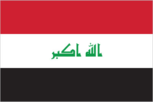
three equal horizontal bands of red (top), white, and black with three green five-pointed stars in a horizontal line centered in the white band; the phrase ALLAHU AKBAR (God is Great) in green Arabic script - Allahu to the right of the middle star and Akbar to the left of the middle star - was added in January 1991 during the Persian Gulf crisis; similar to the flag of Syria, which has two stars but no script, Yemen, which has a plain white band, and that of Egypt which has a gold Eagle of Saladin centered in the white band; design is based upon the Arab Liberation colors Economy Iraq
GDP - composition by sector
- agriculture
- 7.3%
- industry
- 66.6%
- services
- 26.1% (2004 est.)
GDP - per capita (PPP)
$1,900 (2006 est.)
GDP - real growth rate
3.1% (2006 est.)
GDP (official exchange rate)
$46.5 billion (2006 est.)
GDP (purchasing power parity)
$94.1 billion (2005 est.)
Geographic coordinates
33 00 N, 44 00 E
Geography - note
strategic location on Shatt al Arab waterway and at the head of the Persian Gulf People Iraq
Government type
parliamentary democracy
Heliports
8 (2006)
HIV/AIDS - adult prevalence rate
less than 0.1% (2001 est.)
HIV/AIDS - deaths
NA
HIV/AIDS - people living with HIV/AIDS
less than 500 (2003 est.)
Household income or consumption by percentage share
- highest 10%
- NA%
- lowest 10%
- NA%
IDPs
1.6 million (ongoing US-led war and Kurds' subsequent return) (2006) This page was last updated on 8 February, 2007
Imports
$20.76 billion f.o.b. (2006 est.)
Imports - commodities
food, medicine, manufactures
Imports - partners
Turkey 23.3%, Syria 23%, US 11.6%, Jordan 6.2% (2005)
Independence
3 October 1932 (from League of Nations mandate under British administration); note - on 28 June 2004 the Coalition Provisional Authority transferred sovereignty to the Iraqi Interim Government
Industrial production growth rate
NA%
Industries
petroleum, chemicals, textiles, leather, construction materials, food processing, fertilizer, metal fabrication/processing
Infant mortality rate
- female
- 42.61 deaths/1,000 live births (2006 est.)
- male
- 54.39 deaths/1,000 live births
- total
- 48.64 deaths/1,000 live births
Inflation rate (consumer prices)
50% (2006 est.)
International organization participation
ABEDA, AFESD, AMF, CAEU, FAO, G-77, IAEA, IBRD, ICAO, ICRM, IDA, IDB, IFAD, IFC, IFRCS, ILO, IMF, IMO, Interpol, IOC, ISO, ITU, LAS, NAM, OAPEC, OIC, OPEC, PCA, UN, UNCTAD, UNESCO, UNIDO, UNWTO, UPU, WCO, WFTU, WHO, WIPO, WMO, WTO (observer)
Internet country code
.iq
Internet hosts
5 (2006)
Internet Service Providers (ISPs)
1 (2000)
Internet users
36,000 (2005) Transportation Iraq
Iraqi Armed Forces
Iraqi Regular Army (includes Iraqi Special Operations Force, Iraqi Intervention Force), Iraqi Navy (former Iraqi Coastal Defense Force), Iraqi Air Force (former Iraqi Army Air Corps) (2005)
Irrigated land
35,250 sq km (2003)
Judicial branch
the Iraq Constitution calls for the Federal Judicial Authority, comprised of the Higher Juridical Council, Supreme Federal Court, Federal Court of Cassation, Public Prosecution Department, Judiciary Oversight Commission and other federal courts that are regulated in accordance with the law
Labor force
7.4 million (2004 est.)
Labor force - by occupation
- agriculture
- NA%
- industry
- NA%
- services
- NA%
Land boundaries
- border countries
- Iran 1,458 km, Jordan 181 km, Kuwait 240 km, Saudi Arabia 814 km, Syria 605 km, Turkey 352 km
- total
- 3,650 km
Land use
- arable land
- 13.12%
- other
- 86.27% (2005)
- permanent crops
- 0.61%
Languages
Arabic, Kurdish (official in Kurdish regions), Assyrian, Armenian
Legal system
based on European civil and Islamic law under the framework outlined in the Iraqi Constitution
Legislative branch
- bicameral Council of Representatives (consisting of 275 members elected by a closed-list, proportional representation system) and a Federation Council (membership not established and authorities undefined)
- election results
- Council of Representatives - percent of vote by party - Unified Iraqi Alliance 41%, Kurdistan Alliance 22%, Tawafuq Coalition 15%, Iraqi National List 8%, Iraqi Front for National Dialogue 4%, others 10%; number of seats by party - Unified Iraqi Alliance 128, Kurdistan Alliance 53, Tawafuq Coalition 44, Iraqi National List 25, Iraqi Front for National Dialogue 11, others 14
- elections
- held 15 December 2005 to elect a 275-member Council of Representatives; the Council of Representatives elected the Presidency Council and approved the Prime Minister
Life expectancy at birth
- female
- 70.31 years (2006 est.)
- male
- 67.76 years
- total population
- 69.01 years
Literacy
- definition
- age 15 and over can read and write
- female
- 24.4% (2003 est.) Government Iraq
- male
- 55.9%
- total population
- 40.4%
Location
Middle East, bordering the Persian Gulf, between Iran and Kuwait
Manpower available for military service
- females age 18-49
- 5,642,073 (2005 est.)
- males age 18-49
- 5,870,640
Manpower fit for military service
- females age 18-49
- 4,771,105 (2005 est.)
- males age 18-49
- 4,930,074
Manpower reaching military service age annually
- females age 18-49
- 289,879 (2005 est.)
- males age 18-49
- 198,518
Map references
Middle East
Maritime claims
- continental shelf
- not specified
- territorial sea
- 12 nm
Median age
- female
- 19.8 years (2006 est.)
- male
- 19.6 years
- total
- 19.7 years
Merchant marine
- by type
- cargo 11, petroleum tanker 2 (2006)
- total
- 13 ships (1000 GRT or over) 67,796 GRT/101,317 DWT
Military expenditures - dollar figure
$1.34 billion (2005 est.)
Military expenditures - percent of GDP
NA Transnational Issues Iraq
Military service age and obligation
all volunteer force; the Iraqi Government is creating a new professional Iraqi military force of men aged 18 to 40 to defend Iraq from external threats and the current insurgency (2006)
National holiday
Revolution Day, 17 July (1968); note - this holiday was celebrated under the SADDAM Husayn regime; the Government of Iraq has yet to declare a new national holiday
Nationality
- adjective
- Iraqi
- noun
- Iraqi(s)
Natural gas - consumption
1.75 billion cu m (2004 est.)
Natural gas - exports
0 cu m (2004 est.)
Natural gas - imports
0 cu m (2004 est.)
Natural gas - production
1.75 billion cu m (2004 est.)
Natural gas - proved reserves
3.115 trillion cu m (1 January 2005 est.)
Natural hazards
dust storms, sandstorms, floods
Natural resources
petroleum, natural gas, phosphates, sulfur
Net migration rate
0 migrant(s)/1,000 population (2006 est.)
Oil - consumption
351,500 bbl/day (2005 est.)
Oil - exports
1.42 million bbl/day (2005 est.)
Oil - imports
NA bbl/day (2005)
Oil - production
2.093 million bbl/day; note - prewar production (in 2002) was 2.2 million bbl/day (2005 est.)
Oil - proved reserves
112.5 billion bbl (2006 est.)
Pipelines
gas 2,228 km; liquid petroleum gas 918 km; oil 5,506 km; refined products 1,637 km (2006)
Political parties and leaders
- Assyrian Democratic Movement [Yunadim KANNA]; Badr Organization [Hadi al-AMIRI]; Constitutional Monarchy Movement or CMM [Sharif Ali Bin al-HUSAYN]; Da'wa al-Islamiyya Party [Ibrahim al-JA'FARI]; General Conference of Iraqi People [Adnan al-DULAYMI]; Independent Iraqi Alliance or IIA [Falah al-NAQIB]; Iraqi Communist Party [Hamid al-MUSA]; Iraqi Front for National Dialogue [Salih al-MUTLAQ]; Iraqi Hizballah [Karim Mahmud al-MUHAMMADAWI]; Iraqi Independent Democrats or IID [Adnan PACHACHI, Mahdi al-HAFIZ]; Iraqi Islamic Party or IIP [Tariq al-HASHIMI]; Iraqi National Accord or INA [Ayad ALLAWI]; Iraqi National Congress or INC [Ahmad CHALABI]; Iraqi National Council for Dialogue or INCD [Khalaf Ulayan al-Khalifawi al-DULAYMI]; Iraqi National Unity Movement or INUM [Ahmad al-KUBAYSI, chairman]; Islamic Action Organization or IAO [Ayatollah Muhammad al-MUDARRISI]; Jama'at al Fadilah or JAF [Muhammad Ali al-YAQUBI]; Kurdistan Democratic Party or KDP [Masud BARZANI]; Kurdistan Islamic Union [Salah ad-Din Muhammad BAHA al-DIN]; National Reconciliation and Liberation Party [Mishan al-JABBURI]; Patriotic Union of Kurdistan or PUK [Jalal TALABANI]; Sadrist Trend [Muqtada al-SADR] (not an organized political party, but it fields independent candidates affiliated with Muqtada al-SADR); Supreme Council for the Islamic Revolution in Iraq or SCIRI [Abd al-Aziz al-HAKIM]
- note
- the Kurdistan Alliance, Iraqi National List, Tawafuq Coalition, Iraqi Front for National Dialogue, and Unified Iraqi Alliance were only electoral slates consisting of the representatives from the various Iraqi political parties
Political pressure groups and leaders
an insurgency against the Government of Iraq and Coalition forces is primarily concentrated in Baghdad and in areas north, northeast, and west of the capital; the diverse, multigroup insurgency consists principally of Sunni Arabs whose only common denominator is a shared desire to oust the Coalition and end US influence in Iraq; a number of predominantly Shia militias, some of which are associated with political parties, challenge governmental authority in Baghdad and southern Iraq
Population
26,783,383 (July 2006 est.)
Population below poverty line
NA%
Population growth rate
2.66% (2006 est.)
Ports and terminals
Al Basrah, Khawr az Zubayr, Umm Qasr Military Iraq
Radio broadcast stations
after 17 months of unregulated media growth, there are approximately 80 radio stations on the air inside Iraq (2004)
Radios
4.85 million (1997)
Railways
- standard gauge
- 2,200 km 1.435-m gauge (2005)
- total
- 2,200 km
Refugees and internally displaced persons
- refugees (country of origin)
- 22,698 (Palestinian Territories), 13,382 (Iran), 13,332 (Turkey)
Religions
Muslim 97% (Shi'a 60%-65%, Sunni 32%-37%), Christian or other 3%
Reserves of foreign exchange and gold
$15.65 billion (2006 est.)
Roadways
- paved
- 38,399 km
- total
- 45,550 km
- unpaved
- 7,151 km (1999)
Sex ratio
- at birth
- 1.05 male(s)/female
- total population
- 1.02 male(s)/female (2006 est.)
- under 15 years
- 1.03 male(s)/female 15-64 years: 1.03 male(s)/female 65 years and over: 0.89 male(s)/female
Suffrage
18 years of age; universal
Telephone system
- domestic
- repairs to switches and lines destroyed during 2003 have been completed, but sabotage remains a problem; additional switching capacity is improving access; cellular service is widely available in major cities and centered on three regional GSM networks, improving country-wide connectivity. There are currently 8.7 million users of cellular services.
- general assessment
- the aftermath of the liberation of Iraq in 2003 severely disrupted telecommunications throughout Iraq including international connections; USAID repaired switching capabilities and constructed a mobile and satellite communication facility; landlines now exceed pre-war levels
- international
- country code - 964; satellite earth stations - 2 Intelsat (1 Atlantic Ocean and 1 Indian Ocean), 1 Intersputnik (Atlantic Ocean region), and 1 Arabsat (inoperative); coaxial cable and microwave radio relay to Jordan, Kuwait, Syria, and Turkey; despite a new satellite gateway, international calls outside of Baghdad are sometimes problematic
Telephones - main lines in use
1.547 million (2005)
Telephones - mobile cellular
8.7 million (2006)
Television broadcast stations
21 (2004)
Televisions
1.75 million (1997)
Terrain
mostly broad plains; reedy marshes along Iranian border in south with large flooded areas; mountains along borders with Iran and Turkey
Total fertility rate
4.18 children born/woman (2006 est.)
Unemployment rate
25% to 30% (2005 est.)
Waterways
- 5,279 km
- note
- Euphrates River (2,815 km), Tigris River (1,899 km), and Third River (565 km) are principal waterways (2004)