1990 Edition
CIA World Factbook 1990 (Project Gutenberg)
Geography
Climate
desert; mild to cool winters with dry, hot, cloudless summers
Coastline
58 km
Comparative area
slightly more than twice the size of Idaho
Continental shelf
not specific;
Disputes
Iraq began formal UN peace negotiations with Iran in August 1988 to end the war that began on 22 September 1980--sovereignty over the Shatt al Arab waterway, troop withdrawal, freedom of navigation, and prisoner of war exchange are the major issues for negotiation; Kurdish question among Iran, Iraq, Syria, Turkey, and the USSR; shares Neutral Zone with Saudi Arabia--in July 1975, Iraq and Saudi Arabia signed an agreement to divide the zone between them, but the agreement must be ratified before it becomes effective; disputes Kuwaiti ownership of Warbah and Bubiyan islands; periodic disputes with upstream riparian Syria over Euphrates water rights; potential dispute over water development plans by Turkey for the Tigris and Euphrates Rivers
Environment
development of Tigris-Euphrates river systems contingent upon agreements with upstream riparians (Syria, Turkey); air and water pollution; soil degradation (salinization) and erosion; desertification
Land boundaries
3,454 km total; Iran 1,458 km, Iraq - Saudi Arabia Neutral Zone 191 km, Jordan 134 km, Kuwait 240 km, Saudi Arabia 495 km, Syria 605 km, Turkey 331 km
Land use
12% arable land; 1% permanent crops; 9% meadows and pastures; 3% forest and woodland; 75% other; includes 4% irrigated
Natural resources
crude oil, natural gas, phosphates, sulfur
Terrain
mostly broad plains; reedy marshes in southeast; mountains along borders with Iran and Turkey
Territorial sea
12 nm
Total area
434,920 km2; land area: 433,970 km2
People and Society
Birth rate
46 births/1,000 population (1990)
Death rate
7 deaths/1,000 population (1990)
Ethnic divisions
75-80% Arab, 15-20% Kurdish, 5% Turkoman, Assyrian or other
Infant mortality rate
67 deaths/1,000 live births (1990)
Labor force
3,400,000 (1984); 39% services, 33% agriculture, 28% industry, severe labor shortage (1987); expatriate labor force about 1,000,000 (1989)
Language
Arabic (official), Kurdish (official in Kurdish regions), Assyrian, Armenian
Life expectancy at birth
66 years male, 68 years female (1990)
Literacy
55-65% (1989 est.)
Nationality
noun--Iraqi(s); adjective--Iraqi
Net migration rate
0 migrants/1,000 population (1990)
Organized labor
less than 10% of the labor force
Population
18,781,770 (July 1990), growth rate 3.9% (1990)
Religion
97% Muslim (60-65% Shia, 32-37% Sunni), 3% Christian or other
Total fertility rate
7.3 children born/woman (1990)
Government
Administrative divisions
18 provinces (muhafazat, singular--muhafazah); Al Anbar, Al Basrah, Al Muthanna, Al Qadisiyah, An Najaf, As Sulaymaniyah, At Tamim, Babil, Baghdad, Dahuk, Dhi Qar, Diyala, Arbil, Karbala, Maysan, Ninawa, Salah ad Din, Wasit
Capital
Baghdad
Communists
about 1,500 hardcore members
Constitution
22 September 1968, effective 16 July 1970 (interim Constitution); new constitution now in final stages of drafting
Diplomatic representation
Ambassador Dr. Mohamed Sadiq AL-MASHAT; Chancery at 1801 P Street NW, Washington DC 20036; telephone (202) 483-7500; US--Ambassador April C. GLASPIE; Embassy in Masbah Quarter (opposite the Foreign Ministry Club), Baghdad (mailing address is P. O. Box 2447 Alwiyah, Baghdad); telephone [964] (1) 719-6138 or 719-6139, 718-1840, 719-3791
Elections
National Assembly--last held on 1 April 1989 (next to be held NA); results--Shia Arabs 30%, Kurds 15%, Sunni Arabs 53%, Christians 2% est.; seats--(250 total) number of seats by party NA
Executive branch
president, vice president, chairman of the Revolutionary Command Council, vice chairman of the Revolutionary Command Council, prime minister, first deputy prime minister, Council of Ministers
Flag
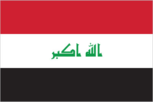
three equal horizontal bands of red (top), white, and black with three green five-pointed stars in a horizontal line centered in the white band; similar to the flags of the YAR which has one star and Syria which has two stars (in a horizontal line centered in the white band)--all green and five-pointed; also similar to the flag of Egypt which has a symbolic eagle centered in the white band
Independence
3 October 1932 (from League of Nations mandate under British administration)
Judicial branch
Court of Cassation
Leaders
Chief of State and Head of Government--President Saddam HUSAYN (since 16 July 1979); Vice President Taha Muhyi al-Din MARUF
Legal system
based on Islamic law in special religious courts, civil law system elsewhere; has not accepted compulsory ICJ jurisdiction
Legislative branch
unicameral National Assembly (Majlis al Umma)
Long-form name
Republic of Iraq
Member of
ACC, Arab League, FAO, G-77, IAEA, IBRD, ICAO, IDA, IDB--Islamic Development Bank, IFAD, IFC, ILO, IMF, IMO, INTELSAT, INTERPOL, ITU, NAM, OAPEC, OIC, OPEC, UN, UNESCO, UPU, WFTU, WHO, WIPO, WMO, WSG, WTO
National holiday
Anniversary of the Revolution, 17 July (1968)
Other political or pressure groups
political parties and activity severely restricted; possibly some opposition to regime from disaffected members of the regime, Army officers, and religious and ethnic dissidents
Political parties
National Progressive Front is a coalition of the Arab Bath Socialist Party, Kurdistan Democratic Party, and Kurdistan Revolutionary Party
Suffrage
universal adult at age 18
Type
republic
Economy
Agriculture
accounts for less than 10% of GNP but 33% of labor force; principal products--wheat, barley, rice, vegetables, dates, other fruit, cotton, wool; livestock--cattle, sheep; not self-sufficient in food output
Aid
US commitments, including Ex-Im (FY70-80), $3 million; Western (non-US) countries, ODA and OOF bilateral commitments (1970-87), $607 million; OPEC bilateral aid (1980-89), $37.2 billion; Communist countries (1970-88), $3.9 billion
Budget
revenues $NA billion; expenditures $35 billion, including capital expenditures of NA (1989)
Currency
Iraqi dinar (plural--dinars); 1 Iraqi dinar (ID) = 1,000 fils
Electricity
9,902,000 kW capacity; 20,000 million kWh produced, 1,110 kWh per capita (1989)
Exchange rates
Iraqi dinars (ID) per US$1--0.3109 (fixed rate since 1982)
Exports
$12.5 billion (f.o.b., 1988); commodities--crude oil and refined products, machinery, chemicals, dates; partners--US, Brazil, USSR, Italy, Turkey, France, Japan, Yugoslavia
External debt
$40 billion (1988 est.), excluding debt to Persian Gulf Arab states
Fiscal year
calendar year
GNP
$35 billion, per capita $1,940; real growth rate 5%
Imports
$10.2 billion (c.i.f., 1988); commodities--manufactures, food; partners--Turkey, US, FRG, UK, France, Japan, Romania, Yugoslavia, Brazil (1988)
Industrial production
NA%
Industries
petroleum, chemicals, textiles, construction materials, food processing
Inflation rate (consumer prices)
30-40% (1989 est.)
Overview
The Bathist regime engages in extensive central planning and management of industrial production and foreign trade while leaving some small-scale industry and services and most agriculture to private enterprise. The economy is dominated by the oil sector, which provides about 95% of foreign exchange earnings. Since the early 1980s financial problems, caused by war expenditures and damage to oil export facilities by Iran, have led the government to implement austerity measures and to reschedule foreign debt payments. Oil exports have gradually increased with the construction of new pipelines. Agricultural development remains hampered by labor shortages, salinization, and dislocations caused by previous land reform and collectivization programs. The industrial sector, although accorded high priority by the government, is under financial constraints. New investment funds are generally allocated only to projects that result in import substitution or foreign exchange earnings.
Unemployment rate
less than 5% (1989 est.)
Communications
Airports
111 total, 101 usable; 72 with permanent-surface runways; 8 with runways over 3,659 m; 53 with runways 2,440-3,659 m; 14 with runways 1,220-2,439 m
Civil air
64 major transport aircraft (including 30 IL-76s used by the Iraq Air Force)
Highways
25,479 km total; 8,290 km paved, 5,534 km improved earth, 11,655 km unimproved earth
Inland waterways
1,015 km; Shatt al Arab usually navigable by maritime traffic for about 130 km, but closed since September 1980 because of Iran-Iraq war; Tigris and Euphrates navigable by shallow-draft steamers (of little importance); Shatt al Basrah canal navigable in sections by shallow-draft vessels
Merchant marine
44 ships (1,000 GRT or over) totaling 947,721 GRT/1,703,988 DWT; includes 1 passenger, 1 passenger-cargo, 18 cargo, 1 refrigerated cargo, 3 roll-on/roll-off cargo, 19 petroleum, oils, and lubricants (POL) tanker, 1 chemical tanker
Pipelines
crude oil, 4,350 km; 725 km refined products; 1,360 km natural gas
Ports
Umm Qasr, Khawr az Zubayr
Railroads
2,962 km total; 2,457 km 1.435-meter standard gauge, 505 km 1.000-meter gauge
Telecommunications
good network consists of coaxial cables, radio relay links, and radiocommunication stations; 632,000 telephones; stations--9 AM, 1 FM, 81 TV; satellite earth stations--1 Atlantic Ocean INTELSAT, 1 Indian Ocean INTELSAT, 1 GORIZONT Atlantic Ocean in the Intersputnik system; coaxial cable and radio relay to Kuwait, Jordan, Syria, and Turkey
Military and Security
Branches
Army, Navy, Air Force, Border Guard Force, mobile police force, Republican Guard
Defense expenditures
NA
Military manpower
males 15-49, 4,097,190; 2,284,417 fit for military service; 219,701 reach military age (18) annually