2007 Edition
CIA World Factbook 2007 (Project Gutenberg)
Introduction
Administrative divisions
28 states and 7 union territories*; Andaman and Nicobar Islands*, Andhra Pradesh, Arunachal Pradesh, Assam, Bihar, Chandigarh*, Chhattisgarh, Dadra and Nagar Haveli*, Daman and Diu*, Delhi*, Goa, Gujarat, Haryana, Himachal Pradesh, Jammu and Kashmir, Jharkhand, Karnataka, Kerala, Lakshadweep*, Madhya Pradesh, Maharashtra, Manipur, Meghalaya, Mizoram, Nagaland, Orissa, Puducherry*, Punjab, Rajasthan, Sikkim, Tamil Nadu, Tripura, Uttar Pradesh, Uttaranchal, West Bengal
Age structure
0-14 years: 30.8% (male 173,478,760/female 163,852,827) 15-64 years: 64.3% (male 363,876,219/female 340,181,764) 65 years and over: 4.9% (male 27,258,020/female 26,704,405) (2006 est.)
Agriculture - products
rice, wheat, oilseed, cotton, jute, tea, sugarcane, potatoes; cattle, water buffalo, sheep, goats, poultry; fish
Airports
341 (2006)
Airports - with paved runways
- over 3,047 m
- 17 2,438 to 3,047 m: 51 1,524 to 2,437 m: 73 914 to 1,523 m: 81
- total
- 243
- under 914 m
- 21 (2006)
Airports - with unpaved runways
- total
- 98 2,438 to 3,047 m: 1 1,524 to 2,437 m: 7 914 to 1,523 m: 42
- under 914 m
- 48 (2006)
Area
- land
- 2,973,190 sq km
- total
- 3,287,590 sq km
- water
- 314,400 sq km
Area - comparative
slightly more than one-third the size of the US
Background
The Indus Valley civilization, one of the oldest in the world, dates back at least 5,000 years. Aryan tribes from the northwest infiltrated onto Indian lands about 1500 B.C.; their merger with the earlier Dravidian inhabitants created the classical Indian culture. Arab incursions starting in the 8th century and Turkish in the 12th were followed by those of European traders, beginning in the late 15th century. By the 19th century, Britain had assumed political control of virtually all Indian lands. Indian armed forces in the British army played a vital role in both World Wars. Nonviolent resistance to British colonialism led by Mohandas GANDHI and Jawaharlal NEHRU brought independence in 1947. The subcontinent was divided into the secular state of India and the smaller Muslim state of Pakistan. A third war between the two countries in 1971 resulted in East Pakistan becoming the separate nation of Bangladesh. Despite impressive gains in economic investment and output, India faces pressing problems such as the ongoing dispute with Pakistan over Kashmir, massive overpopulation, environmental degradation, extensive poverty, and ethnic and religious strife. Geography India
Birth rate
22.01 births/1,000 population (2006 est.)
Budget
- expenditures
- $143.8 billion; including capital expenditures of $15 billion (2006 est.)
- revenues
- $109.4 billion
Capital
- geographic coordinates
- 28 36 N, 77 12 E
- name
- New Delhi
- time difference
- UTC+5.5 (10.5 hours ahead of Washington, DC during Standard Time)
Climate
varies from tropical monsoon in south to temperate in north
Coastline
7,000 km
Constitution
26 January 1950; amended many times
Country name
- conventional long form
- Republic of India
- conventional short form
- India
- local long form
- Republic of India/Bharatiya Ganarajya
- local short form
- India/Bharat
Currency (code)
Indian rupee (INR)
Currency code
INR
Current account balance
$-26.4 billion (2006 est.)
Death rate
8.18 deaths/1,000 population (2006 est.)
Debt - external
$132.1 billion (30 June 2006 est.)
Diplomatic representation from the US
- chief of mission
- Ambassador David C. MULFORD
- embassy
- Shantipath, Chanakyapuri, New Delhi 110021
- mailing address
- use embassy street address
- telephone
- [91] (11) 2419-8000
Diplomatic representation in the US
- chancery
- 2107 Massachusetts Avenue NW, Washington, DC 20008; note - Consular Wing located at 2536 Massachusetts Avenue NW, Washington, DC 20008
- chief of mission
- Ambassador Ranendra SEN
- telephone
- [1] (202) 939-7000
Disputes - international
since China and India launched a security and foreign policy dialogue in 2005, consolidated discussions related to the dispute over most of their rugged, militarized boundary, regional nuclear proliferation, Indian claims that China transferred missiles to Pakistan, and other matters continue; various talks and confidence-building measures have cautiously begun to defuse tensions over Kashmir, particularly since the October 2005 earthquake in the region; Kashmir nevertheless remains the site of the world's largest and most militarized territorial dispute with portions under the de facto administration of China (Aksai Chin), India (Jammu and Kashmir), and Pakistan (Azad Kashmir and Northern Areas); in 2004, India and Pakistan instituted a cease fire in Kashmir and in 2005, restored bus service across the highly militarized Line of Control; Pakistan has taken its dispute on the impact and benefits of India's building the Baglihar Dam on the Chenab River in Jammu and Kashmir to the World Bank for arbitration; UN Military Observer Group in India and Pakistan (UNMOGIP) has maintained a small group of peacekeepers since 1949; India does not recognize Pakistan's ceding historic Kashmir lands to China in 1964; disputes persist with Pakistan over Indus River water sharing; to defuse tensions and prepare for discussions on a maritime boundary, in 2004, India and Pakistan resurveyed a portion of the disputed boundary in Sir Creek estuary at the mouth of the Rann of Kutch; Pakistani maps continue to show its Junagadh claim in Indian Gujarat State; discussions with Bangladesh remain stalled to delimit a small section of river boundary, to exchange 162 miniscule enclaves in both countries, to allocate divided villages, and to stop illegal cross-border trade, migration, violence, and transit of terrorists through the porous border; Bangladesh protests India's attempts to fence off high-traffic sections of the border; dispute with Bangladesh over New Moore/South Talpatty/Purbasha Island in the Bay of Bengal deters maritime boundary delimitation; India seeks cooperation from Bhutan and Burma to keep Indian Nagaland and Assam separatists from hiding in remote areas along the borders; Joint Border Committee with Nepal continues to demarcate minor disputed boundary sections; India maintains a strict border regime to keep out Maoist insurgents and control illegal cross-border activities from Nepal
Distribution of family income - Gini index
32.5 (2000)
Economic aid - recipient
$2.9 billion (FY98/99)
Economy - overview
India's diverse economy encompasses traditional village farming, modern agriculture, handicrafts, a wide range of modern industries, and a multitude of services. Services are the major source of economic growth, accounting for more than half of India's output with less than one quarter of its labor force. About three-fifths of the work force is in agriculture, leading the UPA government to articulate an economic reform program that includes developing basic infrastructure to improve the lives of the rural poor and boost economic performance. The government has reduced controls on foreign trade and investment. Tariffs averaged 12.5% on non-agricultural items in 2006. Higher limits on foreign direct investment were permitted in a few key sectors, such as telecommunications. However, tariff spikes in sensitive categories, including agriculture, and incremental progress on economic reforms still hinder foreign access to India's vast and growing market. Privatization of government-owned industries remained stalled in 2006, and continues to generate political debate; populist pressure from within the UPA government and from its Left Front allies continues to restrain needed initiatives. The economy has posted an average growth rate of more than 7% in the decade since 1996, reducing poverty by about 10 percentage points. India achieved 8.5% GDP growth in 2006, significantly expanding manufacturing. India is capitalizing on its large numbers of well-educated people skilled in the English language to become a major exporter of software services and software workers. Economic expansion has helped New Delhi continue to make progress in reducing its federal fiscal deficit. However, strong growth - more than 8 percent growth in each of the last three years - combined with easy consumer credit and a real estate boom is fueling inflation concerns. The huge and growing population is the fundamental social, economic, and environmental problem.
Electricity - consumption
587.9 billion kWh (2004)
Electricity - exports
60 million kWh (2004)
Electricity - imports
1.5 billion kWh (2004)
Electricity - production
630.6 billion kWh (2004)
Electricity - production by source
- fossil fuel
- 81.7%
- hydro
- 14.5%
- nuclear
- 3.4%
- other
- 0.3% (2001)
Elevation extremes
- highest point
- Kanchenjunga 8,598 m
- lowest point
- Indian Ocean 0 m
Environment - current issues
deforestation; soil erosion; overgrazing; desertification; air pollution from industrial effluents and vehicle emissions; water pollution from raw sewage and runoff of agricultural pesticides; tap water is not potable throughout the country; huge and growing population is overstraining natural resources
Environment - international agreements
- party to
- Antarctic-Environmental Protocol, Antarctic-Marine Living Resources, Antarctic Treaty, Biodiversity, Climate Change, Climate Change-Kyoto Protocol, Desertification, Endangered Species, Environmental Modification, Hazardous Wastes, Law of the Sea, Ozone Layer Protection, Ship Pollution, Tropical Timber 83, Tropical Timber 94, Wetlands, Whaling
- signed, but not ratified
- none of the selected agreements
Ethnic groups
Indo-Aryan 72%, Dravidian 25%, Mongoloid and other 3% (2000)
Exchange rates
Indian rupees per US dollar - 45.5 (2006), 44.101 (2005), 45.317 (2004), 46.583 (2003), 48.61 (2002)
Executive branch
- cabinet
- Cabinet appointed by the president on the recommendation of the prime minister
- chief of state
- President A.P.J. Abdul KALAM (since 25 July 2002); Vice President Bhairon Singh SHEKHAWAT (since 19 August 2002)
- election results
- Abdul KALAM elected president; percent of electoral college vote - 89.6%; Bhairon Singh SHEKHAWAT elected vice president; percent of Parliament vote - 59.8%
- elections
- president elected by an electoral college consisting of elected members of both houses of Parliament and the legislatures of the states for a five-year term (no term limits); election last held July 2002 (next to be held 18 July 2007); vice president elected by both houses of Parliament for a five-year term; election last held 12 August 2002 (next to be held August 2007); prime minister chosen by parliamentary members of the majority party following legislative elections; election last held April - May 2004 (next to be held May 2009)
- head of government
- Prime Minister Manmohan SINGH (since 22 May 2004)
Exports
$112 billion f.o.b. (2006 est.)
Exports - commodities
textile goods, gems and jewelry, engineering goods, chemicals, leather manufactures
Exports - partners
US 16.7%, UAE 8.5%, China 6.6%, Singapore 5.3%, UK 4.9%, Hong Kong 4.4% (2005)
FAX
- [1] (202) 265-4351
- [91] (11) 2419-0017
- consulate(s) general
- Chicago, Houston, New York, San Francisco
- consulate(s) general
- Chennai (Madras), Kolkata (Calcutta), Mumbai (Bombay)
Fiscal year
1 April - 31 March Communications India
Flag description
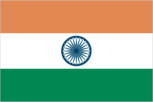
three equal horizontal bands of saffron (subdued orange) (top), white, and green with a blue chakra (24-spoked wheel) centered in the white band; similar to the flag of Niger, which has a small orange disk centered in the white band Economy India
GDP - composition by sector
- agriculture
- 19.9%
- industry
- 19.3%
- services
- 60.7% (2005 est.)
GDP - per capita (PPP)
$3,700 (2006 est.)
GDP - real growth rate
8.5% (2006 est.)
GDP (official exchange rate)
$796.1 billion (2006 est.)
GDP (purchasing power parity)
$4.042 trillion (2006 est.)
Geographic coordinates
20 00 N, 77 00 E
Geography - note
dominates South Asian subcontinent; near important Indian Ocean trade routes; Kanchenjunga, third tallest mountain in the world, lies on the border with Nepal People India
Government type
federal republic
Heliports
28 (2006)
HIV/AIDS - adult prevalence rate
0.9% (2001 est.)
HIV/AIDS - deaths
310,000 (2001 est.)
HIV/AIDS - people living with HIV/AIDS
5.1 million (2001 est.)
Household income or consumption by percentage share
- highest 10%
- 33.5% (1997)
- lowest 10%
- 3.5%
IDPs
at least 600,000 (about half are Kashmiri Pandits from Jammu and Kashmir) (2006)
Illicit drugs
world's largest producer of licit opium for the pharmaceutical trade, but an undetermined quantity of opium is diverted to illicit international drug markets; transit point for illicit narcotics produced in neighboring countries; illicit producer of methaqualone; vulnerable to narcotics money laundering through the hawala system This page was last updated on 8 February, 2007
Imports
$187.9 billion f.o.b. (2006 est.)
Imports - commodities
crude oil, machinery, gems, fertilizer, chemicals
Imports - partners
China 7.3%, US 5.6%, Switzerland 4.7% (2005)
Independence
15 August 1947 (from UK)
Industrial production growth rate
7.5% (2006 est.)
Industries
textiles, chemicals, food processing, steel, transportation equipment, cement, mining, petroleum, machinery, software
Infant mortality rate
- female
- 54.05 deaths/1,000 live births (2006 est.)
- male
- 55.18 deaths/1,000 live births
- total
- 54.63 deaths/1,000 live births
Inflation rate (consumer prices)
5.3% (2006 est.)
International organization participation
AfDB, ARF, AsDB, ASEAN (dialogue partner), BIMSTEC, BIS, C, CERN (observer), CP, EAS, FAO, G- 6, G-15, G-24, G-77, IAEA, IBRD, ICAO, ICC, ICRM, IDA, IFAD, IFC, IFRCS, IHO, ILO, IMF, IMO, Interpol, IOC, IOM (observer), IPU, ISO, ITU, ITUC, MIGA, MONUC, NAM, OAS (observer), ONUB, OPCW, PCA, PIF (partner), SAARC, SACEP, SCO (observer), UN, UNCTAD, UNDOF, UNESCO, UNHCR, UNIDO, UNIFIL, UNMEE, UNMIS, UNMOVIC, UNOCI, UNOMIG, UNWTO, UPU, WCL, WCO, WFTU, WHO, WIPO, WMO, WTO
Internet country code
.in
Internet hosts
1,543,289 (2006)
Internet Service Providers (ISPs)
43 (2000)
Internet users
60 million (2005) Transportation India
Investment (gross fixed)
29.2% of GDP (2006 est.)
Irrigated land
558,080 sq km (2003)
Judicial branch
Supreme Court (one chief justice and 25 associate justices are appointed by the president and remain in office until they reach the age of 65 or are removed for "proved misbehavior")
Labor force
509.3 million (2006 est.)
Labor force - by occupation
- agriculture
- 60%
- industry
- 12%
- services
- 28% (2003)
Land boundaries
- border countries
- Bangladesh 4,053 km, Bhutan 605 km, Burma 1,463 km, China 3,380 km, Nepal 1,690 km, Pakistan 2,912 km
- total
- 14,103 km
Land use
- arable land
- 48.83%
- other
- 48.37% (2005)
- permanent crops
- 2.8%
Languages
English enjoys associate status but is the most important language for national, political, and commercial communication; Hindi is the national language and primary tongue of 30% of the people; there are 14 other official languages: Bengali, Telugu, Marathi, Tamil, Urdu, Gujarati, Malayalam, Kannada, Oriya, Punjabi, Assamese, Kashmiri, Sindhi, and Sanskrit; Hindustani is a popular variant of Hindi/Urdu spoken widely throughout northern India but is not an official language
Legal system
based on English common law; judicial review of legislative acts; accepts compulsory ICJ jurisdiction, with reservations; separate personal law codes apply to Muslims, Christians, and Hindus
Legislative branch
- bicameral Parliament or Sansad consists of the Council of States or Rajya Sabha (a body consisting of not more than 250 members, up to 12 of whom are appointed by the president, the remainder are chosen by the elected members of the state and territorial assemblies; members serve six-year terms) and the People's Assembly or Lok Sabha (545 seats; 543 elected by popular vote, 2 appointed by the president; members serve five-year terms)
- election results
- People's Assembly - percent of vote by party - NA; seats by party - INC 147, BJP 129, CPI(M) 43, SP 38, RJD 23, DMK 16, BSP 15, SS 12, BJD 11, CPI 10, NCP 10, JD(U) 8, SAD 8, PMK 6, JMM 5, LJSP 4, MDMK 4, TDP 4, TRS 4, independent 6, other 29, vacant 13; note - party seat composition as of December 2006
- elections
- People's Assembly - last held 20 April through 10 May 2004 (next must be held before May 2009)
Life expectancy at birth
- female
- 65.57 years (2006 est.)
- male
- 63.9 years
- total population
- 64.71 years
Literacy
- definition
- age 15 and over can read and write
- female
- 48.3% (2003 est.) Government India
- male
- 70.2%
- total population
- 59.5%
Location
Southern Asia, bordering the Arabian Sea and the Bay of Bengal, between Burma and Pakistan
Major infectious diseases
- animal contact disease
- rabies
- degree of risk
- high
- food or waterborne diseases
- bacterial diarrhea, hepatitis A and E, and typhoid fever
- note
- highly pathogenic H5N1 avian influenza has been identified among birds in this country or surrounding region; it poses a negligible risk with extremely rare cases possible among US citizens who have close contact with birds (2007)
- vectorborne diseases
- dengue fever, malaria, and Japanese encephalitis are high risks in some locations
Manpower available for military service
- females age 16-49
- 268,524,835 (2005 est.)
- males age 16-49
- 287,551,111
Manpower fit for military service
- females age 16-49
- 209,917,553 (2005 est.)
- males age 16-49
- 219,471,999
Manpower reaching military service age annually
- females age 16-49
- 10,665,877 (2005 est.)
- males age 18-49
- 11,446,452
Map references
Asia
Maritime claims
- contiguous zone
- 24 nm
- continental shelf
- 200 nm or to the edge of the continental margin
- exclusive economic zone
- 200 nm
- territorial sea
- 12 nm
Median age
- female
- 24.9 years (2006 est.)
- male
- 24.9 years
- total
- 24.9 years
Merchant marine
- by type
- bulk carrier 96, cargo 72, chemical tanker 13, container 8, liquefied gas 17, passenger 3, passenger/cargo 10, petroleum tanker 96, roll on/roll off 1
- foreign-owned
- 10 (China 2, Hong Kong 1, UAE 6, UK 1)
- registered in other countries
- 46 (Bahamas 1, Comoros 1, Cyprus 5, North Korea 1, Liberia 3, Malta 1, Mauritius 2, Panama 19, Saint Vincent and the Grenadines 6, Singapore 5, Venezuela 1, unknown 1) (2006)
- total
- 316 ships (1000 GRT or over) 7,772,313 GRT/13,310,858 DWT
Military branches
Army, Navy (includes naval air arm), Air Force, Coast Guard, various security or paramilitary forces (includes Border Security Force, Assam Rifles, National Security Guards, Indo-Tibetan Border Police, Special Frontier Force, Central Reserve Police Force, Central Industrial Security Force, Railway Protection Force, and Defense Security Corps)
Military expenditures - dollar figure
$19.04 billion (2005 est.)
Military expenditures - percent of GDP
2.5% (2005 est.) Transnational Issues India
Military service age and obligation
16 years of age for voluntary military service (2001)
National holiday
Republic Day, 26 January (1950)
Nationality
- adjective
- Indian
- noun
- Indian(s)
Natural gas - consumption
30.83 billion cu m (2004 est.)
Natural gas - exports
0 cu m (2004 est.)
Natural gas - imports
2.63 billion cu m (2004 est.)
Natural gas - production
28.2 billion cu m (2004 est.)
Natural gas - proved reserves
853.5 billion cu m (1 January 2005 est.)
Natural hazards
droughts; flash floods, as well as widespread and destructive flooding from monsoonal rains; severe thunderstorms; earthquakes
Natural resources
coal (fourth-largest reserves in the world), iron ore, manganese, mica, bauxite, titanium ore, chromite, natural gas, diamonds, petroleum, limestone, arable land
Net migration rate
-0.07 migrant(s)/1,000 population (2006 est.)
Oil - consumption
2.45 million bbl/day (2004 est.)
Oil - exports
350,000 bbl/day (2005 est.)
Oil - imports
2.09 million bbl/day (2005 est.)
Oil - production
785,000 bbl/day (2005 est.)
Oil - proved reserves
5.6 billion bbl (2006 est.)
Pipelines
condensate/gas 8 km; gas 5,184 km; liquid petroleum gas 1,993 km; oil 6,500 km; refined products 6,152 km (2006)
Political parties and leaders
note - India has dozens of national and regional political parties; only parties with four or more seats in the People's Assembly are listed; Bahujan Samaj Party or BSP [MAYAWATI]; Bharatiya Janata Party or BJP [Rajnath SINGH]; Biju Janata Dal or BJD [Naveen PATNAIK]; Communist Party of India or CPI [Ardhendu Bhushan BARDHAN]; Communist Party of India (Marxist) or CPI (M) [Prakash KARAT]; Dravida Munnetra Kazagham or DMK [M. KARUNANIDHI]; Indian National Congress or INC [Sonia GANDHI]; Janata Dal (United) or JD(U) [Sharad YADEV]; Jharkhand Mukti Morcha or JMM [Shibu SOREN]; Lok Jan Shakti Party or LJSP [Ram Vilas PASWAN]; Marumalarchi Dravida Munnetra Kazhagam or MDMK [VAIKU]; Nationalist Congress Party or NCP [Sharad PAWAR]; Pattali Makkal Katchi or PMK [S. RAMADOSS]; Rashtriya Janata Dal or RJD [Laloo Prasad YADAV]; Samajwadi Party or SP [Mulayam Singh YADAV]; Shiromani Akali Dal or SAD [Prakash Singh BADAL]; Shiv Sena or SS [Bal THACKERAY]; Telangana Rashtra Samithi or TRS [K. Chandrasekhar RAO]; Telugu Desam Party or TDP [Chandrababu NAIDU]
Political pressure groups and leaders
numerous religious or militant/chauvinistic organizations, including Vishwa Hindu Parishad, Bajrang Dal, and Rashtriya Swayamsevak Sangh; various separatist groups seeking greater communal and/or regional autonomy, including the All Parties Hurriyat Conference in the Kashmir Valley and the National Socialist Council of Nagaland in the Northeast
Population
1,095,351,995 (July 2006 est.)
Population below poverty line
25% (2002 est.)
Population growth rate
1.38% (2006 est.)
Ports and terminals
Chennai, Haldia, Jawaharal Nehru, Kandla, Kolkata (Calcutta), Mumbai (Bombay), New Mangalore, Vishakhapatnam Military India
Public debt
52.8% of GDP (federal and state debt combined) (2006 est.)
Radio broadcast stations
AM 153, FM 91, shortwave 68 (1998)
Radios
116 million (1997)
Railways
- broad gauge
- 45,718 km 1.676-m gauge (16,528 km electrified)
- narrow gauge
- 14,406 km 1.000-m gauge (165 km electrified); 3,106 km 0.762-m gauge and 0.610-m gauge (2005)
- total
- 63,230 km
Refugees and internally displaced persons
- refugees (country of origin)
- 77,200 (Tibet/China), 50,730 (Sri Lanka), 9,700 (Afghanistan)
Religions
Hindu 80.5%, Muslim 13.4%, Christian 2.3%, Sikh 1.9%, other 1.8%, unspecified 0.1% (2001 census)
Reserves of foreign exchange and gold
$165 billion (2006 est.)
Roadways
- paved
- 1,603,705 km
- total
- 3,383,344 km
- unpaved
- 1,779,639 km (2002)
Sex ratio
- at birth
- 1.05 male(s)/female
- total population
- 1.06 male(s)/female (2006 est.)
- under 15 years
- 1.06 male(s)/female 15-64 years: 1.07 male(s)/female 65 years and over: 1.02 male(s)/female
Suffrage
18 years of age; universal
Telephone system
- domestic
- expansion of domestic service, although still weak in rural areas, resulted from increased competition and dramatic reductions in price led in large part by wireless service; mobile cellular service (both CDMA and GSM) introduced in 1994 and organized nationwide into four metropolitan cities and 19 telecom circles each with about three private service providers and one state-owned service provider; in recent years significant trunk capacity added in the form of fiber-optic cable and one of the world's largest domestic satellite systems, the Indian National Satellite system (INSAT), with six satellites supporting 33,000 very small aperture terminals (VSAT)
- general assessment
- recent deregulation and liberalization of telecommunications laws and policies have prompted rapid growth; local and long distance service provided throughout all regions of the country, with services primarily concentrated in the urban areas; steady improvement is taking place with the recent admission of private and private-public investors, but telephone density remains low at about ten for each 100 persons nationwide and only one per 100 persons in rural areas; there remains a national waiting list of over 1.7 million; fastest growth is in cellular service with modest growth in fixed lines
- international
- country code - 91; nine satellite earth stations - 8 Intelsat (Indian Ocean) and 1 Inmarsat (Indian Ocean region); nine gateway exchanges operating from Mumbai (Bombay), New Delhi, Kolkata (Calcutta), Chennai (Madras), Jalandhar, Kanpur, Gandhinagar, Hyderabad, and Ernakulam; 6 submarine cables, including Sea-Me-We-3 with landing sites at Cochin and Mumbai (Bombay), Sea-Me-We-4 with landing site at Chennai, Fiber-Optic Link Around the Globe (FLAG) with landing site at Mumbai (Bombay), South Africa - Far East (SAFE) with landing site at Cochin, i2icn linking to Singapore with landing sites at Mumbai (Bombay) and Chennai (Madras), and Tata Indicom linking Singapore and Chennai (Madras), provide a significant increase in the bandwidth available for both voice and data traffic (2006)
Telephones - main lines in use
49.75 million (2005)
Telephones - mobile cellular
69,193,321 (2006)
Television broadcast stations
562 (of which 82 stations have 1 kW or greater power and 480 stations have less than 1 kW of power) (1997)
Televisions
63 million (1997)
Terrain
upland plain (Deccan Plateau) in south, flat to rolling plain along the Ganges, deserts in west, Himalayas in north
Total fertility rate
2.73 children born/woman (2006 est.)
Trafficking in persons
- current situation
- India is a source, destination, and transit country for men, women, and children trafficked for the purposes of forced or bonded labor and commercial sexual exploitation; the large population of men, women, and children - numbering in the millions - in debt bondage face involuntary servitude in brick kilns, rice mills, and embroidery factories, while some children endure involuntary servitude as domestic servants; internal trafficking of women and girls for the purposes of commercial sexual exploitation and forced marriage also occurs; the government estimates that 90 percent of India's sex trafficking is internal; India is also a destination for women and girls from Nepal and Bangladesh trafficked for the purpose of commercial sexual exploitation; boys from Afghanistan, Pakistan, and Bangladesh are trafficked through India to the Gulf states for involuntary servitude as child camel jockeys; Indian men and women migrate willingly to the Persian Gulf region for work as domestic servants and low-skilled laborers, but some later find themselves in situations of involuntary servitude including extended working hours, nonpayment of wages, restrictions on their movement by withholding of their passports or confinement to the home, and physical or sexual abuse
- tier rating
- Tier 2 Watch List - India has been on the Tier 2 Watch List since 2004 for its failure to show evidence of increasing efforts to address trafficking in persons
Unemployment rate
7.8% (2006 est.)
Waterways
- 14,500 km
- note
- 5,200 km on major rivers and 485 km on canals suitable for mechanized vessels (2005)