1991 Edition
CIA World Factbook 1991 (Project Gutenberg)
Geography
Climate
- tropical
- varies from tropical monsoon in south to temperate in north
Coastline
- 35.2 km
- 7,000 km
Comparative area
- undetermined
- slightly more than one-third the size of the US
Disputes
- claimed by Madagascar
- boundaries with Bangladesh, China, and Pakistan; water sharing problems with downstream riparians, Bangladesh over the Ganges and Pakistan over the Indus
Environment
- surrounded by reefs; subject to periodic cyclones
- droughts, flash floods, severe thunderstorms common; deforestation; soil erosion; overgrazing; air and water pollution; desertification
Land boundaries
- none
- 14,103 km total; Bangladesh 4,053 km, Bhutan 605 km, Burma 1,463 km, China 3,380, Nepal 1,690 km, Pakistan 2,912 km
Land use
- arable land 0%; permanent crops 0%; meadows and pastures 0%; forest and woodland 0%; other (rock) 100%
- arable land 55%; permanent crops 1%; meadows and pastures 4%; forest and woodland 23%; other 17%; includes irrigated 13%
Maritime claims
- Contiguous zone: 12 nm; Continental shelf: 200 m (depth) or to depth of exploitation; Exclusive economic zone: 200 nm; Territorial sea: 12 nm
- Contiguous zone: 24 nm; Continental shelf: edge of continental margin or 200 nm; Exclusive economic zone: 200 nm; Territorial sea: 12 nm
Natural resources
- none
- coal (fourth-largest reserves in the world), iron ore, manganese, mica, bauxite, titanium ore, chromite, natural gas, diamonds, crude oil, limestone
Note
- navigational hazard since it is usually under water during high tide; located in southern Mozambique Channel about halfway between Africa and Madagascar
- dominates South Asian subcontinent; near important Indian Ocean trade routes
Terrain
- a volcanic rock 2.4 m high
- upland plain (Deccan Plateau) in south, flat to rolling plain along the Ganges, deserts in west, Himalayas in north
Total area
- undetermined
- 3,287,590 km2; land area: 2,973,190 km2
People and Society
Birth rate
29 births/1,000 population (1991)
Death rate
10 deaths/1,000 population (1991)
Ethnic divisions
Indo-Aryan 72%, Dravidian 25%, Mongoloid and other 3%
Infant mortality rate
87 deaths/1,000 live births (1991)
Labor force
284,400,000; 67% agriculture (FY85)
Language
Hindi, English, and 14 other official languages--Bengali, Telugu, Marathi, Tamil, Urdu, Gujarati, Malayalam, Kannada, Oriya, Punjabi, Assamese, Kashmiri, Sindhi, and Sanskrit; 24 languages spoken by a million or more persons each; numerous other languages and dialects, for the most part mutually unintelligible; Hindi is the national language and primary tongue of 30% of the people; English enjoys associate status but is the most important language for national, political, and commercial communication; Hindustani, a popular variant of Hindi/Urdu, is spoken widely throughout northern India
Life expectancy at birth
57 years male, 59 years female (1991)
Literacy
48% (male 62%, female 34%) age 15 and over can read and write (1990 est.)
Nationality
noun--Indian(s); adjective--Indian
Net migration rate
0 migrants/1,000 population (1991)
Organized labor
less than 5% of the labor force
Population
- uninhabited
- 866,351,738 (July 1991), growth rate 1.9% (1991)
Religion
Hindu 82.6%, Muslim 11.4%, Christian 2.4%, Sikh 2.0%, Buddhist 0.7%, Jains 0.5%, other 0.4%
Total fertility rate
3.7 children born/woman (1991)
Government
Administrative divisions
25 states and 7 union territories*; Andaman and Nicobar Islands*, Andhra Pradesh, Arunachal Pradesh, Assam, Bihar, Chandigarh*, Dadra and Nagar Haveli*, Daman and Diu*, Delhi*, Goa, Gujarat, Haryana, Himachal Pradesh, Jammu and Kashmir, Karnataka, Kerala, Lakshadweep*, Madhya Pradesh, Maharashtra, Manipur, Meghalaya, Mizoram, Nagaland, Orissa, Pondicherry*, Punjab, Rajasthan, Sikkim, Tamil Nadu, Tripura, Uttar Pradesh, West Bengal
Capital
New Delhi
Communists
466,000 members claimed by CPI, 361,000 members claimed by CPI/M; Communist extremist groups, about 15,000 members
Constitution
26 January 1950
Diplomatic representation
Ambassador Abid HUSSEIN; Chancery at 2107 Massachusetts Avenue NW, Washington DC 20008; telephone (202) 939-7000; there are Indian Consulates General in Chicago, New York, and San Francisco; US--Ambassador William CLARK, Jr.; Embassy at Shanti Path, Chanakyapuri 110021, New Delhi; telephone [91] (11) 600651; there are US Consulates General in Bombay, Calcutta, and Madras
Elections
People's Assembly--last held 21 May, 12 and 15 June 1991 (next to be held by November 1996); results--percent of vote by party NA; seats--(545 total), 509 elected--Congress (I) Party 225, Bharatiya Janata Party 117, Janata Dal Party 55, Communist Party of India (Marxist) 35, Communist Party of India 13, Telugu Desam 12, AIADMK 11, Samajwadi Janata Party 5, Shiv Sena 4, RSP 4, BSP 1, Congress (S) Party 1, other 26; note--second and third rounds of voting were delayed because of the assassination of Congress President Rajiv GANDHI on 21 May 1991
Executive branch
president, vice president, prime minister, Council of Ministers
Flag
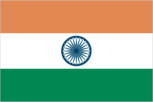
three equal horizontal bands of orange (top), white, and green with a blue chakra (24-spoked wheel) centered in the white band; similar to the flag of Niger which has a small orange disk centered in the white band
Independence
15 August 1947 (from UK)
Judicial branch
Supreme Court
Leaders
Chief of State--President Ramaswamy Iyer VENKATARAMAN (since 25 July 1987); Vice President Dr. Shankar Dayal SHARMA (since 3 September 1987); Head of Government--Prime Minister P. V. Narasimha RAO (since 21 June 1991)
Legal system
based on English common law; limited judicial review of legislative acts; accepts compulsory ICJ jurisdiction, with reservations
Legislative branch
bicameral Parliament (Sansad) consists of an upper house or Council of States (Rajya Sabha) and a lower house or House of the People (Lok Sabha)
Long-form name
- none
- Republic of India
Member of
AfDB, AG (observer), AsDB, C, CCC, CP, ESCAP, FAO, G-6, G-19, G-24, G-77, GATT, IAEA, IBRD, ICAO, ICC, ICFTU, IDA, IFAD, IFC, ILO, IMF, IMO, INMARSAT, INTELSAT, INTERPOL, IOC, ISO, ITU, LORCS, NAM, PCA, SAARC, UN, UNAVEM, UNCTAD, UNESCO, UNIDO, UNIIMOG, UPU, WFTU, WHO, WIPO, WMO, WTO
National holiday
Anniversary of the Proclamation of the Republic, 26 January (1950)
Other political or pressure groups
various separatist groups seeking greater communal autonomy; numerous religious or militant/chauvinistic organizations, including Adam Sena, Anand Marg, Vishwa Hindu Parishad, and Rashtriya Swayamsevak Sangh
Political parties and leaders
Congress (I) Party, P. V. Narasimha RAO, president; Bharatiya Janata Party, L. K. ADVANI; Janata Dal Party, V. P. SINGH; Communist Party of India/Marxist (CPI/M), E. M. S. NAMBOODIRIPAD; Communist Party of India (CPI), C. Rajeswara RAO; Telugu Desam (a regional party in Andhra Pradesh), N. T. Rama RAO; All-India Anna Dravida Munnetra Kazagham (AIADMK; a regional party in Tamil Nadu), JAYALALITHA; Samajwadi Janata Party, CHANDRA SHEKHAR; Shiv Sena, Bal THACKERAY; Revolutionary Socialist Party (RSP), Tridip CHOWDHURY; Bahujana Samaj Party (BSP), Kanshi RAM; Congress (S) Party, leader NA; Communist Party of India/Marxist-Leninist (CPI/ML), Satyanarayan SINGH; Dravida Munnetra Kazagham (a regional party in Tamil Nadu), M. KARUNANIDHI; Akali Dal factions representing Sikh religious community in the Punjab; National Conference (NC; a regional party in Jammu and Kashmir), Farooq ABDULLAH; Asom Gana Parishad (a regional party in Assam), Prafulla MAHANTA
Suffrage
universal at age 18
Type
- French possession administered by Commissioner of the Republic Daniel CONSTANTIN, resident in Reunion
- federal republic
Economy
Agriculture
accounts for about 30% of GNP and employs 67% of labor force; self-sufficient in food grains; principal crops--rice, wheat, oilseeds, cotton, jute, tea, sugarcane, potatoes; livestock--cattle, buffaloes, sheep, goats and poultry; fish catch of about 3 million metric tons ranks among the world's top 10 fishing nations
Budget
revenues $34 billion; expenditures $54 billion, including capital expenditures of $13.3 billion (FY91)
Currency
Indian rupee (plural--rupees); 1 Indian rupee (Re) = 100 paise
Economic aid
US commitments, including Ex-Im (FY70-89), $4.4 billion; Western (non-US) countries, ODA and OOF bilateral commitments (1980-88), $20.1 billion; OPEC bilateral aid (1979-89), $315 million; USSR (1970-89), $11.6 billion; Eastern Europe (1970-89), $105 million
Electricity
70,000,000 kW capacity; 245,000 million kWh produced, 290 kWh per capita (1990)
Exchange rates
Indian rupees (Rs) per US$1--18.329 (January 1990), 17.504 (1990), 16.226 (1989), 13.917 (1988), 12.962 (1987), 12.611 (1986), 12.369 (1985)
Exports
$17.0 billion (f.o.b., FY90); commodities--gems and jewelry, engineering goods, clothing, textiles, chemicals, tea, coffee, fish products; partners--EC 25%, US 19%, USSR and Eastern Europe 17%, Japan 10%
External debt
$69.8 billion (1990 est.)
Fiscal year
1 April-31 March
GNP
$254 billion, per capita $300; real growth rate 4.5% (1990 est.)
Illicit drugs
licit producer of opium poppy for the pharmaceutical trade, but some opium is diverted to illicit international drug markets; major transit country for illicit narcotics produced in neighboring countries
Imports
$24.8 billion (c.i.f., FY90); commodities--petroleum, capital goods, uncut gems and jewelry, chemicals, iron and steel, edible oils; partners--EC 33%, Middle East 19%, Japan 10%, US 9%, USSR and Eastern Europe 8%
Industrial production
growth rate 8.4% (1990); accounts for about 25% of GDP
Industries
textiles, food processing, steel, machinery, transportation equipment, cement, jute manufactures, mining, petroleum, power, chemicals, pharmaceuticals, electronics
Inflation rate (consumer prices)
10.0% (1990)
Overview
- no economic activity
- India's economy is a mixture of traditional village farming and handicrafts, modern agriculture, old and new branches of industry, and a multitude of support services. It presents both the entrepreneurial skills and drives of the capitalist system and widespread government intervention of the socialist mold. Growth of 4% to 5% annually in the 1980s has softened the impact of population growth on unemployment, social tranquility, and the environment. Agricultural output has continued to expand, reflecting the greater use of modern farming techniques and improved seed that have helped to make India self-sufficient in food grains and a net agricultural exporter. However, tens of millions of villagers, particularly in the south, have not benefited from the green revolution and live in abject poverty. Industry has benefited from a partial liberalization of controls. The growth rate of the service sector has also been strong. India, however, has been challenged more recently by much lower foreign exchange reserves, higher inflation, and a large debt service burden.
Unemployment rate
20% (1990 est.)
Communications
Airports
345 total, 288 usable; 198 with permanent-surface runways; 2 with runways over 3,659 m; 57 with runways 2,440-3,659 m; 88 with runways 1,220-2,439 m
Civil air
93 major transport aircraft
Highways
1,633,300 km total (1986); 515,300 km secondary and 1,118,000 km gravel, crushed stone, or earth
Inland waterways
16,180 km; 3,631 km navigable by large vessels
Merchant marine
308 ships (1,000 GRT or over) totaling 6,087,451 GRT/10,150,460 DWT; includes 1 short-sea passenger, 8 passenger-cargo, 100 cargo, 1 roll-on/roll-off cargo, 8 container, 54 petroleum, oils, and lubricants (POL) tanker, 10 chemical tanker, 9 combination ore/oil, 115 bulk, 2 combination bulk
Pipelines
crude oil, 3,497 km; refined products, 1,703 km; natural gas, 902 km (1989)
Ports
- none; offshore anchorage only
- Bombay, Calcutta, Cochin, Kandla, Madras, New Mangalore, Port Blair (Andaman Islands)
Railroads
61,850 km total (1986); 33,553 km 1.676-meter broad gauge, 24,051 km 1.000-meter gauge, 4,246 km narrow gauge (0.762 meter and 0.610 meter); 12,617 km is double track; 6,500 km is electrified
Telecommunications
poor domestic telephone service, international radio communications adequate; 4,700,000 telephones; stations--96 AM, 4 FM, 274 TV (government controlled); domestic satellite system for communications and TV; 3 Indian Ocean INTELSAT earth stations; submarine cables to Malaysia and United Arab Emirates
Military and Security
Branches
Army, Navy, Air Force, Police Force, Border Security Forces, Coast Guard, Assam Rifles
Defense expenditures
$9.2 billion, 3.5% of GNP (FY91) _%_
Manpower availability
males 15-49, 232,793,714; 137,259,444 fit for military service; about 9,431,908 reach military age (17) annually
Note
defense is the responsibility of France _%_