1982 Edition
CIA World Factbook 1982 (Wikisource)
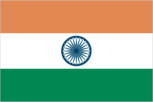
Geography
Area
3,136,500 km2 (includes Indian part of Jammu-Kashmir, Sikkim, Goa, Damao and Diu); 50% arable, 5% permanent meadows and pastures, 20% desert, waste, or urban, 22% forested, 3% inland water
Coastline
7,000 km (includes offshore islands)
Land boundaries
12,700 km2 WATER
Limits of territorial waters (claimed)
12 nm (fishing 200 nm; additional 100 nm is fisheries conservation zone, December 1968; archipelago concept baselines); 200 nm exclusive economic zone
People and Society
Ethnic divisions
72% Indo-Aryan, 25% Dravidian, 3% Mongoloid and other
Labor force
about 197 million; 70% agriculture, more than 10% unemployed and underemployed; shortage of skilled labor is significant and unemployment is rising
Language
24 languages spoken by a million or more persons each; numerous other languages and dialects, for the most part mutually unintelligible; Hindi is the national language and primary tongue of 30% of the people; English enjoys "associate" status but is the most important language for national, political, and commercial communication; Hindustani, a popular variant of Hindi/Urdu, is spoken widely throughout northern India
Literacy
males 39%; females 18%; both sexes 29% (1971 census)
Nationality
noun—Indian(s); adjective—Indian
Organized labor
about 2.5% of total labor force
Population
723,762,000, including Sikkim and the Indian-held part of disputed Jammu-Kashmir (July 1982), average annual growth rate 2.2%
Religion
83.5% Hindu, 10.7% Muslim, 1.8% Sikh, 2.6% Christian, 0.7% Buddhist, 0.7% other
Government
Branches
parliamentary government, national and state; relatively independent judiciary
Capital
New Delhi
Communists
470,000 members claimed by CPI, 270,000 members claimed by CPI/M; Communist extremist groups, about 15,000 members
Elections
national and state elections ordinarily held every five years; may be postponed in emergency and may be held more frequently if government loses confidence vote; last general election in January 1980; state elections staggered Political parties and leaders: Indian National Congress, controlled national government from independence to March 1977, and split in January 1978; larger Congress group is headed by Prime Minister Indira Gandhi; the smaller Congress group is headed by Sharad Pawar; Janata Party led by Chandra Shekhar; Lok Dal Party by Charan Singh; Bharatiya Janata Party by A. B. Vajpayee; Communist Party of India (CPI), C. Rajeswara Rao, general secretary; Communist Party of India/Marxist (CPI/M), E. M. S. Namboodiripad, general secretary; Communist Party of India/Marxist-Leninist (CPI/ML), Satyanarayan Singh, general secretary; All-India Anna Dravida Munnetra Kazhagam (ADMK), a regional party in Tamil Nadu led by M. G. Ramachandran; Akali Dal representing Sikh religious community in the Punjab
Government leader
Prime Minister Indira GANDHI
Legal system
based on English common law; constitution adopted 1950; limited judicial review of legislative acts; accepts compulsory ICJ jurisdiction, with reservations
Member of
ADB, AIOEC, Colombo Plan, Commonwealth, FAO, G-77, GATT, IAEA, IBRD, ICAC, ICAO, ICO, IDA, IFAD, IFC, IHO, ILO, International Lead and Zinc Study Group, IMCO, IMF, IPU, ITC, ITU, IWC—International Wheat Council, NAM, UN, UNESCO, UPU, WHO, WIPO, WMO, WSG, WTO
National holiday
anniversary of the Proclamation of the Republic, 26 January
Official name
Republic of India
Other political or pressure groups
various separatist groups seeking reorganization of states; numerous "senas" or militant/chauvinistic organizations, including Shiv Sena in Bombay, the Anand Marg, and the Rashtriya Swayamserak Sangh
Political subdivisions
22 states, 9 union territories
Suffrage
universal over age 21
Type
federal republic
Economy
Agriculture
main crops—rice, other cereals, pulses, oil-seed, cotton, jute, sugarcane, tobacco, tea, and coffee Fishing: catch 2.5 million metric tons (FY78); exports $151 million (FY77), imports, none in 1976 and 1977
Budget
(FY81 revised est.) central government revenue and capital receipts, $26.4 billion; disbursements, $28.9 billion
Crude steel
9.4 million metric tons of ingots (FY81)
Electric power
34,831,000 kW capacity (1980); 128.874 million kWh produced (1980), 188 kWh per capita
Exports
$9 billion (f.o.b., FY81 est.); engineering goods, textiles and clothing, tea
Fiscal year
fiscal year ends 31 March of stated year
GNP
$150.6 billion (FY8I est. at current prices), $217 per capita; real growth 7% in FY81
Imports
$16 billion (f.o.b., FY81 est.); machinery and transport equipment, petroleum, edible oils, fertilizers
Major industries
textiles, food processing, steel, machinery, transportation equipment, cement, jute manufactures
Major trade partners
US, UK, USSR, Japan
Monetary conversion rate
9.11 rupees=US$1 (November 1981)
Communications
Airfields
355 total, 321 usable; 186 with permanent-surface runways; 2 with runways over 3,659 m, 55 with runways 2,440-3,659 m, 107 with runways 1,220-2,439 m
Civil air
93 major transport aircraft
Highways
1,327,450 km total (1979); 514,250 km hard surfaced, 190,600 km gravel or crushed stone, 495,500 km improved earth, 416,700 km unimproved earth
Inland waterways
16,000 km; 2,575 km navigable by river steamers
Pipelines
crude oil, 1,980 km; refined products, 1,056 km; natural gas, 854 km; slurry 992 km
Ports
9 major, 79 minor
Railroads
60,693 km total (1981); 30,909 km broad gauge (1.676 m), 25,503 km meter gauge (1.00 m), 4,281 km narrow gauge (0.762 m and 0.610 m), government owned; 46 km meter gauge (1.00 m), 855 km broad gauge (1.676 m), 345 km narrow gauge (0.762 m and 0.610 m), privately owned; 12,617 km double track; 4,820 km electrified
Telecommunications
fair domestic telephone service where available, good internal microwave links; telegraph facilities widespread; AM broadcast adequate; international radio communications adequate; 2.6 million telephones (0.4 per 100 popl.); about 174 AM stations at 80 locations, 17 TV stations, 13 earth satellite stations; submarine cables extend to Sri Lanka; 7 satellite stations under construction
Military and Security
Military budget
for fiscal year ending 31 March 1982, $5.7 billion; 17.0% of central government budget
Military manpower
males 15-49, 183,001,000; 111,614,000 fit for military service; about 8,343,000 reach military age (17) annually