2010 Edition
CIA World Factbook 2010 (Project Gutenberg)
Introduction
Background
Settled by Norwegian and Celtic (Scottish and Irish) immigrants during the late 9th and 10th centuries A.D., Iceland boasts the world's oldest functioning legislative assembly, the Althing, established in 930. Independent for over 300 years, Iceland was subsequently ruled by Norway and Denmark. Fallout from the Askja volcano of 1875 devastated the Icelandic economy and caused widespread famine. Over the next quarter century, 20% of the island's population emigrated, mostly to Canada and the US. Limited home rule from Denmark was granted in 1874 and complete independence attained in 1944. The second half of the 20th century saw substantial economic growth driven primarily by the fishing industry. The economy diversified greatly after the country joined the European Economic Area in 1994, but Iceland was especially hard hit by the global financial crisis in the years following 2008. Literacy, longevity, and social cohesion are first rate by world standards.
Geography
Area
- land
- 100,250 sq km
- total
- 103,000 sq km
- water
- 2,750 sq km
Area - comparative
slightly smaller than Kentucky
Climate
temperate; moderated by North Atlantic Current; mild, windy winters; damp, cool summers
Coastline
4,970 km
Elevation extremes
- highest point
- Hvannadalshnukur 2,110 m (at Vatnajokull glacier)
- lowest point
- Atlantic Ocean 0 m
Environment - current issues
water pollution from fertilizer runoff; inadequate wastewater treatment
Environment - international agreements
- party to
- Air Pollution, Air Pollution-Persistent Organic Pollutants, Biodiversity, Climate Change, Climate Change-Kyoto Protocol, Desertification, Endangered Species, Hazardous Wastes, Kyoto Protocol, Law of the Sea, Marine Dumping, Ozone Layer Protection, Ship Pollution, Transboundary Air Pollution, Wetlands, Whaling signed, but not ratified: Environmental Modification, Marine Life Conservation
Freshwater withdrawal (domestic/industrial/agricultural)
- per capita
- 567 cu m/yr (2003)
- total
- 0.17 cu km/yr (34%/66%/0%)
Geographic coordinates
65 00 N, 18 00 W
Geography - note
strategic location between Greenland and Europe; westernmost European country; Reykjavik is the northernmost national capital in the world; more land covered by glaciers than in all of continental Europe
Irrigated land
NA
Land boundaries
0 km
Land use
- arable land
- 0.07%
- other
- 99.93% (2005)
- permanent crops
- 0%
Location
Northern Europe, island between the Greenland Sea and the North Atlantic Ocean, northwest of the United Kingdom
Map references
Europe
Maritime claims
- continental shelf
- 200 nm or to the edge of the continental margin
- exclusive economic zone
- 200 nm
- territorial sea
- 12 nm
Natural hazards
- earthquakes and volcanic activity
- volcanism
- Iceland, situated on top of a hotspot, experiences severe volcanic activity; Eyjafjallajokull (elev. 1,666 m, 5,466 ft) erupted in 2010, sending ash high into the atmosphere and seriously disrupting European air traffic; scientists continue to monitor nearby Katla (elev. 1,512 m, 4,961 ft), which has a high probability of eruption in the very near future, potentially disrupting air traffic; Grimsvotn and Hekla are Iceland's most frequently active volcanoes; other historically active volcanoes include Askja, Bardarbunga, Brennisteinsfjoll, Esjufjoll, Hengill, Krafla, Krisuvik, Kverkfjoll, Oraefajokull, Reykjanes, Torfajokull, and Vestmannaeyjar
Natural resources
fish, hydropower, geothermal power, diatomite
Terrain
mostly plateau interspersed with mountain peaks, icefields; coast deeply indented by bays and fiords
Total renewable water resources
170 cu km (2005)
People and Society
Age structure
0-14 years: 20.7% (male 32,268/female 31,308) 15-64 years: 67.1% (male 104,158/female 101,584) 65 years and over: 12.2% (male 16,952/female 20,424) (2010 est.)
Birth rate
13.36 births/1,000 population (2010 est.)
Death rate
6.9 deaths/1,000 population (July 2010 est.)
Education expenditures
7.5% of GDP (2007)
Ethnic groups
homogeneous mixture of descendants of Norse and Celts 94%, population of foreign origin 6%
HIV/AIDS - adult prevalence rate
0.2% (2007 est.)
HIV/AIDS - deaths
fewer than 100 (2003 est.)
HIV/AIDS - people living with HIV/AIDS
220 (2007 est.)
Infant mortality rate
- female
- 3.07 deaths/1,000 live births (2010 est.)
- male
- 3.36 deaths/1,000 live births
- total
- 3.21 deaths/1,000 live births
Languages
Icelandic, English, Nordic languages, German widely spoken
Life expectancy at birth
- female
- 83.04 years (2010 est.)
- male
- 78.63 years
- total population
- 80.79 years
Literacy
- definition: age 15 and over can read and write
- female
- 99% (2003 est.)
- male
- 99%
- total population
- 99%
Median age
- female
- 35.8 years (2010 est.)
- male
- 34.9 years
- total
- 35.4 years
Nationality
- adjective
- Icelandic
- noun
- Icelander(s)
Net migration rate
0.54 migrant(s)/1,000 population (2010 est.)
Population
308,910 (July 2010 est.)
Population growth rate
0.699% (2010 est.)
Religions
Lutheran Church of Iceland 80.7%, Roman Catholic Church 2.5%, Reykjavik Free Church 2.4%, Hafnarfjorour Free Church 1.6%, other religions 3.6%, unaffiliated 3%, other or unspecified 6.2% (2006 est.)
School life expectancy (primary to tertiary education)
- female
- 20 years (2008)
- male
- 17 years
- total
- 18 years
Sex ratio
- at birth
- 1.04 male(s)/female under 15 years: 1.03 male(s)/female 15-64 years: 1.02 male(s)/female 65 years and over: 0.83 male(s)/female
- total population
- 1 male(s)/female (2010 est.)
Total fertility rate
1.9 children born/woman (2010 est.)
Urbanization
- rate of urbanization
- 0.8% annual rate of change (2005-10 est.)
- urban population
- 92% of total population (2008)
Government
Administrative divisions
8 regions; Austurland, Hofudhborgarsvaedhi, Nordhurland Eystra, Nordhurland Vestra, Sudhurland, Sudhurnes, Vestfirdhir, Vesturland
Capital
- geographic coordinates
- 64 09 N, 21 57 W
- name
- Reykjavik
- time difference
- UTC 0 (5 hours ahead of Washington, DC during Standard Time)
Constitution
16 June 1944, effective 17 June 1944; amended many times
Country name
- conventional long form
- Republic of Iceland
- conventional short form
- Iceland
- local long form
- Lydveldid Island
- local short form
- Island
Diplomatic representation from the US
- chief of mission
- Ambassador Luis E. ARREAGA
- embassy
- Laufasvegur 21, 101 Reykjavik
- FAX
- [354] 562-9118
- mailing address
- US Department of State, 5640 Reykjavik Place, Washington, D.C. 20521-5640
- telephone
- [354] 562-9100
Diplomatic representation in the US
- chancery
- House of Sweden, 2900 K Street NW #509, Washington, DC 20007
- chief of mission
- Ambassador Hjalmar W. HANNESSON
- consulate(s) general
- New York
- FAX
- [1] (202) 265-6656
- telephone
- [1] (202) 265-6653
Executive branch
- cabinet
- Cabinet appointed by the prime minister (For more information visit the World Leaders website )
- chief of state
- President Olafur Ragnar GRIMSSON (since 1 August 1996)
- elections
- president, a largely ceremonial post, elected by popular vote for a four-year term (no term limits); election last held on 28 June 2004 (next to be held in June 2012); following legislative elections, the leader of the majority party or the leader of the majority coalition usually the prime minister note: the presidential election of 28 June 2008 was not held because Olafur Ragnar GRIMSSON had no challengers; he was sworn in on 1 August 2008 2004 election results: Olafur Ragnar GRIMSSON elected president; percent of vote - Olafur Ragnar GRIMSSON 85.6%, Baldur AGUSTSSON 12.5%, Astthor MAGNUSSON 1.9%;
- head of government
- Prime Minister Johanna SIGURDARDOTTIR (since 1 February 2009);
Flag description
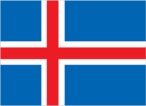
- blue with a red cross outlined in white extending to the edges of the flag; the vertical part of the cross is shifted to the hoist side in the style of the Dannebrog (Danish flag); the colors
- represent three of the elements that make up the island
- red is for the island's volcanic fires, white recalls the snow and ice fields of the island, and blue is for the surrounding ocean
Government type
constitutional republic
Independence
1 December 1918 (became a sovereign state under the Danish Crown); 17 June 1944 (from Denmark)
International organization participation
Arctic Council, Australia Group, BIS, CBSS, CE, EAPC, EBRD, EFTA, FAO, FATF, IAEA, IBRD, ICAO, ICC, ICCt, ICRM, IDA, IFAD, IFC, IFRCS, IHO, ILO, IMF, IMO, IMSO, Interpol, IOC, IPU, ISO, ITSO, ITU, ITUC, MIGA, NATO, NC, NEA, NIB, NSG, OAS (observer), OECD, OPCW, OSCE, PCA, Schengen Convention, UN, UNCTAD, UNESCO, UPU, WCO, WHO, WIPO, WMO, WTO
Judicial branch
Supreme Court or Haestirettur (justices are appointed for life by the Minister of Justice); eight district courts (justices are appointed for life by the Minister of Justice)
Legal system
civil law system based on Danish law; has not accepted compulsory ICJ jurisdiction
Legislative branch
- unicameral Parliament or Althing (63 seats; members elected by popular vote to serve four-year terms)
- election results
- percent of vote by party - Social Democratic Alliance 29.8%, Independence Party 23.7%, Left-Green Movement 21.7%, Progressive Party 14.8%, Citizens' Movement 7.2%, other 2.8%; seats by party - Social Democratic Alliance 20, Independence Party 16, Left-Green Alliance 14, Progressive Party 9, Citizens' Movement 4 note: the Citizens' Movement disintegrated in September 2009; three of its former MPs are now represented under the banner of The Movement and the fourth former MP is an independent
- elections
- last held on 25 April 2009 (next to be held in 2013)
National anthem
- lyrics/music
- Matthias JOCHUMSSON/Sveinbjorn SVEINBJORNSSON note: adopted 1944; the anthem, also known as "O, Guo vors Lands" (O, God of Our Land), was originally written and performed in 1874
- name
- "Lofsongur" (Song of Praise)
National holiday
Independence Day, 17 June (1944)
Political parties and leaders
Independence Party or IP [Bjarni BENEDIKTSSON]; Left-Green Movement or LGM [Steingrimur SIGFUSSON]; Progressive Party or PP [Sigmundur David GUNNLAUGSSON]; Social Democratic Alliance or SDA [Johanna SIGURDARDOTTIR]; The Movement [Birgitta JONSDOTTIR]
Suffrage
18 years of age; universal
Economy
Agriculture - products
potatoes, green vegetables; mutton, chicken, pork, beef, dairy products; fish
Central bank discount rate
14.55% (31 December 2009) 22% (31 December 2008)
Commercial bank prime lending rate
18.99% (31 December 2009 est.) 19.29% (31 December 2007)
Current account balance
-$42 million (2010 est.) -$440 million (2009 est.)
Debt - external
$3.073 billion (2002)
Distribution of family income - Gini index
28 (2006) 25 (2005)
Economy - overview
- Iceland's Scandinavian-type social-market economy combines a capitalist structure and free-market principles with an extensive welfare system. Prior to the 2008 crisis, Iceland had achieved high growth, low unemployment, and a remarkably even distribution of income. The economy depends heavily on the fishing industry, which provides 40% of export earnings, more than 12% of GDP, and employs 7% of the work force. It remains sensitive to declining fish stocks as well as to fluctuations in world prices for its main exports: fish and fish products, aluminum, and ferrosilicon. Iceland's economy has been diversifying into manufacturing and service industries in the last decade, particularly within the fields of software production, biotechnology, and tourism. Abundant geothermal and hydropower sources have attracted substantial foreign investment in the aluminum sector and boosted economic growth, although the financial crisis has put several investment projects on hold. Much of Iceland's economic growth in recent years came as the result of a boom in domestic demand following the rapid expansion of the country's financial sector. Domestic banks expanded aggressively in foreign markets, and consumers and businesses borrowed heavily in foreign currencies, following the privatization of the banking sector in the early 2000s. Worsening global financial conditions throughout 2008 resulted in a sharp depreciation of the krona vis-a-vis other major currencies. The foreign exposure of Icelandic banks, whose loans and other assets totaled more than 10 times the country's GDP, became unsustainable. Iceland's three largest banks collapsed in late 2008. The country secured over $10 billion in loans from the IMF and other countries to stabilize its currency and financial sector, and to back government guarantees for foreign deposits in Icelandic banks. GDP fell 6.8% in 2009, and unemployment peaked at 9.4% in February 2009. GDP fell 3.4% in 2010. Since the collapse of Iceland's financial sector, government economic
- priorities have included
- stabilizing the krona, reducing Iceland's high budget deficit, containing inflation, restructuring the financial sector, and diversifying the economy. Three new banks were established to take over the domestic assets of the collapsed banks. Two of them have foreign majority ownership, while the State holds a majority of the shares of the third. British and Dutch authorities have pressed claims totaling over $5 billion against Iceland to compensate their citizens for losses suffered on deposits held in the failed Icelandic bank, Landsbanki Islands. Iceland agreed to new terms with the UK and the Netherlands to compensate British and Dutch depositors, but the agreement must first be approved by the Icelandic President. Iceland began EU accession negotiations with the EU in July 2010, however, public support has dropped substantially because of concern about losing control over fishing resources and in reaction to measures taken by Brussels during the ongoing Eurozone crisis.
Electricity - consumption
16.48 billion kWh (2009 est.)
Electricity - exports
0 kWh (2008 est.)
Electricity - imports
0 kWh (2008 est.)
Electricity - production
16.84 billion kWh (2009 est.)
Exchange rates
Icelandic kronur (ISK) per US dollar - 139.319 (2010), 123.638 (2009), 85.619 (2008), 63.391 (2007), 70.195 (2006)
Exports
$4.619 billion (2010 est.) $4.05 billion (2009 est.)
Exports - commodities
fish and fish products 40%, aluminum, animal products, ferrosilicon, diatomite
Exports - partners
Netherlands 30.71%, UK 12.73%, Germany 11.21%, Norway 5.75%, Spain 4.82% (2009)
GDP - composition by sector
- agriculture
- 5.5%
- industry
- 24.7%
- services
- 69.9% (2010 est.)
GDP - per capita (PPP)
$38,400 (2010 est.) $40,000 (2009 est.) $43,300 (2008 est.) note: data are in 2010 US dollars
GDP - real growth rate
-3.4% (2010 est.) -6.8% (2009 est.) 1% (2008 est.)
GDP (official exchange rate)
$12.77 billion (2010 est.)
GDP (purchasing power parity)
$11.86 billion (2010 est.) $12.28 billion (2009 est.) $13.17 billion (2008 est.) note: data are in 2010 US dollars
Household income or consumption by percentage share
lowest 10%: NA% highest 10%: NA%
Imports
$3.677 billion (2010 est.) $3.318 billion (2009 est.)
Imports - commodities
machinery and equipment, petroleum products, foodstuffs, textiles
Imports - partners
Norway 12.97%, Netherlands 8.62%, Germany 8.3%, Sweden 8.03%, Denmark 7.27%, US 6.94%, China 4.98%, UK 4.55%, Brazil 4.09% (2009)
Industrial production growth rate
-1% (2010 est.)
Industries
fish processing; aluminum smelting, ferrosilicon production; geothermal power, hydropower, tourism
Inflation rate (consumer prices)
5.5% (2010 est.) 12% (2009 est.)
Investment (gross fixed)
12.4% of GDP (2010 est.)
Labor force
188,000 (2010 est.)
Labor force - by occupation
- agriculture
- 4.8%
- industry
- 22.2%
- services
- 73% (2008)
Market value of publicly traded shares
$1.128 billion (31 December 2009) $5.557 billion (31 December 2008) $40.56 billion (31 December 2007)
Natural gas - consumption
0 cu m (2008 est.)
Natural gas - exports
0 cu m (2008 est.)
Natural gas - imports
0 cu m (2008 est.)
Natural gas - production
0 cu m (2008 est.)
Natural gas - proved reserves
0 cu m (1 January 2010 est.)
Oil - consumption
18,900 bbl/day (2009 est.)
Oil - exports
1,915 bbl/day (2008 est.)
Oil - imports
16,390 bbl/day (2008 est.)
Oil - production
0 bbl/day (2009 est.)
Oil - proved reserves
0 bbl (1 January 2010 est.)
Population below poverty line
NA%
Public debt
123.8% of GDP (2010 est.) 113.9% of GDP (2009 est.)
Reserves of foreign exchange and gold
$4.206 billion (31 December 2010 est.) $3.883 billion (31 December 2009 est.)
Stock of broad money
$19.97 billion (31 December 2009 est.) $24.28 billion (31 December 2009 est.)
Stock of direct foreign investment - abroad
$NA $8.8 billion (31 December 2008)
Stock of direct foreign investment - at home
$NA (31 December 2010) $9.2 billion (#REF!)
Stock of domestic credit
$46.03 billion (31 December 2010 est.) $54.65 billion (31 December 2009 est.)
Stock of narrow money
$4.413 billion (31 December 2010 est) $4.438 billion (31 December 2009 est)
Unemployment rate
8.6% (2010 est.) 8% (2009 est.)
Communications
Broadcast media
state-owned public television broadcaster operates 1 TV channel nationally; several privately-owned TV stations broadcast nationally and roughly another half-dozen operate locally; about half the households utilize multi-channel cable or satellite TV services; state-owned public radio broadcaster operates 2 national networks and 4 regional stations; 2 privately-owned radio stations operate nationally and another 15 provide more limited coverage (2007)
Internet country code
.is
Internet hosts
344,748 (2010)
Internet users
301,600 (2009)
Telephone system
- domestic
- liberalization of the telecommunications sector beginning in the late 1990s has led to increased competition especially in the mobile services segment of the market
- general assessment
- telecommunications infrastructure is modern and fully digitized, with satellite-earth stations, fiber-optic cables, and an extensive broadband network
- international
- country code - 354; the CANTAT-3 and FARICE-1 submarine cable systems provide connectivity to Canada, the Faroe Islands, UK, Denmark, and Germany; a planned new section of the Hibernia-Atlantic submarine cable will provide additional connectivity to Canada, US, and Ireland; satellite earth stations - 2 Intelsat (Atlantic Ocean), 1 Inmarsat (Atlantic and Indian Ocean regions); note - Iceland shares the Inmarsat earth station with the other Nordic countries (Denmark, Finland, Norway, and Sweden)
Telephones - main lines in use
185,200 (2009)
Telephones - mobile cellular
349,000 (2009)
Transportation
Airports
99 (2010)
Airports - with paved runways
- total
- 6 over 3,047 m: 1 1,524 to 2,437 m: 3 914 to 1,523 m: 2 (2010)
Airports - with unpaved runways
- total
- 93 1,524 to 2,437 m: 3 914 to 1,523 m: 27 under 914 m: 63 (2010)
Merchant marine
- by type
- passenger/cargo 2
- registered in other countries
- 19 (Antigua and Barbuda 9, Belize 2, Denmark 3, Finland 1, Gibraltar 1, Norway 3) (2010)
- total
- 2
Ports and terminals
Grundartangi, Hafnarfjordur, Reykjavik
Roadways
- paved/oiled gravel
- 4,438 km (does not include urban roads)
- total
- 12,869 km
- unpaved
- 8,431 km (2009)
Military and Security
Manpower available for military service
males age 16-49: 75,259 (2010 est.)
Manpower fit for military service
males age 16-49: 62,705 females age 16-49: 61,392 (2010 est.)
Manpower reaching militarily significant age annually
- female
- 2,263 (2010 est.)
- male
- 2,318
Military - note
Iceland has no standing military force; under a 1951 bilateral agreement - still valid - its defense was provided by the US-manned Icelandic Defense Force (IDF) headquartered at Keflavik; however, all US military forces in Iceland were withdrawn as of October 2006; although wartime defense of Iceland remains a NATO commitment, in April 2007, Iceland and Norway signed a bilateral agreement providing for Norwegian aerial surveillance and defense of Icelandic airspace (2008)
Military branches
no regular military forces; Icelandic National Police (2008)
Military expenditures
0% of GDP (2005 est.)
Transnational Issues
Disputes - international
Iceland, the UK, and Ireland dispute Denmark's claim that the Faroe Islands' continental shelf extends beyond 200 nm page last updated on January 20, 2011 ======================================================================