2005 Edition
CIA World Factbook 2005 (Project Gutenberg)
Introduction
Administrative divisions
8 regions; Austurland, Hofudhborgarsvaedhi, Nordhurland Eystra, Nordhurland Vestra, Sudhurland, Sudhurnes, Vestfirdhir, Vesturland
Age structure
0-14 years: 22.1% (male 33,302/female 32,257) 15-64 years: 66.2% (male 99,513/female 96,886) 65 years and over: 11.7% (male 15,723/female 19,056) (2005 est.)
Agriculture - products
potatoes, green vegetables, mutton, dairy products, fish
Airports
98 (2004 est.)
Airports - with paved runways
- total
- 5 over 3,047 m: 1 1,524 to 2,437 m: 3 914 to 1,523 m: 1 (2004 est.)
Airports - with unpaved runways
- total
- 93 1,524 to 2,437 m: 3 914 to 1,523 m: 29 under 914 m: 61 (2004 est.) Military Iceland
Area
- land
- 100,250 sq km
- total
- 103,000 sq km
- water
- 2,750 sq km
Area - comparative
slightly smaller than Kentucky
Background
Settled by Norwegian and Celtic (Scottish and Irish) immigrants during the late 9th and 10th centuries A.D., Iceland boasts the world's oldest functioning legislative assembly, the Althing, established in 930. Independent for over 300 years, Iceland was subsequently ruled by Norway and Denmark. Fallout from the Askja volcano of 1875 devastated the Icelandic economy and caused widespread famine. Over the next quarter century, 20% of the island's population emigrated, mostly to Canada and the US. Limited home rule from Denmark was granted in 1874 and complete independence attained in 1944. Literacy, longevity, income, and social cohesion are first-rate by world standards. Geography Iceland
Birth rate
13.73 births/1,000 population (2005 est.)
Budget
- expenditures
- $4.058 billion, including capital expenditures of $467 million (2004 est.)
- revenues
- $4.154 billion
Capital
Reykjavik
Climate
temperate; moderated by North Atlantic Current; mild, windy winters; damp, cool summers
Coastline
4,988 km
Constitution
16 June 1944, effective 17 June 1944; amended many times
Country name
- conventional long form
- Republic of Iceland
- conventional short form
- Iceland
- local long form
- Lydhveldidh Island
- local short form
- Island
Currency (code)
Icelandic krona (ISK)
Currency code
ISK
Current account balance
$-570 million (2004 est.)
Death rate
6.68 deaths/1,000 population (2005 est.)
Debt - external
$3.073 billion (2002)
Diplomatic representation from the US
- chief of mission
- Ambassador James I. GADSDEN
- embassy
- Laufasvegur 21, 101 Reykjavik
- FAX
- [354] 562-9118
- mailing address
- US Embassy, PSC 1003, Box 40, FPO AE 09728-0340
- telephone
- [354] 562-9100
Diplomatic representation in the US
- chancery
- Suite 1200, 1156 15th Street NW, Washington, DC 20005-1704
- chief of mission
- Ambassador Helgi AGUSTSSON
- consulate(s) general
- New York
- FAX
- [1] (202) 265-6656
- telephone
- [1] (202) 265-6653
Disputes - international
Iceland disputes Denmark's alignment of the Faroe Islands' fisheries median line; Iceland, the UK, and Ireland dispute Denmark's claim that the Faroe Islands' continental shelf extends beyond 200 nm This page was last updated on 20 October, 2005 ======================================================================
Economic aid - donor
$NA
Economy - overview
- Iceland's Scandinavian-type economy is basically capitalistic, yet with an extensive welfare system (including generous housing subsidies), low unemployment, and remarkably even distribution of income. In the absence of other natural resources (except for abundant geothermal power), the economy depends heavily on the fishing industry, which provides 70% of export earnings and employs 8% of the work force. The economy remains sensitive to declining fish stocks as well as to fluctuations in world prices for its main
- exports
- fish and fish products, aluminum, and ferrosilicon. Government policies include reducing the budget and current account deficits, limiting foreign borrowing, containing inflation, revising agricultural and fishing policies, diversifying the economy, and privatizing state-owned industries. The government remains opposed to EU membership, primarily because of Icelanders' concern about losing control over their fishing resources. Iceland's economy has been diversifying into manufacturing and service industries in the last decade, and new developments in software production, biotechnology, and financial services are taking place. The tourism sector is also expanding, with the recent trends in ecotourism and whale watching. Growth had been remarkably steady in 1996-2001 at 3%-5%, but could not be sustained in 2002 in an environment of global recession. Growth resumed in 2003, and estimates call for strong growth until 2007, slowly dropping until the end of the decade.
Electricity - consumption
7.692 billion kWh (2002)
Electricity - exports
0 kWh (2002)
Electricity - imports
0 kWh (2002)
Electricity - production
8.271 billion kWh (2002)
Electricity - production by source
- fossil fuel
- 0.1%
- hydro
- 82.5%
- nuclear
- 0%
- other
- 17.5% (geothermal) (2001)
Elevation extremes
- highest point
- Hvannadalshnukur 2,119 m (at Vatnajokull glacier)
- lowest point
- Atlantic Ocean 0 m
Environment - current issues
water pollution from fertilizer runoff; inadequate wastewater treatment
Environment - international agreements
- party to
- Air Pollution, Air Pollution-Persistent Organic Pollutants, Biodiversity, Climate Change, Climate Change-Kyoto Protocol, Desertification, Endangered Species, Hazardous Wastes, Kyoto Protocol, Law of the Sea, Marine Dumping, Ozone Layer Protection, Ship Pollution, Transboundary Air Pollution, Wetlands signed, but not ratified: Environmental Modification, Marine Life Conservation
Ethnic groups
homogeneous mixture of descendants of Norse and Celts 94%, population of foreign origin 6%
Exchange rates
Icelandic kronur per US dollar - 70.192 (2004), 76.709 (2003), 91.662 (2002), 97.425 (2001), 78.616 (2000)
Executive branch
- cabinet
- Cabinet appointed by the prime minister and approved by parliament
- chief of state
- President Olafur Ragnar GRIMSSON (since 1 August 1996)
- election results
- Olafur Ragnar GRIMSSON wins with 85.6% of the vote, Baldur AGUSTSSON 12.5%, Astthor MAGNUSSON 1.9%
- elections
- president, which is largely a ceremonial post, elected by popular vote for a four-year term; election last held 26 June 2004 (next to be held June 2008); following legislative elections, the leader of the majority party or the leader of the majority coalition is usually the prime minister
- head of government
- Prime Minister Halldor ASGRIMSSON (since 15 September 2004); note - Former Prime Minister David ODDSSON switched positions with former Foreign Minister Halldor ASGRIMMSON
Exports
$2.902 billion f.o.b. (2004 est.)
Exports - commodities
fish and fish products 70%, aluminum, animal products, ferrosilicon, diatomite
Exports - partners
UK 19.1%, Germany 17.2%, Netherlands 11.5%, US 9.8%, Spain 6.8%, Denmark 4.6% (2004)
Fiscal year
calendar year Communications Iceland
Flag description
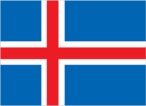
blue with a red cross outlined in white extending to the edges of the flag; the vertical part of the cross is shifted to the hoist side in the style of the Dannebrog (Danish flag) Economy Iceland
GDP - composition by sector
- agriculture
- 11.2%
- industry
- 9.6%
- services
- 79.2% (2004 est.)
GDP - per capita
purchasing power parity - $31,900 (2004 est.)
GDP - real growth rate
1.8% (2004 est.)
GDP (purchasing power parity)
$9.373 billion (2004 est.)
Geographic coordinates
65 00 N, 18 00 W
Geography - note
strategic location between Greenland and Europe; westernmost European country; Reykjavik is the northernmost national capital in the world; more land covered by glaciers than in all of continental Europe People Iceland
Government type
constitutional republic
Highways
- paved/oiled gravel
- 4,331 km
- total
- 13,004 km
- unpaved
- 8,673 km (2004)
HIV/AIDS - adult prevalence rate
0.2% (2001 est.)
HIV/AIDS - deaths
less than 100 (2003 est.)
HIV/AIDS - people living with HIV/AIDS
220 (2001 est.)
Household income or consumption by percentage share
lowest 10%: NA% highest 10%: NA%
Imports
$3.307 billion (2004 est.)
Imports - commodities
machinery and equipment, petroleum products; foodstuffs, textiles
Imports - partners
Germany 12.3%, US 9.9%, Norway 9.7%, Denmark 7.9%, UK 7.2%, Sweden 6.7%, Netherlands 6% (2004)
Independence
1 December 1918 (became a sovereign state under the Danish Crown); 17 June 1944 (from Denmark)
Industrial production growth rate
8.8% (2004 est.)
Industries
fish processing; aluminum smelting, ferrosilicon production, geothermal power; tourism
Infant mortality rate
- female
- 3.16 deaths/1,000 live births (2005 est.)
- male
- 3.45 deaths/1,000 live births
- total
- 3.31 deaths/1,000 live births
Inflation rate (consumer prices)
4% (2004 est.)
International organization participation
Australia Group, BIS, CBSS, CE, EAPC, EBRD, EFTA, FAO, IAEA, IBRD, ICAO, ICC, ICCt, ICFTU, ICRM, IDA, IFAD, IFC, IFRCS, IHO, ILO, IMF, IMO, Interpol, IOC, ISO, ITU, MIGA, NATO, NC, NEA, NIB, OECD, OPCW, OSCE, PCA, UN, UNCTAD, UNESCO, UPU, WCO, WEU (associate), WHO, WIPO, WMO, WTO
Internet country code
.is
Internet hosts
122,175 (2004)
Internet Service Providers (ISPs)
20 (2001)
Internet users
195,000 (2003) Transportation Iceland
Investment (gross fixed)
23.8% of GDP (2004 est.)
Irrigated land
NA sq km
Judicial branch
Supreme Court or Haestirettur (justices are appointed for life by the Minister of Justice); eight district courts (justices are appointed for life by the Minister of Justice)
Labor force
158,100 (2004 est.)
Labor force - by occupation
agriculture, fishing and fish processing 10.3%, industry 18.3%, services 71.4% (2003)
Land boundaries
0 km
Land use
- arable land
- 0.07%
- other
- 99.93% (2001)
- permanent crops
- 0%
Languages
Icelandic, English, Nordic languages, German widely spoken
Legal system
civil law system based on Danish law; has not accepted compulsory ICJ jurisdiction
Legislative branch
- unicameral Parliament or Althing (63 seats; members are elected by popular vote to serve four-year terms)
- election results
- percent of vote by party - Independence Party 33.7%, Social Democratic Alliance 31.0%, Progressive Party 17.7%, Left-Green Alliance 8.8%, Liberal Party 7.4%; seats by party - Independence Party 22, Social Democratic Alliance 20, Progressive Party 12, Left-Green Alliance 5, Liberal Party 4
- elections
- last held 10 May 2003 (next to be held by May 2007)
Life expectancy at birth
- female
- 82.34 years (2005 est.)
- male
- 78.13 years
- total population
- 80.19 years
Literacy
- definition: age 15 and over can read and write
- female
- NA% Government Iceland
- male
- NA%
- total population
- 99.9% (1997 est.)
Location
Northern Europe, island between the Greenland Sea and the North Atlantic Ocean, northwest of the UK
Manpower available for military service
males age 18-49: 69,038 (2005 est.)
Manpower fit for military service
males age 18-49: 56,777 (2005 est.)
Map references
Arctic Region
Maritime claims
- continental shelf
- 200 nm or to the edge of the continental margin
- exclusive economic zone
- 200 nm
- territorial sea
- 12 nm
Median age
- female
- 34.49 years (2005 est.)
- male
- 33.53 years
- total
- 34 years
Merchant marine
- by type
- cargo 2, passenger/cargo 1
- registered in other countries
- 30 (2005)
- total
- 3 ships (1,000 GRT or over) 4,341 GRT/6,019 DWT
Military - note
defense is provided by the US-manned Icelandic Defense Force (IDF) headquartered at Keflavik Transnational Issues Iceland
Military branches
no regular armed forces; Icelandic National Police, Icelandic Coast Guard (Islenska Landhelgisgaeslan)
Military expenditures - dollar figure
0
National holiday
Independence Day, 17 June (1944)
Nationality
- adjective
- Icelandic
- noun
- Icelander(s)
Natural hazards
earthquakes and volcanic activity
Natural resources
fish, hydropower, geothermal power, diatomite
Net migration rate
2.06 migrant(s)/1,000 population (2005 est.)
Oil - consumption
16,300 bbl/day (2001 est.)
Oil - exports
0 bbl/day (2001)
Oil - imports
15,470 bbl/day (2001)
Oil - production
0 bbl/day (2001 est.)
Political parties and leaders
Independence Party or IP [David ODDSSON]; Left-Green Alliance or LGP [Steingrimur SIGFUSSON]; Liberal Party or LP [Gudjon KRISTJANSSON]; Progressive Party or PP [Halldor ASGRIMSSON]; Social Democratic Alliance (includes People's Alliance or PA, Social Democratic Party or SDP, Women's List) or SDA [Ingibjorg Solrun GISLADOTTIR]
Political pressure groups and leaders
NA
Population
296,737 (July 2005 est.)
Population below poverty line
NA%
Population growth rate
0.91% (2005 est.)
Ports and harbors
Grundartangi, Hafnarfjordur, Hornafjordhur, Reykjavik, Seydhisfjordhur
Public debt
35.9% of GDP (2004 est.)
Radio broadcast stations
AM 3, FM about 70 (including repeaters), shortwave 1 (1998)
Radios
260,000 (1997)
Religions
Lutheran Church of Iceland 85.5%, Reykjavik Free Church 2.1%, Roman Catholic Church 2%, Hafnarfjorour Free Church 1.5%, other Christian 2.7%, other or unspecified 3.8%, unaffiliated 2.4% (2004)
Reserves of foreign exchange and gold
$935 million (2004)
Sex ratio
- at birth
- 1.04 male(s)/female under 15 years: 1.03 male(s)/female 15-64 years: 1.03 male(s)/female 65 years and over: 0.82 male(s)/female
- total population
- 1 male(s)/female (2005 est.)
Suffrage
18 years of age; universal
Telephone system
- domestic
- the trunk network consists of coaxial and fiber-optic cables and microwave radio relay links
- general assessment
- extensive domestic service
- international
- country code - 354; satellite earth stations - 2 Intelsat (Atlantic Ocean), 1 Inmarsat (Atlantic and Indian Ocean regions); note - Iceland shares the Inmarsat earth station with the other Nordic countries (Denmark, Finland, Norway, and Sweden)
Telephones - main lines in use
190,700 (2003)
Telephones - mobile cellular
279,100 (2003)
Television broadcast stations
14 (plus 156 low-power repeaters) (1997)
Televisions
98,000 (1997)
Terrain
mostly plateau interspersed with mountain peaks, icefields; coast deeply indented by bays and fiords
Total fertility rate
1.92 children born/woman (2005 est.)
Unemployment rate
3.1% (2004 est.)