1992 Edition
CIA World Factbook 1992 (Project Gutenberg)
Geography
Climate
temperate; moderated by North Atlantic Current; mild, windy winters; damp, cool summers
Coastline
4,988 km
Comparative area
slightly smaller than Kentucky
Continental shelf
edge of continental margin or 200 nm
Disputes
Rockall continental shelf dispute involving Denmark, Ireland, and the UK (Ireland and the UK have signed a boundary agreement in the Rockall area)
Environment
subject to earthquakes and volcanic activity
Exclusive economic zone
200 nm
Land area
100,250 km2
Land boundaries
none
Land use
arable land NEGL%; permanent crops 0%; meadows and pastures 23%; forest and woodland 1%; other 76%
Natural resources
fish, hydroelectric and geothermal power, diatomite
Note
strategic location between Greenland and Europe; westernmost European country
Terrain
mostly plateau interspersed with mountain peaks, icefields; coast deeply indented by bays and fiords
Territorial sea
12 nm
Total area
103,000 km2
People and Society
Birth rate
18 births/1,000 population (1992)
Death rate
7 deaths/1,000 population (1992)
Ethnic divisions
homogeneous mixture of descendants of Norwegians and Celts
Infant mortality rate
4 deaths/1,000 live births (1992)
Labor force
134,429; commerce, finance, and services 55.4%, other manufacturing 14.3%., agriculture 5.8%, fish processing 7.9%, fishing 5.0% (1986)
Languages
Icelandic
Life expectancy at birth
76 years male, 81 years female (1992)
Literacy
100% (male NA%, female NA%) age 15 and over can read and write (1976 est.)
Nationality
noun - Icelander(s); adjective - Icelandic
Net migration rate
-2 migrants/1,000 population (1992)
Organized labor
60% of labor force
Population
259,012 (July 1992), growth rate 0.9% (1992)
Religions
Evangelical Lutheran 96%, other Protestant and Roman Catholic 3%, none 1% (1988)
Total fertility rate
2.2 children born/woman (1992)
Government
Administrative divisions
23 counties (syslar, singular - sysla) and 14 independent towns* (kaupstadhir, singular - kaupstadhur); Akranes*, Akureyri*, Arnessysla, Austur-Bardhastrandarsysla, Austur-Hunavatnssysla, Austur-Skaftafellssysla, Borgarfjardharsysla, Dalasysla, Eyjafjardharsysla, Gullbringusysla, Hafnarfjordhur*, Husavik*, Isafjordhur*, Keflavik*, Kjosarsysla, Kopavogur*, Myrasysla, Neskaupstadhur*, Nordhur-Isafjardharsysla, Nordhur-Mulasys-la, Nordhur-Thingeyjarsysla, Olafsfjordhur*, Rangarvallasysla, Reykjavik*, Saudharkrokur*, Seydhisfjordhur*, Siglufjordhur*, Skagafjardharsysla, Snaefellsnes-og Hnappadalssysla, Strandasysla, Sudhur-Mulasysla, Sudhur-Thingeyjarsysla, Vesttmannaeyjar*, Vestur-Bardhastrandarsysla, Vestur-Hunavatnssysla, Vestur-Isafjardharsysla, Vestur-Skaftafellssysla
Althing
last held on 20 April 1991 (next to be held by April 1995); results - Independence Party 38.6%, Progressive Party 18.9%, Social Democratic Party 15.5%, People's Alliance 14.4%, Womens List 8.13%, Liberals 1.2%, other 3.27% seats - (63 total) Independence 26, Progressive 13, Social Democratic 10, People's Alliance 9, Womens List 5
Capital
Reykjavik
Chief of State
President Vigdis FINNBOGADOTTIR (since 1 August 1980)
Constitution
16 June 1944, effective 17 June 1944
Diplomatic representation
Ambassador Tomas A. TOMASSON; Chancery at 2022 Connecticut Avenue NW, Washington, DC 20008; telephone (202) 265-6653 through 6655; there is an Icelandic Consulate General in New York US: Ambassador Charles E. COBB, Jr.; Embassy at Laufasvegur 21, Box 40, Reykjavik (mailing address is FPO AE 09728-0340); telephone [354] (1) 29100
Executive branch
president, prime minister, Cabinet
Flag
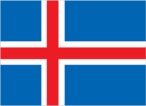
blue with a red cross outlined in white that extends to the edges of the flag; the vertical part of the cross is shifted to the hoist side in the style of the Dannebrog (Danish flag)
Head of Government
Prime Minister David ODDSSON (since 30 April 1991)
Independence
17 June 1944 (from Denmark)
Judicial branch
Supreme Court (Haestirettur)
Legal system
civil law system based on Danish law; does not accept compulsory ICJ jurisdiction
Legislative branch
unicameral Parliament (Althing)
Long-form name
Republic of Iceland
Member of
BIS, CCC, CE, CSCE, EBRD, ECE, EFTA, FAO, GATT, IAEA, IBRD, ICAO, ICC, ICFTU, IDA, IFC, ILO, IMF, IMO, INTELSAT, INTERPOL, IOC, ISO (correspondent), ITU, LORCS, NACC, NATO, NC, NEA, NIB, OECD, PCA, UN, UNCTAD, UNESCO, UPU, WHO, WIPO, WMO
National holiday
Anniversary of the Establishment of the Republic, 17 June (1944)
Political parties and leaders
Independence Party (conservative), David ODDSSON; Progressive Party, Steingrimur HERMANNSSON; Social Democratic Party, Jon Baldvin HANNIBALSSON; People's Alliance (left socialist), Olafur Ragnar GRIMSSON; Citizens Party (conservative nationalist), Julius SOLNES; Women's List
President
last held on 29 June 1980 (next scheduled for June 1992); results - there were no elections in 1984 and 1988 as President Vigdis FINNBOGADOTTIR was unopposed
Suffrage
universal at age 20
Type
republic
Economy
Agriculture
accounts for about 25% of GDP (including fishing); fishing is most important economic activity, contributing nearly 75% to export earnings; principal crops - potatoes and turnips; livestock - cattle, sheep; self-sufficient in crops; fish catch of about 1.4 million metric tons in 1989
Budget
revenues $1.7 billion; expenditures $1.9 billion, including capital expenditures of $NA million (1991 est.)
Currency
krona (plural - kronur); 1 Icelandic krona (IKr) = 100 aurar
Economic aid
US commitments, including Ex-Im (FY70-81), $19.1 million
Electricity
1,063,000 kW capacity; 5,165 million kWh produced, 20,780 kWh per capita (1991)
Exchange rates
Icelandic kronur (IKr) per US$1 - 57.277 (January 1992), 58.996 (1991), 58.284 (1990), 57.042 (1989), 43.014 (1988), 38.677 (1987)
Exports
$1.6 billion (f.o.b., 1991) commodities: fish and fish products, animal products, aluminum, diatomite partners: EC 67.7% (UK 25.3%, FRG 12.7%), US 9.9%, Japan 6% (1990)
External debt
$3 billion (1990)
Fiscal year
calendar year
GDP
purchasing power equivalent - $4.2 billion, per capita $16,200; real growth rate 0.3% (1991)
Imports
$1.7 billion (c.i.f., 1991) commodities: machinery and transportation equipment, petroleum, foodstuffs, textiles partners: EC 49.8% (FRG 12.4%, Denmark 8.6%, UK 8.1%), US 14.4%, Japan 5.6% (1990)
Industrial production
growth rate 1.75% (1991 est.)
Industries
fish processing, aluminum smelting, ferro-silicon production, hydropower
Inflation rate (consumer prices)
7.5% (1991)
Overview
Iceland's prosperous Scandinavian-type economy is basically capitalistic, but with extensive welfare measures, low unemployment, and comparatively even distribution of income. The economy is heavily dependent on the fishing industry, which provides nearly 75% of export earnings. In the absence of other natural resources, Iceland's economy is vulnerable to changing world fish prices. The economic improvements resulting from climbing fish prices in 1990 and a noninflationary labor agreement probably will be reversed by tighter fish quotas and a delay in the construction of an aluminum smelting plant. The conservative government's economic priorities include reducing the budget and current account deficits, containing inflation, revising agricultural and fishing policies, diversifying the economy, and tying the krona to the EC's European currency unit in 1993. The fishing industries - notably the shrimp industry - are experiencing a series of bankruptcies and mergers. Inflation has continued to drop sharply from 20% in 1989 to about 7.5% in 1991 and possibly 3% in 1992, while unemployment is expected to increase to 2.5%. GDP is expected to contract by nearly 4% in 1992.
Unemployment rate
1.8% (1991)
Communications
Airports
94 total, 89 usable; 4 with permanent-surface runways; none with runways over 3,659 m; 1 with runways 2,440-3,659 m; 12 with runways 1,220-2,439 m
Civil air
20 major transport aircraft
Highways
12,343 km total; 166 km bitumen and concrete; 1,284 km bituminous treated and gravel; 10,893 km earth
Merchant marine
12 ships (1,000 GRT or over) totaling 37,969 GRT/57,060 DWT; includes 5 cargo, 3 refrigerated cargo, 2 roll-on/roll-off cargo, 1 petroleum tanker, 1 chemical tanker
Ports
Reykjavik, Akureyri, Hafnarfjordhur, Keflavik, Seydhisfjordhur, Siglufjordhur, Vestmannaeyjar
Telecommunications
adequate domestic service; coaxial and fiber-optical cables and radio relay for trunk network; 135,000 telephones; broadcast stations - 19 AM, 30 (43 repeaters) FM, 13 (132 repeaters) TV; 2 submarine cables; 1 Atlantic Ocean INTELSAT earth station carries majority of international traffic
Military and Security
Branches
no armed forces; Police, Coast Guard; Iceland's defense is provided by the US-manned Icelandic Defense Force (IDF) headquartered at Keflavik
Defense expenditures
none
Manpower availability
males 15-49, 69,072; 61,556 fit for military service; no conscription or compulsory military service