2007 Edition
CIA World Factbook 2007 (Project Gutenberg)
Introduction
Administrative divisions
- 19 counties (megyek, singular - megye), 22 urban counties (singular - megyei varos), and 1 capital city (fovaros)
- capital city
- Budapest
- counties
- Bacs-Kiskun, Baranya, Bekes, Borsod-Abauj-Zemplen, Csongrad, Fejer, Gyor-Moson-Sopron, Hajdu-Bihar, Heves, Jasz-Nagykun-Szolnok, Komarom-Esztergom, Nograd, Pest, Somogy, Szabolcs-Szatmar-Bereg, Tolna, Vas, Veszprem, Zala
- urban counties
- Bekescsaba, Debrecen, Dunaujvaros, Eger, Gyor, Hodmezovasarhely, Kaposvar, Kecskemet, Miskolc, Nagykanizsa, Nyiregyhaza, Pecs, Salgotarjan, Sopron, Szeged, Szekesfehervar, Szekszard, Szolnok, Szombathely, Tatabanya, Veszprem, Zalaegerszeg
Age structure
0-14 years: 15.6% (male 799,163/female 755,389) 15-64 years: 69.2% (male 3,403,375/female 3,505,640) 65 years and over: 15.2% (male 550,297/female 967,470) (2006 est.)
Agriculture - products
wheat, corn, sunflower seed, potatoes, sugar beets; pigs, cattle, poultry, dairy products
Airports
46 (2006)
Airports - with paved runways
- over 3,047 m
- 2 2,438 to 3,047 m: 8 1,524 to 2,437 m: 4 914 to 1,523 m: 4
- total
- 20
- under 914 m
- 2 (2006)
Airports - with unpaved runways
- total
- 26 2,438 to 3,047 m: 2 1,524 to 2,437 m: 3 914 to 1,523 m: 11
- under 914 m
- 10 (2006)
Area
- land
- 92,340 sq km
- total
- 93,030 sq km
- water
- 690 sq km
Area - comparative
slightly smaller than Indiana
Background
Hungary was part of the polyglot Austro-Hungarian Empire, which collapsed during World War I. The country fell under Communist rule following World War II. In 1956, a revolt and announced withdrawal from the Warsaw Pact were met with a massive military intervention by Moscow. Under the leadership of Janos KADAR in 1968, Hungary began liberalizing its economy, introducing so-called "Goulash Communism." Hungary held its first multiparty elections in 1990 and initiated a free market economy. It joined NATO in 1999 and the EU in 2004. Geography Hungary
Birth rate
9.72 births/1,000 population (2006 est.)
Budget
- expenditures
- $59.62 billion; including capital expenditures of $NA (2006 est.)
- revenues
- $48.73 billion
Capital
- daylight saving time
- +1hr, begins last Sunday in March; ends last Sunday in October
- geographic coordinates
- 47 30 N, 19 05 E
- name
- Budapest
- time difference
- UTC+1 (6 hours ahead of Washington, DC during Standard Time)
Climate
temperate; cold, cloudy, humid winters; warm summers
Coastline
0 km (landlocked)
Constitution
18 August 1949, effective 20 August 1949; revised 19 April 1972; 18 October 1989 revision ensured legal rights for individuals and constitutional checks on the authority of the prime minister and also established the principle of parliamentary oversight; 1997 amendment streamlined the judicial system
Country name
- conventional long form
- Republic of Hungary
- conventional short form
- Hungary
- local long form
- Magyar Koztarsasag
- local short form
- Magyarorszag
Currency (code)
forint (HUF)
Currency code
HUF
Current account balance
$-8.392 billion (2006 est.)
Death rate
13.11 deaths/1,000 population (2006 est.)
Debt - external
$107.3 billion (30 June 2006 est.)
Diplomatic representation from the US
- chief of mission
- Ambassador April H. FOLEY
- embassy
- Szabadsag ter 12, H-1054 Budapest
- mailing address
- pouch: American Embassy Budapest, 5270 Budapest Place, US Department of State, Washington, DC 20521-5270
- telephone
- [36] (1) 475-4400
Diplomatic representation in the US
- chancery
- 3910 Shoemaker Street NW, Washington, DC 20008
- chief of mission
- Ambassador Andras SIMONYI
- telephone
- [1] (202) 362-6730
Disputes - international
in 2004, Hungary amended the status law extending special social and cultural benefits - and voted down a referendum to extend dual citizenship - to ethnic Hungarians living in neighboring states, which have objected to such measures; consultations continue between Slovakia and Hungary over Hungary's completion of its portion the Gabcikovo-Nagymaros hydroelectric dam project along the Danube; as a member state that forms part of the EU's external border, Hungary must implement the strict Schengen border rules
Distribution of family income - Gini index
26.9 (2002)
Economic aid - recipient
$3.4 billion in available EU structural adjustment and cohesion funds (2004-06)
Economy - overview
Hungary has made the transition from a centrally planned to a market economy, with a per capita income nearly two-thirds that of the EU-25 average. Hungary continues to demonstrate strong economic growth and acceded to the EU in May 2004. The private sector accounts for over 80% of GDP. Foreign ownership of and investment in Hungarian firms are widespread, with cumulative foreign direct investment totaling more than $60 billion since 1989. Hungarian sovereign debt was upgraded in 2000 - together with the Czech Republic, Hungary holds the highest rating among the Central European transition economies. Rating agencies, however, have expressed concerns over Hungary's fiscal and current account deficits. Inflation has declined from 14% in 1998 to 3.7% in 2006. Unemployment has persisted above 6%. Hungary's labor force participation rate of 57% is one of the lowest in the Organization for Economic Cooperation and Development (OECD). Germany is by far Hungary's largest economic partner. Policy challenges include cutting the public sector deficit to 3% of GDP by 2008, from about 6.5% in 2006, and orchestrating an orderly interest rate reduction without sparking capital outflows.
Electricity - consumption
37.1 billion kWh (2004)
Electricity - exports
6.3 billion kWh (2004)
Electricity - imports
13.8 billion kWh (2004)
Electricity - production
31.83 billion kWh (2004)
Electricity - production by source
- fossil fuel
- 60.1%
- hydro
- 0.5%
- nuclear
- 39%
- other
- 0.3% (2001)
Elevation extremes
- highest point
- Kekes 1,014 m
- lowest point
- Tisza River 78 m
Environment - current issues
the upgrading of Hungary's standards in waste management, energy efficiency, and air, soil, and water pollution to meet EU requirements will require large investments
Environment - international agreements
- party to
- Air Pollution, Air Pollution-Nitrogen Oxides, Air Pollution-Persistent Organic Pollutants, Air Pollution-Sulfur 85, Air Pollution-Volatile Organic Compounds, Antarctic Treaty, Biodiversity, Climate Change, Climate Change-Kyoto Protocol, Desertification, Endangered Species, Environmental Modification, Hazardous Wastes, Law of the Sea, Marine Dumping, Ozone Layer Protection, Ship Pollution, Wetlands, Whaling
- signed, but not ratified
- Air Pollution-Sulfur 94
Ethnic groups
Hungarian 92.3%, Roma 1.9%, other or unknown 5.8% (2001 census)
Exchange rates
forints per US dollar - 215.105 (2006), 199.58 (2005), 202.75 (2004), 224.31 (2003), 257.89 (2002)
Executive branch
- cabinet
- Council of Ministers elected by the National Assembly on the recommendation of the president
- chief of state
- Laszlo SOLYOM (since 5 August 2005)
- election results
- Laszlo SOLYOM elected president by a simple majority in the third round of voting, 185 to 182; Ferenc GYURCSANY elected prime minister; result of legislative vote - 197 to 12
- elections
- president elected by the National Assembly for a five-year term (eligible for a second term); election last held 6-7 June 2005 (next to be held by June 2010); prime minister elected by the National Assembly on the recommendation of the president; election last held 29 September 2004
- head of government
- Prime Minister Ferenc GYURCSANY (since 29 September 2004)
- note
- to be elected, the president must win two-thirds of legislative vote in the first two rounds or a simple majority in the third round
Exports
$67.99 billion f.o.b. (2006 est.)
Exports - commodities
machinery and equipment 61.1%, other manufactures 28.7%, food products 6.5%, raw materials 2%, fuels and electricity 1.6% (2003)
Exports - partners
Germany 30.2%, Italy 5.7%, Austria 5.6%, France 5.3%, UK 5.1% (2005)
FAX
- [1] (202) 966-8135
- [36] (1) 475-4764
- consulate(s) general
- Los Angeles, New York
Fiscal year
calendar year Communications Hungary
Flag description
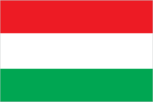
three equal horizontal bands of red (top), white, and green Economy Hungary
GDP - composition by sector
- agriculture
- 3.1%
- industry
- 32.1%
- services
- 64.8% (2006 est.)
GDP - per capita (PPP)
$17,300 (2006 est.)
GDP - real growth rate
3.8% (2006 est.)
GDP (official exchange rate)
$113.1 billion (2006 est.)
GDP (purchasing power parity)
$172.7 billion (2006 est.)
Geographic coordinates
47 00 N, 20 00 E
Geography - note
landlocked; strategic location astride main land routes between Western Europe and Balkan Peninsula as well as between Ukraine and Mediterranean basin; the north-south flowing Duna (Danube) and Tisza Rivers divide the country into three large regions People Hungary
Government type
parliamentary democracy
Heliports
5 (2006)
HIV/AIDS - adult prevalence rate
0.1% (2001 est.)
HIV/AIDS - deaths
less than 100 (2001 est.)
HIV/AIDS - people living with HIV/AIDS
2,800 (2001 est.)
Household income or consumption by percentage share
- highest 10%
- 22.2% (2002)
- lowest 10%
- 4.1%
Illicit drugs
transshipment point for Southwest Asian heroin and cannabis and for South American cocaine destined for Western Europe; limited producer of precursor chemicals, particularly for amphetamine and methamphetamine; improving, but remains vulnerable to money laundering related to organized crime and drug trafficking This page was last updated on 8 February, 2007
Imports
$69.75 billion f.o.b. (2006 est.)
Imports - commodities
machinery and equipment 51.6%, other manufactures 35.7%, fuels and electricity 7.7%, food products 3.1%, raw materials 2.0% (2003)
Imports - partners
Germany 27.5%, Russia 7.4%, China 7.1%, Austria 6.6%, France 4.9%, Italy 4.9%, Netherlands 4.3% (2005)
Independence
1001 (unification by King Stephen I)
Industrial production growth rate
9.5% (2006 est.)
Industries
mining, metallurgy, construction materials, processed foods, textiles, chemicals (especially pharmaceuticals), motor vehicles
Infant mortality rate
- female
- 7.64 deaths/1,000 live births (2006 est.)
- male
- 9.09 deaths/1,000 live births
- total
- 8.39 deaths/1,000 live births
Inflation rate (consumer prices)
3.7% (2006 est.)
International organization participation
ACCT (observer), Australia Group, BIS, CE, CEI, CERN, EAPC, EBRD, EIB, ESA (cooperating state), EU, FAO, G- 9, IAEA, IBRD, ICAO, ICC, ICCt, ICRM, IDA, IEA, IFC, IFRCS, ILO, IMF, IMO, Interpol, IOC, IOM, IPU, ISO, ITU, ITUC, MIGA, MINURSO, NAM (guest), NATO, NEA, NSG, OAS (observer), OECD, OIF (observer), OPCW, OSCE, PCA, SECI, UN, UNCTAD, UNESCO, UNFICYP, UNHCR, UNIDO, UNOMIG, UNWTO, UPU, WCL, WCO, WEU (associate), WFTU, WHO, WIPO, WMO, WTO, ZC
Internet country code
.hu
Internet hosts
608,085 (2006)
Internet Service Providers (ISPs)
16 (2000)
Internet users
3.05 million (2005) Transportation Hungary
Investment (gross fixed)
23.4% of GDP (2006 est.)
Irrigated land
2,300 sq km (2003)
Judicial branch
Constitutional Court (judges are elected by the National Assembly for nine-year terms)
Labor force
4.2 million (2006 est.)
Labor force - by occupation
- agriculture
- 5.5%
- industry
- 33.3%
- services
- 61.2% (2003)
Land boundaries
- border countries
- Austria 366 km, Croatia 329 km, Romania 443 km, Serbia 151 km, Slovakia 677 km, Slovenia 102 km, Ukraine 103 km
- total
- 2,171 km
Land use
- arable land
- 49.58%
- other
- 48.36% (2005)
- permanent crops
- 2.06%
Languages
Hungarian 93.6%, other or unspecified 6.4% (2001 census)
Legal system
rule of law based on Western model; accepts compulsory ICJ jurisdiction, with reservations
Legislative branch
- unicameral National Assembly or Orszaggyules (386 seats; members are elected by popular vote under a system of proportional and direct representation to serve four-year terms)
- election results
- percent of vote by party (5% or more of the vote required for parliamentary representation in the first round) - MSzP 43.2%, Fidesz-KDNP 42%, SzDSz 6.5%, MDF 5%, other 3.3%; seats by party - MSzP 190, Fidesz 141, KDNP 23, SzDSz 20, MDF 11, independent 1
- elections
- last held 9 and 23 April 2006 (next to be held April 2010)
Life expectancy at birth
- female
- 77.14 years (2006 est.)
- male
- 68.45 years
- total population
- 72.66 years
Literacy
- definition
- age 15 and over can read and write
- female
- 99.3% (2003 est.) Government Hungary
- male
- 99.5%
- total population
- 99.4%
Location
Central Europe, northwest of Romania
Manpower available for military service
- females age 18-49
- 2,265,463 (2005 est.)
- males age 18-49
- 2,303,116
Manpower fit for military service
- females age 18-49
- 1,864,580 (2005 est.)
- males age 18-49
- 1,780,513
Manpower reaching military service age annually
- females age 18-49
- 61,037 (2005 est.)
- males age 18-49
- 63,847
Map references
Europe
Maritime claims
none (landlocked)
Median age
- female
- 41.4 years (2006 est.)
- male
- 36.3 years
- total
- 38.7 years
Military branches
Ground Forces, Hungarian Air Force (Magyar Legiero, ML) (2006)
Military expenditures - dollar figure
$1.08 billion (2002 est.)
Military expenditures - percent of GDP
1.75% (2002 est.) Transnational Issues Hungary
Military service age and obligation
18 years of age for voluntary military service; conscription abolished in June 2004 (2004)
National holiday
Saint Stephen's Day, 20 August
Nationality
- adjective
- Hungarian
- noun
- Hungarian(s)
Natural gas - consumption
14.46 billion cu m (2004 est.)
Natural gas - exports
0 cu m (2004 est.)
Natural gas - imports
11.42 billion cu m (2004 est.)
Natural gas - production
2.963 billion cu m (2004 est.)
Natural gas - proved reserves
34.26 billion cu m (1 January 2005 est.)
Natural resources
bauxite, coal, natural gas, fertile soils, arable land
Net migration rate
0.86 migrant(s)/1,000 population (2006 est.)
Oil - consumption
132,000 bbl/day (2004 est.)
Oil - exports
47,180 bbl/day (2001)
Oil - imports
94,000 bbl/day (2004)
Oil - production
47,530 bbl/day (2004 est.)
Oil - proved reserves
110.7 million bbl (1 January 2002)
Pipelines
gas 4,397 km; oil 990 km; refined products 335 km (2006)
Political parties and leaders
Alliance of Free Democrats or SzDSz [Gabor KUNCZE]; Christian Democratic People's Party or KDNP [Zsolt SEMJEN]; Hungarian Civic Alliance or Fidesz [Viktor ORBAN, chairman]; Hungarian Democratic Forum or MDF [Ibolya DAVID]; Hungarian Socialist Party or MSzP [Istvan HILLER, chairman]
Political pressure groups and leaders
NA
Population
9,981,334 (July 2006 est.)
Population below poverty line
8.6%
Population growth rate
-0.25% (2006 est.)
Ports and terminals
Budapest, Dunaujvaros, Gyor-Gonyu, Csepel, Baja, Mohacs (2003) Military Hungary
Public debt
68.6% of GDP (2006 est.)
Radio broadcast stations
AM 17, FM 57, shortwave 3 (1998)
Radios
7.01 million (1997)
Railways
- broad gauge
- 36 km 1.524-m gauge
- narrow gauge
- 219 km 0.760-m gauge (2005)
- standard gauge
- 7,682 km 1.435-m gauge (2,628 km electrified)
- total
- 7,937 km
Religions
Roman Catholic 51.9%, Calvinist 15.9%, Lutheran 3%, Greek Catholic 2.6%, other Christian 1%, other or unspecified 11.1%, unaffiliated 14.5% (2001 census)
Reserves of foreign exchange and gold
$21.05 billion (2006 est.)
Roadways
- paved
- 70,050 km (30,874 km of interurban roads including 626 km of expressways)
- total
- 159,568 km
- unpaved
- 89,518 km (2005)
Sex ratio
- at birth
- 1.06 male(s)/female
- total population
- 0.91 male(s)/female (2006 est.)
- under 15 years
- 1.06 male(s)/female 15-64 years: 0.97 male(s)/female 65 years and over: 0.57 male(s)/female
Suffrage
18 years of age; universal
Telephone system
- domestic
- the system is digitalized and highly automated; trunk services are carried by fiber-optic cable and digital microwave radio relay; a program for fiber-optic subscriber connections was initiated in 1996; heavy use is made of mobile cellular telephones
- general assessment
- the telephone system has been modernized and is capable of satisfying all requests for telecommunication service
- international
- country code - 36; Hungary has fiber-optic cable connections with all neighboring countries; the international switch is in Budapest; satellite earth stations - 2 Intelsat (Atlantic Ocean and Indian Ocean regions), 1 Inmarsat, 1 very small aperture terminal (VSAT) system of ground terminals
Telephones - main lines in use
3.356 million (2005)
Telephones - mobile cellular
9.32 million (2005)
Television broadcast stations
35 (plus 161 low-power repeaters) (1995)
Televisions
4.42 million (1997)
Terrain
mostly flat to rolling plains; hills and low mountains on the Slovakian border
Total fertility rate
1.32 children born/woman (2006 est.)
Unemployment rate
7.4% (2006 est.)
Waterways
1,622 km (most on Danube River) (2006)