1994 Edition
CIA World Factbook 1994 (Project Gutenberg)
Introduction
Administrative divisions
38 counties (megyek, singular - megye) and 1 capital city* (fovaros); Bacs-Kiskun, Baranya, Bekes, Bekescsaba, Borsod-Abauj-Zemplen, Budapest*, Csongrad, Debrecen, Dunaujvaros, Eger, Fejer, Gyor, Gyor-Moson-Sopron, Hajdu-Bihar, Heves, Hodmezovasarhely, Jasz-Nagykun-Szolnok, Kaposvar, Kecskemet, Komarom-Esztergom, Miskolc, Nagykanizsa, Nograd, Nyiregyhaza, Pecs, Pest, Somogy, Sopron, Szabolcs-Szatmar-Bereg, Szeged, Szekesfehervar, Szolnok, Szombathely, Tatabanya, Tolna, Vas, Veszprem, Zala, Zalaegerszeg
Agriculture
including forestry, accounts for 15% of GDP and 16% of employment; highly diversified crop and livestock farming; principal crops - wheat, corn, sunflowers, potatoes, sugar beets; livestock - hogs, cattle, poultry, dairy products; self-sufficient in food output
Airports
total: 126 usable: 65 with permanent-surface runways: 12 with runways over 3,659 m: 1 with runways 2,440-3,659 m: 18 with runways 1,060-2,439 m: 31 note: a C-130 can land on a 1,060-m airstrip
Area
total area: 93,030 sq km land area: 92,340 sq km comparative area: slightly smaller than Indiana
Birth rate
12.46 births/1,000 population (1994 est.)
Branches
Ground Forces, Air and Air Defense Forces, Border Guard, Territorial Defense
Budget
revenues: $10.2 billion expenditures: $12.5 billion, including capital expenditures of $NA (1993 est.)
Capital
Budapest
Climate
temperate; cold, cloudy, humid winters; warm summers
Coastline
0 km (landlocked)
Constitution
18 August 1949, effective 20 August 1949, revised 19 April 1972; 18 October 1989 revision ensured legal rights for individuals and constitutional checks on the authority of the prime minister and also established the principle of parliamentary oversight
Currency
1 forint (Ft) = 100 filler
Death rate
12.72 deaths/1,000 population (1994 est.)
Defense expenditures
66.5 billion forints, NA% of GNP (1993 est.); note - conversion of defense expenditures into US dollars using the current exchange rate could produce misleading results
Digraph
HU
Diplomatic representation in US
chief of mission: Ambassador Pal TAR chancery: 3910 Shoemaker Street NW, Washington, DC 20008 telephone: (202) 362-6730
Economic aid
recipient: assistance pledged by OECD countries since 1989 about $9 billion
Electricity
capacity: 7,200,000 kW production: 30 billion kWh consumption per capita: 3,000 kWh (1992)
Environment
current issues: air pollution; industrial and municipal pollution of Lake Balaton natural hazards: levees are common along many streams, but flooding occurs almost every year international agreements: party to - Air Pollution, Air Pollution-Nitrogen Oxides, Air Pollution-Sulphur, Antarctic Treaty, Biodiversity, Climate Change, Endangered Species, Environmental Modification, Hazardous Wastes, Marine Dumping, Nuclear Test Ban, Ozone Layer Protection, Ship Pollution, Wetlands; signed, but not ratified - Air Pollution-Volatile Organic Compounds, Antarctic-Environmental Protocol, Law of the Sea
Ethnic divisions
Hungarian 89.9%, Gypsy 4%, German 2.6%, Serb 2%, Slovak 0.8%, Romanian 0.7%
Exchange rates
forints per US$1 - 93.46 (September 1993), 92.5 (1993), 78.99 (1992), 74.74 (1991), 63.21 (1990), 59.07 (1989)
Executive branch
chief of state: President Arpad GONCZ (since 3 August 1990; previously interim president from 2 May 1990); election last held 3 August 1990 (next to be held NA 1995); results - President GONCZ elected by parliamentary vote; note - President GONCZ was elected by the National Assembly with a total of 295 votes out of 304 as interim President from 2 May 1990 until elected President head of government: Prime Minister Peter BOROSS (since 12 December 1993 on the death of Jozsef ANTALL); new prime minister will probably be Gyula HORN cabinet: Council of Ministers; elected by the National Assembly on recommendation of the president
Exports
$8.9 billion (f.o.b., 1993 est.) commodities: raw materials, semi-finished goods, chemicals 39.6%, machinery 14.5%, consumer goods 22.3%, food and agriculture 20.0%, fuels and energy 3.6% (January-June 1993) partners: EC 49.8% (Germany 27.8%, Italy 9.5%), Austria 10.7%, the FSU 13.1%, Eastern Europe 9.8% (1992)
External debt
$24.7 billion (November 1993)
FAX
- (202) 966-8135 consulate(s) general: Los Angeles and New York
- [36] (1) 132-8934
Fiscal year
calendar year
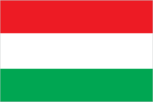
Flag
three equal horizontal bands of red (top), white, and green
Highways
total: 130,224 km paved: 61,948 km unpaved: 68,276 km (1988)
Illicit drugs
transshipment point for Southeast Asia heroin transiting the Balkan route
Imports
$12.5 billion (f.o.b., 1993 est.) commodities: fuels and energy 13.9%, raw materials, semi-finished goods, chemicals 35.9%, machinery 22.4%, consumer goods 21.8%, food and agriculture 6.0% (January-June 1993) partners: EC 42.8% (Germany 23.6%, Italy 6.3%), Austria 14.4%, the FSU 16.8%, Eastern Europe 9.2%
Independence
1001 (unification by King Stephen I)
Industrial production
growth rate 4% (1993 est.)
Industries
mining, metallurgy, construction materials, processed foods, textiles, chemicals (especially pharmaceuticals), buses, automobiles
Infant mortality rate
12.5 deaths/1,000 live births (1994 est.)
Inflation rate (consumer prices)
23% (1993 est.)
Inland waterways
1,622 km (1988)
International disputes
Gabcikovo Dam dispute with Slovakia
Irrigated land
1,750 sq km (1989)
Judicial branch
Constitutional Court
Labor force
5.4 million by occupation: services, trade, government, and other 44.8%, industry 29.7%, agriculture 16.1%, construction 7.0% (1991)
Land boundaries
total 1,989 km, Austria 366 km, Croatia 329 km, Romania 443 km, Serbia and Montenegro 151 km (all with Serbia), Slovakia 515 km, Slovenia 82 km, Ukraine 103 km
Land use
arable land: 50.7% permanent crops: 6.1% meadows and pastures: 12.6% forest and woodland: 18.3% other: 12.3%
Languages
Hungarian 98.2%, other 1.8%
Legal system
in process of revision, moving toward rule of law based on Western model
Legislative branch
unicameral
Life expectancy at birth
total population: 71.37 years male: 67.37 years female: 75.58 years (1994 est.)
Literacy
age 15 and over can read and write (1980) total population: 99% male: 99% female: 98%
Location
Central Europe, between Slovakia and Romania
Manpower availability
males age 15-49 2,636,888; fit for military service 2,105,628; reach military age (18) annually 90,134 (1994 est.)
Map references
Ethnic Groups in Eastern Europe, Europe
Maritime claims
none; landlocked
Member of
Australian Group, BIS, CCC, CE, CEI, CERN, COCOM (cooperating), CSCE, EBRD, ECE, FAO, G-9, GATT, IAEA, IBRD, ICAO, IDA, IFC, ILO, IMF, IMO, INTELSAT, INTERPOL, IOC, IOM, ISO, ITU, LORCS, MTCR, NACC, NAM (guest), NSG, OAS (observer), PCA, UN, UNAVEM II, UNCTAD, UNESCO, UNHCR, UNIDO, UNIKOM, UNOMOZ, UNOMUR, UNOSOM, UNTAC, UPU, WFTU, WHO, WIPO, WMO, WTO, ZC
Merchant marine
10 cargo ships (1,000 GRT or over) and 1 bulk totaling 46,121 GRT/61,613 DWT
Names
conventional long form: Republic of Hungary conventional short form: Hungary local long form: Magyar Koztarsasag local short form: Magyarorszag
National Assembly (Orszaggyules)
elections last held on 8 and 29 May 1994 (next to be held spring 1998); results - percent of vote by party NA; seats - (386 total) Hungarian Socialist Party 209, Alliance of Free Democrats 70, Hungarian Democratic Forum 37, Independent Smallholders 26, Christian Democratic People's Party 22, Federation of Young Democrats 20, other 2
National holiday
St. Stephen's Day (National Day), 20 August (commemorates the founding of Hungarian state circa 1000 A.D.)
National product
GDP - purchasing power equivalent - $57 billion (1993 est.)
National product per capita
$5,500 (1993 est.)
National product real growth rate
-1% (1993 est.)
Nationality
noun: Hungarian(s) adjective: Hungarian
Natural resources
bauxite, coal, natural gas, fertile soils
Net migration rate
0 migrant(s)/1,000 population (1994 est.)
Note
landlocked; strategic location astride main land routes between Western Europe and Balkan Peninsula as well as between Ukraine and Mediterranean basin
Overview
Hungary is still in the midst of a difficult transition from a command to a market economy. Its economic reforms during the Communist era gave it a head start on this process, particularly in terms of attracting foreign investors - Hungary has accounted for about half of all foreign direct investment in Eastern Europe since 1989. Nonetheless, the economy continued to contract in 1993, with real GDP falling perhaps 1%. Although the privatization process has lagged, in December 1993 Hungary carried out the largest privatization yet in Eastern Europe, selling a controlling interest in the Matav telecommunications firm to private investors - including a 30% share to a US-German consortium for $875 million. Overall, about half of GDP now originates in the private sector. Unemployment rose to about 13% in 1993 while inflation remained above 20%, and falling exports pushed the trade deficit to about $3 billion. The government hopes that economic recovery in Western Europe in 1994 will boost exports, lower the trade deficit, and help jump-start the economy. The budget, however, is likely to remain a serious concern; depressed tax revenue pushed up the budget deficit in 1993.
Pipelines
crude oil 1,204 km; natural gas 4,387 km (1991)
Political parties and leaders
Democratic Forum, Sandor LESZAK, chairman; Independent Smallholders (FKGP), Jozsef TORGYAN, president; Hungarian Socialist Party (MSZP), Gyula HORN, president; Christian Democratic People's Party (KDNP), Dr. Lazlo SURJAN, president; Federation of Young Democrats (FIDESZ), Viktor ORBAN, chairman; Alliance of Free Democrats (SZDSZ), Ivan PETO, chairman note: the Hungarian Socialist (Communist) Workers' Party (MSZMP) renounced Communism and became the Hungarian Socialist Party (MSZP) in October 1989; there is still a small MSZMP
Population
10,319,113 (July 1994 est.)
Population growth rate
-0.03% (1994 est.)
Ports
Budapest and Dunaujvaros are river ports on the Danube; coastal outlets are Rostock (Germany), Gdansk (Poland), Gdynia (Poland), Szczecin (Poland), Galati (Romania), and Braila (Romania)
Railroads
7,765 km total; 7,508 km 1.435-meter standard gauge, 222 km narrow gauge (mostly 0.760-meter), 35 km 1.520-meter broad gauge; 1,236 km double track, 2,249 km electrified; all government owned (1990)
Religions
Roman Catholic 67.5%, Calvinist 20%, Lutheran 5%, atheist and other 7.5%
Suffrage
18 years of age; universal
Telecommunications
automatic telephone network based on microwave radio relay system; 1,128,800 phones (1991); telephone density is at 19.4 per 100 inhabitants; 49% of all phones are in Budapest; 608,000 telephones on order (1991); 12-15 year wait for a phone; 14,213 telex lines (1991); broadcast stations - 32 AM, 15 FM, 41 TV (8 Soviet TV repeaters); 4.2 million TVs (1990); 1 satellite ground station using INTELSAT and Intersputnik
Terrain
mostly flat to rolling plains
Total fertility rate
1.83 children born/woman (1994 est.)
Type
republic
Unemployment rate
13% (1993)
US diplomatic representation
chief of mission: Ambassador Donald BLINKEN embassy: V. Szabadsag Ter 12, Budapest mailing address: Am Embassy, Unit 1320, Budapest; APO AE 09213 telephone: [36] (1) 112-6450