2015 Edition
CIA World Factbook 2015 Archive (Wayback Machine ZIP)
Introduction
Background
Once part of Spain's vast empire in the New World, Honduras became an independent nation in 1821. After two and a half decades of mostly military rule, a freely elected civilian government came to power in 1982. During the 1980s, Honduras proved a haven for anti-Sandinista contras fighting the Marxist Nicaraguan Government and an ally to Salvadoran Government forces fighting leftist guerrillas. The country was devastated by Hurricane Mitch in 1998, which killed about 5,600 people and caused approximately $2 billion in damage. Since then, the economy has slowly rebounded.
Geography
Area
- land
- 111,890 sq km
- total
- 112,090 sq km
- water
- 200 sq km
Area - comparative
slightly larger than Tennessee
Climate
subtropical in lowlands, temperate in mountains
Coastline
Caribbean Sea 669 km; Gulf of Fonseca 163 km
Elevation extremes
- highest point
- Cerro Las Minas 2,870 m
- lowest point
- Caribbean Sea 0 m
Environment - current issues
urban population expanding; deforestation results from logging and the clearing of land for agricultural purposes; further land degradation and soil erosion hastened by uncontrolled development and improper land use practices such as farming of marginal lands; mining activities polluting Lago de Yojoa (the country's largest source of fresh water), as well as several rivers and streams, with heavy metals
Environment - international agreements
- party to
- Biodiversity, Climate Change, Climate Change-Kyoto Protocol, Desertification, Endangered Species, Hazardous Wastes, Law of the Sea, Marine Dumping, Ozone Layer Protection, Ship Pollution, Tropical Timber 83, Tropical Timber 94, Wetlands
- signed, but not ratified
- none of the selected agreements
Freshwater withdrawal (domestic/industrial/agricultural)
- per capita
- 295.6 cu m/yr (2006)
- total
- 2.12 cu km/yr (16%/23%/61%)
Geographic coordinates
15 00 N, 86 30 W
Geography - note
has only a short Pacific coast but a long Caribbean shoreline, including the virtually uninhabited eastern Mosquito Coast
Irrigated land
878.5 sq km (2007)
Land boundaries
- border countries (3)
- Guatemala 244 km, El Salvador 391 km, Nicaragua 940 km
- total
- 1,575 km
Land use
- arable land 9.1%; permanent crops 4%; permanent pasture 15.7%
- agricultural land
- 28.8%
- forest
- 45.3%
- other
- 25.9% (2011 est.)
Location
Central America, bordering the Caribbean Sea, between Guatemala and Nicaragua and bordering the Gulf of Fonseca (North Pacific Ocean), between El Salvador and Nicaragua
Map references
Central America and the Caribbean
Maritime claims
- contiguous zone
- 24 nm
- continental shelf
- natural extension of territory or to 200 nm
- exclusive economic zone
- 200 nm
- territorial sea
- 12 nm
Natural hazards
frequent, but generally mild, earthquakes; extremely susceptible to damaging hurricanes and floods along the Caribbean coast
Natural resources
timber, gold, silver, copper, lead, zinc, iron ore, antimony, coal, fish, hydropower
Terrain
mostly mountains in interior, narrow coastal plains
Total renewable water resources
95.93 cu km (2011)
People and Society
Age structure
- 0-14 years
- 34.18% (male 1,527,234/female 1,462,763)
- 15-24 years
- 21.14% (male 943,039/female 906,273)
- 25-54 years
- 35.73% (male 1,578,654/female 1,546,902)
- 55-64 years
- 4.85% (male 197,602/female 226,294)
- 65 years and over
- 4.09% (male 156,023/female 201,889) (2015 est.)
Birth rate
23.14 births/1,000 population (2015 est.)
Child labor - children ages 5-14
- percentage
- 16% (2002 est.)
- total number
- 280,809
Children under the age of 5 years underweight
7.1% (2012)
Contraceptive prevalence rate
73.2% (2011/12)
Death rate
5.17 deaths/1,000 population (2015 est.)
Demographic profile
- Honduras is one of the poorest countries in Latin America and has the world's highest murder rate. More than half of the population lives in poverty and per capita income is one of the lowest in the region. Poverty rates are higher among rural and indigenous people and in the south, west, and along the eastern border than in the north and central areas where most of Honduras' industries and infrastructure are concentrated. The increased productivity needed to break Honduras' persistent high poverty rate depends, in part, on further improvements in educational attainment. Although primary-school enrollment is near 100%, educational quality is poor, the drop-out rate and grade repetition remain high, and teacher and school accountability is low.
- Honduras' population growth rate has slowed since the 1990s, but it remains high at nearly 2% annually because the birth rate averages approximately three children per woman and more among rural, indigenous, and poor women. Consequently, Honduras' young adult population - ages 15 to 29 - is projected to continue growing rapidly for the next three decades and then stabilize or slowly shrink. Population growth and limited job prospects outside of agriculture will continue to drive emigration. Remittances represent about a fifth of GDP.
Dependency ratios
- elderly dependency ratio
- 7.7%
- potential support ratio
- 13.1% (2015 est.)
- total dependency ratio
- 57.8%
- youth dependency ratio
- 50.1%
Drinking water source
- urban: 97.4% of population
- rural: 83.8% of population
- total: 91.2% of population
- urban: 2.6% of population
- rural: 16.2% of population
- total: 8.8% of population (2015 est.)
Education expenditures
NA
Ethnic groups
mestizo (mixed Amerindian and European) 90%, Amerindian 7%, black 2%, white 1%
Health expenditures
8.7% of GDP (2013)
HIV/AIDS - adult prevalence rate
0.42% (2014 est.)
HIV/AIDS - deaths
1,200 (2014 est.)
HIV/AIDS - people living with HIV/AIDS
23,000 (2014 est.)
Hospital bed density
0.7 beds/1,000 population (2012)
Infant mortality rate
- female
- 15.66 deaths/1,000 live births (2015 est.)
- male
- 20.59 deaths/1,000 live births
- total
- 18.18 deaths/1,000 live births
Languages
Spanish (official), Amerindian dialects
Life expectancy at birth
- female
- 72.74 years (2015 est.)
- male
- 69.34 years
- total population
- 71 years
Literacy
- definition
- age 15 and over can read and write
- female
- 88.6% (2015 est.)
- male
- 88.4%
- total population
- 88.5%
Major infectious diseases
- degree of risk
- high
- food or waterborne diseases
- bacterial diarrhea, hepatitis A, and typhoid fever
- vectorborne diseases
- dengue fever and malaria (2013)
Major urban areas - population
TEGUCIGALPA (capital) 1.123 million; San Pedro Sula 852,000 (2015)
Median age
- female
- 22.7 years (2015 est.)
- male
- 21.9 years
- total
- 22.3 years
Nationality
- adjective
- Honduran
- noun
- Honduran(s)
Net migration rate
-1.16 migrant(s)/1,000 population (2015 est.)
Obesity - adult prevalence rate
16.3% (2014)
Physicians density
0.37 physicians/1,000 population (2005)
Population
- 8,746,673
- note
- estimates for this country explicitly take into account the effects of excess mortality due to AIDS; this can result in lower life expectancy, higher infant mortality, higher death rates, lower population growth rates, and changes in the distribution of population by age and sex than would otherwise be expected (July 2015 est.)
Population growth rate
1.68% (2015 est.)
Religions
Roman Catholic 97%, Protestant 3%
Sanitation facility access
- urban: 86.7% of population
- rural: 77.7% of population
- total: 82.6% of population
- urban: 13.3% of population
- rural: 22.3% of population
- total: 17.4% of population (2015 est.)
School life expectancy (primary to tertiary education)
- female
- 12 years (2013)
- male
- 11 years
- total
- 11 years
Sex ratio
- 0-14 years
- 1.04 male(s)/female
- 15-24 years
- 1.04 male(s)/female
- 25-54 years
- 1.02 male(s)/female
- 55-64 years
- 0.87 male(s)/female
- 65 years and over
- 0.77 male(s)/female
- at birth
- 1.05 male(s)/female
- total population
- 1.01 male(s)/female (2015 est.)
Total fertility rate
2.78 children born/woman (2015 est.)
Unemployment, youth ages 15-24
- female
- 13.8% (2011 est.)
- male
- 5.5%
- total
- 8%
Urbanization
- rate of urbanization
- 3.14% annual rate of change (2010-15 est.)
- urban population
- 54.7% of total population (2015)
Government
Administrative divisions
18 departments (departamentos, singular - departamento); Atlantida, Choluteca, Colon, Comayagua, Copan, Cortes, El Paraiso, Francisco Morazan, Gracias a Dios, Intibuca, Islas de la Bahia, La Paz, Lempira, Ocotepeque, Olancho, Santa Barbara, Valle, Yoro
Capital
- daylight saving time
- none scheduled for 2013
- geographic coordinates
- 14 06 N, 87 13 W
- name
- Tegucigalpa
- time difference
- UTC-6 (1 hour behind Washington, DC during Standard Time)
Constitution
several previous; latest approved 11 January 1982, effective 20 January 1982; amended many times, last in 2012 (2013)
Country name
- conventional long form
- Republic of Honduras
- conventional short form
- Honduras
- local long form
- Republica de Honduras
- local short form
- Honduras
Diplomatic representation from the US
- chief of mission
- Ambassador James D. NEALON (since 21 August 2014)
- embassy
- Avenida La Paz, Apartado Postal No. 3453, Tegucigalpa
- FAX
- [504] 2236-9037
- mailing address
- American Embassy, APO AA 34022, Tegucigalpa
- telephone
- [504] 2236-9320, 2238-5114
Diplomatic representation in the US
- chancery
- Suite 4-M, 3007 Tilden Street NW, Washington, DC 20008
- chief of mission
- Ambassador Jorge Alberto MILLA Reyes (since 21 May 2014)
- consulate(s) general
- Atlanta, Chicago, Dallas, Houston, Los Angeles, McAllen (TX), Miami, New Orleans, New York, San Francisco
- FAX
- [1] (202) 966-9751
- telephone
- [1] (202) 966-2604
Executive branch
- cabinet
- Cabinet appointed by president
- chief of state
- President Juan Orlando HERNANDEZ Alvarado (since 27 January 2014); Vice Presidents Ricardo ALVAREZ, Rossana GUEVARA, and Lorena HERRERA (since 27 January 2014); note - the president is both chief of state and head of government
- election results
- Juan Orlando HERNANDEZ Alvarado elected president; percent of vote - Juan Orlando HERNANDEZ Alvarado (PNH) 36.9%, Xiomara CASTRO (LIBRE) 28.8%, Mauricio VILLEDA (PL) 20.3%, Salvador NASRALLA (PAC) 13.4%, other 0.6%
- elections/appointments
- president directly elected by simple majority popular vote for a single 4-year term; election last held on 24 November 2013 (next to be held in November 2017)
- head of government
- President Juan Orlando HERNANDEZ Alvarado (since 27 January 2014); Vice Presidents Ricardo ALVAREZ, Rossana GUEVARA, and Lorena HERRERA (since 27 January 2014)
Flag description
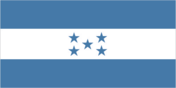
- three equal horizontal bands of blue (top), white, and blue, with five blue, five-pointed stars arranged in an X pattern centered in the white band; the stars represent the members of the former Federal Republic of Central America: Costa Rica, El Salvador, Guatemala, Honduras, and Nicaragua; the blue bands symbolize the Pacific Ocean and the Caribbean Sea; the white band represents the land between the two bodies of water and the peace and prosperity of its people
- note
- similar to the flag of El Salvador, which features a round emblem encircled by the words REPUBLICA DE EL SALVADOR EN LA AMERICA CENTRAL centered in the white band; also similar to the flag of Nicaragua, which features a triangle encircled by the words REPUBLICA DE NICARAGUA on top and AMERICA CENTRAL on the bottom, centered in the white band
Government type
democratic constitutional republic
Independence
15 September 1821 (from Spain)
International law organization participation
accepts compulsory ICJ jurisdiction with reservations; accepts ICCt jurisdiction
International organization participation
BCIE, CACM, CD, CELAC, EITI (candidate country), FAO, G-11, G-77, IADB, IAEA, IBRD, ICAO, ICCt, ICRM, IDA, IFAD, IFC, IFRCS, ILO, IMF, IMO, Interpol, IOC (suspended), IOM, IPU, ISO (subscriber), ITSO, ITU, ITUC (NGOs), LAES, LAIA (observer), MIGA, MINURSO, MINUSTAH, NAM, OAS, OPANAL, OPCW, Pacific Alliance (observer), PCA, Petrocaribe, SICA, UN, UNCTAD, UNESCO, UNIDO, Union Latina, UNWTO, UPU, WCO (suspended), WFTU (NGOs), WHO, WIPO, WMO, WTO
Judicial branch
- highest court(s)
- Supreme Court of Justice or Corte Suprema de Justicia (15 principal judges - including the court president - and 7 alternates; court organized into civil, criminal, and labor chambers); note - the court has both judicial and constitutional jurisdiction
- judge selection and term of office
- court president elected by his peers; judges elected by the National Congress from candidates proposed by the Nominating Board, a diverse 7-member group of judicial officials, other government and non-government officials selected by each of their organizations; judges elected by Congress for renewable, 7-year terms
- subordinate courts
- courts of appeal; courts of first instance; peace courts
Legal system
civil law system
Legislative branch
- description
- unicameral National Congress or Congreso Nacional (128 seats; members directly elected in multi-seat constituencies by proportional representation vote; members serve 4-year terms)
- election results
- percent of vote by party - NA; seats by party - PNH 48, LIBRE 37, PL 27, PAC 13, DC 1, UD 1, PINU 1
- elections
- last held on 24 November 2013 (next to be held in November 2017)
National anthem
- lyrics/music
- Augusto Constancio COELLO/Carlos HARTLING
- name
- "Himno Nacional de Honduras" (National Anthem of Honduras)
- note
- adopted 1915; the anthem's seven verses chronicle Honduran history; on official occasions, only the chorus and last verse are sung
National holiday
Independence Day, 15 September (1821)
National symbol(s)
scarlet macaw, white-tailed deer; national colors: blue, white
Political parties and leaders
- Anti-Corruption Party or PAC [Salvador NASRALLA]
- Christian Democratic Party or DC [Felicito AVILA Ordonez]
- Democratic Unification Party or UD [Cesar HAM]
- Freedom and Refounding Party or LIBRE [Jose Manuel ZELAYA Rosales]
- Liberal Party or PL [Mauricio VILLEDA Bermudez]
- National Party of Honduras or PNH [Gladys Aurora LOPEZ]
- Social Democratic Innovation and Unity Party or PINU [Jorge Rafael AGUILAR Paredes]
Political pressure groups and leaders
- Beverage and Related Industries Syndicate or STIBYS
- Committee for the Defense of Human Rights in Honduras or CODEH
- Commiittee of the Relatives of the Disappeared in Honduras or COFADEH
- Confederation of Honduran Workers or CTH
- Coordinating Committee of Popular Organizations or CCOP
- General Workers Confederation or CGT
- Honduran Council of Private Enterprise or COHEP
- National Association of Honduran Campesinos or ANACH
- National Union of Campesinos or UNC
- Popular Bloc or BP
- United Confederation of Honduran Workers or CUTH
- United Farm Workers' Movement of the Aguan OR MUCA
Suffrage
18 years of age; universal and compulsory
Economy
Agriculture - products
bananas, coffee, citrus, corn, African palm; beef; timber; shrimp, tilapia, lobster, sugar, oriental vegetables
Budget
- expenditures
- $4.335 billion (2014 est.)
- revenues
- $3.354 billion
Budget surplus (+) or deficit (-)
-5.1% of GDP (2014 est.)
Central bank discount rate
6.25% (31 December 2010)
Commercial bank prime lending rate
- 17.5% (31 December 2014 est.)
- 20.08% (31 December 2013 est.)
Current account balance
- -$1.444 billion (2014 est.)
- -$1.655 billion (2013 est.)
Debt - external
- $7.111 billion (31 December 2014 est.)
- $6.636 billion (31 December 2013 est.)
Distribution of family income - Gini index
- 57.7 (2007)
- 53.8 (2003)
Economy - overview
Honduras, the second poorest country in Central America, suffers from extraordinarily unequal distribution of income, as well as high underemployment. While historically dependent on the export of bananas and coffee, Honduras has diversified its export base to include apparel and automobile wire harnessing. Honduras’s economy depends heavily on US trade and remittances. The US-Central America-Dominican Republic Free Trade Agreement (CAFTA-DR) came into force in 2006 and has helped foster foreign direct investment, but physical and political insecurity, as well as crime and perceptions of corruption, may deter potential investors; about 15% of foreign direct investment is from US firms. The economy registered modest economic growth of 2.6%-4.0% from 2010 to 2014, insufficient to improve living standards for the nearly 65% of the population in poverty. Honduras signed a three-year IMF stand-by arrangement in December 2014 that will help ease its poor fiscal position. In November 2014 along with his counterparts from El Salvador and Guatemala, President HERNANDEZ announced the “Plan of the Alliance for Prosperity in the Northern Triangle.” This plan seeks to address the challenges facing the three Northern Triangle countries, including steps the governments will take to stimulate economic growth, increase transparency and fiscal responsibility, reduce violence, modernize the justice system, improve infrastructure, and promote educational opportunities over the next several years.
Exchange rates
- lempiras (HNL) per US dollar -
- 21.1 (2014 est.)
- 20.494 (2013 est.)
- 19.64 (2012 est.)
- 18.895 (2011 est.)
- 18.9 (2010 est.)
Exports
- $8.52 billion (2014 est.)
- $7.833 billion (2013 est.)
Exports - commodities
coffee, apparel, coffee, shrimp, automobile wire harnesses, cigars, bananas, gold, palm oil, fruit, lobster, lumber
Exports - partners
US 35.2%, Germany 8.4%, El Salvador 8%, Guatemala 6.3%, Nicaragua 5.9%, Mexico 4.4% (2014)
Fiscal year
calendar year
GDP - composition, by end use
- (2014 est.)
- exports of goods and services
- 48.2%
- government consumption
- 16.1%
- household consumption
- 80.8%
- imports of goods and services
- -71.1%
- investment in fixed capital
- 25.2%
- investment in inventories
- 0.7%
GDP - composition, by sector of origin
- agriculture
- 14%
- industry
- 27.4%
- services
- 58.7% (2014 est.)
GDP - per capita (PPP)
- $4,700 (2014 est.)
- $4,600 (2013 est.)
- $4,500 (2012 est.)
- note
- data are in 2014 US dollars
GDP - real growth rate
- 3.1% (2014 est.)
- 2.8% (2013 est.)
- 4.1% (2012 est.)
GDP (official exchange rate)
$19.51 billion (2014 est.)
GDP (purchasing power parity)
- $39.08 billion (2014 est.)
- $37.91 billion (2013 est.)
- $36.88 billion (2012 est.)
- note
- data are in 2014 US dollars
Gross national saving
- 14.4% of GDP (2014 est.)
- 10.4% of GDP (2013 est.)
- 16.2% of GDP (2012 est.)
Household income or consumption by percentage share
- highest 10%
- 42.4% (2009 est.)
- lowest 10%
- 0.4%
Imports
- $11.79 billion (2014 est.)
- $11.03 billion (2013 est.)
Imports - commodities
communications equipment, machinery and transport, industrial raw materials, chemical products, fuels, foodstuffs
Imports - partners
US 43.3%, Guatemala 9.4%, China 7.6%, Mexico 5.6%, El Salvador 5.1% (2014)
Industrial production growth rate
2.8% (2014 est.)
Industries
sugar, coffee, woven and knit apparel, wood products, cigars
Inflation rate (consumer prices)
- 6.1% (2014 est.)
- 5.2% (2013 est.)
Labor force
3.579 million (2014 est.)
Labor force - by occupation
- agriculture
- 39.2%
- industry
- 20.9%
- services
- 39.8% (2005 est.)
Market value of publicly traded shares
$NA
Population below poverty line
60% (2010 est.)
Public debt
- 44.3% of GDP (2014 est.)
- 43.6% of GDP (2013 est.)
Reserves of foreign exchange and gold
- $2.934 billion (31 December 2014 est.)
- $3.009 billion (31 December 2013 est.)
Stock of broad money
- $7.623 billion (31 December 2014 est.)
- $7.11 billion (31 December 2013 est.)
Stock of domestic credit
- $11.6 billion (31 December 2014 est.)
- $10.81 billion (31 December 2013 est.)
Stock of narrow money
- $2.006 billion (31 December 2014 est.)
- $1.934 billion (31 December 2013 est.)
Taxes and other revenues
17.3% of GDP (2014 est.)
Unemployment rate
- 4.5% (2014 est.)
- 4.5% (2013 est.)
- note
- about one-third of the people are underemployed
Energy
Carbon dioxide emissions from consumption of energy
10.33 million Mt (2012 est.)
Crude oil - exports
0 bbl/day (2010 est.)
Crude oil - imports
0 bbl/day (2010 est.)
Crude oil - production
20 bbl/day (2013 est.)
Crude oil - proved reserves
0 bbl (1 January 2014 est.)
Electricity - consumption
5.091 billion kWh (2011 est.)
Electricity - exports
237 million kWh (2011 est.)
Electricity - from fossil fuels
60% of total installed capacity (2011 est.)
Electricity - from hydroelectric plants
29.3% of total installed capacity (2011 est.)
Electricity - from nuclear fuels
0% of total installed capacity (2011 est.)
Electricity - from other renewable sources
10.7% of total installed capacity (2011 est.)
Electricity - imports
76 million kWh (2011 est.)
Electricity - installed generating capacity
1.815 million kW (2011 est.)
Electricity - production
6.713 billion kWh (2011 est.)
Natural gas - consumption
0 cu m (2012 est.)
Natural gas - exports
0 cu m (2012 est.)
Natural gas - imports
0 cu m (2012 est.)
Natural gas - production
0 cu m (2012 est.)
Natural gas - proved reserves
0 cu m (1 January 2014 est.)
Refined petroleum products - consumption
58,220 bbl/day (2013 est.)
Refined petroleum products - exports
0 bbl/day (2010 est.)
Refined petroleum products - imports
46,370 bbl/day (2010 est.)
Refined petroleum products - production
0 bbl/day (2010 est.)
Communications
Broadcast media
multiple privately owned terrestrial TV networks, supplemented by multiple cable TV networks; Radio Honduras is the lone government-owned radio network; roughly 300 privately owned radio stations (2007)
Internet country code
.hn
Internet users
- percent of population
- 19.4% (2014 est.)
- total
- 1.7 million
Radio broadcast stations
AM 241, FM 53, shortwave 12 (1998)
Telephone system
- domestic
- beginning in 2003, private sub-operators allowed to provide fixed lines in order to expand telephone coverage contributing to a small increase in fixed-line teledensity; mobile-cellular subscribership is roughly 100 per 100 persons
- general assessment
- fixed-line connections are increasing but still limited; competition among multiple providers of mobile-cellular services is contributing to a sharp increase in subscribership
- international
- country code - 504; landing point for both the Americas Region Caribbean Ring System (ARCOS-1) and the MAYA-1 fiber-optic submarine cable system that together provide connectivity to South and Central America, parts of the Caribbean, and the US; satellite earth stations - 2 Intelsat (Atlantic Ocean); connected to Central American Microwave System (2011)
Telephones - fixed lines
- subscriptions per 100 inhabitants
- 6 (2014 est.)
- total subscriptions
- 530,000
Telephones - mobile cellular
- subscriptions per 100 inhabitants
- 90 (2014 est.)
- total
- 7.7 million
Television broadcast stations
11 (plus 17 repeaters) (1997)
Transportation
Airports
103 (2013)
Airports - with paved runways
- 1,524 to 2,437 m
- 3
- 2,438 to 3,047 m
- 3
- 914 to 1,523 m
- 4
- total
- 13
- under 914 m
- 3 (2013)
Airports - with unpaved runways
- 73 (2013)
- 1,524 to 2,437 m
- 1
- 914 to 1,523 m
- 16
- total
- 90
Merchant marine
- by type
- bulk carrier 5, cargo 39, carrier 2, chemical tanker 5, container 1, passenger 4, passenger/cargo 1, petroleum tanker 21, refrigerated cargo 7, roll on/roll off 3
- foreign-owned
- 47 (Bahrain 5, Canada 1, Chile 1, China 2, Egypt 2, Greece 4, Israel 1, Japan 4, Lebanon 2, Montenegro 1, Panama 1, Singapore 11, South Korea 6, Taiwan 1, Thailand 2, UAE 1, UK 1, US 1) (2010)
- total
- 88
Ports and terminals
- major seaport(s)
- La Ceiba, Puerto Cortes, San Lorenzo, Tela
Railways
- narrow gauge
- 164 km 1.067-m gauge; 115 km 1.057-m gauge; 420 km 0.914-m gauge (2014)
- total
- 699 km
Roadways
- note
- an additional 8,951 km of non-official roads used by the coffee industry (2012)
- paved
- 3,367 km
- total
- 14,742 km
- unpaved
- 11,375 km (1,543 km summer only)
Waterways
465 km (most navigable only by small craft) (2012)
Military and Security
Manpower available for military service
- females age 16-49
- 1,991,418 (2010 est.)
- males age 16-49
- 2,045,914
Manpower fit for military service
- females age 16-49
- 1,539,688 (2010 est.)
- males age 16-49
- 1,525,578
Manpower reaching militarily significant age annually
- female
- 92,087 (2010 est.)
- male
- 95,895
Military branches
Honduran Armed Forces (Fuerzas Armadas de Honduras, FFAA): Army, Navy (includes Naval Infantry), Honduran Air Force (Fuerza Aerea Hondurena, FAH) (2012)
Military expenditures
- 1.05% of GDP (2012)
- 1.13% of GDP (2011)
- 1.05% of GDP (2010)
Military service age and obligation
18 years of age for voluntary 2- to 3-year military service; no conscription (2012)
Transnational Issues
Disputes - international
International Court of Justice (ICJ) ruled on the delimitation of "bolsones" (disputed areas) along the El Salvador-Honduras border in 1992 with final settlement by the parties in 2006 after an Organization of American States survey and a further ICJ ruling in 2003; the 1992 ICJ ruling advised a tripartite resolution to a maritime boundary in the Gulf of Fonseca with consideration of Honduran access to the Pacific; El Salvador continues to claim tiny Conejo Island, not mentioned in the ICJ ruling, off Honduras in the Gulf of Fonseca; Honduras claims the Belizean-administered Sapodilla Cays off the coast of Belize in its constitution, but agreed to a joint ecological park around the cays should Guatemala consent to a maritime corridor in the Caribbean under the OAS-sponsored 2002 Belize-Guatemala Differendum
Illicit drugs
transshipment point for drugs and narcotics; illicit producer of cannabis, cultivated on small plots and used principally for local consumption; corruption is a major problem; some money-laundering activity
Refugees and internally displaced persons
- IDPs
- at least 29,400 (violence, extortion, threats, forced recruitment by urban gangs) (2013)