2003 Edition
CIA World Factbook 2003 (Project Gutenberg)
Introduction
Administrative divisions
18 departments (departamentos, singular - departamento); Atlantida, Choluteca, Colon, Comayagua, Copan, Cortes, El Paraiso, Francisco Morazan, Gracias a Dios, Intibuca, Islas de la Bahia, La Paz, Lempira, Ocotepeque, Olancho, Santa Barbara, Valle, Yoro
Age structure
0-14 years: 41.6% (male 1,414,791; female 1,357,537) 15-64 years: 54.8% (male 1,811,757; female 1,843,456) 65 years and over: 3.6% (male 114,791; female 127,457) (2003 est.)
Agriculture - products
bananas, coffee, citrus; beef; timber; shrimp
Airports
115 (2002)
Airports - with paved runways
- total
- 12 2,438 to 3,047 m: 3 1,524 to 2,437 m: 2 914 to 1,523 m: 3
- under 914 m
- 4 (2002)
Airports - with unpaved runways
- total
- 103 1,524 to 2,437 m: 2 914 to 1,523 m: 18
- under 914 m
- 83 (2002) Military Honduras
Area
- land
- 111,890 sq km
- total
- 112,090 sq km
- water
- 200 sq km
Area - comparative
slightly larger than Tennessee
Background
Part of Spain's vast empire in the New World, Honduras became an independent nation in 1821. After two and one-half decades of mostly military rule, a freely elected civilian government came to power in 1982. During the 1980s, Honduras proved a haven for anti-Sandinista contras fighting the Marxist Nicaraguan Government and an ally to Salvadoran Government forces fighting against leftist guerrillas. The country was devastated by Hurricane Mitch in 1998, which killed about 5,600 people and caused almost $1 billion in damage. Geography Honduras
Birth rate
31.67 births/1,000 population (2003 est.)
Budget
- expenditures
- $411.9 million, including capital expenditures of $106 million (1999 est.)
- revenues
- $607 million
Capital
Tegucigalpa
Climate
subtropical in lowlands, temperate in mountains
Coastline
820 km
Constitution
11 January 1982, effective 20 January 1982; amended 1995
Country name
- conventional long form
- Republic of Honduras
- conventional short form
- Honduras
- local long form
- Republica de Honduras
- local short form
- Honduras
Currency
lempira (HNL)
Currency code
HNL
Death rate
6.44 deaths/1,000 population (2003 est.)
Debt - external
$5.4 billion (2002)
Diplomatic representation from the US
- chief of mission
- Ambassador Larry Leon PALMER
- embassy
- Avenida La Paz, Apartado Postal No. 3453, Tegucigalpa
- mailing address
- American Embassy, APO AA 34022, Tegucigalpa
- telephone
- [504] 238-5114, 236-9320
Diplomatic representation in the US
- chief of mission
- Ambassador Mario Miguel CANAHUATI
- consulate(s) general
- Chicago, Houston, Los Angeles, Miami, New Orleans, New York, Phoenix, San Francisco, San Juan (Puerto Rico), Tampa
- honorary consulate(s)
- Atlanta, Boston, Detroit, Jacksonville
Disputes - international
in 1992, ICJ ruled on the delimitation of "bolsones" (disputed areas) along the El Salvador-Honduras border, but they still remain largely undemarcated; in 2002, El Salvador filed an application to the ICJ to revise the decision on a section of bolsones; the ICJ also advised a tripartite resolution to a maritime boundary in the Golfo de Fonseca with consideration of Honduran access to the Pacific; El Salvador claims tiny Conejo Island, not mentioned by the ICJ, off Honduras in the Golfo de Fonseca; Honduras claims Sapodilla Cays off the coast of Belize but agreed to creation of a joint ecological park and Guatemalan corridor in the Caribbean in the 2002 Belize-Guatemala Differendum; Nicaragua filed a claim against Honduras in 1999 and against Colombia in 2001 at the ICJ over a complex maritime dispute in the Caribbean Sea
Distribution of family income - Gini index
56.3 (1998)
Economic aid - recipient
$557.8 million (1999)
Economy - overview
Honduras, one of the poorest countries in the Western Hemisphere with an extraordinarily unequal distribution of income, is banking on expanded trade privileges under the Enhanced Caribbean Basin Initiative and on debt relief under the Heavily Indebted Poor Countries (HIPC) initiative. While the country has met most of its macroeconomic targets, it failed to meet the IMF's goals to liberalize its energy and telecommunications sectors. Growth remains dependent on the status of the US economy, its major trading partner, on commodity prices, particularly coffee, and on reduction of the high crime rate.
Electricity - consumption
3.822 billion kWh (2001)
Electricity - exports
0 kWh (2001)
Electricity - imports
308 million kWh (2001)
Electricity - production
3.778 billion kWh (2001)
Electricity - production by source
- fossil fuel
- 50.2%
- hydro
- 49.8%
- nuclear
- 0%
- other
- 0% (2001)
Elevation extremes
- highest point
- Cerro Las Minas 2,870 m
- lowest point
- Caribbean Sea 0 m
Environment - current issues
urban population expanding; deforestation results from logging and the clearing of land for agricultural purposes; further land degradation and soil erosion hastened by uncontrolled development and improper land use practices such as farming of marginal lands; mining activities polluting Lago de Yojoa (the country's largest source of fresh water), as well as several rivers and streams, with heavy metals
Environment - international agreements
- party to
- Biodiversity, Climate Change, Climate Change-Kyoto Protocol, Desertification, Endangered Species, Hazardous Wastes, Law of the Sea, Marine Dumping, Nuclear Test Ban, Ozone Layer Protection, Ship Pollution, Tropical Timber 83, Tropical Timber 94, Wetlands
- signed, but not ratified
- none of the selected agreements
Ethnic groups
mestizo (mixed Amerindian and European) 90%, Amerindian 7%, black 2%, white 1%
Exchange rates
lempiras per US dollar - 16.43 (2002), 15.47 (2001), 14.84 (2000), 14.21 (1999), 13.39 (1998)
Executive branch
- cabinet
- Cabinet appointed by president
- chief of state
- President Ricardo (Joest) MADURO (since 27 January 2002); First Vice President Vicente WILLIAMS Agasse (since 27 January 2002); Second Vice President Armida Villela Maria DE LOPEZ Contreras (since 27 January 2002); Third Vice President Alberto DIAZ Lobo (since 27 January 2002); note - the president is both the chief of state and head of government
- election results
- Ricardo (Joest) MADURO (PN) elected president - 52.2%, Raphael PINEDA Ponce (PL) 44.3%, others 3.5%
- elections
- president elected by popular vote for a four-year term; election last held 25 November 2001 (next to be held NA November 2005)
- head of government
- President Ricardo (Joest) MADURO (since 27 January 2002); First Vice President Vicente WILLIAMS Agasse (since 27 January 2002); Second Vice President Armida Villela Maria DE LOPEZ Contreras (since 27 January 2002); Third Vice President Alberto DIAZ Lobo (since 27 January 2002); note - the president is both the chief of state and head of government
Exports
$1.3 billion f.o.b. (2002 est.)
Exports - commodities
coffee, bananas, shrimp, lobster, meat; zinc, lumber (2000)
Exports - partners
US 69.5%, El Salvador 3%, Guatemala 2% (2002)
FAX
- [1] (202) 966-9751
- [504] 236-9037
- chancery
- Suite 4-M, 3007 Tilden Street NW, Washington, DC 20008
- telephone
- [1] (202) 966-2604
Fiscal year
calendar year Communications Honduras
Flag description
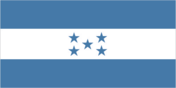
three equal horizontal bands of blue (top), white, and blue with five blue, five-pointed stars arranged in an X pattern centered in the white band; the stars represent the members of the former Federal Republic of Central America - Costa Rica, El Salvador, Guatemala, Honduras, and Nicaragua; similar to the flag of El Salvador, which features a round emblem encircled by the words REPUBLICA DE EL SALVADOR EN LA AMERICA CENTRAL centered in the white band; also similar to the flag of Nicaragua, which features a triangle encircled by the word REPUBLICA DE NICARAGUA on top and AMERICA CENTRAL on the bottom, centered in the white band Economy Honduras
GDP
purchasing power parity - $16.29 billion (2002 est.)
GDP - composition by sector
- agriculture
- 14%
- industry
- 32%
- services
- 54% (2002 est.)
GDP - per capita
purchasing power parity - $2,500 (2002 est.)
GDP - real growth rate
2.5% (2002 est.)
Geographic coordinates
15 00 N, 86 30 W
Geography - note
has only a short Pacific coast but a long Caribbean shoreline, including the virtually uninhabited eastern Mosquito Coast People Honduras
Government type
democratic constitutional republic
Highways
- paved
- 2,775 km
- total
- 13,603 km
- unpaved
- 10,828 km (1999 est.)
HIV/AIDS - adult prevalence rate
1.6% (2001 est.)
HIV/AIDS - deaths
3,300 (2001 est.)
HIV/AIDS - people living with HIV/AIDS
57,000 (2001 est.)
Household income or consumption by percentage share
- highest 10%
- 42.7% (1998)
- lowest 10%
- 0.6%
Illicit drugs
transshipment point for drugs and narcotics; illicit producer of cannabis, cultivated on small plots and used principally for local consumption; corruption is a major problem; some money-laundering activity This page was last updated on 18 December, 2003
Imports
$2.7 billion f.o.b. (2002 est.)
Imports - commodities
machinery and transport equipment, industrial raw materials, chemical products, fuels, foodstuffs (2000)
Imports - partners
US 55.3%, El Salvador 4.3%, Mexico 4.2% (2002)
Independence
15 September 1821 (from Spain)
Industrial production growth rate
4% (1999 est.)
Industries
sugar, coffee, textiles, clothing, wood products
Infant mortality rate
- female
- 26.14 deaths/1,000 live births (2003 est.)
- male
- 33.6 deaths/1,000 live births
- total
- 29.96 deaths/1,000 live births
Inflation rate (consumer prices)
7.7% (2002 est.)
International organization participation
BCIE, CACM, ECLAC, FAO, G-77, IADB, IAEA, IBRD, ICAO, ICCt, ICFTU, ICRM, IDA, IFAD, IFC, IFRCS, ILO, IMF, IMO, Interpol, IOC, IOM, ISO (subscriber), ITU, LAES, LAIA (observer), MINURSO, NAM, OAS, OPANAL, OPCW (signatory), PCA, RG, UN, UNCTAD, UNESCO, UNIDO, UPU, WCL, WFTU, WHO, WIPO, WMO, WToO, WTrO
Internet country code
.hn
Internet Service Providers (ISPs)
8 (2000)
Internet users
40,000 (2000) Transportation Honduras
Irrigated land
760 sq km (1998 est.)
Judicial branch
Supreme Court of Justice or Corte Suprema de Justicia (judges are elected for seven-year terms by the National Congress)
Labor force
2.3 million (1997 est.)
Labor force - by occupation
agriculture 34%, industry 21%, services 45% (2001 est.)
Land boundaries
- border countries
- Guatemala 256 km, El Salvador 342 km, Nicaragua 922 km
- total
- 1,520 km
Land use
- arable land
- 15.15%
- other
- 81.72% (1998 est.)
- permanent crops
- 3.13%
Languages
Spanish, Amerindian dialects
Legal system
rooted in Roman and Spanish civil law with increasing influence of English common law; recent judicial reforms include abandoning Napoleonic legal codes in favor of the oral adversarial system; accepts ICJ jurisdiction, with reservations
Legislative branch
- unicameral National Congress or Congreso Nacional (128 seats; members are elected proportionally to the number of votes their party's presidential candidate receives to serve four-year terms)
- election results
- percent of vote by party - NA; seats by party - PN 61, PL 55, PUD 5, PDC 4, PINU-SD 3
- elections
- last held 25 November 2001 (next to be held NA November 2005)
Life expectancy at birth
- female
- 68.06 years (2003 est.)
- male
- 65.31 years
- total population
- 66.65 years
Literacy
- definition
- age 15 and over can read and write
- female
- 76.3% (2003 est.) Government Honduras
- male
- 76.1%
- total population
- 76.2%
Location
Middle America, bordering the Caribbean Sea, between Guatemala and Nicaragua and bordering the Gulf of Fonseca (North Pacific Ocean), between El Salvador and Nicaragua
Map references
Central America and the Caribbean
Maritime claims
- contiguous zone
- 24 NM
- continental shelf
- natural extension of territory or to 200 NM
- exclusive economic zone
- 200 NM
- territorial sea
- 12 NM
Median age
- female
- 19.2 years (2002)
- male
- 18.4 years
- total
- 18.8 years
Merchant marine
- convenience
- Argentina 1, Bahrain 1, Belize 1, British Virgin Islands 1, Bulgaria 1, China 8, Costa Rica 1, Cyprus 1, Egypt 6, El Salvador 1, Germany 1, Greece 18, Hong Kong 3, Indonesia 2, Italy 1, Japan 7, Lebanon 4, Liberia 4, Maldives 2, Marshall Islands 1, Mexico 1, Nigeria 1, Norway 1, Panama 14, Philippines 1, Romania 2, Russia 1, Saint Kitts and Nevis 3, Saint Vincent and the Grenadines 1, Singapore 24, South Korea 12, Spain 1, Syria 1, Taiwan 4, Tanzania 1, Trinidad and Tobago 1, Turkey 2, Turks and Caicos Islands 1, United Arab Emirates 6, UK 1, US 5, Vanuatu 1, Vietnam 1, Virgin Islands (UK) 1 (2002 est.)
- note
- includes some foreign-owned ships registered here as a flag of
- ships by type
- bulk 18, cargo 140, chemical tanker 4, container 7, livestock carrier 2, passenger 2, passenger/cargo 3, petroleum tanker 55, refrigerated cargo 10, roll on/roll off 4, short-sea passenger 4, specialized tanker 1
- total
- 250 ships (1,000 GRT or over) 680,784 GRT/765,815 DWT
Military branches
Army, Navy (including marines), Air Force
Military expenditures - dollar figure
$35 million (FY99)
Military expenditures - percent of GDP
0.6% (FY99) Transnational Issues Honduras
Military manpower - availability
- males age 15-49
- 1,594,266 (2003 est.)
Military manpower - fit for military service
- males age 15-49
- 948,957 (2003 est.)
Military manpower - military age
18 years of age (2003 est.)
Military manpower - reaching military age annually
- males
- 74,895 (2003 est.)
National holiday
Independence Day, 15 September (1821)
Nationality
- adjective
- Honduran
- noun
- Honduran(s)
Natural hazards
frequent, but generally mild, earthquakes; extremely susceptible to damaging hurricanes and floods along the Caribbean coast
Natural resources
timber, gold, silver, copper, lead, zinc, iron ore, antimony, coal, fish, hydropower
Net migration rate
-2.04 migrant(s)/1,000 population (2003 est.)
Oil - consumption
29,000 bbl/day (2001 est.)
Oil - exports
NA (2001)
Oil - imports
NA (2001)
Oil - production
0 bbl/day (2001 est.)
Political parties and leaders
Christian Democratic Party or PDC [Dr. Hernan CORRALES Padilla]; Democratic Unification Party or PUD [leader NA]; Liberal Party or PL [Roberto MICHELETTI Bain]; National Innovation and Unity Party-Social Democratic Party or PINU-SD [Olban F. VALLADARES]; National Party of Honduras or PN [Raphael CALLEJAS]
Political pressure groups and leaders
Committee for the Defense of Human Rights in Honduras or CODEH; Confederation of Honduran Workers or CTH; Coordinating Committee of Popular Organizations or CCOP; General Workers Confederation or CGT; Honduran Council of Private Enterprise or COHEP; National Association of Honduran Campesinos or ANACH; National Union of Campesinos or UNC; Popular Bloc or BP; United Federation of Honduran Workers or FUTH
Population
- 6,669,789
- note
- estimates for this country explicitly take into account the effects of excess mortality due to AIDS; this can result in lower life expectancy, higher infant mortality and death rates, lower population and growth rates, and changes in the distribution of population by age and sex than would otherwise be expected (July 2003 est.)
Population below poverty line
53% (1993 est.)
Population growth rate
2.32% (2003 est.)
Ports and harbors
La Ceiba, Puerto Castilla, Puerto Cortes, San Lorenzo, Tela, Puerto Lempira
Radio broadcast stations
AM 241, FM 53, shortwave 12 (1998)
Radios
2.45 million (1997)
Railways
- narrow gauge
- 279 km 1.067-m gauge; 420 km 0.914-m gauge (2002)
- total
- 699 km
Religions
Roman Catholic 97%, Protestant minority
Sex ratio
- at birth
- 1.05 male(s)/female
- total population
- 1 male(s)/female (2003 est.)
- under 15 years
- 1.04 male(s)/female 15-64 years: 0.98 male(s)/female 65 years and over: 0.9 male(s)/female
Suffrage
18 years of age; universal and compulsory
Telephone system
- domestic
- NA
- general assessment
- inadequate system
- international
- satellite earth stations - 2 Intelsat (Atlantic Ocean); connected to Central American Microwave System
Telephones - main lines in use
234,000 (1997)
Telephones - mobile cellular
14,427 (1997)
Television broadcast stations
11 (plus 17 repeaters) (1997)
Televisions
570,000 (1997)
Terrain
mostly mountains in interior, narrow coastal plains
Total fertility rate
4.07 children born/woman (2003 est.)
Unemployment rate
28% (2002 est.)
Waterways
465 km (navigable by small craft)