1995 Edition
CIA World Factbook 1995 (Project Gutenberg)
Geography
Area
total area: 112,090 sq km land area: 111,890 sq km comparative area: slightly larger than Tennessee
Climate
subtropical in lowlands, temperate in mountains
Coastline
820 km
Environment
current issues: urban population expanding; deforestation results from logging and the clearing of land for agricultural purposes; further land degradation and soil erosion hastened by uncontrolled development and improper land use practices such as farming of marginal lands; mining activities polluting Lago de Yojoa (the country's largest source of freshwater) with heavy metals as well as several rivers and streams natural hazards: frequent, but generally mild, earthquakes; damaging hurricanes and floods along Caribbean coast international agreements: party to - Endangered Species, Law of the Sea, Marine Dumping, Nuclear Test Ban, Ozone Layer Protection, Tropical Timber 83, Wetlands; signed, but not ratified - Biodiversity, Climate Change
International disputes
land boundary dispute with El Salvador mostly resolved by 11 September 1992 International Court of Justice (ICJ) decision; with respect to the maritime boundary in the Golfo de Fonseca, ICJ referred to an earlier agreement in this century and advised that some tripartite resolution among El Salvador, Honduras and Nicaragua likely would be required
Irrigated land
900 sq km (1989 est.)
Land boundaries
total 1,520 km, Guatemala 256 km, El Salvador 342 km, Nicaragua 922 km
Land use
arable land: 14% permanent crops: 2% meadows and pastures: 30% forest and woodland: 34% other: 20%
Location
Middle America, bordering the Caribbean Sea, between Guatemala and Nicaragua and bordering the North Pacific Ocean, between El Salvador and Nicaragua
Map references
Central America and the Caribbean
Maritime claims
contiguous zone: 24 nm continental shelf: natural extension of territory or to 200 nm exclusive economic zone: 200 nm territorial sea: 12 nm
Natural resources
timber, gold, silver, copper, lead, zinc, iron ore, antimony, coal, fish
Terrain
mostly mountains in interior, narrow coastal plains
People and Society
Age structure
0-14 years: 43% (female 1,159,846; male 1,201,927) 15-64 years: 53% (female 1,468,950; male 1,444,959) 65 years and over: 4% (female 95,361; male 88,700) (July 1995 est.)
Birth rate
34.12 births/1,000 population (1995 est.)
Death rate
6 deaths/1,000 population (1995 est.)
Ethnic divisions
mestizo (mixed Indian and European) 90%, Indian 7%, black 2%, white 1%
Infant mortality rate
43.4 deaths/1,000 live births (1995 est.)
Labor force
1.3 million by occupation: agriculture 62%, services 20%, manufacturing 9%, construction 3%, other 6% (1985)
Languages
Spanish, Indian dialects
Life expectancy at birth
total population: 68.04 years male: 65.64 years female: 70.55 years (1995 est.)
Literacy
age 15 and over can read and write (1990 est.) total population: 73% male: 76% female: 71%
Nationality
noun: Honduran(s) adjective: Honduran
Net migration rate
-1.56 migrant(s)/1,000 population (1995 est.)
Population
5,459,743 (July 1995 est.)
Population growth rate
2.66% (1995 est.)
Religions
Roman Catholic 97%, Protestant minority
Total fertility rate
4.55 children born/woman (1995 est.)
Government
Administrative divisions
18 departments (departamentos, singular - departamento); Atlantida, Choluteca, Colon, Comayagua, Copan, Cortes, El Paraiso, Francisco Morazan, Gracias a Dios, Intibuca, Islas de la Bahia, La Paz, Lempira, Ocotepeque, Olancho, Santa Barbara, Valle, Yoro
Capital
Tegucigalpa
Constitution
11 January 1982, effective 20 January 1982
Digraph
HO
Diplomatic representation in US
chief of mission: Ambassador Roberto FLORES Bermudez chancery: 3007 Tilden Street NW, Washington, DC 20008 telephone: [1] (202) 966-7702, 2604, 5008, 4596
Executive branch
chief of state and head of government: President Carlos Roberto REINA Idiaquez (since 27 January 1994); election last held 28 November 1993 (next to be held November 1997); results - Carlos Roberto REINA Idiaquez (PLH) 53%, Oswaldo RAMOS Soto (PNH) 41%, other 6% cabinet: Cabinet
FAX
- [1] (202) 966-9751 consulate(s) general: Chicago, Houston, Los Angeles, Miami, New Orleans, New York, San Francisco, and San Juan (Puerto Rico) consulate(s): Boston, Detroit, and Jacksonville
- [504] 36-9037
Flag
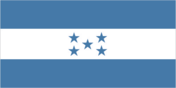
three equal horizontal bands of blue (top), white, and blue with five blue five-pointed stars arranged in an X pattern centered in the white band; the stars represent the members of the former Federal Republic of Central America - Costa Rica, El Salvador, Guatemala, Honduras, and Nicaragua; similar to the flag of El Salvador, which features a round emblem encircled by the words REPUBLICA DE EL SALVADOR EN LA AMERICA CENTRAL centered in the white band; also similar to the flag of Nicaragua, which features a triangle encircled by the word REPUBLICA DE NICARAGUA on top and AMERICA CENTRAL on the bottom, centered in the white band
Independence
15 September 1821 (from Spain)
Judicial branch
Supreme Court of Justice (Corte Suprema de Justica)
Legal system
rooted in Roman and Spanish civil law; some influence of English common law; accepts ICJ jurisdiction, with reservations
Legislative branch
unicameral
Member of
BCIE, CACM, ECLAC, FAO, G-77, GATT, IADB, IBRD, ICAO, ICFTU, ICRM, IDA, IFAD, IFC, IFRCS, ILO, IMF, IMO, INTELSAT, INTERPOL, IOC, IOM, ITU, LAES, LAIA (observer), MINURSO, NAM, OAS, OPANAL, PCA, UN, UNCTAD, UNESCO, UNIDO, UPU, WCL, WFTU, WHO, WIPO, WMO
Names
conventional long form: Republic of Honduras conventional short form: Honduras local long form: Republica de Honduras local short form: Honduras
National Congress (Congreso Nacional)
elections last held on 27 November 1993 (next to be held November 1997); results - PNH 53%, PLH 41%, PDCH 1.0%, PINU-SD 2.5%, other 2.5%; seats - (134 total) PNH 55, PLH 77, PINU-SD 2
National holiday
Independence Day, 15 September (1821)
Other political or pressure groups
National Association of Honduran Campesinos (ANACH); Honduran Council of Private Enterprise (COHEP); Confederation of Honduran Workers (CTH); National Union of Campesinos (UNC); General Workers Confederation (CGT); United Federation of Honduran Workers (FUTH); Committee for the Defense of Human Rights in Honduras (CODEH); Coordinating Committee of Popular Organizations (CCOP)
Political parties and leaders
Liberal Party (PLH), Rafael PINEDA Ponce, president; National Party of Honduras (PNH), Oswaldo RAMOS Soto, president; National Innovation and Unity Party (PINU), Olban VALLADARES, president; Christian Democratic Party (PDCH), Efrain DIAZ Arrivillaga, president
Suffrage
18 years of age; universal and compulsory
Type
republic
US diplomatic representation
chief of mission: Ambassador William T. PRYCE embassy: Avenida La Paz, Apartado Postal No 3453, Tegucigalpa mailing address: American Embassy, APO AA 34022, Tegucigalpa telephone: [504] 36-9320, 38-5114
Economy
Agriculture
most important sector, accounting for 28% of GDP, more than 60% of the labor force, and two-thirds of exports; principal products include bananas, coffee, timber, beef, citrus fruit, shrimp; importer of wheat
Budget
revenues: $527 million expenditures: $668 million, including capital expenditures of $166 million (1993 est.)
Currency
1 lempira (L) = 100 centavos
Economic aid
recipient: US commitments, including Ex-Im (FY70-89), $1.4 billion; Western (non-US) countries, ODA and OOF bilateral commitments (1970-89), $1.1 billion
Electricity
capacity: 290,000 kW production: 2.3 billion kWh consumption per capita: 445 kWh (1993)
Exchange rates
lempiras (L) per US$1 - 9.1283 (October 1994), 7.2600 (1993), 5.8300 (1992), 5.4000 (1991); 2.0000 (fixed rate until 1991) 5.70 parallel black-market rate (November 1990); the lempira was allowed to float in 1992
Exports
$850 million (f.o.b., 1993 est) commodities: bananas, coffee, shrimp, lobster, minerals, meat, lumber partners: US 53%, Germany 11%, Belgium 8%, UK 5%
External debt
$4 billion (1994 est.)
Fiscal year
calendar year
Illicit drugs
transshipment point for narcotics; illicit producer of cannabis, cultivated on small plots and used principally for local consumption
Imports
$990 million (c.i.f. 1994 est) commodities: machinery and transport equipment, chemical products, manufactured goods, fuel and oil, foodstuffs partners: US 50%, Mexico 8%, Guatemala 6%
Industrial production
growth rate 10% (1992 est.); accounts for 22% of GDP
Industries
agricultural processing (sugar and coffee), textiles, clothing, wood products
Inflation rate (consumer prices)
30% (1994 est.)
National product
GDP - purchasing power parity - $9.7 billion (1994 est.)
National product per capita
$1,820 (1994 est.)
National product real growth rate
-1.9% (1994 est.)
Overview
Honduras is one of the poorest countries in the Western Hemisphere. Agriculture, the most important sector of the economy, accounts for 28% of GDP, employs 62% of the labor force, and produces two-thirds of exports. Productivity remains low. Manufacturing, still in its early stages, employs 9% of the labor force, accounts for 15% of GDP, and generates 20% of exports. The service sectors, including public administration, account for 50% of GDP and employ 20% of the labor force. Many basic problems face the economy, including rapid population growth, high unemployment, inflation, a lack of basic services, a large and inefficient public sector, and the dependence of the export sector mostly on coffee and bananas, which are subject to sharp price fluctuations. A far-reaching reform program, initiated by former President CALLEJAS in 1990 and scaled back by President REINA, is beginning to take hold.
Unemployment rate
10%; underemployed 30%-40% (1992)
Communications
Radio
broadcast stations: AM 176, FM 0, shortwave 7 radios: NA
Telephone system
NA telephones; 7 telephones/1,000 persons; inadequate system local: NA intercity: NA international: 2 INTELSAT (Atlantic Ocean) earth stations and the Central American microwave radio relay system
Television
broadcast stations: 28 televisions: NA
Transportation
Airports
total: 159 with paved runways 2,438 to 3,047 m: 3 with paved runways 1,524 to 2,437 m: 2 with paved runways 914 to 1,523 m: 4 with paved runways under 914 m: 118 with unpaved runways 2,438 to 3,047 m: 1 with unpaved runways 1,524 to 2,438 m: 4 with unpaved runways 914 to 1,523 m: 27
Highways
total: 8,950 km paved: 1,700 km unpaved: otherwise improved 5,000 km; unimproved earth 2,250 km
Inland waterways
465 km navigable by small craft
Merchant marine
total: 271 ships (1,000 GRT or over) totaling 802,990 GRT/1,210,553 DWT ships by type: bulk 31, cargo 171, chemical tanker 1, combination bulk 1, container 6, liquefied gas tanker 2, livestock carrier 3, oil tanker 21, passenger 2, passenger-cargo 3, refrigerated cargo 19, roll-on/roll-off cargo 7, short-sea passenger 2, specialized tanker 1, vehicle carrier 1 note: a flag of convenience registry; Russia owns 14 ships, Vietnam 7, North Korea 4, US 3, Hong Kong 2, South Korea 2, Greece 1
Ports
La Ceiba, Puerto Castilla, Puerto Cortes, San Lorenzo, Tela, Puerto Lempira
Railroads
total: 785 km narrow gauge: 508 km 1.067-m gauge; 277 km 0.914-m gauge
Military and Security
Branches
Army, Navy (includes Marines), Air Force, Public Security Forces (FUSEP)
Defense expenditures
exchange rate conversion - $41 million, about 0.4% of GDP (1994) ________________________________________________________________________ HONG KONG (dependent territory of the UK)
Manpower availability
males age 15-49 1,275,670; males fit for military service 760,113; males reach military age (18) annually 62,405 (1995 est.)