1989 Edition
CIA World Factbook 1989 (Internet Archive)
Countries
182
Data Records
15,825
Categories
5
Source
CIA World Factbook 1989 (Internet Archive)
Geography
Climate
- subtropical in lowlands, temperate in mountains
- tropical monsoon; cool and humid in winter, hot and rainy from spring through summer, warm and sunny in fall
- equatorial; scant rainfall, constant wind, burning sun
Coastline
- 820 km
- 733 km
- 6.4 km
Comparative area
- slightly larger than Tennessee
- slightly less than six times the size of Washington, DC
- about 2.7 times the size of The Mall in Washington, DC
Contiguous zone
- 24 nm
- 1 2 nm
Continental shelf
- 200 meters or to depth of exploitation
- 200 meters or to depth of exploitation
- 200 m
Disputes
- several sections of the boundary with El Salvador are in dispute
- scheduled to become a Special Administrative Region of China in 1997
Environment
- subject to frequent, but generally mild, earthquakes; damaging hurricanes along Caribbean coast; deforestation; soil erosion
- more than 200 islands; occasional typhoons
- almost totally covered with grasses, prostrate vines, and low-growing shrubs; small area of trees in the center; lacks fresh water; primarily a nesting, roosting, and foraging habitat for seabirds, shorebirds, and marine wildlife; feral cats
Exclusive fishing zone
3 nm
Extended economic zone
- 200 nm
- 200 nm
Land boundaries
- 1,520 km total; Guatemala 256 km, El Salvador 342 km, Nicaragua 922 km
- none
Land boundary
30 km with China
Land use
- 14% arable land; 2% permanent crops; 30% meadows and pastures; 34% forest and woodland; 20% other; includes 1% irrigated
- 7% arable land; 1% permanent crops; 1% meadows and pastures; 12% forest and woodland; 79% other; includes 3% irrigated
- 0% arable land; 0% permanent crops; 0% meadows and pastures; 5% forest and woodland; 95% other
Natural resources
- timber, gold, silver, copper, lead, zinc, iron ore, antimony, coal, fish
- outstanding deepwater harbor, feldspar
- guano (deposits worked until late 1800s)
Note
remote location 2,575 km southwest of Honolulu in the North Pacific Ocean, just north of the Equator, about halfway between Hawaii and Australia
Terrain
- mostly mountains in interior, narrow coastal plains
- hilly to mountainous with steep slopes; lowlands in north
- low-lying, nearly level, sandy, coral island surrounded by a narrow fringing reef; depressed central area
Territorial sea
- 1 2 nm
- 3 nm
- 1 2 nm
Total area
- 112,090 km2; land area: 111,890km2
- 1,040 km2; land area: 990 km2
- 1.6 km2; land area: 1.6 km2
People and Society
Birth rate
- 37 births/ 1 ,000 population (1990)
- 1 3 births/ 1 ,000 population (1990)
Death rate
- 7 deaths/ 1 ,000 population (1990)
- 5 deaths/ 1,000 population (1990)
Ethnic divisions
- 90% mestizo (mixed Indian and European), 7% Indian, 2% black, 1% white
- 98% Chinese, 2% other
Infant mortality rate
- 62 deaths/ 1,000 live births (1990)
- 6 deaths/ 1,000 live births (1990)
Labor force
- 1,300,000; 62% agriculture, 20% services, 9% manufacturing, 3% construction, 6% other (1985)
- 2,640,000; 35.8% manufacturing; 22.7% wholesale and retail trade, restaurants and hotel, 17.1% services, 7.5% construction, 8.4% transport and communications, 6.1% financing, insurance, and real estate (1986)
Language
- Spanish, Indian dialects
- Chinese (Cantonese), English
Life expectancy at birth
- 64 years male, 67 years female (1990)
- 76 years male, 82 years female (1990)
Literacy
- 56%
- 75%
Nationality
- noun — Honduran(s); adjective— Honduran
- adjective — Hong Kong
Net migration rate
- 0 migrants/ 1 ,000 population (1990)
- 2 migrants/ 1 ,000 population (1990)
Note
American civilians evacuated in 1 942 after Japanese air and naval attacks during World War II; occupied by US military during World War II, but abandoned after the war; public entry is by special-use permit only and generally restricted to scientists and educators
Organized labor
- 40% of urban labor force, 20% of rural work force (1985)
- 15% of labor force (1986)
Population
- 5,259,699 (July 1990), growth rate 3.0% (1990)
- 5,759,990 (July 1990), growth rate 1.0% (1990)
- uninhabited
Religion
- about 97% Roman Catholic; small Protestant minority
- 90% eclectic mixture of local religions, 10% Christian
Total fertility rate
- 4.8 children born/ woman (1990)
- 1.4 children born/ woman (1990)
Government
Administrative divisions
- 1 8 departments (departamentos, singular — departamento); Atlantida, Choluteca, Colon, Comayagua, Copan, Cortes, El Paraiso, Francisco Morazan, Gracias a Dios, Intibuca, Islas de la Bahia, La Paz, Lempira, Ocotepeque, Olancho, Santa Barbara, Valle, Yoro
- none (colony of the UK)
Capital
- Tegucigalpa
- Victoria
Communists
- up to 1 ,500; Honduran leftist groups — Communist Party of Honduras (PCH), Party for the Transformation of Honduras (PTH), Morazanist Front for the Liberation of Honduras (FMLH), People's Revolutionary Union/Popular Liberation Movement (URP/MPL), Popular Revolutionary ForcesLorenzo Zelaya (FPR/ LZ), Socialist Party of Honduras Central American Workers Revolutionary Party (PASO/PRTC)
- 5,000 (est.) cadres affiliated with Communist Party of China
Constitution
- 11 January 1982, effective 20 January 1982
- unwritten; partly statutes, partly common law and practice
Diplomatic representation
- Ambassador Jorge Ramon HERNANDEZ Alcerro; Chancery at Suite 100, 4301 Connecticut Avenue NW, Washington DC 20008; telephone (202) 966-7700 through 7702; there are Honduran Consulates General in Chicago, Los Angeles, Miami, New Orleans, New York, and San Francisco, and Consulates in Baton Rouge, Boston, Detroit, Houston, and Jacksonville; US — Ambassador Crescencio ARCOS; Embassy at Avenida La Paz, Tegucigalpa (mailing address is APO Miami 34022); telephone [504)32-3120
- as a British colony, the interests of Hong Kong in the US are represented by the UK; US— Con sul General Donald M. ANDERSON; Consulate General at 26 Garden Road, Hong Kong (mailing address is Box 30, Hong Kong, or FPO San Francisco 96659-0002); telephone [852] (5) 23901 1
Elections
- President — last held on 26 November 1989 (next to be held November 1993); results — Leonardo Rafael Callejas (PNH) 51%, Jose Azcona Hoyo (PLH) 43.3%, others 5.7%; National Congress — last held on 24 November 1985 (next to be held November 1993); results— PLH 51%, PNH 45%, PDCH 1.9%, PINU 1.5%, others 0.65; seats— (134 total) PLH 62, PNH 71, PINU 1
- Legislative Council — indirect elections last held 26 September 1985 (next to be held in September 1991) seats — (58 total; 26 elected, 32 appointed)
Executive branch
- president, Council of Ministers (cabinet)
- British monarch, governor, chief secretary of the Executive Council
Flag
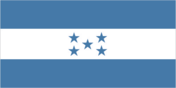
- three equal horizontal bands of blue (top), white, and blue with five blue fivepointed stars arranged in an X pattern centered in the white band; the stars represent the members of the former Federal Republic of Central America — Costa Rica, El Salvador, Guatemala, Honduras, and Nicaragua; similar to the flag of El Salvador which features a round emblem
- blue with the flag of the UK in the upper hoist-side quadrant with the Hong Kong coat of arms on a white disk centered on the outer half of the flag; the coat of arms contains a shield (bearing two junks below a crown) held by a lion (representing the UK) and a dragon (representing China) with another lion above the shield and a banner bearing the words HONG KONG below the shield
Independence
- 15 September 1821 (from Spain)
- none (colony of the UK); the UK signed an agreement with China on 19 December 1984 to return Hong Kong to China on 1 July 1997; in the joint declaration, China promises to respect Hong Kong's existing social and economic systems and lifestyle for 50 years after transition
Judicial branch
- Supreme Court of Justice (Corte Suprema de Justica)
- Supreme Court
Leaders
- Chief of State and Head of Government— Rafael Leonardo CALLEJAS Romero (since 26 January 1990) Political parties and leaders: Liberal Party (PLH)— faction leaders, Carlos Flores Facusse (leader of Florista Liberal Movement), Carlos Montoya (Azconista subfaction), Ramon Villeda Bermudez and Jorge Arturo Reina (M-Lider faction); National Party (PNH), Ricardo Maduro, party president; PNH faction leaders — Oswaldo Ramos Soto and Rafael Leonardo Callejas (Monarca faction); National Innovation and Unity Party-Social Democrats (PINU-SD), Enrique Aguilar Cerrato Paz; Christian Democratic Party (PDCH), Jorge Illescas; Democratic Action (AD), Walter Lopez Reyes
- Chief of State— Queen ELIZABETH II (since 6 February 1952); Head of Government — Governor Sir David Clive WILSON (since 9 April 1987); Chief Secretary Sir David Robert FORD (since NA February 1987)
Legal system
- rooted in Roman and Spanish civil law; some influence of English common law; accepts ICJ jurisdiction, with reservations
- based on English common law
Legislative branch
- unicameral National Congress (Congreso Nacional)
- Legislative Council
Long-form name
- Republic of Honduras
- none; abbreviated HK
- none
Member of
- CACM, FAO, G-77, IADB, IBRD, ICAO, ICO, IDA, IDB— InterAmerican Development Bank, I FAD, IFC, ILO, IMF, IMO, INTELSAT, INTERPOL, ISO, ITU, OAS, PAHO, SELA, UN, UNESCO, UPEB, UPU, WFTU, WHO, WMO
- ADB, ESCAP (associate member), GATT, IMO, INTERPOL, Multifiber Arrangement, WMO
National holiday
- Independence Day, 1 5 September (1821)
- Liberation Day, 29 August (1945)
Other political or pressure groups
- National Association of Honduran Campesinos (ANACH), Honduran Council of Private Enterprise (COHEP), Confederation of Honduran Workers (CTH), National Union of Campesinos (UNC), General Workers Confederation (CGT), United Federation of Honduran Workers (FUTH), Committee for the Defense of Human Rights in Honduras (CODEH), Coordinating Committee of Popular Organizations (CCOP)
- Federation of Trade Unions (Communist controlled), Hong Kong and Kowloon Trade Union Council (Nationalist Chinese dominated), Hong Kong General Chamber of Commerce, Chinese General Chamber of Commerce (Communist controlled), Federation of Hong Kong Industries, Chinese Manufacturers' Association of Hong Kong, Hong Kong Professional Teachers' Union, and several small pro-democracy groups.
Political parties
none
Suffrage
- universal and compulsory at age
- limited to about 71,000 professionals of electoral college and functional constituencies
Type
- republic
- colony of the UK; scheduled to revert to China in 1997
- unincorporated territory of the US administered by the Fish and Wildlife Service of the US Department of the Interior as part of the National Wildlife Refuge System
Economy
Agriculture
- most important sector, accounting for nearly 30% of GDP, over 60% of the labor force, and two-thirds of exports; principal products include baHong Kong {colony of the UK) nanas, coffee, timber, beef, citrus fruit, shrimp; importer of wheat
- minor role in the economy; rice, vegetables, dairy products; less than 20% self-sufficient; shortages of rice, wheat, water
Aid
- US commitments, including Ex-Im (FY70-88), $1.3 billion; Western (non-US) countries, ODA and OOF bilateral commitments (1970-87), $776 million
- US commitments, including Ex-Im (FY70-87), $141.2 million; Western (nonUS) countries, ODA and OOF bilateral commitments (1970-87), $899.8 million
Budget
- revenues $1,053 million; expenditures $949 million, including capital expenditures of $159 million (1989)
- $6.9 billion (FY89)
Currency
- lempira (plural — lempiras); 1 lempira (L) = 100 centavos
- Hong Kong dollar (plural — dollars); 1 Hong Kong dollar (HK$) = 100 cents
Electricity
- 655,000 kW capacity; 1,980 million kWh produced, 390 kWh per capita (1989)
- 7,800,000 kW capacity; 23,000 million kWh produced, 4,030 kWh per capita (1989)
Exchange rates
- lempiras (L) per US$1 — 2.00 (fixed rate); 3.50 parallel exchange and black-market rate (October 1989)
- Hong Kong dollars (H KS) per US$— 7.800 (March 1989), 7.810 (1988), 7.760 (1987), 7.795 (1986), 7.811 (1985); note— linked to the US dollar at the rate of about 7.8 HK$ per 1 US$ since 1985
Exports
- $1.0 billion (f.o.b., 1988); commodities— bananas, coffee, shrimp, lobster, minerals, lumber; partners — US 52%, FRG 11%, Japan, Italy, Belgium
- $63.2 billion (f.o.b., 1988), including reexports of $22.9 billion; commodities— clothing, textile yarn and fabric, footwear, electrical appliances, watches and clocks, toys; partners — US 31%, China 14%, FRG 8%, UK 6%, Japan 5%
External debt
- $3.2 billion (December 1989)
- $9.6 billion (December 1988)
Fiscal year
- calendar year
- 1 April-31 March
GDP
- S4.4 billion, per capita $890; real growth rate 4.0% (1988)
- $57 billion, per capita $10,000; real growth rate 3% (1989)
Illicit drugs
illicit producer of cannabis, cultivated on small plots and used principally for local consumption; transshipment point for cocaine
Imports
- $1.4 billion (c.i.f. 1988); commodities— machinery and transport equipment, chemical products, manufactured goods, fuel and oil, foodstuffs; partners — US 39%, Japan 9%, CACM, Venezuela, Mexico
- $63.9 billion (c.i.f., 1988); commodities— foodstuffs, transport equipment, raw materials, semimanufactures, petroleum; partners — China 31%, Japan 20%, Taiwan 9%, US 8%
Industrial production
- growth rate 5% (1988)
- growth rate 7.0% (1988)
Industries
- agricultural processing (sugar and coffee), textiles, clothing, wood products
- textiles, clothing, tourism, electronics, plastics, toys, watches, clocks
Inflation rate (consumer prices)
- 1 1% (1989)
- 9.5% (1989)
Overview
- Honduras is one of the poorest countries in the Western Hemisphere. Agriculture is the most important sector of the economy, accounting for nearly 30% of GDP, employing 62% of the labor force, and producing two-thirds of exports. Productivity remains low, however, leaving considerable room for improvement. Although industry is still in its early stages, it employs nearly 1 5% of the labor force, accounts for 23% of GDP, and generates 20% of exports. The service sectors, including public administration, account for 48% of GDP and employ nearly 20% of the labor force. Basic problems facing the economy include a high population growth rate, a high unemployment rate, a lack of basic services, a large and inefficient public sector, and an export sector dependent mostly on coffee and bananas, which are subject to sharp price fluctuations.
- Hong Kong has a free-market economy and is autonomous in financial affairs. Natural resources are limited and food and raw materials must be imported. Manufacturing is the backbone of the economy, accounting for more than 20% of GDP, employing 36% of the labor force, and exporting about 90% of output. Real GDP growth averaged a remakable 8% in 1987-88, then slowed to a respectable 3% in 1989. Unemployment, which has been declining since the mid-1980s, is now less than 2%. A shortage of labor continues to put upward pressure on prices and the cost of living. Short-term prospects remain solid so long as major trading partners continue to be prosperous. The crackdown in China in 1989 casts a long shadow over the longer term economic outlook.
- no economic activity
Unemployment rate
- 1 2% unemployed, 30-40% underemployed (1988)
- 1.6% (1988)
Communications
Airports
- 180 total, 140 usable; 8 with permanent-surface runways; none with runways over 3,659 m; 4 with runways 2,440-3,659 m; 12 with runways 1,2202,439 m
- 2 total; 2 usable; 2 with permanent-surface runways; none with runways over 3,659 m; 1 with runways 2,440-3,659 m; none with runways 1,2202,439 m
- airstrip constructed in 1 937 for scheduled refueling stop on the round-theworld flight of Amelia Earhart and Fred Noonan — they left Lae, New Guinea, for Howland Island, but were never seen again; the airstrip is no longer serviceable
Branches
- Armed Forces, Naval Forces, Air Force
- Headquarters of British Forces, Gurkha Brigade, Royal Navy, Royal Air Force, Royal Hong Kong Auxiliary Air Force, Royal Hong Kong Police Force
Civil air
- 9 major transport aircraft
- 1 6 major transport aircraft
Defense expenditures
- 1.9% of GDP, or $82.5 million (1 990 est.) Lema Channel SttrttionilmipVIII
- 0.5% of GDP, or $300 million (1989 est.); this represents one-fourth of the total cost of defending the colony, the remainder being paid by the UK
Highways
- 8,950 km total; 1,700 km paved, 5,000 km otherwise improved, 2,250 km unimproved earth
- 1,100 km total; 794 km paved, 306 km gravel, crushed stone, or earth
Inland waterways
465 km navigable by small craft
Merchant marine
- 149 ships (1,000 GRT or over) totaling 438,495 GRT/660,990 DWT; includes 2 passenger-cargo, 87 cargo, 1 2 refrigerated cargo, 9 container, 1 roll-on/roll-off cargo, 17 petroleum, oils, and lubricants (POL) tanker, 2 liquefied gas, 1 specialized tanker, 1 vehicle carrier, 1 7 bulk; note — a flag of convenience registry
- 134 ships (1,000 GRT or over), totaling 4,391,102 GRT/ 7,430,337 DWT; includes 1 passenger, 1 short-sea passenger, 1 1 cargo, 1 0 refrigerated cargo, 13 container, 2 roll-on/roll-off cargo, 10 petroleum, oils, and lubricants (POL) tanker, 1 chemical tanker, 9 combination ore/oil, 7 liquefied gas, 69 bulk; note — a flag of convenience registry; ships registered in Hong Kong fly the UK flag and an estimated 500 Hong Kong-owned ships are registered elsewhere
Military manpower
- males 15-49, 1,222,858; 727,851 fit for military service; 61,493 reach military age (18) annually
- males 15-49, 1,703,890; 1,320,914 fit for military service; 46,440 reach military age (18) annually
Note
- defense is the responsibility of the UK How land Island (territory of the US) North Pacific \ l«' Ocean
- Earhart Light is a day beacon near the middle of the west coast that was partially destroyed during World War II, but has since been rebuilt in memory of famed aviatrix Amelia Earhart Defense Forces
- defense is the responsibility of the US; visited annually by the US Coast Guard
Ports
- Puerto Castilla, Puerto Cortes, San Lorenzo
- Hong Kong
- none; offshore anchorage only, one boat landing area along the middle of the west coast
Railroads
- 785 km total; 508 km 1.067meter gauge, 277 km 0.914-meter gauge
- 35 km 1.435-meter standard gauge, government owned
Telecommunications
- improved, but still inadequate; connection into Central American Microwave System; 35,100 telephones; stations — 176 AM, no FM, 28 TV, 7 shortwave; 2 Atlantic Ocean INTELSAT earth stations Defense Forces
- modern facilities provide excellent domestic and international services; 2,300,000 telephones; microwave transmission links and extensive optical fiber transmission network; stations — 6 AM, 6 FM, 4 TV; 1 British Broadcasting Corporation (BBC) relay station and 1 British Forces Broadcasting Service relay station; 2,500,000 radio receivers; 1,312,000 TV sets (1,224,000 color TV sets); satellite earth stations — 1 Pacific Ocean INTELSAT and 2 Indian Ocean INTELSAT; coaxial cable to Guangzhou, Hong Kong (continued) China; links to 5 international submarine cables providing access to ASEAN member nations, Japan, Taiwan, Australia, Middle East, and Western Europe Defense Forces