1982 Edition
CIA World Factbook 1982 (Wikisource)
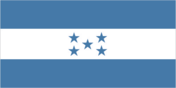
Geography
Area
12,150 km2; 27% forested, 30% pasture, 36% waste and built up, 7% cropland
Coastline
820 km
Land boundaries
1,530 km WATER
Limits of territorial waters (claimed)
12 nm (fishing 200 nm; exclusive economic zone 200 nm)
People and Society
Ethnic divisions
90% mestizo, 7% Indian, 2% Negro, and 1% white
Labor force
approx. 1 million (1980); 59.3% agriculture, 12.7% services, 12.5% manufacturing, 8.3% commerce, 3.0% transportation, 2.7% construction, 1.1% financial sector, 0.4% mining; 10.8% unemployed; 3% unspecified
Language
Spanish
Literacy
47% of persons 10 years of age and over (est. 1970)
Nationality
noun—Honduran(s); adjective—Honduran
Organized labor
40% of urban labor force, 20% of rural work force (1981)
Population
4,103,000 (July 1982), average annual growth rate 4.1%
Religion
about 97% Roman Catholic
Government
Branches
constitution provides for elected President, unicameral legislature, and national judicial branch
Capital
Tegucigalpa
Communists
about 1,500
Elections
national election 29 November 1981 for president; members of unicameral legislature chosen by proportional representation and 281 municipal councils Political parties and leaders: the armed forces have fulfilled their pledge to restore civilian government; they will monitor Suazo's administration closely, however, and could seize power once again; major political leaders—Liberal Party (PLH), Roberto Suazo Córdova (Rodista faction), Carlos Roberto Reina Idiaquez and Jorge Arturo Reina Idiaquez (ALIPO faction), Ramón Villeda Bermúdez and Conrado Napky Damas (FUL faction); National Party (PNH), Ricardo Zúniga Augustinus, Mario Rivera López; National Innovation and Unity Party (PINU), Miguel Andonie Fernández, Enrique Aguilar Paz; Honduran Christian Democratic Party (PDCH), Hernán Corrales Padilla; Communist Party of Honduras (PCH), Rigoberto Padilla Rush (uninscribed) Voting strength (1981 election with 98% vote tally): PLH 633,365; PNH 486,092, PINU 29,133, PDCH 18,785; legislative seats (with 98% vote tally)—PLH 44, PNH 34, PINU 2-3, PDCH 1
Government leader
President Roberto SUAZO Córdova took office in January 1982
Legal system
based on Roman and Spanish civil law; some influence of English common law; new constitution became effective in January 1982; judicial review of legislative acts in Supreme Court; legal education at University of Honduras in Tegucigalpa; accepts compulsory 1CJ jurisdiction, with reservations
Member of
CACM, FAO, G-77, IADB, IBRD, ICAO, ICO, IDA, IDB, IFAD, IFC, ILO, IMCO, IMF, ISO, ITU, OAS, UN, UNESCO, UPEB, UPU, WHO, WMO
National holiday
Independence Day, 15 September
Official name
Republic of Honduras
Other political or pressure groups
National Association of Honduran Campesinos (ANACH), Council of Honduran Private Enterprise (COHEP), Confederation of Honduran Workers (CTH), National Union of Campesinos (UNC), General Workers Confederation (CGT), United Federation of Honduran Workers (FUTH)
Political subdivisions
18 departments
Suffrage
universal and compulsory over age 21
Type
republic
Economy
Agriculture
main crops—bananas, coffee, corn, beans, cotton, sugarcane, tobacco; caloric intake, 2,015 calories per day per capita (1977)
Aid
economic commitments—US, including Ex-Im, (FY70-80), $260 million loans; other Western (non-US) countries, ODA and ODF, (1970-79), $90.0 million; military-assistance from US (FY79-80), $23 million
Budget
(1980) expenditures $448 million, revenues $379 million
Electric power
178,000 kW capacity (1980); 970 million kWh produced (1980), 253 kWh per capita Exports: $835 million (f.o.b., 1980); bananas, coffee, lumber, meat, petroleum products
Fiscal year
calendar year
Fishing
catch 6,405 metric tons (1978); exports est. $0.8 million (1976); imports $0.8 million (1974)
GDP
$2.5 billion (1980), $660 per capita; 62% private consumption, 13% government consumption, 30% domestic investment; -5% net foreign balance (1978); real growth rate, average 1975-79, 6.9%; real growth rate 1980, 2.5%
Imports
$1,019 million (c.i.f., 1980); manufactured products, machinery, transportation equipment, chemicals, petroleum
Major industries
agricultural processing, textiles, clothing, wood products
Major trade partners
exports—50% US, 9% CACM, 18% West Germany (1977); imports—43% US, 6% Venezuela, 12% CACM, 11% Japan, 4% West Germany (1977)
Monetary conversion rate
2 lempiras=US$1 (official)
Communications
Airfields
217 total, 213 usable; 5 with permanent-surface runways; 2 with runways 2,440-3,659 m; 6 with runways 1,220-2,439 m
Civil air
14 major transport aircraft, including 1 leased in
Highways
8,950 km total; 1,700 km paved, 5,000 km otherwise improved, 2,250 km unimproved earth
Inland waterways
1,200 km navigable by small craft
Ports
5 major (Puerto Cortes, La Ceiba, Tela, San Lorenzo, Puerto Castilla), 3 minor
Railroads
751 km total; 293 km 1.067-meter gauge, 458 km 0.914-meter gauge
Telecommunications
improved, but still inadequate; connection into Central American microwave net; 20,000 telephones (0.5 per 100 popl.); 104 AM, 12 FM, and 7 TV stations
Military and Security
Military budget
proposed for fiscal year ending 31 December 1981, $45.2 million; about 6.7% of central government budget (includes the armed forces and other military)
Military manpower
males 15-49, 874,000; 521,000 fit for military service; about 44,000 reach military age (18) annually