2008 Edition
CIA World Factbook 2008 (Project Gutenberg)
Introduction
Background
The native Taino Amerindians - who inhabited the island of Hispaniola when it was discovered by COLUMBUS in 1492 - were virtually annihilated by Spanish settlers within 25 years. In the early 17th century, the French established a presence on Hispaniola, and in 1697, Spain ceded to the French the western third of the island, which later became Haiti. The French colony, based on forestry and sugar-related industries, became one of the wealthiest in the Caribbean, but only through the heavy importation of African slaves and considerable environmental degradation. In the late 18th century, Haiti's nearly half million slaves revolted under Toussaint L'OUVERTURE. After a prolonged struggle, Haiti became the first black republic to declare its independence in 1804. The poorest country in the Western Hemisphere, Haiti has been plagued by political violence for most of its history. After an armed rebellion led to the forced resignation and exile of President Jean-Bertrand ARISTIDE in February 2004, an interim government took office to organize new elections under the auspices of the United Nations Stabilization Mission in Haiti (MINUSTAH). Continued violence and technical delays prompted repeated postponements, but Haiti finally did inaugurate a democratically elected president and parliament in May of 2006.
Geography
Area
total: 27,750 sq km land: 27,560 sq km water: 190 sq km
Area - comparative
slightly smaller than Maryland
Climate
tropical; semiarid where mountains in east cut off trade winds
Coastline
1,771 km
Elevation extremes
lowest point: Caribbean Sea 0 m highest point: Chaine de la Selle 2,680 m
Environment - current issues
extensive deforestation (much of the remaining forested land is being cleared for agriculture and used as fuel); soil erosion; inadequate supplies of potable water
Environment - international agreements
party to: Biodiversity, Climate Change, Climate Change-Kyoto Protocol, Desertification, Law of the Sea, Marine Dumping, Marine Life Conservation, Ozone Layer Protection signed, but not ratified: Hazardous Wastes
Freshwater withdrawal (domestic/industrial/agricultural)
total: 0.99 cu km/yr (5%/1%/94%) per capita: 116 cu m/yr (2000)
Geographic coordinates
19 00 N, 72 25 W
Geography - note
shares island of Hispaniola with Dominican Republic (western one-third is Haiti, eastern two-thirds is the Dominican Republic)
Irrigated land
920 sq km (2003)
Land boundaries
total: 360 km border countries: Dominican Republic 360 km
Land use
arable land: 28.11% permanent crops: 11.53% other: 60.36% (2005)
Location
Caribbean, western one-third of the island of Hispaniola, between the Caribbean Sea and the North Atlantic Ocean, west of the Dominican Republic
Map references
Central America and the Caribbean
Maritime claims
territorial sea: 12 nm contiguous zone: 24 nm exclusive economic zone: 200 nm continental shelf: to depth of exploitation
Natural hazards
lies in the middle of the hurricane belt and subject to severe storms from June to October; occasional flooding and earthquakes; periodic droughts
Natural resources
bauxite, copper, calcium carbonate, gold, marble, hydropower
Terrain
mostly rough and mountainous
Total renewable water resources
14 cu km (2000)
People and Society
Age structure
0-14 years: 41.8% (male 1,881,509/female 1,851,591) 15-64 years: 54.7% (male 2,386,761/female 2,495,233) 65 years and over: 3.5% (male 135,695/female 173,764) (2008 est.)
Birth rate
35.69 births/1,000 population (2008 est.)
Death rate
10.15 deaths/1,000 population (2008 est.)
Education expenditures
1.4% of GDP (1991)
Ethnic groups
black 95%, mulatto and white 5%
HIV/AIDS - adult prevalence rate
5.6% (2003 est.)
HIV/AIDS - deaths
24,000 (2003 est.)
HIV/AIDS - people living with HIV/AIDS
280,000 (2003 est.)
Infant mortality rate
total: 62.33 deaths/1,000 live births male: 66.88 deaths/1,000 live births female: 57.64 deaths/1,000 live births (2008 est.)
Languages
French (official), Creole (official)
Life expectancy at birth
total population: 57.56 years male: 55.83 years female: 59.35 years (2008 est.)
Literacy
definition: age 15 and over can read and write total population: 52.9% male: 54.8% female: 51.2% (2003 est.)
Major infectious diseases
degree of risk: high food or waterborne diseases: bacterial and protozoal diarrhea, hepatitis A and E, and typhoid fever vectorborne diseases: dengue fever and malaria water contact disease: leptospirosis (2008)
Median age
total: 18.5 years male: 18.1 years female: 19 years (2008 est.)
Nationality
noun: Haitian(s) adjective: Haitian
Net migration rate
-0.61 migrant(s)/1,000 population (2008 est.)
Population
8,924,553 note: estimates for this country explicitly take into account the effects of excess mortality due to AIDS; this can result in lower life expectancy, higher infant mortality, higher death rates, lower population growth rates, and changes in the distribution of population by age and sex than would otherwise be expected (July 2008 est.)
Population growth rate
2.493% (2008 est.)
Religions
Roman Catholic 80%, Protestant 16% (Baptist 10%, Pentecostal 4%, Adventist 1%, other 1%), none 1%, other 3% note: roughly half of the population practices voodoo
Sex ratio
at birth: 1.03 male(s)/female under 15 years: 1.02 male(s)/female 15-64 years: 0.96 male(s)/female 65 years and over: 0.78 male(s)/female total population: 0.97 male(s)/female (2008 est.)
Total fertility rate
4.79 children born/woman (2008 est.)
Government
Administrative divisions
10 departments (departements, singular - departement); Artibonite, Centre, Grand 'Anse, Nippes, Nord, Nord-Est, Nord-Ouest, Ouest, Sud, Sud-Est
Capital
name: Port-au-Prince geographic coordinates: 18 32 N, 72 20 W time difference: UTC-5 (same time as Washington, DC during Standard Time) daylight saving time: +1hr, begins first Sunday in April; ends last Sunday in October
Constitution
approved March 1987; suspended June 1988 with most articles reinstated March 1989; constitutional government ousted in a military coup in September 1991, although in October 1991, military government claimed to be observing the constitution; returned to constitutional rule in October 1994; constitution, while technically in force between 2004-2006, was not enforced; returned to constitutional rule in May 2006
Country name
conventional long form: Republic of Haiti conventional short form: Haiti local long form: Republique d'Haiti/Repiblik d' Ayiti local short form: Haiti/Ayiti
Diplomatic representation from the US
chief of mission: Ambassador Janet A. SANDERSON embassy: Tabarre 41, Route de Tabarre, Port-au-Prince mailing address: use mailing address telephone: [509] 229-8000
Diplomatic representation in the US
chief of mission: Ambassador Raymond JOSEPH chancery: 2311 Massachusetts Avenue NW, Washington, DC 20008 telephone: [1] (202) 332-4090
Executive branch
chief of state: President Rene PREVAL (since 14 May 2006) head of government: Prime Minister Michele PIERRE-LOUIS (since 5 September 2008) cabinet: Cabinet chosen by the prime minister in consultation with the president elections: president elected by popular vote for a five-year term (may not serve consecutive terms); election last held 7 February 2006 (next to be held in 2011); prime minister appointed by the president, ratified by the National Assembly election results: Rene PREVAL elected president; percent of vote - Rene PREVAL 51%
FAX
- [1] (202) 745-7215 consulate(s) general: Boston, Chicago, Miami, New York, San Juan (Puerto Rico)
- [509] 229-8028
Flag description
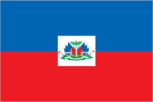
two equal horizontal bands of blue (top) and red with a centered white rectangle bearing the coat of arms, which contains a palm tree flanked by flags and two cannons above a scroll bearing the motto L'UNION FAIT LA FORCE (Union Makes Strength)
Government type
republic
Independence
1 January 1804 (from France)
International organization participation
ACP, Caricom, CDB, FAO, G-77, IADB, IAEA, IBRD, ICAO, ICCt (signatory), ICRM, IDA, IFAD, IFC, IFRCS, ILO, IMF, IMO, Interpol, IOC, IOM, ITSO, ITU, ITUC, LAES, MIGA, NAM, OAS, OIF, OPANAL, OPCW, PCA, UN, UNCTAD, UNESCO, UNIDO, Union Latina, UNWTO, UPU, WCL, WCO, WFTU, WHO, WIPO, WMO, WTO
Judicial branch
Supreme Court or Cour de Cassation
Legal system
based on Roman civil law system; accepts compulsory ICJ jurisdiction
Legislative branch
bicameral National Assembly or Assemblee Nationale consists of the Senate (30 seats; members elected by popular vote to serve six-year terms; one-third elected every two years) and the Chamber of Deputies (99 seats; members are elected by popular vote to serve four-year terms); note - in reestablishing the Senate, the candidate in each department receiving the most votes in the last election serves six years, the candidate with the second most votes serves four years, and the candidate with the third most votes serves two years elections: Senate - last held 21 April 2006 with run-off elections on 3 December 2006 (next regular election, for one third of seats, to be held in 2008); Chamber of Deputies - last held 21 April 2006 with run-off elections on 3 December 2006 and 29 April 2007 (next regular election to be held in 2010) election results: Senate - percent of vote by party - NA; seats by party - L'ESPWA 11, FUSION 5, OPL 4, FL 3, LAAA 2, UNCRH 2, PONT 2, ALYANS 1; Chamber of Deputies - percent of vote by party - NA; seats by party - L'ESPWA 23, FUSION 17, FRN 12, OPL 10, ALYANS 10, LAAA 5, MPH 3, MOCHRENA 3, other 10; results for six other seats contested on 3 December 2006 remain unknown
National holiday
Independence Day, 1 January (1804)
Political parties and leaders
Artibonite in Action or LAAA [Youri LATORTUE]; Assembly of Progressive National Democrats or RDNP [Leslie MANIGAT]; Convention for Democratic Unity or KID [Evans PAUL]; Cooperative Action to Build Haiti or KONBA [Evans LESCOUFALIR]; Democratic Alliance or ALYANS [Evans PAUL] (coalition composed of KID and PPRH); Effort and Solidarity to Create an Alternative for the People or ESKAMP [Joseph JASME]; For Us All or PONT [Jean-Marie CHERESTAL]; Front for Hope or L'ESPWA [Rene PREVAL] (alliance of ESKAMP, PLB, and grass-roots organizations Grand-Anse Resistance Committee, the Central Plateau Peasants' Group, and Kombit Sudest); Haitian Christian Democratic Party or PDCH [Osner FEVRY and Marie-Denise CLAUDE]; Haitian Democratic and Reform Movement or MODEREH [Dany TOUSSAINT and Pierre Soncon PRINCE]; Heads Together or Tet-Ansanm [Dr. Gerard BLOT]; Independent Movement for National Reconciliation or MIRN [Luc FLEURINORD]; Justice for Peace and National Development or JPDN [Rigaud DUPLAN]; Fanmi Lavalas or FL [Rudy HERIVEAUX]; Liberal Party of Haiti or PLH [Gehy MICHEL]; Merging of Haitian Social Democratic Parties or FUSION or FPSDH [Serge GILLES] (coalition of Ayiti Capable, Haitian National Revolutionary Party, and National Congress of Democratic Movements); Mobilization for Haiti's Development or MPH [Samir MOURRA]; Mobilization for National Development or MDN [Hubert de RONCERAY]; Movement for National Reconstruction or MRN [Jean Henold BUTEAU]; Movement for the Installation of Democracy in Haiti or MIDH [Marc BAZIN]; National Christian Union for the Reconstruction of Haiti or UNCRH [Marie Claude GERMAIN]; National Front for the Reconstruction of Haiti or FRN [Guy PHILIPPE]; New Christian Movement for a New Haiti or MOCHRENA [Luc MESADIEU]; Open the Gate Party or PLB [Anes LUBIN]; Popular Party for the Renewal of Haiti or PPRH [Claude ROMAIN]; Struggling People's Organization or OPL [Edgard LEBLANC]; Union of Nationalist and Progressive Haitians or UNITE [Edouard FRANCISQUE]
Political pressure groups and leaders
Autonomous Organizations of Haitian Workers or CATH [Fignole ST-CYR]; Confederation of Haitian Workers or CTH; Federation of Workers Trade Unions or FOS; General Organization of Independent Haitian Workers [Patrick NUMAS]; Grand-Anse Resistance Committee, or KOREGA; National Popular Assembly or APN; Papaye Peasants Movement or MPP [Chavannes JEAN-BAPTISTE]; Popular Organizations Gathering Power or PROP; Protestant Federation of Haiti; Roman Catholic Church
Suffrage
18 years of age; universal
Economy
Agriculture - products
coffee, mangoes, sugarcane, rice, corn, sorghum; wood
Budget
revenues: $815.9 million expenditures: $802.2 million (2007 est.)
Commercial bank prime lending rate
46.99% (31 December 2007)
Currency (code)
gourde (HTG)
Currency code
HTG
Current account balance
-$467 million (2007 est.)
Debt - external
$1.475 billion (31 December 2007 est.)
Distribution of family income - Gini index
59.2 (2001)
Economic aid - recipient
$515 million (2005 est.)
Economy - overview
Haiti is the poorest country in the Western Hemisphere, with 80% of the population living under the poverty line and 54% in abject poverty. Two-thirds of all Haitians depend on the agricultural sector, mainly small-scale subsistence farming, and remain vulnerable to damage from frequent natural disasters, exacerbated by the country's widespread deforestation. A macroeconomic program developed in 2005 with the help of the International Monetary Fund helped the economy grow 3.5% in 2007, the highest growth rate since 1999. US economic engagement under the Haitian Hemispheric Opportunity through Partnership Encouragement (HOPE) Act, passed in December 2006, has boosted the garment and automotive parts exports and investment by providing tariff-free access to the US. Haiti suffers from high inflation, a lack of investment because of insecurity and limited infrastructure, and a severe trade deficit. In 2005, Haiti paid its arrears to the World Bank, paving the way for reengagement with the Bank. The government relies on formal international economic assistance for fiscal sustainability. Remittances are the primary source of foreign exchange, equaling nearly a quarter of GDP and more than twice the earnings from exports.
Electricity - consumption
330 million kWh (2006 est.)
Electricity - exports
0 kWh (2007 est.)
Electricity - imports
0 kWh (2007 est.)
Electricity - production
549 million kWh (2006 est.)
Electricity - production by source
fossil fuel: 60.3% hydro: 39.7% nuclear: 0% other: 0% (2001)
Exchange rates
gourdes (HTG) per US dollar - 37.138 (2007), 40.232 (2006), 40.449 (2005), 38.352 (2004), 42.367 (2003)
Exports
$522 million f.o.b. (2007 est.)
Exports - commodities
apparel, manufactures, oils, cocoa, mangoes, coffee
Exports - partners
US 72.9%, Dominican Republic 8.8%, Canada 3.3% (2007)
Fiscal year
1 October - 30 September
GDP - composition by sector
agriculture: 28% industry: 20% services: 52% (2004 est.)
GDP - per capita (PPP)
$1,300 (2007 est.)
GDP - real growth rate
3.2% (2007 est.)
GDP (official exchange rate)
$5.435 billion (2007 est.)
GDP (purchasing power parity)
$11.38 billion (2007 est.)
Household income or consumption by percentage share
lowest 10%: 0.7% highest 10%: 47.7% (2001)
Imports
$1.734 billion f.o.b. (2007 est.)
Imports - commodities
food, manufactured goods, machinery and transport equipment, fuels, raw materials
Imports - partners
US 41.2%, Netherlands Antilles 14.9%, China 4.7%, Brazil 4.4% (2007)
Industrial production growth rate
2.5% (2007 est.)
Industries
sugar refining, flour milling, textiles, cement, light assembly based on imported parts
Inflation rate (consumer prices)
8.5% (2007 est.)
Investment (gross fixed)
28.9% of GDP (2006 est.)
Labor force
3.6 million note: shortage of skilled labor, unskilled labor abundant (1995)
Labor force - by occupation
agriculture: 66% industry: 9% services: 25% (1995)
Market value of publicly traded shares
$NA
Natural gas - consumption
0 cu m (2007 est.)
Natural gas - exports
0 cu m (2007 est.)
Natural gas - imports
0 cu m (2007 est.)
Natural gas - production
0 cu m (2007 est.)
Natural gas - proved reserves
0 cu m (1 January 2006 est.)
Oil - consumption
12,370 bbl/day (2006 est.)
Oil - exports
0 bbl/day (2005)
Oil - imports
11,980 bbl/day (2005)
Oil - production
0 bbl/day (2007 est.)
Oil - proved reserves
0 bbl (1 January 2006 est.)
Population below poverty line
80% (2003 est.)
Reserves of foreign exchange and gold
$444 million (31 December 2007 est.)
Stock of domestic credit
$1.537 billion (31 December 2007)
Stock of money
$704.7 million (31 December 2007)
Stock of quasi money
$1.561 billion (31 December 2007)
Unemployment rate
widespread unemployment and underemployment; more than two-thirds of the labor force do not have formal jobs (2002 est.)
Communications
Internet country code
.ht
Internet hosts
7 (2008)
Internet Service Providers (ISPs)
3 (2000)
Internet users
1 million (2007)
Radio broadcast stations
AM 41, FM 26, shortwave 0 (1999)
Radios
415,000 (1997)
Telephone system
general assessment: domestic facilities barely adequate; international facilities slightly better; telephone density in Haiti remains the lowest in the Latin American and Caribbean region domestic: coaxial cable and microwave radio relay trunk service; combined fixed and mobile-cellular teledensity is about 25 per 100 persons international: country code - 509; satellite earth station - 1 Intelsat (Atlantic Ocean)
Telephones - main lines in use
150,000 (2006)
Telephones - mobile cellular
2.2 million (2007)
Television broadcast stations
2 (plus a cable TV service) (1997)
Televisions
38,000 (1997)
Transportation
Airports
14 (2007)
Airports - with paved runways
total: 4 2,438 to 3,047 m: 1 914 to 1,523 m: 3 (2007)
Airports - with unpaved runways
total: 10 914 to 1,523 m: 1 under 914 m: 9 (2007)
Ports and terminals
Cap-Haitien
Roadways
total: 4,160 km paved: 1,011 km unpaved: 3,149 km (2000)
Military and Security
Manpower available for military service
males age 16-49: 2,047,083 females age 16-49: 2,047,953 (2008 est.)
Manpower fit for military service
males age 16-49: 1,303,743 females age 16-49: 1,332,316 (2008 est.)
Manpower reaching militarily significant age annually
male: 105,655 female: 104,376 (2008 est.)
Military branches
no regular military forces - small Coast Guard; the regular Haitian Armed Forces (FAdH) - Army, Navy, and Air Force - have been demobilized but still exist on paper unless they are constitutionally abolished (2007)
Military expenditures
0.4% of GDP (2006)
Transnational Issues
Disputes - international
since 2004, about 8,000 peacekeepers from the UN Stabilization Mission in Haiti (MINUSTAH) maintain civil order in Haiti; despite efforts to control illegal migration, Haitians cross into the Dominican Republic and sail to neighboring countries; Haiti claims US-administered Navassa Island
Illicit drugs
Caribbean transshipment point for cocaine en route to the US and Europe; substantial bulk cash smuggling activity; Colombian narcotics traffickers favor Haiti for illicit financial transactions; pervasive corruption; significant consumer of cannabis This page was last updated on 18 December, 2008