2001 Edition
CIA World Factbook 2001 (Project Gutenberg)
Introduction
Administrative divisions
9 departments (departements, singular - departement); Artibonite, Centre, Grand'Anse, Nord, Nord-Est, Nord-Ouest, Ouest, Sud, Sud-Est
Age structure
0-14 years: 40.31% (male 1,421,945; female 1,385,580) 15-64 years: 55.52% (male 1,869,323; female 1,997,246) 65 years and over: 4.17% (male 140,556; female 149,899) (2001 est.)
Agriculture - products
coffee, mangoes, sugarcane, rice, corn, sorghum; wood
Airports
13 (2000 est.)
Airports - with paved runways
total: 3 2,438 to 3,047 m: 1 914 to 1,523 m: 2 (2000 est.)
Airports - with unpaved runways
total: 10 914 to 1,523 m: 2 under 914 m: 8 (2000 est.) Haiti Military
Area
total: 27,750 sq km land: 27,560 sq km water: 190 sq km
Area - comparative
slightly smaller than Maryland
Background
One of the poorest countries in the Western Hemisphere, Haiti has been plagued by political violence for most of its history. Over three decades of dictatorship followed by military rule ended in 1990 when Jean-Bertrand ARISTIDE was elected president. Most of his term was usurped by a military takeover, but he was able to return to office in 1994 and oversee the installation of a close associate to the presidency in 1996. ARISTIDE won a second term as president in 2000, and took office early the following year. Haiti Geography
Birth rate
31.68 births/1,000 population (2001 est.)
Budget
revenues: $317 million expenditures: $362 million, including capital expenditures of $84 million (FY99/00 est.)
Capital
Port-au-Prince
Climate
tropical; semiarid where mountains in east cut off trade winds
Coastline
1,771 km
Constitution
approved March 1987; suspended June 1988, with most articles reinstated March 1989; in October 1991, government claimed to be observing the constitution; return to constitutional rule, October 1994
Country name
conventional long form: Republic of Haiti conventional short form: Haiti local long form: Republique d'Haiti local short form: Haiti
Currency
gourde (HTG)
Currency code
HTG
Death rate
15 deaths/1,000 population (2001 est.)
Debt - external
$1 billion (1998 est.)
Diplomatic representation from the US
chief of mission: Ambassador Brian Dean CURRAN embassy: 5 Harry Truman Boulevard, Port-au-Prince mailing address: P. O. Box 1761, Port-au-Prince telephone: [509] 222-0354, 222-0269, 222-0200, 223-4776
Diplomatic representation in the US
chief of mission: Ambassador (vacant); Charge d'Affaires Louis Harold JOSEPH chancery: 2311 Massachusetts Avenue NW, Washington, DC 20008 telephone: [1] (202) 332-4090
Disputes - international
claims US-administered Navassa Island
Economic aid - recipient
$730.6 million (1995)
Economy - overview
About 80% of the population lives in abject poverty. Nearly 70% of all Haitians depend on the agriculture sector, which consists mainly of small-scale subsistence farming and employs about two-thirds of the economically active work force. The country has experienced little job creation since the former President PREVAL took office in February 1996, although the informal economy is growing. Following legislative elections in May 2000, fraught with irregularities, international donors - including the US and EU - suspended almost all aid to Haiti. This destabilized the Haitian currency, the gourde, and, combined with a 40% fuel price hike in September, caused widespread price increases. Prices appear to have leveled off in January 2001.
Electricity - consumption
625 million kWh (1999)
Electricity - exports
0 kWh (1999)
Electricity - imports
0 kWh (1999)
Electricity - production
672 million kWh (1999)
Electricity - production by source
fossil fuel: 52.83% hydro: 47.17% nuclear: 0% other: 0% (1999)
Elevation extremes
lowest point: Caribbean Sea 0 m highest point: Chaine de la Selle 2,680 m
Environment - current issues
extensive deforestation (much of the remaining forested land is being cleared for agriculture and used as fuel); soil erosion; inadequate supplies of potable water
Environment - international agreements
party to: Biodiversity, Climate Change, Desertification, Law of the Sea, Marine Dumping, Marine Life Conservation, Ozone Layer Protection signed, but not ratified: Hazardous Wastes, Nuclear Test Ban
Ethnic groups
black 95%, mulatto and white 5%
Exchange rates
gourdes per US dollar - 23.761 (January 2001), 22.524 (2000), 17.965 (1999), 16.505 (1998), 17.311 (1997), 15.093 (1996)
Executive branch
chief of state: President Jean-Bertrand ARISTIDE (since 7 February 2001) head of government: Prime Minister Jean-Marie CHERESTAL (since 9 February 2001) cabinet: Cabinet chosen by the prime minister in consultation with the president elections: president elected by popular vote for a five-year term; election last held 26 November 2000 (next to be held NA 2005); prime minister appointed by the president, ratified by the Congress election results: Jean-Bertrand ARISTIDE elected president; percent of vote - Jean-Bertrand ARISTIDE 92%
Exports
$186 million (f.o.b., 1999)
Exports - commodities
manufactures, coffee, oils, mangoes
Exports - partners
US 89%, EU 8% (1999)
FAX
- [1] (202) 745-7215 consulate(s) general: Boston, Chicago, Miami, New York, and San Juan (Puerto Rico)
- [509] 23-1641
Fiscal year
1 October - 30 September Haiti Communications
Flag description
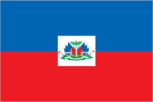
two equal horizontal bands of blue (top) and red with a centered white rectangle bearing the coat of arms, which contains a palm tree flanked by flags and two cannons above a scroll bearing the motto L'UNION FAIT LA FORCE (Union Makes Strength) Haiti Economy
GDP
purchasing power parity - $12.7 billion (2000 est.)
GDP - composition by sector
agriculture: 32% industry: 20% services: 48% (1999 est.)
GDP - per capita
purchasing power parity - $1,800 (2000 est.)
GDP - real growth rate
1.2% (2000 est.)
Geographic coordinates
19 00 N, 72 25 W
Geography - note
shares island of Hispaniola with Dominican Republic (western one-third is Haiti, eastern two-thirds is the Dominican Republic) Haiti People
Government type
elected government
Highways
total: 4,160 km paved: 1,011 km unpaved: 3,149 km (1996)
HIV/AIDS - adult prevalence rate
5.17% (1999 est.)
HIV/AIDS - deaths
23,000 (1999 est.)
HIV/AIDS - people living with HIV/AIDS
210,000 (1999 est.)
Household income or consumption by percentage share
lowest 10%: NA% highest 10%: NA%
Illicit drugs
major Caribbean transshipment point for cocaine en route to the US and Europe; vulnerable to money laundering
Imports
$1.2 billion (c.i.f., 1999)
Imports - commodities
food, machinery and transport equipment, fuels, raw materials
Imports - partners
US 60%, EU 13% (1999)
Independence
1 January 1804 (from France)
Industrial production growth rate
0.6% (1997 est.)
Industries
sugar refining, flour milling, textiles, cement, tourism, light assembly industries based on imported parts
Infant mortality rate
95.23 deaths/1,000 live births (2001 est.)
Inflation rate (consumer prices)
19% (2000 est.)
International organization participation
ACCT, ACP, Caricom (observer), CCC, ECLAC, FAO, G-77, IADB, IAEA, IBRD, ICAO, ICRM, IDA, IFAD, IFC, IFRCS, ILO, IMF, IMO, Intelsat, Interpol, IOC, IOM, ITU, LAES, OAS, OPANAL, OPCW, PCA, UN, UNCTAD, UNESCO, UNIDO, UPU, WCL, WFTU, WHO, WIPO, WMO, WToO, WTrO
Internet country code
.ht
Internet Service Providers (ISPs)
3 (2000)
Internet users
6,000 (2000) Haiti Transportation
Irrigated land
750 sq km (1993 est.)
Judicial branch
Supreme Court or Cour de Cassation
Labor force
3.6 million (1995) note: shortage of skilled labor, unskilled labor abundant (1998)
Labor force - by occupation
agriculture 66%, services 25%, industry 9%
Land boundaries
total: 275 km border countries: Dominican Republic 275 km
Land use
arable land: 20% permanent crops: 13% permanent pastures: 18% forests and woodland: 5% other: 44% (1993 est.)
Languages
French (official), Creole (official)
Legal system
based on Roman civil law system; accepts compulsory ICJ jurisdiction
Legislative branch
bicameral National Assembly or Assemblee Nationale consists of the Senate (27 seats; members serve six-year terms; one-third elected every two years) and the Chamber of Deputies (83 seats; members are elected by popular vote to serve four-year terms) elections: Senate - last held for two-thirds of seats 21 May 2000, with runoffs on 9 July boycotted by the opposition; about eight seats still disputed; election for remaining one-third held on 26 November 2000 (next to be held NA 2002); Chamber of Deputies - last held 21 May 2000, with runoffs on 30 July boycotted by the opposition; one vacant seat rerun 26 November 2000 (next election NA 2004) election results: Senate - percent of vote by party - NA%; seats by party - FL 26, independent 1; Chamber of Deputies - percent of vote by party - NA%; seats by party - FL 73, OPL 1, other minor parties and independents 9
Life expectancy at birth
total population: 49.38 years male: 47.67 years female: 51.17 years (2001 est.)
Literacy
definition: age 15 and over can read and write total population: 45% male: 48% female: 42.2% (1995 est.) Haiti Government
Location
Caribbean, western one-third of the island of Hispaniola, between the Caribbean Sea and the North Atlantic Ocean, west of the Dominican Republic
Map references
Central America and the Caribbean
Maritime claims
contiguous zone: 24 NM continental shelf: to depth of exploitation exclusive economic zone: 200 NM territorial sea: 12 NM
Merchant marine
none (2000 est.)
Military branches
Haitian National Police (HNP) note: the regular Haitian Army, Navy, and Air Force have been demobilized but still exist on paper until constitutionally abolished
Military expenditures - dollar figure
$NA; note - mainly for police and security activities
Military expenditures - percent of GDP
NA% Haiti Transnational Issues
Military manpower - availability
males age 15-49: 1,635,253 (2001 est.)
Military manpower - fit for military service
males age 15-49: 888,305 (2001 est.)
Military manpower - military age
18 years of age
Military manpower - reaching military age annually
males: 87,049 (2001 est.)
National holiday
Independence Day, 1 January (1804)
Nationality
noun: Haitian(s) adjective: Haitian
Natural hazards
lies in the middle of the hurricane belt and subject to severe storms from June to October; occasional flooding and earthquakes; periodic droughts
Natural resources
bauxite, copper, calcium carbonate, gold, marble, hydropower
Net migration rate
-2.64 migrant(s)/1,000 population (2001 est.)
Political parties and leaders
Alliance for the Liberation and Advancement of Haiti or ALAH [Reynold GEORGES]; Assembly of Progressive National Democrats or RDNP [Leslie MANIGAT]; Convergence (opposition coalition composed of ESPACE, OPL, and MOCHRENA) [Gerard PIERRE-CHARLES, Evans PAUL, Luc MESADIEU, Victor BENOIT]; Democratic Consultation Group coalition or ESPACE [Evans PAUL, Victor Benoit] composed of the following parties: National Congress of Democratic Movements or KONAKOM, National Progressive Revolutionary Party or PANPRA, Generation 2004, and Haiti Can; Haitian Christian Democratic Party or PDCH [Marie-France CLAUDE]; Haitian Democratic Party or PADEM [Clark PARENT]; Lavalas Family or FL [Jean-Bertrand ARISTIDE]; Mobilization for National Development or MDN [Hubert DE RONCERAY]; Movement for National Reconstruction or MRN [Rene THEODORE]; Movement for the Installation of Democracy in Haiti or MIDH [Marc BAZIN]; Movement for the Organization of the Country or MOP [Gesner COMEAU and Jean MOLIERE]; National Front for Change and Democracy or FNCD [Evans PAUL and Turneb DELPE]; New Christian Movement for a New Haiti or MOCHRENA [Luc MESADIEU]; Struggling People's Organization or OPL [Gerard PIERRE-CHARLES]
Political pressure groups and leaders
Autonomous Haitian Workers or CATH; Confederation of Haitian Workers or CTH; Federation of Workers Trade Unions or FOS; National Popular Assembly or APN; Papaye Peasants Movement or MPP; Popular Organizations Gathering Power or PROP; Roman Catholic Church
Population
6,964,549 note: estimates for this country explicitly take into account the effects of excess mortality due to AIDS; this can result in lower life expectancy, higher infant mortality and death rates, lower population and growth rates, and changes in the distribution of population by age and sex than would otherwise be expected (July 2001 est.)
Population below poverty line
80% (1998 est.)
Population growth rate
1.4% (2001 est.)
Ports and harbors
Cap-Haitien, Gonaives, Jacmel, Jeremie, Les Cayes, Miragoane, Port-au-Prince, Port-de-Paix, Saint-Marc
Radio broadcast stations
AM 41, FM 26, shortwave 0 (1999)
Radios
415,000 (1997)
Railways
total: 40 km (single track; privately owned industrial line) - closed in early 1990s narrow gauge: 40 km 0.760-m gauge
Religions
Roman Catholic 80%, Protestant 16% (Baptist 10%, Pentecostal 4%, Adventist 1%, other 1%), none 1%, other 3% (1982) note: roughly one-half of the population also practices Voodoo
Sex ratio
at birth: 1.05 male(s)/female under 15 years: 1.03 male(s)/female 15-64 years: 0.94 male(s)/female 65 years and over: 0.94 male(s)/female total population: 0.97 male(s)/female (2001 est.)
Suffrage
18 years of age; universal
Telephone system
general assessment: domestic facilities barely adequate; international facilities slightly better domestic: coaxial cable and microwave radio relay trunk service international: satellite earth station - 1 Intelsat (Atlantic Ocean)
Telephones - main lines in use
60,000 (1997)
Telephones - mobile cellular
0 (1995)
Television broadcast stations
2 (plus a cable TV service) (1997)
Televisions
38,000 (1997)
Terrain
mostly rough and mountainous
Total fertility rate
4.4 children born/woman (2001 est.)
Unemployment rate
widespread unemployment and underemployment; more than two-thirds of the labor force do not have formal jobs (1999)
Waterways
NEGL; less than 100 km navigable