1990 Edition
CIA World Factbook 1990 (Project Gutenberg)
Geography
Climate
tropical; semiarid where mountains in east cut off trade winds
Coastline
1,771 km
Comparative area
slightly larger than Maryland
Contiguous zone
24 nm;
Continental shelf
to depth of exploitation;
Disputes
claims US-administered Navassa Island
Environment
lies in the middle of the hurricane belt and subject to severe storms from June to October; occasional flooding and earthquakes; deforestation
Extended economic zone
200 nm;
Land boundary
275 km with the Dominican Republic
Land use
20% arable land; 13% permanent crops; 18% meadows and pastures; 4% forest and woodland; 45% other; includes 3% irrigated
Natural resources
bauxite
Note
shares island of Hispaniola with Dominican Republic
Terrain
mostly rough and mountainous
Territorial sea
12 nm
Total area
27,750 km2; land area: 27,560 km2
People and Society
Birth rate
45 births/1,000 population (1990)
Death rate
16 deaths/1,000 population (1990)
Ethnic divisions
95% black, 5% mulatto and European
Infant mortality rate
107 deaths/1,000 live births (1990)
Labor force
2,300,000; 66% agriculture, 25% services, 9% industry; shortage of skilled labor, unskilled labor abundant (1982)
Language
French (official) spoken by only 10% of population; all speak Creole
Life expectancy at birth
52 years male, 55 years female (1990)
Literacy
23%
Nationality
noun--Haitian(s); adjective--Haitian
Net migration rate
- 6 migrants/1,000 population (1990)
Organized labor
NA
Population
6,142,141 (July 1990), growth rate 2.3% (1990)
Religion
75-80% Roman Catholic (of which an overwhelming majority also practice Voodoo), 10% Protestant
Total fertility rate
6.4 children born/woman (1990)
Government
Administrative divisions
9 departments, (departements, singular--departement); Artibonite, Centre, Grand'Anse, Nord, Nord-Est, Nord-Ouest, Ouest, Sud, Sud-Est
Capital
Port-au-Prince
Communists
United Party of Haitian Communists (PUCH), Rene Theodore
Constitution
27 August 1983, suspended February 1986; draft constitution approved March 1987, suspended June 1988, most articles reinstated March 1989
Diplomatic representation
Ambassador (vacant), Charge d'Affaires Fritz VOUGY; Chancery at 2311 Massachusetts Avenue NW, Washington DC 20008; telephone (202) 332-4090 through 4092; there are Haitian Consulates General in Boston, Chicago, Miami, New York, and San Juan (Puerto Rico); US--Ambassador Alvin ADAMS; Embassy at Harry Truman Boulevard, Port-au-Prince (mailing address is P. O. Box 1761, Port-au-Prince), telephone [509] (1) 20354 or 20368, 20200, 20612
Elections
President--last held 17 January 1988 (next to be held by mid-June 1990); on 13 March 1990 Ertha Pascal-Trouillot became provisional president after the resignation of President Lieut. Gen Prosper Avril; Legislature--last held 17 January 1988, but dissolved on 20 June 1988; the government has promised an election by mid-June 1990
Executive branch
president, Council of Ministers (cabinet)
Flag
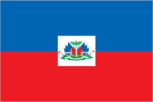
two equal horizontal bands of blue (top) and red with a centered white rectangle bearing the coat of arms which contains a palm tree flanked by flags and two cannons above a scroll bearing the motto L'UNION FAIT LA FORCE (Union Makes Strength)
Independence
1 January 1804 (from France)
Judicial branch
Court of Appeal (Cour de Cassation)
Leaders
Chief of State and Head of Government--Provisional President Ertha PASCAL-TROUILLOT (since 13 March 1990)
Legal system
based on Roman civil law system; accepts compulsory ICJ jurisdiction
Legislative branch
bicameral National Assembly (Assemblee Nationale) consisted of an upper house or Senate and a lower house or House of Representatives, but was dissolved on 20 June 1988 after the coup of 19 June 1988 (there was a subsequent coup on 18 September 1988); after naming a civilian as provisional president on 13 March 1990, it was announced that a Council of State was being formed
Long-form name
Republic of Haiti
Member of
CCC, FAO, G-77, GATT, IADB, IAEA, IBA, IBRD, ICAO, ICO, IDA, IDB--Inter-American Development Bank, IFAD, IFC, ILO, IMF, IMO, INTELSAT, INTERPOL, IRC, ITU, OAS, PAHO, SELA, UN, UNESCO, UPU, WHO, WMO, WTO
National holiday
Independence Day, 1 January (1804)
Other political or pressure groups
Democratic Unity Confederation (KID), Roman Catholic Church, Confederation of Haitian Workers (CTH), Federation of Workers Trade Unions (FOS), Autonomous Haitian Workers
Political parties and leaders
Haitian Christian Democratic Party (PDCH), Sylvio Claude; Haitian Social Christian Party (PSCH), Gregoire Eugene; Movement for the Installation of Democracy in Haiti (MIDH), Marc Bazin; National Alliance Front (FNC), Gerard Gourgue; National Agricultural and Industrial Party (PAIN), Louis Dejoie; Congress of Democratic Movements (CONACOM), Victor Bono; National Progressive Revolutionary Party (PANPRA), Serge Gilles; National Patriotic Movement of November 28 (MNP-28), Dejean Belizaire; Movement for the Organization of the Country (MOP), Gesner Comeau; Mobilization for National Development (MDN), Hubert De Ronceray
Suffrage
none
Type
republic
Economy
Agriculture
accounts for 32% of GDP and employs 65% of work force; mostly small-scale subsistence farms; commercial crops--coffee and sugarcane; staple crops--rice, corn, sorghum, mangoes; shortage of wheat flour
Aid
US commitments, including Ex-Im (FY70-88), $638 million; Western (non-US) countries, ODA and OOF bilateral commitments (1970-87), $627 million
Budget
revenues $252 million; expenditures $357 million, including capital expenditures of $NA million (1988)
Currency
gourde (plural--gourdes); 1 gourde (G) = 100 centimes
Electricity
230,000 kW capacity; 482 million kWh produced, 75 kWh per capita (1989)
Exchange rates
gourdes (G) per US$1-- 5.0 (fixed rate)
Exports
$200 million (f.o.b., FY88); commodities--light manufactures 65%, coffee 17%, other agriculture 8%, other products 10%; partners--US 77%, France 5%, Italy 4%, FRG 3%, other industrial 9%, less developed countries 2% (FY86)
External debt
$820 million (December 1988)
Fiscal year
1 October-30 September
GDP
$2.4 billion, per capita $380; real growth rate 0.3% (1988 est.)
Imports
$344 million (c.i.f., FY88); commodities--machines and manufactures 36%, food and beverages 21%, petroleum products 11%, fats and oils 12%, chemicals 12%; partners--US 65%, Netherlands Antilles 6%, Japan 5%, France 4%, Canada 2%, Asia 2% (FY86)
Industrial production
growth rate - 2% (FY87)
Industries
sugar refining, textiles, flour milling, cement manufacturing, bauxite mining, tourism, light assembly industries based on imported parts
Inflation rate (consumer prices)
5.8% (1988)
Overview
About 85% of the population live in absolute poverty. Agriculture is mainly small-scale subsistence farming and employs 65% of the work force. The majority of the population does not have ready access to safe drinking water, adequate medical care, or sufficient food. Few social assistance programs exist, and the lack of employment opportunities remains the most critical problem facing the economy.
Unemployment rate
50% (1988 est.)
Communications
Airports
15 total, 10 usable; 3 with permanent-surface runways; none with runways over 3,659 m; 1 with runways 2,440-3,659 m; 4 with runways 1,220-2,439 m
Civil air
4 major transport aircraft
Highways
4,000 km total; 950 km paved, 900 km otherwise improved, 2,150 km unimproved
Inland waterways
negligible; less than 100 km navigable
Ports
Port-au-Prince, Cap-Haitien
Railroads
40 km 0.760-meter narrow gauge, single-track, privately owned industrial line
Telecommunications
domestic facilities barely adequate, international facilities slightly better; 36,000 telephones; stations--33 AM, no FM, 4 TV, 2 shortwave; 1 Atlantic Ocean earth station
Military and Security
Branches
Army, Navy, Air Corps
Defense expenditures
NA
Military manpower
males 15-49, 1,264,238; 679,209 fit for military service; 59,655 reach military age (18) annually