2016 Edition
CIA World Factbook 2016 Archive (HTML)
Introduction
Background
Since independence from Portugal in 1974, Guinea-Bissau has experienced considerable political and military upheaval. In 1980, a military coup established authoritarian dictator Joao Bernardo 'Nino' VIEIRA as president. Despite setting a path to a market economy and multiparty system, VIEIRA's regime was characterized by the suppression of political opposition and the purging of political rivals. Several coup attempts through the 1980s and early 1990s failed to unseat him. In 1994 VIEIRA was elected president in the country's first free, multiparty election. A military mutiny and resulting civil war in 1998 eventually led to VIEIRA's ouster in May 1999. In February 2000, a transitional government turned over power to opposition leader Kumba YALA after he was elected president in transparent polling. In September 2003, after only three years in office, YALA was overthrown in a bloodless military coup, and businessman Henrique ROSA was sworn in as interim president. In 2005, former President VIEIRA was reelected, pledging to pursue economic development and national reconciliation; he was assassinated in March 2009. Malam Bacai SANHA was elected in an emergency election held in June 2009, but he passed away in January 2012 from a long-term illness. A military coup in April 2012 prevented Guinea-Bissau's second-round presidential election - to determine SANHA's successor - from taking place. Following mediation by the Economic Community of Western African States, a civilian transitional government assumed power in 2012 and remained until Jose Mario VAZ won free and fair election in 2014.
Geography
Area
- 36,125 sq km 28,120 sq km 8,005 sq km
- land
- 28,120 sq km
- total
- 36,125 sq km
- water
- 8,005 sq km
Area - comparative
slightly less than three times the size of Connecticut
Climate
tropical; generally hot and humid; monsoonal-type rainy season (June to November) with southwesterly winds; dry season (December to May) with northeasterly harmattan winds
Coastline
350 km
Elevation
- 70 m lowest point: Atlantic Ocean 0 m highest point: unnamed elevation in the eastern part of the country 300 m
- elevation extremes
- lowest point: Atlantic Ocean 0 m
- highest point
- unnamed elevation in the eastern part of the country 300 m
- mean elevation
- 70 m
Environment - current issues
deforestation; soil erosion; overgrazing; overfishing
Environment - international agreements
- Biodiversity, Climate Change, Climate Change-Kyoto Protocol, Desertification, Endangered Species, Hazardous Wastes, Law of the Sea, Ozone Layer Protection, Wetlands none of the selected agreements
- party to
- Biodiversity, Climate Change, Climate Change-Kyoto Protocol, Desertification, Endangered Species, Hazardous Wastes, Law of the Sea, Ozone Layer Protection, Wetlands
- signed, but not ratified
- none of the selected agreements
Geographic coordinates
12 00 N, 15 00 W
Geography - note
this small country is swampy along its western coast and low-lying inland
Irrigated land
250 sq km (2012)
Land boundaries
- 762 km Guinea 421 km, Senegal 341 km
- border countries (2)
- Guinea 421 km, Senegal 341 km
- total
- 762 km
Land use
- 44.8% arable land 8.2%; permanent crops 6.9%; permanent pasture 29.7% 55.2% 0% (2011 est.)
- agricultural land
- 44.8%
- forest
- 55.2%
- other
- 0% (2011 est.)
Location
Western Africa, bordering the North Atlantic Ocean, between Guinea and Senegal
Map references
Africa
Maritime claims
- 12 nm 200 nm
- exclusive economic zone
- 200 nm
- territorial sea
- 12 nm
Natural hazards
hot, dry, dusty harmattan haze may reduce visibility during dry season; brush fires
Natural resources
fish, timber, phosphates, bauxite, clay, granite, limestone, unexploited deposits of petroleum
Terrain
mostly low-lying coastal plain with a deeply indented estuarine coastline rising to savanna in east; numerous off-shore islands including the Arquipelago Dos Bijagos consisting of 18 main islands and many small islets
People and Society
Age structure
- 39.28% (male 344,976/female 346,102) 20.17% (male 176,050/female 178,842) 32.53% (male 285,258/female 286,955) 4.62% (male 31,030/female 50,215) 3.4% (male 22,121/female 37,610) (2016 est.)
- 0-14 years
- 39.28% (male 344,976/female 346,102)
- 15-24 years
- 20.17% (male 176,050/female 178,842)
- 25-54 years
- 32.53% (male 285,258/female 286,955)
- 55-64 years
- 4.62% (male 31,030/female 50,215)
- 65 years and over
- 3.4% (male 22,121/female 37,610) (2016 est.)
Birth rate
32.9 births/1,000 population (2016 est.)
Child labor - children ages 5-14
- 226,316 57% (2010 est.)
- percentage
- 57% (2010 est.)
- total number
- 226,316
Children under the age of 5 years underweight
17% (2014)
Contraceptive prevalence rate
14.2% (2010)
Death rate
14.1 deaths/1,000 population (2016 est.)
Demographic profile
Guinea-Bissau’s young and growing population is sustained by high fertility; approximately 60% of the population is under the age of 25. Its large reproductive-age population and total fertility rate of more than 4 children per woman offsets the country’s high infant and maternal mortality rates. The latter is among the world’s highest because of the prevalence of early childbearing, a lack of birth spacing, the high percentage of births outside of health care facilities, and a shortage of medicines and supplies. Guinea-Bissau’s history of political instability, a civil war, and several coups (the latest in 2012) have resulted in a fragile state with a weak economy, high unemployment, rampant corruption, widespread poverty, and thriving drug and child trafficking. With the country lacking educational infrastructure, school funding and materials, and qualified teachers, and with the cultural emphasis placed on religious education, parents frequently send boys to study in residential Koranic schools (daaras) in Senegal and The Gambia. They often are extremely deprived and are forced into street begging or agricultural work by marabouts (Muslim religious teachers), who enrich themselves at the expense of the children. Boys who leave their marabouts often end up on the streets of Dakar or other large Senegalese towns and are vulnerable to even worse abuse. Some young men lacking in education and job prospects become involved in the flourishing international drug trade. Local drug use and associated violent crime are growing.
Dependency ratios
- 78.4% 72.8% 5.7% 17.7% (2015 est.)
- elderly dependency ratio
- 5.7%
- potential support ratio
- 17.7% (2015 est.)
- total dependency ratio
- 78.4%
- youth dependency ratio
- 72.8%
Drinking water source
- urban: 98.8% of population rural: 60.3% of population total: 79.3% of population urban: 1.2% of population rural: 39.7% of population total: 20.7% of population (2015 est.)
- rural
- 39.7% of population
- total
- 20.7% of population (2015 est.)
- urban
- 1.2% of population
Education expenditures
2.4% of GDP (2013)
Ethnic groups
Fulani 28.5%, Balanta 22.5%, Mandinga 14.7%, Papel 9.1%, Manjaco 8.3%, Beafada 3.5%, Mancanha 3.1%, Bijago 2.1%, Felupe 1.7%, Mansoanca 1.4%, Balanta Mane 1%, other 1.8%, none 2.2% (2008 est.)
Health expenditures
5.6% of GDP (2014)
HIV/AIDS - adult prevalence rate
3.69% (2014 est.)
HIV/AIDS - deaths
1,900 (2014 est.)
HIV/AIDS - people living with HIV/AIDS
42,000 (2014 est.)
Hospital bed density
1 beds/1,000 population (2009)
Infant mortality rate
- 87.5 deaths/1,000 live births 96.9 deaths/1,000 live births 77.7 deaths/1,000 live births (2016 est.)
- female
- 77.7 deaths/1,000 live births (2016 est.)
- male
- 96.9 deaths/1,000 live births
- total
- 87.5 deaths/1,000 live births
Languages
- Crioulo 90.4%, Portuguese 27.1% (official), French 5.1%, English 2.9%, other 2.4% shares sum to more than 100% because some respondents gave more than one answer on the census (2008 est.)
- note
- shares sum to more than 100% because some respondents gave more than one answer on the census (2008 est.)
Life expectancy at birth
- 50.6 years 48.6 years 52.7 years (2016 est.)
- female
- 52.7 years (2016 est.)
- male
- 48.6 years
- total population
- 50.6 years
Literacy
- age 15 and over can read and write 59.9% 71.8% 48.3% (2015 est.)
- definition
- age 15 and over can read and write
- female
- 48.3% (2015 est.)
- male
- 71.8%
- total population
- 59.9%
Major infectious diseases
- very high bacterial and protozoal diarrhea, hepatitis A, and typhoid fever malaria, dengue fever, and yellow fever schistosomiasis rabies (2016)
- animal contact disease
- rabies (2016)
- degree of risk
- very high
- food or waterborne diseases
- bacterial and protozoal diarrhea, hepatitis A, and typhoid fever
- vectorborne diseases
- malaria, dengue fever, and yellow fever
- water contact disease
- schistosomiasis
Major urban areas - population
BISSAU (capital) 492,000 (2015)
Maternal mortality rate
549 deaths/100,000 live births (2015 est.)
Median age
- 20 years 19.5 years 20.5 years (2016 est.)
- female
- 20.5 years (2016 est.)
- male
- 19.5 years
- total
- 20 years
Nationality
- Bissau-Guinean(s) Bissau-Guinean
- adjective
- Bissau-Guinean
- noun
- Bissau-Guinean(s)
Net migration rate
0 migrant(s)/1,000 population (2016 est.)
Obesity - adult prevalence rate
6.3% (2014)
Physicians density
0.1 physicians/1,000 population (2009)
Population
1,759,159 (July 2016 est.)
Population growth rate
1.88% (2016 est.)
Religions
Muslim 45.1%, Christian 22.1%, animist 14.9%, none 2%, unspecified 15.9% (2008 est.)
Sanitation facility access
- urban: 33.5% of population rural: 8.5% of population total: 20.8% of population urban: 66.5% of population rural: 91.5% of population total: 79.2% of population (2015 est.)
- rural
- 91.5% of population
- total
- 79.2% of population (2015 est.)
- urban
- 66.5% of population
School life expectancy (primary to tertiary education)
- 9 years NA NA (2006)
- female
- NA (2006)
- male
- NA
- total
- 9 years
Sex ratio
- 1.03 male(s)/female 1 male(s)/female 0.98 male(s)/female 0.99 male(s)/female 0.62 male(s)/female 0.6 male(s)/female 0.96 male(s)/female (2016 est.)
- 0-14 years
- 1 male(s)/female
- 15-24 years
- 0.98 male(s)/female
- 25-54 years
- 0.99 male(s)/female
- 55-64 years
- 0.62 male(s)/female
- 65 years and over
- 0.6 male(s)/female
- at birth
- 1.03 male(s)/female
- total population
- 0.96 male(s)/female (2016 est.)
Total fertility rate
4.16 children born/woman (2016 est.)
Urbanization
- 49.3% of total population (2015) 4.13% annual rate of change (2010-15 est.)
- rate of urbanization
- 4.13% annual rate of change (2010-15 est.)
- urban population
- 49.3% of total population (2015)
Government
Administrative divisions
9 regions (regioes, singular - regiao); Bafata, Biombo, Bissau, Bolama/Bijagos, Cacheu, Gabu, Oio, Quinara, Tombali
Capital
- Bissau 11 51 N, 15 35 W UTC 0 (5 hours ahead of Washington, DC, during Standard Time)
- geographic coordinates
- 11 51 N, 15 35 W
- name
- Bissau
- time difference
- UTC 0 (5 hours ahead of Washington, DC, during Standard Time)
Citizenship
- yes yes no 5 years
- citizenship by birth
- yes
- citizenship by descent
- yes
- dual citizenship recognized
- no
- residency requirement for naturalization
- 5 years
Constitution
promulgated 16 May 1984; amended 1991, 1993, 1996; note - constitution suspended following military coup in April 2012 and restored in 2014 (2016)
Country name
- Republic of Guinea-Bissau Guinea-Bissau Republica da Guine-Bissau Guine-Bissau Portuguese Guinea the country is named after the Guinea region of West Africa that lies along the Gulf of Guinea and stretches north to the Sahel; "Bissau" distinguishes the country from neighboring Guinea
- `conventional long form
- Republic of Guinea-Bissau
- conventional short form
- Guinea-Bissau
- former
- Portuguese Guinea
- local long form
- Republica da Guine-Bissau
- local short form
- Guine-Bissau
- note
- the country is named after the Guinea region of West Africa that lies along the Gulf of Guinea and stretches north to the Sahel; "Bissau" distinguishes the country from neighboring Guinea
Diplomatic representation from the US
the US Embassy suspended operations on 14 June 1998 in the midst of violent conflict between forces loyal to then President VIEIRA and a military-led junta; the US Ambassador to Senegal, currently Ambassador James P. ZUMWALT, is accredited to Guinea-Bissau
Diplomatic representation in the US
- none; note - Guinea-Bissau does not have official representation in Washington, DC
- chief of mission
- none; note - Guinea-Bissau does not have official representation in Washington, DC
Executive branch
- President Jose Mario VAZ (since 17 June 2014) Prime Minister Baciro DJA (since 27 May 2016); the initial appointment of Baciro DJA in August 2015 was nullified by the Supreme Court and he resigned; Prime Minister Carlos CORREIA (since 17 September 2015) was dismissed by President VAZ on 12 May 2016 Cabinet nominated by the prime minister, appointed by the president president directly elected by absolute majority popular vote in two rounds if needed for a 5-year term (no term limits); election last held on 13 April 2014 with a runoff on 18 May 2014 (next to be held in 2019); prime minister appointed by the president after consultation with party leaders in the National People's Assembly first round - Jose Mario VAZ (PAIGC) 41%, Nuno Gomez NABIAM (independent) 25.1%, other 33.9%; Jose Mario VAZ elected president in second round - Jose Mario VAZ 61.9%, Nuno Gomez NABIAM 38.1%
- cabinet
- Cabinet nominated by the prime minister, appointed by the president
- chief of state
- President Jose Mario VAZ (since 17 June 2014)
- election results
- first round - Jose Mario VAZ (PAIGC) 41%, Nuno Gomez NABIAM (independent) 25.1%, other 33.9%; Jose Mario VAZ elected president in second round - Jose Mario VAZ 61.9%, Nuno Gomez NABIAM 38.1%
- elections/appointments
- president directly elected by absolute majority popular vote in two rounds if needed for a 5-year term (no term limits); election last held on 13 April 2014 with a runoff on 18 May 2014 (next to be held in 2019); prime minister appointed by the president after consultation with party leaders in the National People's Assembly
- head of government
- Prime Minister Baciro DJA (since 27 May 2016); the initial appointment of Baciro DJA in August 2015 was nullified by the Supreme Court and he resigned; Prime Minister Carlos CORREIA (since 17 September 2015) was dismissed by President VAZ on 12 May 2016
Flag description
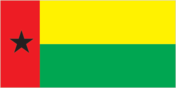
- two equal horizontal bands of yellow (top) and green with a vertical red band on the hoist side; there is a black five-pointed star centered in the red band; yellow symbolizes the sun; green denotes hope; red represents blood shed during the struggle for independence; the black star stands for African unity uses the popular Pan-African colors of Ethiopia; the flag design was heavily influenced by the Ghanaian flag
- note
- uses the popular Pan-African colors of Ethiopia; the flag design was heavily influenced by the Ghanaian flag
Government type
semi-presidential republic
Independence
24 September 1973 (declared); 10 September 1974 (from Portugal)
International law organization participation
accepts compulsory ICJ jurisdiction; non-party state to the ICCt
International organization participation
ACP, AfDB, AOSIS, AU, CPLP, ECOWAS, FAO, FZ, G-77, IBRD, ICAO, ICRM, IDA, IDB, IFAD, IFC, IFRCS, ILO, IMF, IMO, Interpol, IOC, IOM, IPU, ITSO, ITU, ITUC (NGOs), MIGA, MINUSMA, NAM, OIC, OIF, OPCW, UN, UNCTAD, UNESCO, UNIDO, UNWTO, UPU, WADB (regional), WAEMU, WCO, WFTU (NGOs), WHO, WIPO, WMO, WTO
Judicial branch
- Supreme Court or Suprema Tribunal Justica (consists of 9 judges and organized into Civil, Criminal, and Social and Administrative Disputes Chambers); note - the Supreme Court has both appellate and constitutional jurisdiction judges nominated by the Higher Council of the Magistrate, a major government organ responsible for judge appointments, dismissals, and judiciary discipline; judges appointed by the president for life Appeal Court; regional (first instance) courts; military court
- highest court(s)
- Supreme Court or Suprema Tribunal Justica (consists of 9 judges and organized into Civil, Criminal, and Social and Administrative Disputes Chambers); note - the Supreme Court has both appellate and constitutional jurisdiction
- judge selection and term of office
- judges nominated by the Higher Council of the Magistrate, a major government organ responsible for judge appointments, dismissals, and judiciary discipline; judges appointed by the president for life
- subordinate courts
- Appeal Court; regional (first instance) courts; military court
Legal system
mixed legal system of civil law which incorporated Portuguese law at independence and influenced by early French civil code and customary law
Legislative branch
- unicameral National People's Assembly or Assembleia Nacional Popular (102 seats; members directly elected in 2 single- and 27 multi-seat constituencies by closed party-list proportional representation vote to serve 4-year terms) last held on 13 April 2014 (next to be held in 2018) percent of vote by party - PAIGC 48.0%, PRS 30.8%, other parties 21.2%; seats by party - PAIGC 57, PRS 41, other 4
- description
- unicameral National People's Assembly or Assembleia Nacional Popular (102 seats; members directly elected in 2 single- and 27 multi-seat constituencies by closed party-list proportional representation vote to serve 4-year terms)
- election results
- percent of vote by party - PAIGC 48.0%, PRS 30.8%, other parties 21.2%; seats by party - PAIGC 57, PRS 41, other 4
- elections
- last held on 13 April 2014 (next to be held in 2018)
National anthem
- "Esta e a Nossa Patria Bem Amada" (This Is Our Beloved Country) Amilcar Lopes CABRAL/XIAO He adopted 1974; a delegation from then Portuguese Guinea visited China in 1963 and heard music by XIAO He; Amilcar Lopes CABRAL, the leader of Guinea-Bissau's independence movement, asked the composer to create a piece that would inspire his people to struggle for independence
- lyrics/music
- Amilcar Lopes CABRAL/XIAO He
- name
- "Esta e a Nossa Patria Bem Amada" (This Is Our Beloved Country)
- note
- adopted 1974; a delegation from then Portuguese Guinea visited China in 1963 and heard music by XIAO He; Amilcar Lopes CABRAL, the leader of Guinea-Bissau's independence movement, asked the composer to create a piece that would inspire his people to struggle for independence
National holiday
Independence Day, 24 September (1973)
National symbol(s)
- black star; national colors: red, yellow, green, black
- black star; national colors
- red, yellow, green, black
Political parties and leaders
African Party for the Independence of Guinea-Bissau and Cabo Verde or PAIGC [Domingos Simoes PEREIRA] Democratic Convergence Party or PCD [Vicente FERNANDES] New Democracy Party or PND [Mamadu Iaia DJALO] Party for Social Renewal or PRS [Alberto NAMBEIA] Republican Party for Independence and Development or PRID [Aristides GOMES] Union for Change or UM [Agnelo REGALA]
Political pressure groups and leaders
Chamber of Commerce of Agriculture, Industry, and Services
Suffrage
18 years of age; universal
Economy
Agriculture - products
rice, corn, beans, cassava (manioc, tapioca), cashew nuts, peanuts, palm kernels, cotton; timber; fish
Budget
- $195.1 million $229.6 million (2015 est.)
- expenditures
- $229.6 million (2015 est.)
- revenues
- $195.1 million
Budget surplus (+) or deficit (-)
-3.3% of GDP (2015 est.)
Central bank discount rate
4.25% (31 December 2009) 4.75% (31 December 2008)
Commercial bank prime lending rate
15% (31 December 2015 est.) 15% (31 December 2014 est.)
Current account balance
-$10 million (2015 est.) -$38 million (2014 est.)
Debt - external
$1.095 billion (31 December 2010 est.) $941.5 million (31 December 2000 est.)
Economy - overview
Guinea-Bissau is highly dependent on subsistence agriculture, cashew nut exports, and foreign assistance. Two out of three Bissau-Guineans remain below the absolute poverty line. The legal economy is based on farming and fishing, but illegal logging and trafficking in narcotics are also important economic activities. The combination of limited economic prospects, weak institutions, and favorable geography have made this West African country a way station for drugs bound for Europe while trade in illegal logging, food, and fishing is also significant. Guinea-Bissau has substantial potential for development of mineral resources including phosphates, bauxite, and mineral sands. The country’s climate and soil make it feasible to grow a wide range of cash crops, fruit, vegetables, and tubers; however, cashews generate more than 80% of export receipts and are the main source of income for many rural communities. With renewed donor support following elections in April-May 2014 and a successful regional bond issuance, the government of Guinea-Bissau made progress paying salaries, settling domestic arrears, and gaining more control over revenues and expenditures, but was deposed by the President in August 2015. A political stalemate since then has resulted in weak governance.
Exchange rates
Communaute Financiere Africaine francs (XOF) per US dollar - 591.45 (2015 est.) 494.42 (2014 est.) 494.42 (2013 est.) 510.53 (2012 est.) 471.87 (2011 est.)
Exports
$202.9 million (2015 est.) $171.9 million (2014 est.)
Exports - commodities
fish, shrimp; cashews, peanuts, palm kernels, raw and sawn lumber
Exports - partners
India 63.5%, Nigeria 20.3%, China 5.7%, Togo 5.6% (2015)
Fiscal year
calendar year
GDP - composition, by end use
- 92.9% 11.1% 5.9% 0.1% 20.4% -30.4% (2015 est.)
- exports of goods and services
- 20.4%
- government consumption
- 11.1%
- household consumption
- 92.9%
- imports of goods and services
- -30.4% (2015 est.)
- investment in fixed capital
- 5.9%
- investment in inventories
- 0.1%
GDP - composition, by sector of origin
- 45% 13.3% 41.7% (2015 est.)
- agriculture
- 45%
- industry
- 13.3%
- services
- 41.7% (2015 est.)
GDP - per capita (PPP)
- $1,500 (2015 est.) $1,500 (2014 est.) $1,500 (2013 est.) data are in 2015 US dollars
- note
- data are in 2015 US dollars
GDP - real growth rate
4.8% (2015 est.) 2.5% (2014 est.) 0.8% (2013 est.)
GDP (official exchange rate)
$1.057 billion (2015 est.)
GDP (purchasing power parity)
- $2.68 billion (2015 est.) $2.557 billion (2014 est.) $2.494 billion (2013 est.) data are in 2015 US dollars
- note
- data are in 2015 US dollars
Gross national saving
10.3% of GDP (2015 est.) 7.4% of GDP (2014 est.) 2.6% of GDP (2013 est.)
Household income or consumption by percentage share
- 2.9% 28% (2002)
- highest 10%
- 28% (2002)
- lowest 10%
- 2.9%
Imports
$199.5 million (2015 est.) $227.5 million (2014 est.)
Imports - commodities
foodstuffs, machinery and transport equipment, petroleum products
Imports - partners
Portugal 27.1%, Senegal 12.8%, China 6.5%, Spain 5.5%, Cuba 4.8% (2015)
Industrial production growth rate
3% (2015 est.)
Industries
agricultural products processing, beer, soft drinks
Inflation rate (consumer prices)
1.4% (2015 est.) -1.5% (2014 est.)
Labor force
731,300 (2013 est.)
Labor force - by occupation
- 82% 18% (2000 est.)
- agriculture
- 82%
- industry and services
- 18% (2000 est.)
Market value of publicly traded shares
$NA
Population below poverty line
67% (2015 est.)
Stock of broad money
$489.4 million (31 December 2015 est.) $452.1 million (31 December 2014 est.)
Stock of domestic credit
$206.5 million (31 December 2015 est.) $160.1 million (31 December 2014 est.)
Stock of narrow money
$454.8 million (31 December 2015 est.) $392.5 million (31 December 2014 est.)
Taxes and other revenues
18.5% of GDP (2015 est.)
Unemployment rate
NA%
Energy
Carbon dioxide emissions from consumption of energy
500,000 Mt (2013 est.)
Crude oil - exports
0 bbl/day (2013 est.)
Crude oil - imports
0 bbl/day (2013 est.)
Crude oil - production
0 bbl/day (2015 est.)
Crude oil - proved reserves
0 bbl (1 January 2016 es)
Electricity - consumption
31.62 million kWh (2014 est.)
Electricity - exports
0 kWh (2013 est.)
Electricity - from fossil fuels
99% of total installed capacity (2015 est.)
Electricity - from hydroelectric plants
0% of total installed capacity (2015 est.)
Electricity - from nuclear fuels
0% of total installed capacity (2015 est.)
Electricity - from other renewable sources
1% of total installed capacity (2015 est.)
Electricity - imports
0 kWh (2013 est.)
Electricity - installed generating capacity
39,000 kW (2015 est.)
Electricity - production
34 million kWh (2014 est.)
Electricity access
- 1,300,000 21% 37% 6% (2013)
- electrification - rural areas
- 6% (2013)
- electrification - total population
- 21%
- electrification - urban areas
- 37%
- population without electricity
- 1,300,000
Natural gas - consumption
0 cu m (2013 est.)
Natural gas - exports
0 cu m (2013 est.)
Natural gas - imports
0 cu m (2013 est.)
Natural gas - production
0 cu m (2013 est.)
Natural gas - proved reserves
0 cu m (1 January 2014 es)
Refined petroleum products - consumption
2,500 bbl/day (2014 est.)
Refined petroleum products - exports
0 bbl/day (2013 est.)
Refined petroleum products - imports
2,423 bbl/day (2013 est.)
Refined petroleum products - production
0 bbl/day (2013 est.)
Communications
Broadcast media
1 state-owned TV station and a second station, Radio e Televisao de Portugal (RTP) Africa, is operated by Portuguese public broadcaster (RTP); 1 state-owned radio station, several private radio stations, and some community radio stations; multiple international broadcasters are available (2007)
Internet country code
.gw
Internet users
- 61,000 3.5% (July 2015 est.)
- percent of population
- 3.5% (July 2015 est.)
- total
- 61,000
Telephone system
- small system including a combination of microwave radio relay, open-wire lines, radiotelephone, and mobile cellular communications fixed-line teledensity less than 1 per 100 persons; mobile cellular teledensity is roughly 70 per 100 persons country code - 245 (2015)
- domestic
- fixed-line teledensity less than 1 per 100 persons; mobile cellular teledensity is roughly 70 per 100 persons
- general assessment
- small system including a combination of microwave radio relay, open-wire lines, radiotelephone, and mobile cellular communications
- international
- country code - 245 (2015)
Telephones - fixed lines
- 5,000 less than 1 (July 2012 est.)
- subscriptions per 100 inhabitants
- less than 1 (July 2012 est.)
- total subscriptions
- 5,000
Telephones - mobile cellular
- 1.238 million 72 (July 2015 est.)
- subscriptions per 100 inhabitants
- 72 (July 2015 est.)
- total
- 1.238 million
Transportation
Airports
8 (2013)
Airports - with paved runways
- 1 (2013)
- 1,524 to 2,437 m
- 1 (2013)
- over 3,047 m
- 1
- total
- 2
Airports - with unpaved runways
- 3 (2013)
- 1,524 to 2,437 m
- 1
- 914 to 1,523 m
- 2
- total
- 6
- under 914 m
- 3 (2013)
Civil aircraft registration country code prefix
J5 (2016)
Ports and terminals
- Bissau, Buba, Cacheu, Farim
- major seaport(s)
- Bissau, Buba, Cacheu, Farim
Roadways
- 3,455 km 965 km 2,490 km (2002)
- paved
- 965 km
- total
- 3,455 km
- unpaved
- 2,490 km (2002)
Waterways
(rivers are partially navigable; many inlets and creeks provide shallow-water access to much of interior) (2012)
Military and Security
Military branches
- People's Revolutionary Armed Force (FARP): Army, Navy, National Air Force (Forca Aerea Nacional); Presidential Guard (2012)
- People's Revolutionary Armed Force (FARP)
- Army, Navy, National Air Force (Forca Aerea Nacional); Presidential Guard (2012)
Military expenditures
1.85% of GDP (2012) 1.81% of GDP (2011) 1.85% of GDP (2010)
Military service age and obligation
18-25 years of age for selective compulsory military service (Air Force service is voluntary); 16 years of age or younger, with parental consent, for voluntary service (2013)
Transnational Issues
Disputes - international
in 2006, political instability within Senegal's Casamance region resulted in thousands of Senegalese refugees, cross-border raids, and arms smuggling into Guinea-Bissau
Illicit drugs
increasingly important transit country for South American cocaine en route to Europe; enabling environment for trafficker operations due to pervasive corruption; archipelago-like geography near the capital facilitates drug smuggling
Refugees and internally displaced persons
- 8,601 (Senegal) (2015)
- refugees (country of origin)
- 8,601 (Senegal) (2015)
Trafficking in persons
- Guinea-Bissau is a source country for children subjected to forced labor and sex trafficking; the extent to which adults are trafficked for forced labor or forced prostitution is unclear; boys are forced into street vending in Guinea-Bissau and manual labor, agriculture, and mining in Senegal, while girls may be forced into street vending, domestic service, and, to a lesser extent, prostitution in Guinea and Senegal; some Bissau-Guinean boys at Koranic schools are forced into begging by religious teachers Tier 3 - Guinea-Bissau does not fully comply with the minimum standards for the elimination of trafficking and is not making significant efforts to do so; despite enacting an anti-trafficking law and adopting a national action plan in 2011, the country failed to demonstrate any notable anti-trafficking efforts for the third consecutive year; existing laws prohibiting all forms of trafficking were not used to prosecute any trafficking offenders in 2014, and only one case of potential child labor trafficking was under investigation; authorities continued to rely entirely on NGOs and international organizations to provide victims with protective services; no trafficking prevention activities were conducted (2015)
- current situation
- Guinea-Bissau is a source country for children subjected to forced labor and sex trafficking; the extent to which adults are trafficked for forced labor or forced prostitution is unclear; boys are forced into street vending in Guinea-Bissau and manual labor, agriculture, and mining in Senegal, while girls may be forced into street vending, domestic service, and, to a lesser extent, prostitution in Guinea and Senegal; some Bissau-Guinean boys at Koranic schools are forced into begging by religious teachers
- tier rating
- Tier 3 - Guinea-Bissau does not fully comply with the minimum standards for the elimination of trafficking and is not making significant efforts to do so; despite enacting an anti-trafficking law and adopting a national action plan in 2011, the country failed to demonstrate any notable anti-trafficking efforts for the third consecutive year; existing laws prohibiting all forms of trafficking were not used to prosecute any trafficking offenders in 2014, and only one case of potential child labor trafficking was under investigation; authorities continued to rely entirely on NGOs and international organizations to provide victims with protective services; no trafficking prevention activities were conducted (2015)