2005 Edition
CIA World Factbook 2005 (Project Gutenberg)
Introduction
Administrative divisions
9 regions (regioes, singular - regiao); Bafata, Biombo, Bissau, Bolama, Cacheu, Gabu, Oio, Quinara, Tombali; note - Bolama may have been renamed Bolama/Bijagos
Age structure
0-14 years: 41.5% (male 293,280/female 294,483) 15-64 years: 55.5% (male 376,719/female 409,402) 65 years and over: 3% (male 17,865/female 24,278) (2005 est.)
Agriculture - products
rice, corn, beans, cassava (tapioca), cashew nuts, peanuts, palm kernels, cotton; timber; fish
Airports
28 (2004 est.)
Airports - with paved runways
- total
- 3 over 3,047 m: 1 1,524 to 2,437 m: 1 914 to 1,523 m: 1 (2004 est.)
Airports - with unpaved runways
- total
- 25 1,524 to 2,437 m: 1 914 to 1,523 m: 4 under 914 m: 20 (2004 est.) Military Guinea-Bissau
Area
- land
- 28,000 sq km
- total
- 36,120 sq km
- water
- 8,120 sq km
Area - comparative
slightly less than three times the size of Connecticut
Background
Since independence from Portugal in 1974, Guinea-Bissau has experienced considerable upheaval. The founding government consisted of a single party system and command economy. In 1980, a military coup established Joao VIEIRA as president and a path to a market economy and multiparty system was implemented. A number of coup attempts through the 1980s and early 1990s failed to unseat him and in 1994 he was elected president in the country's first free elections. A military coup attempt and civil war in 1998 eventually led to VIEIRA's ouster in 1999. In February 2000, an interim government turned over power when opposition leader Kumba YALA took office following two rounds of transparent presidential elections. YALA was ousted in a bloodless coup in September 2003, and Henrique ROSA was sworn in as President. Guinea-Bissau's transition back to democracy will be complicated by its crippled economy, devastated in the civil war. Geography Guinea-Bissau
Birth rate
37.65 births/1,000 population (2005 est.)
Budget
- expenditures
- NA, including capital expenditures of NA
- revenues
- NA
Capital
Bissau
Climate
tropical; generally hot and humid; monsoonal-type rainy season (June to November) with southwesterly winds; dry season (December to May) with northeasterly harmattan winds
Coastline
350 km
Constitution
16 May 1984; amended 4 May 1991, 4 December 1991, 26 February 1993, 9 June 1993, and 1996
Country name
- conventional long form
- Republic of Guinea-Bissau
- conventional short form
- Guinea-Bissau
- former
- Portuguese Guinea
- local long form
- Republica da Guine-Bissau
- local short form
- Guine-Bissau
Currency (code)
Communaute Financiere Africaine franc (XOF); note - responsible authority is the Central Bank of the West African States; previously the Guinea-Bissau peso (GWP) was used
Currency code
XOF; GWP
Death rate
16.53 deaths/1,000 population (2005 est.)
Debt - external
$941.5 million (2000 est.)
Diplomatic representation from the US
- the US Embassy suspended operations on 14 June 1998 in the midst of violent conflict between forces loyal to then President VIEIRA and military-led junta; US embassy Dakar is responsible for covering
- Guinea-Bissau
- telephone - [221] 823-4296; FAX - [221] 822-5903
Diplomatic representation in the US
- chancery
- 1511 K Street NW, Suite 519, Washington, DC 20005
- chief of mission
- Ambassador (vacant); Charge d'Affaires Henrique Adriano DA SILVA
- FAX
- [1] (202) 347-3954
- telephone
- [1] (202) 347-3950
Disputes - international
attempts to stem refugees and cross-border raids, arms smuggling, and political instability from a separatist movement in Senegal's Casamance region This page was last updated on 20 October, 2005 ======================================================================
Economic aid - recipient
$115.4 million (1995)
Economy - overview
One of the 10 poorest countries in the world, Guinea-Bissau depends mainly on farming and fishing. Cashew crops have increased remarkably in recent years, and the country now ranks sixth in cashew production. Guinea-Bissau exports fish and seafood along with small amounts of peanuts, palm kernels, and timber. Rice is the major crop and staple food. However, intermittent fighting between Senegalese-backed government troops and a military junta destroyed much of the country's infrastructure and caused widespread damage to the economy in 1998; the civil war led to a 28% drop in GDP that year, with partial recovery in 1999-2002. Before the war, trade reform and price liberalization were the most successful part of the country's structural adjustment program under IMF sponsorship. The tightening of monetary policy and the development of the private sector had also begun to reinvigorate the economy. Because of high costs, the development of petroleum, phosphate, and other mineral resources is not a near-term prospect. However, unexploited offshore oil reserves could provide much-needed revenue in the long run. The inequality of income distribution is one of the most extreme in the world. The government and international donors continue to work out plans to forward economic development from a lamentably low base. In December 2003, the World Bank, IMF, and UNDP were forced to step in to provide emergency budgetary support in the amount of $107 million for 2004, representing over 80% of the total national budget. Government drift and indecision, however, have resulted in continued low growth in 2004.
Electricity - consumption
51.15 million kWh (2002)
Electricity - exports
0 kWh (2002)
Electricity - imports
0 kWh (2002)
Electricity - production
55 million kWh (2002)
Electricity - production by source
- fossil fuel
- 100%
- hydro
- 0%
- nuclear
- 0%
- other
- 0% (2001)
Elevation extremes
- highest point
- unnamed location in the northeast corner of the country 300 m
- lowest point
- Atlantic Ocean 0 m
Environment - current issues
deforestation; soil erosion; overgrazing; overfishing
Environment - international agreements
- party to
- Biodiversity, Climate Change, Desertification, Endangered Species, Law of the Sea, Wetlands signed, but not ratified: none of the selected agreements
Ethnic groups
African 99% (Balanta 30%, Fula 20%, Manjaca 14%, Mandinga 13%, Papel 7%), European and mulatto less than 1%
Exchange rates
Communaute Financiere Africaine francs (XOF) per US dollar - 528.29 (2004), 581.2 (2003), 696.99 (2002), 733.04 (2001), 711.98 (2000) note: since 1 January 1999, the XOF franc is pegged to the euro at a rate of 655.957 XOF francs per euro
Executive branch
- cabinet
- NA
- chief of state
- President Henrique ROSA (interim; since 28 September 2003); note - a September 2003 coup overthrew the elected government of Kumba YALA; General Verissimo Correia SEABRA served as interim president from 14 to 28 September 2003
- election results
- Kumba YALA elected president; percent of vote, second ballot - Kumba YALA (PRS) 72%, Malan Bacai SANHA (PAIGC) 28% note: a bloodless coup led to the dissolution of the elected government of Kumba YALA in September 2003; General Verissimo Correia SEABRA served as interim president from 14 September 2003 until stepping aside on 28 September 2003 with the establishment of a caretaker government
- elections
- president elected by popular vote for a five-year term; election last held 28 November 1999 and 16 January 2000 (next to be held May 2005); prime minister appointed by the president after consultation with party leaders in the legislature
- head of government
- Prime Minister Carlos GOMES Junior (since 9 May 2004)
Exports
$54 million f.o.b. (2002 est.)
Exports - commodities
cashew nuts, shrimp, peanuts, palm kernels, sawn lumber
Exports - partners
India 52.1%, US 22.2%, Nigeria 13.2% (2004)
Fiscal year
calendar year Communications Guinea-Bissau
Flag description
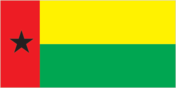
two equal horizontal bands of yellow (top) and green with a vertical red band on the hoist side; there is a black five-pointed star centered in the red band; uses the popular pan-African colors of Ethiopia Economy Guinea-Bissau
GDP - composition by sector
- agriculture
- 62%
- industry
- 12%
- services
- 26% (1999 est.)
GDP - per capita
purchasing power parity - $700 (2004 est.)
GDP - real growth rate
2.6% (2004 est.)
GDP (purchasing power parity)
$1.008 billion (2004 est.)
Geographic coordinates
12 00 N, 15 00 W
Geography - note
this small country is swampy along its western coast and low-lying further inland People Guinea-Bissau
Government type
republic, multiparty since mid-1991
Highways
- paved
- 453 km
- total
- 4,400 km
- unpaved
- 3,947 km (1999 est.)
HIV/AIDS - adult prevalence rate
10% (2003 est.)
HIV/AIDS - deaths
1,200 (2001 est.)
HIV/AIDS - people living with HIV/AIDS
17,000 (2001 est.)
Household income or consumption by percentage share
lowest 10%: 0.5% highest 10%: 42.4% (1991)
Imports
$104 million f.o.b. (2002 est.)
Imports - commodities
foodstuffs, machinery and transport equipment, petroleum products
Imports - partners
Senegal 44.6%, Portugal 13.8%, China 4.2% (2004)
Independence
24 September 1973 (unilaterally declared by Guinea-Bissau); 10 September 1974 (recognized by Portugal)
Industrial production growth rate
2.6% (1997 est.)
Industries
agricultural products processing, beer, soft drinks
Infant mortality rate
- female
- 96.25 deaths/1,000 live births (2005 est.)
- male
- 117.78 deaths/1,000 live births
- total
- 107.17 deaths/1,000 live births
Inflation rate (consumer prices)
4% (2002 est.)
International organization participation
ACCT, ACP, AfDB, AU, ECOWAS, FAO, FZ, G-77, IBRD, ICAO, ICCt (signatory), ICFTU, ICRM, IDA, IDB, IFAD, IFC, IFRCS, ILO, IMF, IMO, Interpol, IOC, IOM, ITU, NAM, OIC, OPCW (signatory), UN, UNCTAD, UNESCO, UNIDO, UPU, WADB (regional), WAEMU, WFTU, WHO, WIPO, WMO, WToO, WTO
Internet country code
.gw
Internet hosts
2 (2004)
Internet Service Providers (ISPs)
2 (2002)
Internet users
19,000 (2003) Transportation Guinea-Bissau
Irrigated land
170 sq km (1998 est.)
Judicial branch
Supreme Court or Supremo Tribunal da Justica (consists of nine justices appointed by the president and serve at his pleasure; final court of appeals in criminal and civil cases); Regional Courts (one in each of nine regions; first court of appeals for Sectoral Court decisions; hear all felony cases and civil cases valued at over $1,000); 24 Sectoral Courts (judges are not necessarily trained lawyers; they hear civil cases under $1,000 and misdemeanor criminal cases)
Labor force
480,000 (1999)
Labor force - by occupation
agriculture 82% (2000 est.)
Land boundaries
- border countries
- Guinea 386 km, Senegal 338 km
- total
- 724 km
Land use
- arable land
- 10.67%
- other
- 80.51% (2001)
- permanent crops
- 8.82%
Languages
Portuguese (official), Crioulo, African languages
Legal system
NA
Legislative branch
- unicameral National People's Assembly or Assembleia Nacional Popular (100 seats; members are elected by popular vote to serve a maximum of four years)
- election results
- percent of vote by party - PAIGC 31.5%, PRS 24.8%, PUSD 16.1%, UE 4.1%, APU 1.3%, 13 other parties 22.2%; seats by party - PAIGC 45, PRS 35, PUSD 17, UE 2, APU 1
- elections
- last held 28 March 2004 (next to be held NA 2008)
Life expectancy at birth
- female
- 48.52 years (2005 est.)
- male
- 44.77 years
- total population
- 46.61 years
Literacy
- definition: age 15 and over can read and write
- female
- 27.4% (2003 est.) Government Guinea-Bissau
- male
- 58.1%
- total population
- 42.4%
Location
Western Africa, bordering the North Atlantic Ocean, between Guinea and Senegal
Major infectious diseases
- degree of risk
- very high
- food or waterborne diseases
- bacterial and protozoal diarrhea, hepatitis A, and typhoid fever
- respiratory disease
- meningococcal meningitis (2004)
- vectorborne diseases
- malaria and yellow fever are high risks in some locations
- water contact disease
- schistosomiasis
Manpower available for military service
males age 18-49: 288,770 (2005 est.)
Manpower fit for military service
males age 18-49: 152,760 (2005 est.)
Map references
Africa
Maritime claims
- exclusive economic zone
- 200 nm
- territorial sea
- 12 nm
Median age
- female
- 19.57 years (2005 est.)
- male
- 18.37 years
- total
- 18.97 years
Military branches
People's Revolutionary Armed Force (FARP; includes Army, Navy, and Air Force), paramilitary force
Military expenditures - dollar figure
$8.9 million (2004)
Military expenditures - percent of GDP
3.1% (2004) Transnational Issues Guinea-Bissau
Military service age and obligation
18 years of age for compulsory military service (2001)
National holiday
Independence Day, 24 September (1973)
Nationality
- adjective
- Guinean
- noun
- Guinean(s)
Natural hazards
hot, dry, dusty harmattan haze may reduce visibility during dry season; brush fires
Natural resources
fish, timber, phosphates, bauxite, clay, granite, limestone, unexploited deposits of petroleum
Net migration rate
-1.54 migrant(s)/1,000 population (2005 est.)
Oil - consumption
2,500 bbl/day (2001 est.)
Oil - exports
NA
Oil - imports
NA
Oil - production
0 bbl/day (2001 est.)
Political parties and leaders
African Party for the Independence of Guinea-Bissau and Cape Verde or PAIGC [Carlos GOMES Junior]; Front for the Liberation and Independence of Guinea or FLING [Francois MENDY]; Guinea-Bissau Resistance-Ba Fata Movement or RGB-MB [Helder Vaz LOPES]; Guinean Civic Forum or FCG [Antonieta Rosa GOMES]; International League for Ecological Protection or LIPE [Alhaje Bubacar DJALO, president]; National Union for Democracy and Progress or UNDP [Abubacer BALDE, secretary general]; Party for Democratic Convergence or PCD [Victor MANDINGA]; Social Renovation Party or PRS [Kumba YALA]; Union for Change or UM [Jorge MANDINGA, president, Dr. Anne SAAD, secretary general]; United Platform or UP [coalition formed by PCD, FDS, FLING, and RGB-MB]; United Social Democratic Party or PUSD [Francisco Jose FADUL]
Political pressure groups and leaders
NA
Population
1,416,027 (July 2005 est.)
Population below poverty line
NA
Population growth rate
1.96% (2005 est.)
Ports and harbors
Bissau, Buba, Cacheu, Farim
Radio broadcast stations
AM 1 (transmitter out of service), FM 4, shortwave 0 (2002)
Radios
49,000 (1997)
Religions
indigenous beliefs 50%, Muslim 45%, Christian 5%
Sex ratio
- at birth
- 1.03 male(s)/female under 15 years: 1 male(s)/female 15-64 years: 0.92 male(s)/female 65 years and over: 0.74 male(s)/female
- total population
- 0.94 male(s)/female (2005 est.)
Suffrage
18 years of age; universal
Telephone system
- domestic
- combination of microwave radio relay, open-wire lines, radiotelephone, and cellular communications
- general assessment
- small system
- international
- country code - 245
Telephones - main lines in use
10,600 (2003)
Telephones - mobile cellular
1,300 (2003)
Television broadcast stations
NA (1997)
Televisions
NA
Terrain
mostly low coastal plain rising to savanna in east
Total fertility rate
4.93 children born/woman (2005 est.)
Unemployment rate
NA (1998)
Waterways
4 largest rivers are navigable for some distance; many inlets and creeks give shallow-water access to much of interior (2004)