1996 Edition
CIA World Factbook 1996 (Project Gutenberg)
Introduction
Description
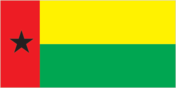
two equal horizontal bands of yellow (top) and green with a vertical red band on the hoist side; there is a black five-pointed star centered in the red band; uses the popular pan-African colors of Ethiopia
Location
12 00 N, 15 00 W -- Western Africa, bordering the North Atlantic Ocean, between Guinea and Senegal Flag ----
Geography
Area
- comparative area
- slightly less than three times the size of Connecticut
- land area
- 28,000 sq km
- total area
- 36,120 sq km
Climate
tropical; generally hot and humid; monsoonal-type rainy season (June to November) with southwesterly winds; dry season (December to May) with northeasterly harmattan winds
Coastline
350 km
Environment
- current issues
- deforestation; soil erosion; overgrazing; overfishing
- international agreements
- party to - Biodiversity, Climate Change, Desertification, Endangered Species, Law of the Sea, Nuclear Test Ban, Wetlands
- natural hazards
- hot, dry, dusty harmattan haze may reduce visibility during dry season; brush fires
Geographic coordinates
12 00 N, 15 00 W
International disputes
none
Irrigated land
NA sq km
Land boundaries
- border countries
- Guinea 386 km, Senegal 338 km
- total
- 724 km
Land use
- arable land
- 11%
- forest and woodland
- 38%
- meadows and pastures
- 43%
- other
- 7%
- permanent crops
- 1%
Location
Western Africa, bordering the North Atlantic Ocean, between Guinea and Senegal
Map references
Africa
Maritime claims
- exclusive economic zone
- 200 nm
- territorial sea
- 12 nm
Natural resources
phosphates, bauxite, unexploited deposits of petroleum, fish, timber
Terrain
- mostly low coastal plain rising to savanna in east
- highest point
- unnamed location in the northeast corner of the country 300 m
- lowest point
- Atlantic Ocean 0 m
People and Society
Age structure
0-14 years: 43% (male 247,471; female 246,725) 15-64 years: 54% (male 295,132; female 329,681) 65 years and over: 3% (male 15,603; female 16,718) (July 1996 est.)
Birth rate
39.7 births/1,000 population (1996 est.)
Death rate
16.23 deaths/1,000 population (1996 est.)
Ethnic divisions
African 99% (Balanta 30%, Fula 20%, Manjaca 14%, Mandinga 13%, Papel 7%), European and mulatto less than 1%
Infant mortality rate
115.8 deaths/1,000 live births (1996 est.)
Languages
Portuguese (official), Criolo, African languages
Life expectancy at birth
- female
- 49.99 years (1996 est.)
- male
- 46.63 years
- total population
- 48.28 years
Literacy
- age 15 and over can read and write (1995 est.)
- female
- 42.5%
- male
- 68%
- total population
- 54.9%
Nationality
- adjective
- Guinea-Bissauan
- noun
- Guinea-Bissauan(s)
Net migration rate
0 migrant(s)/1,000 population (1996 est.)
Population
1,151,330 (July 1996 est.)
Population growth rate
2.35% (1996 est.)
Religions
indigenous beliefs 65%, Muslim 30%, Christian 5%
Sex ratio
- all ages
- 0.94 male(s)/female (1996 est.)
- at birth
- 1.03 male(s)/female
- under 15 years
- 1 male(s)/female 15-64 years: 0.9 male(s)/female 65 years and over: 0.93 male(s)/female
Total fertility rate
5.34 children born/woman (1996 est.)
Government
Administrative divisions
9 regions (regioes, singular - regiao); Bafata, Biombo, Bissau, Bolama, Cacheu, Gabu, Oio, Quinara, Tombali
Capital
Bissau
Constitution
16 May 1984, amended 4 May 1991 (currently undergoing revision to liberalize popular participation in the government)
Data code
PU
Diplomatic representation in US
- chancery
- 918 16th Street NW, Mezzanine Suite, Washington, DC 20006
- chief of mission
- Ambassador Alfredo Lopes CABRAL
- telephone
- [1] (202) 872-4222
Executive branch
- cabinet
- Council of Ministers was appointed by the president
- chief of state
- President of the Republic of Guinea-Bissau Joao Bernardo VIEIRA (assumed power 14 November 1980) was elected for a five-year term by universal suffrage; election last held August 1994 (next to be held 1999); results - Joao Bernardo VIEIRA 52%, Kumba YALLA 48%
- head of government
- Prime Minister Manuel SATURNINO (since 5 November 1994) was appointed by the president
FAX
- [1] (202) 872-4226
- [245] 252282
Flag
two equal horizontal bands of yellow (top) and green with a vertical red band on the hoist side; there is a black five-pointed star centered in the red band; uses the popular pan-African colors of Ethiopia
Independence
10 September 1974 (from Portugal)
International organization participation
ACCT (associate), ACP, AfDB, ECA, ECOWAS, FAO, G-77, IBRD, ICAO, ICRM, IDA, IDB, IFAD, IFC, IFRCS, ILO, IMF, IMO, Intelsat (nonsignatory user), Interpol, IOM (observer), ITU, NAM, OAU, OIC, UN, UNAMIR, UNAVEM III, UNCTAD, UNESCO, UNIDO, UNOMIL, UPU, WFTU, WHO, WIPO, WMO, WToO, WTrO
Judicial branch
none; there is a Ministry of Justice in the Council of Ministers
Legal system
NA
Legislative branch
unicameral
Name of country
- conventional long form
- Republic of Guinea-Bissau
- conventional short form
- Guinea-Bissau
- former
- Portuguese Guinea
- local long form
- Republica de Guine-Bissau
- local short form
- Guine-Bissau
National holiday
Independence Day, 10 September (1974)
National People's Assembly
(Assembleia Nacional Popular) elections last held 3 July and 7 August 1994 (next to be held 1999); results - percent of vote by party NA; seats - (100 total) PAIGC 62, RGB 19, PRS 12, Union for Change Coalition 6, FLING 1
Political parties and leaders
African Party for the Independence of Guinea-Bissau and Cape Verde (PAIGC), President Joao Bernardo VIEIRA, leader; Guinea-Bissau Resistance (RGB), Helder Jorge VAZ Gomes Lopes, leader; Democratic Front (FD); Social Renovation Party (PRS), Koumba YALLA, leader; Union for Change Coalition; Front for the Liberation and Independence of Guinea (FLING); Democratic Social Front (FDS), Rafael BARBOSA, leader; Bafata Movement, Domingos Fernandes GARNER, leader; Guinea-Bissau Resistance (RGB); Union for Change Coalition
Suffrage
15 years of age; universal
Type of government
republic, formerly highly centralized, multiparty since mid-1991
US diplomatic representation
- chief of mission
- Ambassador Peggy BLACKFORD
- embassy
- Bairro de Penha, Bissau
- mailing address
- C.P. 297, 1067 Bissau Codex, Bissau, Guinea-Bissau
- telephone
- [245] 252273, 252274, 252275, 252276
Economy
Agriculture
rice, corn, beans, cassava (tapioca), cashew nuts, peanuts, palm kernels, cotton; fishing and forest potential not fully exploited
Budget
- expenditures
- $NA, including capital expenditures of $NA
- revenues
- $NA
Currency
1 Guinea-Bissauan peso (PG) = 100 centavos
Economic aid
- recipient
- ODA, $NA
Economic overview
Guinea-Bissau ranks among the poorest countries in the world. Agriculture and fishing are the main economic activities. Cashew nuts, peanuts, and palm kernels are the primary exports. Exploitation of known mineral deposits is unlikely at present because of a weak infrastructure and the high cost of development. With IMF support, the country is committed to an economic reform program emphasizing monetary stability and private sector growth. This process will continue at a slow pace because of a heavy foreign debt burden and internal constraints.
Electricity
- capacity
- 22,000 kW
- consumption per capita
- 37 kWh (1993)
- production
- 40 million kWh
Exchange rates
Guinea-Bissauan pesos (PG) per US$1 - 17,659 (December 1995), 12,892 (1994), 10,082 (1993), 6,934 (1992), 3,659 (1991), 2,185 (1990)
Exports
- $32 million (f.o.b., 1994)
- commodities
- cashews, fish, peanuts, palm kernels
- partners
- Portugal, Spain, Senegal, India, Nigeria, Cote d'Ivoire
External debt
$692 million (December 1993 est.)
Fiscal year
calendar year
GDP
purchasing power parity - $1 billion (1994 est.)
GDP composition by sector
- agriculture
- 44%
- industry
- 8%
- services
- 48% (1993 est.)
GDP per capita
$900 (1995 est.)
GDP real growth rate
NA%
Imports
- $63 million (f.o.b., 1994)
- commodities
- foodstuffs, transport equipment, petroleum products, machinery and equipment
- partners
- Portugal, Netherlands, China, Germany, Senegal
Industrial production growth rate
NA%
Industries
agricultural products processing, beer, soft drinks
Inflation rate (consumer prices)
15% (1994 est.)
Labor force
- 403,000 (est.)
- by occupation
- agriculture 90%, industry, services, and commerce 5%, government 5%
Unemployment rate
NA%
Communications
Branches
People's Revolutionary Armed Force (FARP; includes Army, Navy, and Air Force), paramilitary force
Defense expenditures
exchange rate conversion - $9 million, 4.5% of GDP (1994)
Manpower availability
- males age 15-49
- 259,738
- males fit for military service
- 148,291 (1996 est.)
Radio broadcast stations
AM 2, FM 3, shortwave 0
Radios
40,000 (1992 est.)
Telephone system
- poor system
- domestic
- combination of microwave radio relay, open-wire lines, and radiotelephone communications
- international
- NA
Telephones
3,000 (1988 est.)
Television broadcast stations
1
Televisions
NA Defense