1991 Edition
CIA World Factbook 1991 (Project Gutenberg)
Geography
Climate
tropical; generally hot and humid; monsoon-type rainy season (June to November) with southwesterly winds; dry season (December to May) with northeasterly harmattan winds
Coastline
350 km
Comparative area
slightly less than three times the size of Connecticut
Disputes
the International Court of Justice (ICJ) has rendered its decision on the Guinea-Bissau/Senegal maritime boundary (in favor of Senegal)--that decision has been rejected by Guinea-Bissau
Environment
hot, dry, dusty harmattan haze may reduce visibility during dry season
Land boundaries
724 km total; Guinea 386, Senegal 338 km
Land use
arable land 11%; permanent crops 1%; meadows and pastures 43%; forest and woodland 38%; other 7%
Maritime claims
Exclusive economic zone: 200 nm; Territorial sea: 12 nm
Natural resources
unexploited deposits of petroleum, bauxite, phosphates; fish, timber
Terrain
mostly low coastal plain rising to savanna in east
Total area
36,120 km2; land area: 28,000 km2
People and Society
Birth rate
42 births/1,000 population (1991)
Death rate
18 deaths/1,000 population (1991)
Ethnic divisions
African about 99% (Balanta 30%, Fula 20%, Manjaca 14%, Mandinga 13%, Papel 7%); European and mulatto less than 1%
Infant mortality rate
125 deaths/1,000 live births (1991)
Labor force
403,000 (est.); agriculture 90%, industry, services, and commerce 5%, government 5%; population of working age 53% (1983)
Language
Portuguese (official); Criolo and numerous African languages
Life expectancy at birth
45 years male, 48 years female (1991)
Literacy
36% (male 50%, female 24%) age 15 and over can read and write (1990 est.)
Nationality
noun--Guinea-Bissauan(s); adjective--Guinea-Bissauan
Net migration rate
0 migrants/1,000 population (1991)
Organized labor
only one trade union--the National Union of Workers of Guinea-Bissau (UNTG)
Population
1,023,544 (July 1991), growth rate 2.4% (1991)
Religion
indigenous beliefs 65%, Muslim 30%, Christian 5%
Total fertility rate
5.8 children born/woman (1991)
Government
Administrative divisions
9 regions (regioes, singular--regiao); Bafata, Biombo, Bissau, Bolama, Cacheu, Gabu, Oio, Quinara, Tombali
Capital
Bissau
Communists
a few Communists, some sympathizers
Constitution
16 May 1984
Diplomatic representation
Ambassador Alfredo Lopes CABRAL; Chancery (temporary) at the Guinea-Bissauan Permanent Mission to the UN, Suite 604, 211 East 43rd Street, New York, NY 10017; telephone (212) 661-3977; US--Ambassador William L. JACOBSEN, Jr.; Embassy at 17 Avenida Domingos Ramos, Bissau (mailing address is 1067 Bissau Codex, Bissau, Guinea-Bissau); telephone [245] 20-1139, 20-1145, 20-1113
Elections
President of Council of State--last held 19 June 1989 (next to be held NA 1993); results--Brig. Gen. Joao Bernardo VIEIRA was reelected without opposition by the National People's Assembly; National People's Assembly--last held 15 June 1989 (next to be held 15 June 1994); results--PAIGC is the only party; seats--(150 total) PAIGC 150, appointed by Regional Councils
Executive branch
president of the Council of State, vice presidents of the Council of State, Council of State, Council of Ministers (cabinet)
Flag
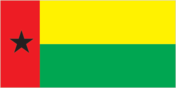
two equal horizontal bands of yellow (top) and green with a vertical red band on the hoist side; there is a black five-pointed star centered in the red band; uses the popular pan-African colors of Ethiopia; similar to the flag of Cape Verde which has the black star raised above the center of the red band and is framed by two corn stalks and a yellow clam shell
Independence
24 September 1973 (from Portugal; formerly Portuguese Guinea)
Judicial branch
none; there is a Ministry of Justice in the Council of Ministers
Leaders
Chief of State and Head of Government--President of the Council of State Brig. Gen. Joao Bernardo VIEIRA (assumed power 14 November 1980 and elected President of Council of State on 16 May 1984); First Vice President Col. Iafai CAMARA (since 7 November 1985); Second Vice President Vasco CABRAL (since 21 June 1989)
Legal system
NA
Legislative branch
unicameral National People's Assembly (Assembleia Nacional Popular)
Long-form name
Republic of Guinea-Bissau
Member of
ACCT (associate), ACP, AfDB, ECA, ECOWAS, FAO, G-77, IBRD, ICAO, IDA, IDB, IFAD, IFC, ILO, IMF, IMO, IOM (observer), ITU, LORCS, NAM, OAU, OIC, UN, UNCTAD, UNESCO, UNIDO, UPU, WFTU, WHO, WIPO, WMO
National holiday
Independence Day, 24 September (1973)
Political parties and leaders
only party--African Party for the Independence of Guinea-Bissau and Cape Verde (PAIGC), President Joao Bernardo VIEIRA, leader; the party decided to retain the binational title despite its formal break with Cape Verde
Suffrage
universal at age 15
Type
republic; highly centralized one-party regime since September 1974; the African Party for the Independence of Guinea-Bissau and Cape Verde (PAIGC) held an extraordinary party congress in December 1990 and established a two-year transition program during which the constitution will be revised, allowing for multiple political parties and a presidential election in 1993
Economy
Agriculture
accounts for over 50% of GDP, nearly 100% of exports, and 90% of employment; rice is the staple food; other crops include corn, beans, cassava, cashew nuts, peanuts, palm kernels, and cotton; not self-sufficient in food; fishing and forestry potential not fully exploited
Budget
revenues $22.7 million; expenditures $30.8 million, including capital expenditures of $18.0 million (1989 est.)
Currency
Guinea-Bissauan peso (plural--pesos); 1 Guinea-Bissauan peso (PG) = 100 centavos
Economic aid
US commitments, including Ex-Im (FY70-89), $49 million; Western (non-US) countries, ODA and OOF bilateral commitments (1970-88), $561 million; OPEC bilateral aid (1979-89), $41 million; Communist countries (1970-89), $68 million
Electricity
22,000 kW capacity; 28 million kWh produced, 30 kWh per capita (1989)
Exchange rates
Guinea-Bissauan pesos (PG) per US$1--1987.2 (1989), 1363.6 (1988), 851.65 (1987), 238.98 (1986), 173.61 (1985)
Exports
$14.2 million (f.o.b., 1989 est.); commodities--cashews, fish, peanuts, palm kernels; partners--Portugal, Senegal, France, The Gambia, Netherlands, Spain
External debt
$462 million (December 1990 est.)
Fiscal year
calendar year
GDP
$154 million, per capita $160; real growth rate 5.0% (1989)
Imports
$68.9 million (f.o.b., 1989 est.); commodities--capital equipment, consumer goods, semiprocessed goods, foods, petroleum; partners--Portugal, Netherlands, Senegal, USSR, Germany
Industrial production
growth rate - 1.0% (1989 est.); accounts for 10% of GDP (1989 est.)
Industries
agricultural processing, beer, soft drinks
Inflation rate (consumer prices)
25% (1990 est.)
Overview
Guinea-Bissau ranks among the poorest countries in the world, with a per capita GDP below $200. Agriculture and fishing are the main economic activities, with cashew nuts, peanuts, and palm kernels the primary exports. Exploitation of known mineral deposits is unlikely at present because of a weak infrastructure and the high cost of development. The government's four-year plan (1988-91) has targeted agricultural development as the top priority.
Unemployment rate
NA%
Communications
Airports
37 total, 18 usable; 5 with permanent-surface runways; none with runways over 3,659 m; 1 with runways 2,440-3,659 m; 5 with runways 1,220-2,439 m
Civil air
2 major transport aircraft
Highways
3,218 km; 2,698 km bituminous, remainder earth
Inland waterways
scattered stretches are important to coastal commerce
Ports
Bissau
Telecommunications
poor system of radio relay, open-wire lines, and radiocommunications; 3,000 telephones; stations--1 AM, 2 FM, 1 TV; 1 Atlantic Ocean INTELSAT earth station
Military and Security
Branches
People's Revolutionary Armed Force (FARP; including Army, Navy, Air Force), paramilitary force
Defense expenditures
$5 million, 3.2% of GDP (1987) _%_
Manpower availability
males 15-49, 222,371; 126,797 fit for military service