2020 Edition
factbook.json (GitHub)
Introduction
Background
Guam was settled by Austronesian people around 1500 B.C. These people became the indigenous Chamorro and were influenced by later migrations, including the Micronesians in the first millennium A.D., and island Southeast Asians around 900. Society was stratified, with higher classes living along the coast and lower classes living inland. Spanish explorer Ferdinand MAGELLAN was the first European to see Guam in 1521, and Spain claimed the island in 1565 because it served as a refueling stop for ships between Mexico and the Philippines. Spain formally colonized Guam in 1668. Spain’s brutal repression of the Chamorro, along with new diseases and intermittent warfare, reduced the indigenous population from more than 100,000 to less than 5,000 by the 1700s. Spain tried to repopulate the island by forcing people from nearby islands to settle on Guam and preventing them from escaping. Guam became a hub for whalers and traders in the western Pacific in the early 1800s. During the 1898 Spanish-American War, the US Navy occupied Guam and set up a military administration. The US Navy opposed local control of government despite repeated petitions from the Chamorro. Japan invaded Guam in 1941 and instituted a repressive regime. During the US recapture of Guam in 1944, the island’s two largest villages were destroyed. After World War II, political pressure from local Chamorro leaders led to Guam being established as an unincorporated organized US territory in 1950, with US citizenship granted to all Chamorro. In a referendum in 1982, more than 75% of voters chose closer relations with the US over independence, although no change in status was made because of disagreements on the future right of Chamorro self-determination. The US military holds about 29% of Guam’s land and stations several thousand troops on the island. The installations are some of the most strategically important US bases in the Pacific; they also constitute the island’s most important source of income and economic stability.
Geography
Area
- land
- 544 sq km
- total
- 544 sq km
- water
- 0 sq km
Area - comparative
three times the size of Washington, D.C.
Climate
tropical marine; generally warm and humid, moderated by northeast trade winds; dry season (January to June), rainy season (July to December); little seasonal temperature variation
Coastline
125.5 km
Elevation
- highest point
- Mount Lamlam 406 m
- lowest point
- Pacific Ocean 0 m
Geographic coordinates
13 28 N, 144 47 E
Geography - note
largest and southernmost island in the Mariana Islands archipelago and the largest island in Micronesia; strategic location in western North Pacific Ocean
Irrigated land
2 sq km (2012)
Land boundaries
- total
- 0 km
Land use
- agricultural land
- 29.6% (2023 est.)
- agricultural land: arable land
- arable land: 1.9% (2023 est.)
- agricultural land: permanent crops
- permanent crops: 13% (2023 est.)
- agricultural land: permanent pasture
- permanent pasture: 14.8% (2023 est.)
- forest
- 52.4% (2023 est.)
- other
- 18% (2023 est.)
Location
Oceania, island in the North Pacific Ocean, about three-quarters of the way from Hawaii to the Philippines
Map references
Oceania
Maritime claims
- exclusive economic zone
- 200 nm
- territorial sea
- 12 nm
Natural hazards
frequent squalls during rainy season; relatively rare but potentially destructive typhoons (June to December)
Natural resources
aquatic wildlife (supporting tourism), fishing (largely undeveloped)
Population distribution
no large cities exist on the island; large villages (municipalities) attract much of the population; the largest of these is Dededo
Terrain
volcanic origin, surrounded by coral reefs; relatively flat coralline limestone plateau (source of most fresh water), with steep coastal cliffs and narrow coastal plains in north, low hills in center, mountains in south
People and Society
Age structure
- 0-14 years
- 26.4% (male 23,139/female 21,632)
- 15-64 years
- 62.7% (male 55,591/female 50,741)
- 65 years and over
- 10.9% (2024 est.) (male 8,615/female 9,814)
Birth rate
17.9 births/1,000 population (2025 est.)
Currently married women (ages 15-49)
40.4% (2020 est.)
Death rate
6.18 deaths/1,000 population (2025 est.)
Dependency ratios
- elderly dependency ratio
- 17.3 (2024 est.)
- potential support ratio
- 5.8 (2024 est.)
- total dependency ratio
- 59.4 (2024 est.)
- youth dependency ratio
- 42.1 (2024 est.)
Drinking water source
- improved: total
- total: 99.7% of population (2022 est.)
- unimproved: total
- total: 0.3% of population (2022 est.)
Ethnic groups
Native Hawaiian and other Pacific Islander 46.1% (Chamorro 32.8%, Chuukese 6.7%, Palauan 1.4%, Pohnpeian 1.4%, Yapese 1%, other Native Hawaiian and other Pacific Islander 2.8%), Asian 35.5% (Filipino 29.1%, Korean 2.2%, Japanese 1.4%, Chinese (except Taiwanese) 1.3%, other Asian 1.5%), White 6.8%, African descent or African-American 0.9%, Indigenous 0.1%, other 0.6%, mixed 10% (2020 est.)
Gross reproduction rate
1.31 (2025 est.)
Infant mortality rate
- female
- 10.9 deaths/1,000 live births
- male
- 11 deaths/1,000 live births
- total
- 10.7 deaths/1,000 live births (2025 est.)
Languages
English 43.3%, Filipino 24.9%, Chamorro 16%, other Pacific Island languages 9.4%, Asian languages 6.5% (2020 est.)
Life expectancy at birth
- female
- 80.5 years
- male
- 75.6 years
- total population
- 78 years (2024 est.)
Major urban areas - population
147,000 HAGATNA (capital) (2018)
Median age
- female
- 31.1 years
- male
- 29.6 years
- total
- 30.5 years (2025 est.)
Nationality
- adjective
- Guamanian
- noun
- Guamanian(s) (US citizens)
Net migration rate
-10.92 migrant(s)/1,000 population (2025 est.)
Population
- female
- 82,187
- male
- 87,345
- total
- 169,532 (2024 est.)
Population growth rate
0.08% (2025 est.)
Religions
Christian (predominantly Roman Catholic) 94.2%, folk religions 1.5%, Buddhist 1.1%, other 1.6%, unaffiliated 1.7% (2020 est.)
Sanitation facility access
- improved: total
- total: 99.2% of population (2022 est.)
- unimproved: total
- total: 0.8% of population (2022 est.)
Sex ratio
- 0-14 years
- 1.07 male(s)/female
- 15-64 years
- 1.1 male(s)/female
- 65 years and over
- 0.88 male(s)/female
- at birth
- 1.07 male(s)/female
- total population
- 1.06 male(s)/female (2024 est.)
Total fertility rate
2.7 children born/woman (2025 est.)
Urbanization
- rate of urbanization
- 0.84% annual rate of change (2020-25 est.)
- urban population
- 95.2% of total population (2022)
Government
Capital
- etymology
- the name Hagatna is derived from the Chamorro word haga, meaning "life's blood" and referring to the town's role as the center of government for the island
- geographic coordinates
- 13 28 N, 144 44 E
- name
- Hagatna (Agana)
- time difference
- UTC+10 (15 hours ahead of Washington, DC, during Standard Time)
Citizenship
see United States
Constitution
- history
- effective 1 July 1950 (Guam Act of 1950 serves as a constitution)
Country name
- abbreviation
- GU
- conventional long form
- none
- conventional short form
- Guam
- etymology
- the native Chamorro name for the island, Guahan (meaning "we have"), was changed to Guam in the 1898 Treaty of Paris, when Spain relinquished Guam, Cuba, Puerto Rico, and the Philippines to the US
- local long form
- none
- local short form
- Guahan
Dependency status
unincorporated, organized territory of the US, with policy relations between Guam and the Federal government under the jurisdiction of the Office of Insular Affairs, US Department of the Interior
Diplomatic representation from the US
- embassy
- none (territory of the US)
Diplomatic representation in the US
none (territory of the US)
Executive branch
- cabinet
- Cabinet appointed by the governor with the consent of the Legislature
- chief of state
- President Donald J. TRUMP (since 20 January 2025)
- election results
- 2022: Lourdes LEON GUERRERO reelected governor; percent of vote - Lourdes LEON GUERRERO (Democratic Party) 55%, Felix CAMACHO (Republican Party) 44%; Josh TENORIO (Democratic Party) elected lieutenant governor 2018: Lourdes LEON GUERRERO elected governor; percent of vote - Lourdes LEON GUERRERO (Democratic Party) 50.7%, Ray TENORIO (Republican Party) 26.4%; Josh TENORIO (Democratic Party) elected lieutenant governor
- election/appointment process
- president and vice president indirectly elected on the same ballot by an Electoral College of electors chosen from each state to serve a 4-year term (eligible for a second term); under the US Constitution, residents of unincorporated territories, such as Guam, do not vote in elections for US president and vice president, but they can vote in Democratic and Republican presidential primary elections; governor and lieutenant governor elected on the same ballot by absolute majority vote in 2 rounds, if needed, for a 4-year term (eligible for 2 consecutive terms)
- expected date of next election
- gubernatorial: 3 November 2026
- head of government
- Governor Lourdes LEON GUERRERO (since 7 January 2019)
- most recent election date
- gubernatorial: 8 November 2022
Flag
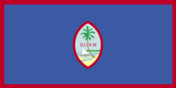
description: territorial flag is dark blue with a narrow red border on all four sides; centered is a red-bordered, pointed, vertical ellipse containing a beach scene, a proa (outrigger canoe with sail), and a palm tree; the word GUAM in red is centered in the ellipse; the proa is sailing in Agana Bay with the promontory of Puntan Dos Amantes in the background meaning: blue stands for the sea and red for the blood shed in the fight against oppression; the central emblem is shaped like a Chamorro sling stone (a weapon for defense or hunting)
Government type
unincorporated organized territory of the US with local self-government; republican form of territorial government with separate executive, legislative, and judicial branches
Independence
none (territory of the US)
International organization participation
AOSIS (observer), IOC, PIF (observer), SPC, UPU
Judicial branch
- highest court(s)
- Supreme Court of Guam (consists of 3 justices)
- judge selection and term of office
- justices appointed by the governor and confirmed by the Guam legislature; justices appointed for life but subject to retention election every 10 years
- subordinate courts
- Superior Court of Guam (includes several divisions); US Federal District Court for the District of Guam (a US territorial court; appeals beyond this court are heard before the US Court of Appeals for the Ninth Circuit)
Legal system
common law modeled on US system; US federal laws apply
Legislative branch
- electoral system
- plurality/majority
- expected date of next election
- November 2024
- legislative structure
- unicameral
- legislature name
- Legislature of Guam (Liheslaturan Guahan)
- most recent election date
- 11/8/2022
- number of seats
- 15 (directly elected)
- parties elected and seats per party
- Democratic Party (9); Republican Party (6)
- percentage of women in chamber
- 40%
- scope of elections
- full renewal
- term in office
- 2 years
National anthem(s)
- history
- official anthem, as a US territory; played before "Stand, Ye Guamanians"
- lyrics/music
- Francis Scott KEY/John Stafford SMITH
- title
- "The Star-Spangled Banner"
National color(s)
deep blue, red
National holiday
Discovery Day (or Magellan Day), first Monday in March (1521)
National symbol(s)
coconut tree
Political parties
Democratic Party Republican Party
Suffrage
18 years of age; universal
Economy
Agricultural products
fruits, copra, vegetables; eggs, pork, poultry, beef
Average household expenditures
- on alcohol and tobacco
- 1.3% of household expenditures (2021 est.)
- on food
- 34.6% of household expenditures (2021 est.)
Budget
- expenditures
- $1.299 billion (2016 est.)
- revenues
- $1.24 billion (2016 est.)
Economic overview
small Pacific island US territorial economy; upper income, tourism-based economy; hard-hit by COVID-19 disruptions; relaunched many industries via vaccination tourism; domestic economy relies on multiple military bases; environmentally fragile economy
Exchange rates
the US dollar is used
Exports
- Exports 2020
- $379 million (2020 est.)
- Exports 2021
- $193 million (2021 est.)
- Exports 2022
- $545 million (2022 est.)
Exports - commodities
scrap iron, scrap copper, trunks and cases (2023)
Exports - partners
Taiwan 42%, Hong Kong 12%, Philippines 11%, Italy 8%, Australia 6% (2023)
GDP (official exchange rate)
$6.91 billion (2022 est.)
Imports
- Imports 2020
- $3.388 billion (2020 est.)
- Imports 2021
- $3.662 billion (2021 est.)
- Imports 2022
- $4.421 billion (2022 est.)
Imports - commodities
refined petroleum, cars, trunks and cases, gas turbines, flavored water (2023)
Imports - partners
Singapore 52%, Japan 15%, Malaysia 6%, Taiwan 4%, Greece 4% (2023)
Industries
national defense, tourism, construction, transshipment services, concrete products, printing and publishing, food processing, textiles
Labor force
77,700 (2024 est.)
Public debt
- Public debt 2013
- 32.1% of GDP (2013)
Real GDP growth rate
- Real GDP growth rate 2020
- -10.5% (2020 est.)
- Real GDP growth rate 2021
- 2.1% (2021 est.)
- Real GDP growth rate 2022
- 5.1% (2022 est.)
Real GDP per capita
- Real GDP per capita 2014
- $34,400 (2014 est.)
- Real GDP per capita 2015
- $35,200 (2015 est.)
- Real GDP per capita 2016
- $35,600 (2016 est.)
Unemployment rate
- Unemployment rate 2022
- 5.5% (2022 est.)
- Unemployment rate 2023
- 5.4% (2023 est.)
- Unemployment rate 2024
- 5.6% (2024 est.)
Youth unemployment rate (ages 15-24)
- female
- 14.1% (2024 est.)
- male
- 13.3% (2024 est.)
- total
- 13.7% (2024 est.)
Energy
Electricity
- consumption
- 1.715 billion kWh (2023 est.)
- installed generating capacity
- 525,000 kW (2023 est.)
- transmission/distribution losses
- 90.023 million kWh (2023 est.)
Electricity access
- electrification - total population
- 100% (2022 est.)
Electricity generation sources
- fossil fuels
- 92.1% of total installed capacity (2023 est.)
- solar
- 7.8% of total installed capacity (2023 est.)
- wind
- 0.1% of total installed capacity (2023 est.)
Energy consumption per capita
- Total energy consumption per capita 2019
- 150.555 million Btu/person (2019 est.)
Petroleum
- refined petroleum consumption
- 11,000 bbl/day (2023 est.)
Communications
Broadband - fixed subscriptions
- subscriptions per 100 inhabitants
- 2 (2022 est.)
- total
- 3,000 (2022 est.)
Broadcast media
about a dozen TV channels, including digital; multi-channel cable TV services are available; roughly 20 radio stations
Internet country code
.gu
Internet users
- percent of population
- 81% (2017 est.)
Telephones - fixed lines
- subscriptions per 100 inhabitants
- 43 (2022 est.)
- total subscriptions
- 70,000 (2021 est.)
Telephones - mobile cellular
- subscriptions per 100 inhabitants
- 62 (2009 est.)
- total subscriptions
- 98,000 (2009 est.)
Transportation
Airports
3 (2025)
Civil aircraft registration country code prefix
N
Heliports
2 (2025)
Merchant marine
- by type
- other 3
- total
- 3 (2023)
Ports
- key ports
- Apra Harbor
- large
- 0
- medium
- 1
- ports with oil terminals
- 1
- small
- 0
- total ports
- 1 (2024)
- very small
- 0
Military and Security
Military - note
the US military maintains thousands of active-duty uniformed personnel and several bases and installations on the island
Military and security forces
Guam Police Department (GPD); Guam (US) National Guard
Environment
Carbon dioxide emissions
- from petroleum and other liquids
- 1.819 million metric tonnes of CO2 (2023 est.)
- total emissions
- 1.819 million metric tonnes of CO2 (2023 est.)
Environmental issues
freshwater scarcity; reef damage; inadequate sewage treatment; rapid proliferation of the non-native brown tree snake
Waste and recycling
- municipal solid waste generated annually
- 141,500 tons (2024 est.)
- percent of municipal solid waste recycled
- 17.9% (2011 est.)