1999 Edition
CIA World Factbook 1999 (Internet Archive)
Geography
Area
total: 340 sq km land: 340 sq km water: 0 sq km
Area--comparative
twice the size of Washington, DC
Climate
tropical; tempered by northeast trade winds
Coastline
121 km
Elevation extremes
lowest point: Caribbean Sea 0 m highest point: Mount Saint Catherine 840 m
Environment--current issues
NA
Environment--international agreements
party to: Biodiversity, Climate Change, Desertification, Law of the Sea, Ozone Layer Protection, Whaling signed, but not ratified: none of the selected agreements
Geographic coordinates
12 07 N, 61 40 W
Geography--note
the administration of the islands of the Grenadines group is divided between Saint Vincent and the Grenadines and Grenada
Irrigated land
NA sq km
Land boundaries
0 km
Land use
arable land: 15% permanent crops: 18% permanent pastures: 3% forests and woodland: 9% other: 55% (1993 est.)
Location
Caribbean, island between the Caribbean Sea and Atlantic Ocean, north of Trinidad and Tobago
Map references
Central America and the Caribbean
Maritime claims
exclusive economic zone: 200 nm territorial sea: 12 nm
Natural hazards
lies on edge of hurricane belt; hurricane season lasts from June to November
Natural resources
timber, tropical fruit, deepwater harbors
Terrain
volcanic in origin with central mountains
People and Society
Age structure
0-14 years: 43% (male 21,055; female 20,365) 15-64 years: 53% (male 27,524; female 23,766) 65 years and over: 4% (male 2,034; female 2,264) (1999 est.)
Birth rate
27.62 births/1,000 population (1999 est.)
Death rate
5.15 deaths/1,000 population (1999 est.)
Ethnic groups
black
Infant mortality rate
11.13 deaths/1,000 live births (1999 est.)
Languages
English (official), French patois
Life expectancy at birth
total population: 71.6 years male: 68.97 years female: 74.29 years (1999 est.)
Literacy
definition: age 15 and over can read and write total population: 98% male: 98% female: 98% (1970 est.)
Nationality
noun: Grenadian(s) adjective: Grenadian
Net migration rate
-13.74 migrant(s)/1,000 population (1999 est.)
Population
97,008 (July 1999 est.)
Population growth rate
0.87% (1999 est.)
Religions
Roman Catholic 53%, Anglican 13.8%, other Protestant sects 33.2%
Sex ratio
at birth: 1.02 male(s)/female under 15 years: 1.03 male(s)/female 15-64 years: 1.16 male(s)/female 65 years and over: 0.9 male(s)/female total population: 1.09 male(s)/female (1999 est.)
Total fertility rate
3.57 children born/woman (1999 est.)
Government
Administrative divisions
6 parishes and 1 dependency*; Carriacou and Petit Martinique*, Saint Andrew, Saint David, Saint George, Saint John, Saint Mark, Saint Patrick
Capital
Saint George's
Constitution
19 December 1973
Country name
conventional long form: none conventional short form: Grenada
Data code
GJ
Executive branch
chief of state: Queen ELIZABETH II (since 6 February 1952), represented by Governor General Daniel WILLIAMS (since 9 August 1996) head of government: Prime Minister Keith MITCHELL (since 22 June 1995) cabinet: Cabinet appointed by the governor general on the advice of the prime minister elections: none; the monarch is hereditary; governor general appointed by the monarch; prime minister appointed by the governor general from among the members of the House of Assembly
Flag description
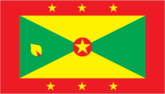
a rectangle divided diagonally into yellow triangles (top and bottom) and green triangles (hoist side and outer side), with a red border around the flag; there are seven yellow, five-pointed stars with three centered in the top red border, three centered in the bottom red border, and one on a red disk superimposed at the center of the flag; there is also a symbolic nutmeg pod on the hoist-side triangle (Grenada is the world's second-largest producer of nutmeg, after Indonesia); the seven stars represent the seven administrative divisions
Government type
parliamentary democracy
Independence
7 February 1974 (from UK)
International organization participation
ACP, C, Caricom, CDB, ECLAC, FAO, G-77, IBRD, ICAO, ICFTU, ICRM, IDA, IFAD, IFC, IFRCS, ILO, IMF, Interpol, IOC, ISO (subscriber), ITU, LAES, NAM, OAS, OECS, OPANAL, OPCW, UN, UNCTAD, UNESCO, UNIDO, UPU, WCL, WHO, WToO, WTrO Diplomatic representation in the US: chief of mission: Ambassador Denis G. ANTOINE chancery: 1701 New Hampshire Avenue NW, Washington, DC 20009 consulate(s): New York Diplomatic representation from the US: chief of mission: the ambassador to Barbados is accredited to Grenada embassy: Point Salines, Saint George's mailing address: P. O. Box 54, Saint George's, Grenada, West Indies
Judicial branch
West Indies Associate States Supreme Court (an associate judge resides in Grenada) Political parties and leaders: National Democratic Congress or
Legal system
based on English common law
Legislative branch
bicameral Parliament consists of the Senate (a 13-member body, 10 appointed by the government and three by the leader of the opposition) and the House of Representatives (15 seats; members are elected by popular vote to serve five-year terms) elections: last held on 18 January 1999 (next to be held by NA October 2004) election results: House of Representatives--percent of vote by party--NA; seats by party--NNP 15
National holiday
Independence Day, 7 February (1974)
Suffrage
18 years of age; universal
Economy
Agriculture--products
bananas, cocoa, nutmeg, mace, citrus, avocados, root crops, sugarcane, corn, vegetables
Budget
revenues: $85.8 million expenditures: $102.1 million, including capital expenditures of $28 million (1997)
Currency
1 East Caribbean dollar (EC$) = 100 cents
Debt--external
$74 million (1997 est.)
Economic aid--recipient
$8.3 million (1995)
Economy--overview
In this island economy progress in fiscal reforms and prudent macroeconomic management have boosted annual growth to nearly 5% in 1997-98. The increase in economic activity has been led by construction and trade. Tourist facilities are being expanded; tourism is the leading foreign exchange earner. Major short-term concerns are the rising fiscal deficit and the deterioration in the external account balance. Grenada shares a common central bank and a common currency with seven other members of the Organization of Eastern Caribbean States (OECS).
Electricity--consumption
70 million kWh (1996)
Electricity--exports
0 kWh (1996)
Electricity--imports
0 kWh (1996)
Electricity--production
70 million kWh (1996)
Electricity--production by source
fossil fuel: 100% hydro: 0% nuclear: 0% other: 0% (1996)
Exchange rates
East Caribbean dollars (EC$) per US$1--2.7000 (fixed rate since 1976)
Exports
$22 million (1997)
Exports--commodities
bananas, cocoa, nutmeg, fruit and vegetables, clothing, mace
Exports--partners
Caricom 32.3%, UK 20%, US 13%, Netherlands 8.8% (1991)
Fiscal year
calendar year
GDP
purchasing power parity--$340 million (1998 est.)
GDP--composition by sector
agriculture: 9.7% industry: 15% services: 75.3% (1996 est.)
GDP--per capita
purchasing power parity?$3,500 (1998 est.)
GDP--real growth rate
5% (1998 est.)
Household income or consumption by percentage share
lowest 10%: NA% highest 10%: NA%
Imports
$166.5 million (1997)
Imports--commodities
food 25%, manufactured goods 22%, machinery 20%, chemicals 10%, fuel 6% (1989)
Imports--partners
US 31.2%, Caricom 23.6%, UK 13.8%, Japan 7.1% (1991)
Industrial production growth rate
0.7% (1997 est.)
Industries
food and beverages, textiles, light assembly operations, tourism, construction
Inflation rate (consumer prices)
1.4% (1998)
Labor force
36,000
Labor force--by occupation
services 31%, agriculture 24%, construction 8%, manufacturing 5%, other 32% (1985)
Population below poverty line
NA%
Unemployment rate
20% (1 October 1996)
Communications
Radio broadcast stations
AM 1, FM 0, shortwave 0
Radios
80,000 (1993 est.)
Telephone system
automatic, islandwide telephone system domestic: interisland VHF and UHF radiotelephone links international: new SHF radiotelephone links to Trinidad and Tobago and Saint Vincent; VHF and UHF radio links to Trinidad
Telephones
5,650 (1988 est.)
Television broadcast stations
2 (1997)
Televisions
30,000 (1993 est.)
Transportation
Airports
3 (1998 est.) Airports--with paved runways: total: 2 2,438 to 3,047 m: 1 914 to 1,523 m: 1 (1998 est.) Airports--with unpaved runways: total: 1 under 914 m: 1 (1998 est.)
Highways
total: 1,040 km paved: 638 km unpaved: 402 km (1996 est.) Ports and harbors: Grenville, Saint George's
Merchant marine
none
Railways
0 km
Military and Security
Military branches
Royal Grenada Police Force (includes Special Service Unit), Coast Guard
Military expenditures--dollar figure
$NA
Military expenditures--percent of GDP
NA%
Transnational Issues
Disputes--international
none
Illicit drugs
small-scale cannabis cultivation; lesser transshipment point for marijuana and cocaine to US