1993 Edition
CIA World Factbook 1993 (Project Gutenberg)
Geography
Area
total area: 340 km2 land area: 340 km2 comparative area: slightly less than twice the size of Washington, DC
Climate
tropical; tempered by northeast trade winds
Coastline
121 km
Environment
lies on edge of hurricane belt; hurricane season lasts from June to November
International disputes
none
Irrigated land
NA km2
Land boundaries
0 km
Land use
arable land: 15% permanent crops: 26% meadows and pastures: 3% forest and woodland: 9% other: 47%
Location
in the eastern Caribbean Sea, about 150 im north of Trinidad and Tobago
Map references
Central America and the Caribbean, South America, Standard Time Zones of the World
Maritime claims
exclusive economic zone: 200 nm territorial sea: 12 nm
Natural resources
timber, tropical fruit, deepwater harbors
Note
islands of the Grenadines group are divided politically with Saint Vincent and the Grenadines
Terrain
volcanic in origin with central mountains
People and Society
Birth rate
30.85 births/1,000 population (1993 est.)
Death rate
6.46 deaths/1,000 population (1993 est.)
Ethnic divisions
black African
Infant mortality rate
12.7 deaths/1,000 live births (1993 est.)
Labor force
36,000 by occupation: services 31%, agriculture 24%, construction 8%, manufacturing 5%, other 32% (1985)
Languages
English (official), French patois
Life expectancy at birth
total population: 70.15 years male: 67.79 years female: 72.54 years (1993 est.)
Literacy
age 15 and over having ever attended school (1970) total population: 98% male: 98% female: 98%
Nationality
noun: Grenadian(s) adjective: Grenadian
Net migration rate
-21.95 migrant(s)/1,000 population (1993 est.)
Population
93,830 (July 1993 est.)
Population growth rate
0.24% (1993 est.)
Religions
Roman Catholic, Anglican, other Protestant sects
Total fertility rate
4 children born/woman (1993 est.)
Government
Administrative divisions
6 parishes and 1 dependency*; Carriacou and Petit Martinique*, Saint Andrew,, Saint David, Saint George, Saint John, Saint Mark, Saint Patrick
Capital
Saint George's
Chief of State
Queen ELIZABETH II (since 6 February 1952), represented by Governor General Reginald Oswald PALMER (since 6 August 1992)
Constitution
19 December 1973
Digraph
GJ
Diplomatic representation in US
chief of mission: Ambassador Denneth MODESTE chancery: 1701 New Hampshire Avenue NW, Washington, DC 20009 telephone: (202) 265-2561
Executive branch
British monarch, governor general, prime minister, Ministers of Government (cabinet)
FAX
(809) 444-4820
Flag
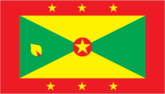
a rectangle divided diagonally into yellow triangles (top and bottom) and green triangles (hoist side and outer side) with a red border around the flag; there are seven yellow five-pointed stars with three centered in the top red border, three centered in the bottom red border, and one on a red disk superimposed at the center of the flag; there is also a symbolic nutmeg pod on the hoist-side triangle (Grenada is the world's second-largest producer of nutmeg, after Indonesia); the seven stars represent the seven administrative divisions
Head of Government
Prime Minister Nicholas BRATHWAITE (since 13 March 1990)
House of Representatives
last held on 13 March 1990 (next to be held by NA March 1996); results - percent of vote by party NA; seats - (15 total) NDC 8, GULP 3, TNP 2, NNP 2
Independence
7 February 1974 (from UK)
Judicial branch
Supreme Court
Legal system
based on English common law
Legislative branch
bicameral Parliament consists of an upper house or Senate and a lower house or House of Representatives
Member of
ACP, C, CARICOM, CDB, ECLAC, FAO, G-77, IBRD, ICAO, ICFTU, IDA, IFAD, IFC, ILO, IMF, INTERPOL, IOC, ITU, LAES, LORCS, NAM, OAS, OECS, OPANAL, UN, UNCTAD, UNESCO, UNIDO, UPU, WCL, WHO, WTO
Names
conventional long form: none conventional short form: Grenada
National holiday
Independence Day, 7 February (1974)
Political parties and leaders
National Democratic Congress (NDC), Nicholas BRATHWAITE; Grenada United Labor Party (GULP), Sir Eric GAIRY; The National Party (TNP), Ben JONES; New National Party (NNP), Keith MITCHELL; Maurice Bishop Patriotic Movement (MBPM), Terrence MARRYSHOW; New Jewel Movement (NJM), Bernard COARD
Suffrage
18 years of age; universal
Type
parliamentary democracy
US diplomatic representation
chief of mission: Charge d'Affaires Annette T. VELER embassy: Ross Point Inn, Saint George's mailing address: P. O. Box 54, Saint George's telephone: (809) 444-1173 through 1178
Economy
Agriculture
accounts for 16% of GDP and 80% of exports; bananas, cocoa, nutmeg, and mace account for two-thirds of total crop production; world's second-largest producer and fourth-largest exporter of nutmeg and mace; small-size farms predominate, growing a variety of citrus fruits, avocados, root crops, sugarcane, corn, and vegetables
Budget
revenues $78 million; expenditures $51 million, including capital expenditures of $22 million (1991 est.)
Currency
1 EC dollar (EC$) = 100 cents
Economic aid
US commitments, including Ex-Im (FY84-89), $60 million; Western (non-US) countries, ODA and OOF bilateral commitments (1970-89), $70 million; Communist countries (1970-89), $32 million
Electricity
12,500 kW capacity; 26 million kWh produced, 310 kWh per capita (1992)
Exchange rates
East Caribbean dollars (EC$) per US$1 - 2.70 (fixed rate since 1976)
Exports
$30 million (f.o.b., 1991 est.) commodities: nutmeg 36%, cocoa beans 9%, bananas 14%, mace 8%, textiles 5% partners: US 12%, UK, FRG, Netherlands, Trinidad and Tobago (1989)
External debt
$104 million (1990 est.)
Fiscal year
calendar year
Imports
$110 million (f.o.b., 1991 est.) commodities: food 25%, manufactured goods 22%, machinery 20%, chemicals 10%, fuel 6% (1989) partners: US 29%, UK, Trinidad and Tobago, Japan, Canada (1989)
Industrial production
growth rate 5.8% (1989 est.); accounts for 9% of GDP
Industries
food and beverage, textile, light assembly operations, tourism, construction
Inflation rate (consumer prices)
2.6% (1991 est.)
National product
GDP - purchasing power equivalent - $250 million (1992 est.)
National product per capita
$3,000 (1992 est.)
National product real growth rate
-0.4% (1992 est.)
Overview
The economy is essentially agricultural and centers on the traditional production of spices and tropical plants. Agriculture accounts for about 16% of GDP and 80% of exports and employs 24% of the labor force. Tourism is the leading foreign exchange earner, followed by agricultural exports. Manufacturing remains relatively undeveloped, but is expected to grow, given a more favorable private investment climate since 1983. The economy achieved an impressive average annual growth rate of 5.5% in 1986-91 but stalled in 1992. Unemployment remains high at about 25%.
Unemployment rate
25% (1992 est.)
Communications
Airports
total: 3 usable: 3 with permanent-surface runways: 2 with runways over 3,659 m: with runways 2,440-3,659 m: 1 with runways 1,220-2,439 m: 1
Highways
1,000 km total; 600 km paved, 300 km otherwise improved; 100 km unimproved
Ports
Saint George's
Telecommunications
automatic, islandwide telephone system with 5,650 telephones; new SHF radio links to Trinidad and Tobago and Saint Vincent; VHF and UHF radio links to Trinidad and Carriacou; broadcast stations - 1 AM, no FM, 1 TV
Military and Security
Branches
Royal Grenada Police Force, Coast Guard
Defense expenditures
$NA, NA% of GDP
Manpower availability
NA