1989 Edition
CIA World Factbook 1989 (Internet Archive)
Geography
Climate
- tropical; tempered by northeast trade winds
- subtropical tempered by trade winds; relatively high humidity
Coastline
- 121 km
- 306 km
Comparative area
- slightly less than twice the size of Washington, DC
- 10 times the size of Washington, DC
Contijienlal shelf
200 meters or to depth of exploitation
Environment
- lies on edge of hurricane belt; hurricane season lasts from June to November
- subject to hurricanes (June to October); La Soufriere is an active volcano
Extended economic zone
- 200 nm
- 200 nm
Land boundaries
- none
- 14 km with Netherlands Antilles
Land use
- 1 5% arable land; 26% permanent crops; 3% meadows and pastures; 9% forest and woodland; 47% other
- 18% arable land; 5% permanent crops; 13% meadows and pastures; 40% forest and woodland; 24% other; includes 1% irrigated
Natural resources
- timber, tropical fruit, deepwater harbors
- cultivable land, beaches, and climate that foster tourism
Note
- islands of the Grenadines group are divided politically with St. Vincent and the Grenadines
- located 500 km southeast of Puerto Rico in the Caribbean Sea
Terrain
- volcanic in origin with central mountains
- Basse-Terre is volcanic in origin with interior mountains; Grand-Terre is low limestone formation
Territorial sea
- 1 2 nm
- 1 2 nm
Total area
- 340 km2; land area: 340 km2
- 1,780 km2; land area: 1,760 km2
People and Society
Birth rate
- 36 births/ 1,000 population (1990)
- 20 births/ 1 ,000 population (1990)
Death rate
- 7 deaths/ 1,000 population (1990)
- 7 deaths/ 1 ,000 population (1990)
Ethnic divisions
- mainly of black African descent
- 90% black or mulatto; 5% white; less than 5% East Indian, Lebanese, Chinese
Infant mortality rate
- 30 deaths/ 1,000 live births (1990)
- 1 7 deaths/ 1 ,000 live births (1990)
Labor force
- 36,000; 31% services, 24% agriculture, 8% construction, 5% manufacturing, 32% other (1985)
- 120,000; 53.0% services, government, and commerce, 25.8% industry, 21.2% agriculture
Language
- English (official); some French patois
- French, Creole patois
Life expectancy at birth
- 69 years male, 74 years female (1990)
- 70 years male, 77 years female (1990)
Literacy
- 85%
- over 70%
Nationality
- noun — Grenadian(s); adjective— Grenadian
- noun — Guadeloupian(s); adjective— Guadeloupe
Net migration rate
- —33 migrants/ 1 ,000 population (1990)
- —6 migrants/ 1 ,000 population (1990)
Organized labor
- 20% of labor force
- 1 1% of labor force
Population
- 84,135 (July 1990), growth rate -0.4% (1990)
- 342,175 (July 1990), growth rate 0.8% (1990)
Religion
- largely Roman Catholic; Anglican; other Protestant sects
- 95% Roman Catholic, 5% Hindu and pagan African
Total fertility rate
- 4.9 children born/ woman (1990)
- 2.1 children born/ woman (1990)
Government
Administrative divisions
- 6 parishes and 1 dependency*; Carriacou and Little Martinique*, Saint Andrew, Saint David, Saint George, Saint John, Saint Mark, Saint Patrick
- none (overseas department of France)
Capital
- Saint George's
- Basse-Terre
Communists
- about 450 members of the New Jewel Movement (pro-Soviet) and the Maurice Bishop Patriotic Movement (proCuban)
- 3,000 est.
Constitution
- 19 December 1973
- 28 September 1958 (French Constitution)
Diplomatic representation
- Ambassador Albert O. XAVIER; Chancery at 1701 New Hampshire Avenue NW, Washington DC 20009; telephone (202) 265-2561; there is a Grenadian Consulate General in New York; US— Charge d'Affaires James F. COOPER; Embassy at Ross Point Inn, Saint George's (mailing address is P. O. Box 54, Saint George's); telephone [440] 1731 or 1734
- as an overseas department of France, the interests of Guadeloupe are represented in the US by
Elections
- House of Representatives — last held on 13 March 1990 (next to be held by March 1 996); results — percent of vote by party NA; seats— (15 total) NDC 8, GULP 3, TNP 2, NNP 2
- General Council — last held NA 1986 (next to be held by NA 1992); results — percent of vote by party NA; seats — (42 total) number of seats by party NA; Regional Council — last held on 16 March 1986 (next to be held by 16 March 1992); results— RPR 33.1%, PS 28.7%, PCG 23.8%, UDF 10.7%, others 3.8%; seats— (41 total) RPR 15, PS 12, PCG 10, UDF 4; French Senate — last held on 5 and 12 June 1988 (next to be held June 1994); Guadeloupe elects two representatives; results — percent of vote by party NA; seats— (2 total) PCG 1, PS 1; French National Assembly — last held on 5 and 12 June 1988 (next to be held June 1994); Guadeloupe elects four representatives; results — percent of vote by party NA; seats— (4 total) PS 2 seats, RPR 1 seat, PCG 1 seat
Executive branch
- British monarch, governor general, prime minister, Ministers of Government (cabinet)
- government commissioner
Flag
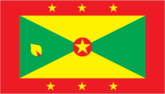
a rectangle divided diagonally into yellow triangles (top and bottom) and green triangles (hoist side and outer side) with a red border around the flag; there are seven yellow five-pointed stars with three centered in the top red border, three centered in the bottom red border, and one on a red disk superimposed at the center of the flag; there is also a symbolic nutmeg pod on the hoist-side triangle (Grenada is the world's second-largest producer of nutmeg, after Indonesia); the seven stars represent the seven administrative divisions
Independence
- 7 February 1974 (from UK)
- none (overseas department of France)
Judicial branch
- Supreme Court
- Court of Appeal (Cour d'Appel) with jurisdiction over Guadeloupe, French Guiana, and Martinique
Leaders
- Chief of State— Queen ELIZABETH II (since 6 February 1952), represented by Governor General Sir Paul SCOON (since 30 September 1978); Head of Government — Prime Minister Nicholas BRATHWAITE (since 13 March 1990) Political parties and leaders: National Democratic Congress (NDC), Nicholas Brathwaite; Grenada United Labor Party (GULP), Sir Eric Gairy; The National Party (TNP), Ben Jones; New National Party (NNP), Keith Mitchell; Maurice Bishop Patriotic Movement (MBPM), Terrence Merryshow; New Jewel Movement (NJM), Bernard Coard
- Chief of State — President Francois MITTERRAND (since 21 May 1981); Head of Government — Commissioner of the Republic Jean-Paul PROUST (since November 1989) Political parties and leaders: Rally for the Republic (RPR), Marlene Captant; Communist Party of Guadeloupe (PCG), Christian Medard Celeste; Socialist Party (PSG), Dominique Larifla; Independent Republicans; Union for French Democracy (UDF); Union for a New Majority (UNM)
Legal system
- based on English common law
- French legal system
Legislative branch
- bicameral Parliament consists of an upper house or Senate and a lower house or House of Representatives
- unicameral General Council and unicameral Regional Council
Long-form name
- none
- Department of Guadeloupe
Member of
- ACP, CARICOM, FAO, G77, GATT (de facto), IBRD, ICAO, IDA, IFAD, IFC, ILO, IMF, ITU, NAM, OAS, DECS, PAHO, SELA, UN, UNESCO, UPU, WHO Grenada (continued)
- WFTU
National holiday
- Independence Day, 7 February (1974)
- Taking of the Bastille, 14 July (1789)
Other political or pressure groups
Popular Union for the Liberation of Guadeloupe (UPLG); Popular Movement for Independent Guadeloupe (MPGI); General Union of Guadeloupe Workers (UGTG); General Federation of Guadeloupe Workers (CGTG); Christian Movement for the Liberation of Guadeloupe (KLPG)
Suffrage
- universal at age 18
- universal at age 18
Type
- parliamentary democracy
- overseas department of France
Economy
Agriculture
accounts for 20% of GDP and 90% of exports; bananas, cocoa, nutmeg, and mace account for two-thirds of total crop production; world's second-largest producer and fourth-largest exporter of nutmeg and mace; small-size farms predominate, growing a variety of citrus fruits, avocados, root crops, sugarcane, corn, and vegetables
Aid
US commitments, including Ex-Im (FY84-88), $60 million; Western (non-US) countries, ODA and OOF bilateral commitments (1970-87), $61 million; Communist countries (1970-88), $32 million
Budget
revenues $74.2 million; expenditures $82.3 million, including capital expenditures of $27.8 million (1989 est.)
Currency
East Caribbean dollar (plural — dollars); 1 EC dollar (ECS) = 100 cents
Electricity
1 1,400 kW capacity; 24 million kWh produced, 280 kWh per capita (1989) Guadeloupe (overseas department of France)
Exchange rates
East Caribbean dollars (ECS) per US$1— 2.70 (fixed rate since 1976)
Exports
$31.8 million (f.o.b., 1988 est.); commodities — nutmeg 35%, cocoa beans 15%, bananas 13%, mace 7%, textiles; partners— US 4%, UK, FRG, Netherlands, Trinidad and Tobago
External debt
$108 million (1989 est.)
Fiscal year
calendar year
GDP
$129.7 million, per capita $1,535; real growth rate 5% (1988)
Imports
$92.6 million (c.i.f., 1988 est.); commodities — machinery 24%, food 22%, manufactured goods 19%, petroleum 8%; partners— US 32%, UK, Trinidad and Tobago, Japan, Canada
Industrial production
growth rate 5.8% (1989 est.)
Industries
food and beverage, textile, light assembly operations, tourism, construction
Inflation rate (consumer prices)
5.0% (1989 est.)
Overview
The economy is essentially agricultural and centers on the traditional production of spices and tropical plants. Agriculture accounts for about 20% of GDP and 90% of exports and employs 24% of the labor force. Tourism is the leading foreign exchange earner, followed by agricultural exports. Manufacturing remains relatively undeveloped, but with a more favorable private investment climate since 1983, it is expected to grow. Despite an impressive average annual growth rate for the economy of 5.5% during the period 1984-88, unemployment remains high at about 26%.
Unemployment rate
26% (1988)
Communications
Airports
- 1 1 total, 8 usable; 5 with permanent-surface runways; none with runways over 3,659 m; 2 with runways 2,440-3,659 m; 2 with runways 1,220-2,439 m
- 3 total, 3 usable; 2 with permanent-surface runways; none with runways over 3,659 m; 1 with runways 2,440-3,659 m; 1 with runways 1,220-2,439 m
Branches
Royal Grenada Police Force
Civil air
- 2 major transport aircraft
- no major transport aircraft
Defense expenditures
NA 20km BasseTerre Caribbean Sea St Martin and St Barthelemy are not shown
Highways
- 80 km
- 1,000 km total; 600 km paved, 300 km otherwise improved; 100 km unimproved
Merchant marine
1 refrigerated cargo (1,000 GRT or over) totaling 1,021 GRT/ 1,778 DWT; note— operates under the registry of Denmark
Military manpower
NA
Note
defense is responsibility of Denmark 15 km Caribbean Sea Hillsborough . t ..Qftonde *> Is/and Caribbean Sea L SAINT GEORGE'S
Ports
- Kangerluarsoruseq (Faeringehavn), Paamiut (Frederikshaab), Nuuk (Godthaab), Sisitniut (Holsteinsborg), Julianehaab, Maarmorilik, North Star Bay, and at least 10 minor ports
- Saint George's
Telecommunications
- adequate domestic and international service provided by cables and radio relay; 17,900 telephones; stations— 5 AM, 7 (35 relays) FM, 4 (9 relays) TV; 2 coaxial submarine cables; 1 Atlantic Ocean INTELSAT earth station Defense Forces
- automatic, islandwide telephone system with 5,650 telephones; new SHF links to Trinidad and Tobago and St. Vincent; VHF and UHF links to Trinidad and Carriacou; stations— 1 AM, no FM, 1 TV Defense Forces