1987 Edition
CIA World Factbook 1987 (Internet Archive)
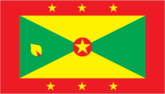
Geography
Climate
tropical; tempered by northeast trade winds
Coastline
121 km
Comparative area
about twice the size of Washington, D.C.
Environment
lies on edge of hurricane belt; hurricane season lasts from June to November
Extended economic zone
200 nm
Land use
15% arable land; 26% permanent crops; 3% meadows and pastures; 9% forest and woodland; 47% other
Special notes
islands of the Grenadines group are divided politically with St. Vincent and the Grenadines
Terrain
volcanic in origin with central mountains
Territorial sea
12 nm
Total area
- ase ZB 2 “s Carriacou s of Caribbean Ka 3 Sea & Oe g Caribbean Sea
- 340 km?; land area: 340 km?
People and Society
Ethnic divisions
mainly of black African descent
Infant mortality rate
16.7/1,000 (1985)
Labor force
36,000; 31% services, 24% agriculture, 8% construction, 5% manufacturing, 31% other; 35-40% unemployment (1985)
Language
English (official); some French patois
Life expectancy
69
Literacy
85%
Nationality
noun—Grenadian(s); adjective—Grenadian
Organized labor
80% of labor force
Population
84,748 (July 1987), average annual growth rate —0.49%
Religion
largely Roman Catholic; Anglican; other Protestant sects
Government
Administrative divisicns
6 parishes
Branches
bicameral legislature (15-member elected House of Representatives and 18-member appointed Senate); executive is Cabinet led by the Prime Minister; judiciary consists of Grenada Supreme Court, composed of the High Court of Justice and two-tier Court of Appeals
Capital
St. George’s
Communists
the New Jewel Movement (which is currently trying to revitalize) and the less hardline Maurice Bishop Patriotic Movement
Elections
last general election held 3 December 1984 Political parties and leaders: New National Party (NNP) is ruling party and was formed in 1984 as a three-party centrist coalition—Grenada National Party (GNP), National Democratic Party (NDP), and Grenada Democratic Movement (GDM); currently the NDP, led by George Brizan, and the GDM, led by Francis Alexis, are not represented in the NNP; former Prime Minister Sir Eric Gairy revived his Grenada United Labor Party (GULP) in 1984; Grenada Democratic Labor Party (GDLP) was formed by Marcel Peters, who was elected as a GULP candidate but changed parties after assuming his seat in the House of Representatives; Democratic Labor Congress (DLC) was formed in 1986 by disaffected NNP member Kenny Lalsingh and Winston Whyte of Christian Democratic Labor Party (CDLP); the Maurice Bishop Patriotic Movement (MBPM) was formed in May 1984 and is composed of pro-Cuban Socialists; the New Jewel Movement (NJM) consists of supporters of Bernard Coard and other hardliners accused of killing Bishop in 1983; GDLP and DLC form the official opposition; Marcel Peters was recently replaced as leader of the parliamentary opposition by Phinsley St. Louis, leader of the newly formed Organization for National Equality (ONE)
Government leaders
Sir Paul SCOON, Governor General (since 1978); Herbert BLAIZE, Prime Minister (since December 1984)
Legal system
based on English common law
Member of
CARICOM, FAO, G-77, GATT (de facto), IBRD, ICAO, IDA, IFAD, IFC, ILO, IMF, ITU, NAM, OAS, PAHO, SELA, UN, UNESCO, UPU, WHO
National holiday
Independence Day, 7 February
Official name
Grenada
Suffrage
universal adult
Type
independent state; recognizes Elizabeth II as Chief of State
Voting strength
(1984 election) NNP 59%, GULP 36%, MBPM 5%; parliamentary seats—NNP, 14; GDLP, 1
Economy
Agriculture
cocoa, nutmeg, mace, and bananas
Budget
revenues, $32 million; expenditures, $61 million (1984)
Electric power
11,380 kW capacity; 24 million kWh produced, 280 kWh per capita (1986)
Exports
$22.1 million (f.0.b., 1985); cocoa beans, nutmeg, bananas, mace
Fiscal year
calendar year
GDP
$86.8 million (1984 est.), $1,000 per capita; real growth rate 3.0% (1986 est.); average inflation rate 6.0% (1985 est.)
Imports
$62.6 million (f.0.b., 1985); food, machinery and transport equipment, oil, building materials
Major trade partners
exports—35% UK, 9% FRG, 6% Netherlands, 6% US, (1984 est.); imports—20% UK, 17% US, 17% Trinidad and Tobago (1983)
Monetary conversion rate
2.70 East Caribbean dollars=US$1 (November 1986)
Communications
Airfields
3 total, 3 usable; 2 with permanent-surface runways, } with runways 2,440-3,659 m, 1 with runways 1,220-2,439 m
Civil air
no major transport aircraft
Highways
1,000 km total; 600 km paved, 800 km otherwise improved; 100 km unimproved
Ports
1 major (St. George’s), 1 minor
Railroads
none
Telecommunications
automatic, islandwide telephone system with 5,650 telephones (5.1 per 100 popl.); new SHF links to Trinidad and Tobago and St. Vincent; VHF and UHF links to Trinidad and Carriacou; 1 AM and 1 TV stations
Military and Security
Branches
Royal Grenada Police Force