1986 Edition
CIA World Factbook 1986 (Internet Archive)
Geography
Agriculture
- arable areas largely in hay; sheep grazing; garden produce
- main crops — cocoa, nutmeg, mace, and bananas
Airfields
- 10 total, 7 usable; 5 with permanent-surface runways; 2 with runways 2,440-3,659 m, 2 with runways 1,220-2,439 m
- 3 total, 3 usable; 2 with permanent-surface runways, 1 with runways 2,440-3,659 m, 1 with runways 1, 220-2,439 m
Area
manufacturing, 31% other; 35-40% unemployment (1985)
Branches
- legislative authority rests jointly with the elected 25-seat Landsting and Danish parliament; executive power vested in Premier and four-person council; 19 lower courts
- bicameral legislature (15-member elected House of Representatives and 13member appointed Senate); executive is Cabinet led by the Prime Minister; judiciary consists of Grenada Supreme Court, composed of the High Court of Justice and twotier Court of Appeals
- Royal Grenada Police Force
Budget
(1984 est.) revenues, $32 million; expenditures, $61 million
Capital
- Godthab (Nuuk)
- St. George's
Civil air
- 2 major transport aircraft
- no major transport aircraft
Coastline
121 km People
Communists
the New Jewel Movement, which is currently trying to revitalize, and the less hardline Maurice Bishop Patriotic Movement
Elections
- held every four years; most recent, 6 June 1984
- last general election held 3 December 1984 Political parties and leaders: the New National Party (NNP) is the ruling party and is a three-party centrist coalition composed of the Grenada National Party (GNP), the National Democratic Party (NDP), and the Grenada Democratic Movement (GDM); former Prime Minister Sir Eric Gairy revived his Grenada United Labor Party (GULP) in 1984; Grenada Democratic Labor Party (GDLP) formed by Marcel Peters, the only opposition member of parliament, who was elected as a GULP candidate but changed parties after he assumed his seat in the House of Representatives; the Maurice Bishop Patriotic Movement (MBPM) was formed in May 1984 and is composed of pro-Cuban Socialists; the New Jewel Movement (NJM) consists of supporters of Bernard Coard and other hardliners accused of killing Bishop in 1983
Electric power
- 84,000 kW capacity (1985); 168 million kWh produced (1985), 3,170 kWh per capita
- 1 1,000 kW capacity (1985); 23 million kWh produced (1985), 261 kWh per capita
Ethnic divisions
mainly of black African descent
Exports
- $168.4 million (f.o.b., 1980); fish and fish products, metallic ores and concentrates
- $18.9 million (f.o.b., 1983); cocoa beans, nutmeg, bananas, mace
Fiscal year
- calendar year Communications
- calendar year Communications
Fishing
catch 105,830 tons (1982); exports $108.6 million (1980)
GDP
$86.8 million (1984 est), $940 per capita; real growth rate 0.6% (1984 est.); average inflation rate 5% (1984 est.)
GNP
included in that of Denmark
Government leaders
- MARGRETHE II, Queen (since January 1972); Jonathan MOTZFELDT, Prime Minister (since May 1979)
- Sir Paul SCOON, Governor General (since 1978); Herbert BLAIZE, Prime Minister (since December 1984)
Highways
- 80 km
- 1,000 km total; 600 km paved, 300 km otherwise improved; 100 km unimproved
Imports
- $259.4 million (c.i.f., 1980); petroleum and petroleum products, machinery and transport equipment, food products
- $55.6 million (c.i.f., 1983); food, machinery and transport equipment, oil, building materials
Infant mortality rate
16.7/1,000(1985)
Labor force
36,000 (1985); 31 % services, 24% agriculture, 8% construction, 5%
Language
English (official); some French patois
Legal system
- Danish law; transformed from colony to province in 1953; limited home rule began in spring 1979
- based on English common law
Life expectancy
69
Limits of territorial waters (claimed)
12 nm (200 nm exclusive economic zone)
Literacy
85%
Major industries
mining, fishing, sealing
Major trade partners
- (1980) Denmark 49.4%, Finland 9.5%, FRG 8.1%, US 6.3%, UK 2.9%
- exports — 35% UK, 9% FRG, 6% Netherlands, 6% US, (1984 est); imports— 17% US, 17% Trinidad and Tobago, 20% UK (1983)
Member of
CARICOM, FAO, G-77, GATT (de facto), IBRD, ICAO, IDA, IFAD, IFC, ILO, IMF, ITU, NAM, OAS, PAHO, SELA, UN, UNESCO, UPU, WHO Economy
Military manpower
included with Denmark ^TCarriacou Caribbean A & . Caribbean Sea .SAINT GEORGE'S ^Grenada See regional mip III Land 344 km2 (Grenada and southern Grenadines); twice the size of Washington, D. C.; 44% cultivated; 17% unused but potentially productive; 12% forest; 4% pasture; 23% built on, waste, and other Water
Monetary conversion rate
- 8.915 Danish Kroner=US$l (December 1985 average)
- 2.70 East Caribbean dollars=US$l (December 1985)
National holiday
Independence Day, 7 February
Nationality
noun — Grenadian(s); adjective— Grenadian
Natural resources
zinc, lead, iron ore, coal, molybdenum, cryolite, uranium, fish
Official name
- Greenland
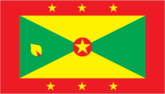
- Grenada
Organized labor
80% of labor force Government
Other political or pressure group
Grenada Democratic Labor Party (GDLP) is the official opposition
Political parties
Siumut, 1 1 seats (moderate socialist, advocating more distinct Greenland identity and greater autonomy from Denmark); Atassut Party, 1 1 seats (more conservative, favors continuing close relations with Denmark); Inuit Ataqatigiit, 3 seats (Marxist-Leninist party favoring complete independence from Denmark rather than home rule) Economy
Political subdivisions
- 3 counties, 18 communes
- 6 parishes
Population
86,000 (July 1986), average annual growth rate —0.5%
Ports
- 1 major, 9 minor, 7 secondary
- 1 major (St. George's), 1 minor
Railroads
- none
- none
Religion
largely Roman Catholic; Anglican; other Protestant sects
Suffrage
- universal, but not compulsory, over age 21
- universal adult
Telecommunications
- adequate domestic and international service provided by cables and radio relay; 17,900 telephones (31.0 per 100 popl.); 7 AM, 24 FM, 9 TV stations; 2 coaxial submarine cables; 1 Atlantic Ocean satellite station Defense Forces Defense is responsibility of Denmark
- automatic, islandwide telephone system with 5,650 telephones (5.1 per 100 popl.); new SHF links to Trinidad and Tobago and St. Vincent; VHP and UHF links to Trinidad and Carriacou; 1 AM station, 1 TV station Defense Forces
Type
- self-governing province of Kingdom of Denmark; two representatives in Danish parliament; separate Minister for Greenland in the Danish Cabinet (Ministry to be phased out during 1986-87)
- independent state; recognizes Elizabeth II as Chief of State
Voting strength
(1984 election) NNP 59%, GULP 36%, MBPM 5%; parliamentary seats— NNP, 14; GDLP, 1