2017 Edition
CIA World Factbook 2017 Archive (HTML)
Introduction
Background
Greenland, the world's largest island, is about 81% ice-capped. Vikings reached the island in the 10th century from Iceland; Danish colonization began in the 18th century, and Greenland became an integral part of the Danish Realm in 1953. It joined the European Community (now the EU) with Denmark in 1973 but withdrew in 1985 over a dispute centered on stringent fishing quotas. Greenland remains a member of the Overseas Countries and Territories Association of the EU. Greenland was granted self-government in 1979 by the Danish parliament; the law went into effect the following year. Greenland voted in favor of increased self-rule in November 2008 and acquired greater responsibility for internal affairs when the Act on Greenland Self-Government was signed into law in June 2009. Denmark, however, continues to exercise control over several policy areas on behalf of Greenland, including foreign affairs, security, and financial policy in consultation with Greenland's Self-Rule Government.
Geography
Area
- 2,166,086 sq km 2,166,086 sq km (410,449 sq km ice-free, 1,755,637 sq km ice-covered)
- land
- 2,166,086 sq km (410,449 sq km ice-free, 1,755,637 sq km ice-covered)
- total
- 2,166,086 sq km
Area - comparative
slightly more than three times the size of Texas
Climate
arctic to subarctic; cool summers, cold winters
Coastline
44,087 km
Elevation
- 1,792 m lowest point: Atlantic Ocean 0 m highest point: Gunnbjorn Fjeld 3,694 m
- elevation extremes
- lowest point: Atlantic Ocean 0 m
- highest point
- Gunnbjorn Fjeld 3,694 m
- mean elevation
- 1,792 m
Environment - current issues
protection of the arctic environment; preservation of the Inuit traditional way of life, including whaling and seal hunting
Geographic coordinates
72 00 N, 40 00 W
Geography - note
dominates North Atlantic Ocean between North America and Europe; sparse population confined to small settlements along coast; close to one-quarter of the population lives in the capital, Nuuk; world's second largest ice sheet after that of Antarctica
Irrigated land
NA
Land boundaries
0 km
Land use
- 0.6% arable land 0%; permanent crops 0%; permanent pasture 0.6% 0% 99.4% (2011 est.)
- agricultural land
- 0.6%
- forest
- 0%
- other
- 99.4% (2011 est.)
Location
Northern North America, island between the Arctic Ocean and the North Atlantic Ocean, northeast of Canada
Map references
Arctic Region
Maritime claims
- 3 nm 200 nm or agreed boundaries or median line 200 nm or agreed boundaries or median line
- continental shelf
- 200 nm or agreed boundaries or median line
- exclusive fishing zone
- 200 nm or agreed boundaries or median line
- territorial sea
- 3 nm
Natural hazards
continuous permafrost over northern two-thirds of the island
Natural resources
coal, iron ore, lead, zinc, molybdenum, diamonds, gold, platinum, niobium, tantalite, uranium, fish, seals, whales, hydropower, possible oil and gas
Population - distribution
settlement concentrated on the southwest shoreline, with limited settlements scattered along the remaining coast; interior is uninhabited
Terrain
flat to gradually sloping icecap covers all but a narrow, mountainous, barren, rocky coast
People and Society
Age structure
- 21.11% (male 6,195/female 5,986) 15.48% (male 4,506/female 4,429) 41.21% (male 12,473/female 11,309) 12.96% (male 4,112/female 3,370) 9.24% (male 2,862/female 2,471) (2017 est.)
- 0-14 years
- 21.11% (male 6,195/female 5,986)
- 15-24 years
- 15.48% (male 4,506/female 4,429)
- 25-54 years
- 41.21% (male 12,473/female 11,309)
- 55-64 years
- 12.96% (male 4,112/female 3,370)
- 65 years and over
- 9.24% (male 2,862/female 2,471) (2017 est.)
Birth rate
14.4 births/1,000 population (2017 est.)
Death rate
8.7 deaths/1,000 population (2017 est.)
Drinking water source
- urban: 100% of population rural: 100% of population total: 100% of population urban: 0% of population rural: 0% of population total: 0% of population (2015 est.)
- rural
- 0% of population
- total
- 0% of population (2015 est.)
- urban
- 0% of population
Ethnic groups
Inuit 88%, Danish and other 12% (2010 est.)
HIV/AIDS - adult prevalence rate
NA
HIV/AIDS - deaths
NA
HIV/AIDS - people living with HIV/AIDS
NA
Hospital bed density
8.2 beds/1,000 population (2014)
Infant mortality rate
- 8.9 deaths/1,000 live births 10.1 deaths/1,000 live births 7.5 deaths/1,000 live births (2017 est.)
- female
- 7.5 deaths/1,000 live births (2017 est.)
- male
- 10.1 deaths/1,000 live births
- total
- 8.9 deaths/1,000 live births
Languages
Greenlandic (East Inuit) (official), Danish (official), English
Life expectancy at birth
- 72.6 years 69.9 years 75.5 years (2017 est.)
- female
- 75.5 years (2017 est.)
- male
- 69.9 years
- total population
- 72.6 years
Literacy
- age 15 and over can read and write 100% 100% 100% (2015 est.)
- definition
- age 15 and over can read and write
- female
- 100% (2015 est.)
- male
- 100%
- total population
- 100%
Major urban areas - population
NUUK (capital) 17,000 (2014)
Median age
- 33.9 years 35 years 32.7 years (2017 est.)
- female
- 32.7 years (2017 est.)
- male
- 35 years
- total
- 33.9 years
Nationality
- Greenlander(s) Greenlandic
- adjective
- Greenlandic
- noun
- Greenlander(s)
Net migration rate
-6 migrant(s)/1,000 population (2017 est.)
Physicians density
1.73 physicians/1,000 population (2014)
Population
57,713 (July 2017 est.)
Population distribution
settlement concentrated on the southwest shoreline, with limited settlements scattered along the remaining coast; interior is uninhabited
Population growth rate
-0.03% (2017 est.)
Religions
Evangelical Lutheran, traditional Inuit spiritual beliefs
Sanitation facility access
- urban: 100% of population rural: 100% of population total: 100% of population urban: 0% of population rural: 0% of population total: 0% of population (2015 est.)
- rural
- 0% of population
- total
- 0% of population (2015 est.)
- urban
- 0% of population
Sex ratio
- 1.05 male(s)/female 1.03 male(s)/female 1.02 male(s)/female 1.1 male(s)/female 1.26 male(s)/female 1.15 male(s)/female 1.1 male(s)/female (2016 est.)
- 0-14 years
- 1.03 male(s)/female
- 15-24 years
- 1.02 male(s)/female
- 25-54 years
- 1.1 male(s)/female
- 55-64 years
- 1.26 male(s)/female
- 65 years and over
- 1.15 male(s)/female
- at birth
- 1.05 male(s)/female
- total population
- 1.1 male(s)/female (2016 est.)
Total fertility rate
1.99 children born/woman (2017 est.)
Urbanization
- 87.2% of total population (2017) 0.27% annual rate of change (2015-20 est.)
- rate of urbanization
- 0.27% annual rate of change (2015-20 est.)
- urban population
- 87.2% of total population (2017)
Government
Administrative divisions
- 4 municipalities (kommuner, singular kommune); Kujalleq, Qaasuitsup, Qeqqata, Sermersooq the North and East Greenland National Park (Avannaarsuani Tunumilu Nuna Allanngutsaaliugaq) and the Thule Air Base in Pituffik (in northwest Greenland) are two unincorporated areas; the national park's 972,000 sq km - about 46% of the island - makes it the largest national park in the world and also the most northerly
- note
- the North and East Greenland National Park (Avannaarsuani Tunumilu Nuna Allanngutsaaliugaq) and the Thule Air Base in Pituffik (in northwest Greenland) are two unincorporated areas; the national park's 972,000 sq km - about 46% of the island - makes it the largest national park in the world and also the most northerly
Capital
- Nuuk (Godthaab) 64 11 N, 51 45 W UTC-3 (2 hours ahead of Washington, DC, during Standard Time) +1hr, begins last Sunday in March; ends last Sunday in October Greenland has four time zones
- daylight saving time
- +1hr, begins last Sunday in March; ends last Sunday in October
- geographic coordinates
- 64 11 N, 51 45 W
- name
- Nuuk (Godthaab)
- note
- Greenland has four time zones
- time difference
- UTC-3 (2 hours ahead of Washington, DC, during Standard Time)
Citizenship
see Denmark
Constitution
previous 1953 (Greenland established as a constituency in the Danish constitution), 1979 (Greenland Home Rule Act); latest 21 June 2009 (Greenland Self-Government Act) (2016)
Country name
- none Greenland none Kalaallit Nunaat named by Norwegian adventurer Erik THORVALDSSON (Erik the Red) in A.D. 985 in order to entice settlers to the island
- conventional long form
- none
- conventional short form
- Greenland
- local long form
- none
- local short form
- Kalaallit Nunaat
- note
- named by Norwegian adventurer Erik THORVALDSSON (Erik the Red) in A.D. 985 in order to entice settlers to the island
Dependency status
part of the Kingdom of Denmark; self-governing overseas administrative division of Denmark since 1979
Diplomatic representation from the US
none (self-governing overseas administrative division of Denmark); note - the US Embassy in Copenhagen has an office devoted to Greenland
Diplomatic representation in the US
- none (self-governing overseas administrative division of Denmark): note - Greenland has an office in the Danish Embassy to the US; it also has offices in the Danish consulates of Chicago and New York
- none (self-governing overseas administrative division of Denmark)
- note - Greenland has an office in the Danish Embassy to the US; it also has offices in the Danish consulates of Chicago and New York
Executive branch
- Queen MARGRETHE II of Denmark (since 14 January 1972), represented by High Commissioner Mikaela ENGELL (since April 2011) Premier Kim KIELSEN (since 30 September 2014) Home Rule Government elected by the Parliament (Landsting) on the basis of the strength of parties the monarchy is hereditary; high commissioner appointed by the monarch; premier indirectly elected by Parliament for a 4-year term Kim KIELSEN elected premier; Parliament vote - Kim KIELSEN (S) 34.3%, Sara OLSVIG (IA) 33.2%, Anda ULDUM (D) 11.8%, other 20.7%
- cabinet
- Home Rule Government elected by the Parliament (Landsting) on the basis of the strength of parties
- chief of state
- Queen MARGRETHE II of Denmark (since 14 January 1972), represented by High Commissioner Mikaela ENGELL (since April 2011)
- election results
- Kim KIELSEN elected premier; Parliament vote - Kim KIELSEN (S) 34.3%, Sara OLSVIG (IA) 33.2%, Anda ULDUM (D) 11.8%, other 20.7%
- elections/appointments
- the monarchy is hereditary; high commissioner appointed by the monarch; premier indirectly elected by Parliament for a 4-year term
- head of government
- Premier Kim KIELSEN (since 30 September 2014)
Flag description
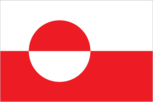
two equal horizontal bands of white (top) and red with a large disk slightly to the hoist side of center - the top half of the disk is red, the bottom half is white; the design represents the sun reflecting off a field of ice; the colors are the same as those of the Danish flag and symbolize Greenland's links to the Kingdom of Denmark
Government type
parliamentary democracy (Parliament of Greenland); part of the Kingdom of Denmark
Independence
none (extensive self-rule as part of the Kingdom of Denmark; foreign affairs is the responsibility of Denmark, but Greenland actively participates in international agreements relating to Greenland)
International organization participation
Arctic Council, ICC, NC, NIB, UPU
Judicial branch
- High Court of Greenland (consists of the presiding professional judge and 2 lay assessors); note - appeals beyond the High Court of Greenland can be heard by the Supreme Court (in Copenhagen) judges appointed by the monarch upon the recommendation of the Judicial Appointments Council, a 6-member independent body of judges and lawyers; judges appointed for life with retirement at age 70 Court of Greenland; 18 district or magistrates' courts
- highest court(s)
- High Court of Greenland (consists of the presiding professional judge and 2 lay assessors); note - appeals beyond the High Court of Greenland can be heard by the Supreme Court (in Copenhagen)
- judge selection and term of office
- judges appointed by the monarch upon the recommendation of the Judicial Appointments Council, a 6-member independent body of judges and lawyers; judges appointed for life with retirement at age 70
- subordinate courts
- Court of Greenland; 18 district or magistrates' courts
Legal system
the laws of Denmark apply where applicable and Greenlandic law applies to other areas
Legislative branch
- unicameral Parliament or Inatsisartut (Landsting) (31 seats; members directly elected in multi-seat constituencies by proportional representation vote to serve 4-year terms) last held on 28 November 2014 (next to be held by 2018) percent of vote by party - S 34.6%, IA 33.5%, D 11.9%, PN 11.7%, A 6.6%, other 1.7%; seats by party - S 11, IA 11, D 4, PN 3, A 2 2 representatives were elected to the Danish Parliament or Folketing on 18 June 2015 (next to be held by June 2019); percent of vote by party - NA; seats by party - S 1, IA 1 (2013)
- description
- unicameral Parliament or Inatsisartut (Landsting) (31 seats; members directly elected in multi-seat constituencies by proportional representation vote to serve 4-year terms)
- election results
- percent of vote by party - S 34.6%, IA 33.5%, D 11.9%, PN 11.7%, A 6.6%, other 1.7%; seats by party - S 11, IA 11, D 4, PN 3, A 2
- elections
- last held on 28 November 2014 (next to be held by 2018)
- note
- 2 representatives were elected to the Danish Parliament or Folketing on 18 June 2015 (next to be held by June 2019); percent of vote by party - NA; seats by party - S 1, IA 1 (2013)
National anthem
- "Nunarput utoqqarsuanngoravit" ("Our Country, Who's Become So Old" also translated as "You Our Ancient Land") Henrik LUND/Jonathan PETERSEN adopted 1916; the government also recognizes "Nuna asiilasooq" as a secondary anthem
- lyrics/music
- Henrik LUND/Jonathan PETERSEN
- name
- "Nunarput utoqqarsuanngoravit" ("Our Country, Who's Become So Old" also translated as "You Our Ancient Land")
- note
- adopted 1916; the government also recognizes "Nuna asiilasooq" as a secondary anthem
National holiday
National Day, June 21; note - marks the summer solstice and the longest day of the year in the Northern Hemisphere
National symbol(s)
- polar bear; national colors: red, white
- polar bear; national colors
- red, white
Political parties and leaders
Democrats Party or D (Demokraatit) [Randi VESTERGAARD EVALDSEN] Forward Party or S (Siumut) [Kim KIELSEN] Inuit Community or IA (Inuit Ataqatigiit) [Sara OLSVIG] Inuit Party or PI (Partii Inuit) [Nikku OLSEN] Partii Naleraq or PN [Hans ENOKSEN] Solidarity Party or A (Atassut) [Siverth Karl HEILMANN]
Political pressure groups and leaders
conservationists; environmentalists; independence activists
Suffrage
18 years of age; universal
Economy
Agriculture - products
sheep, cow, reindeer, fish
Budget
- $1.578 billion $1.876 billion (2014 est.)
- expenditures
- $1.876 billion (2014 est.)
- revenues
- $1.578 billion
Budget surplus (+) or deficit (-)
-13.5% of GDP (2015 est.)
Central bank discount rate
NA%
Debt - external
$36.4 million (2010) $58 million (2009)
Distribution of family income - Gini index
33.9 (2015 est.) 34.3 (2014 est.)
Economy - overview
Greenland’s economy depends on exports of shrimp and fish, and on a substantial subsidy from the Danish Government. Fish account for over 90% of its exports, subjecting the economy to fluctuations in world demand. The subsidy from the Danish Government is budgeted to be about $535 million in 2017, more than 50% of government revenues, and 25% of GDP. The economy is expanding after a period of decline. In 2016 the economy grew 4.6% compared to 1.1% in 2015 and negative growth in the years 2013-14. For 2017 the economy is expected to continue to expand at a more subdued rate. The expansion has been driven by larger quotas for shrimp, the predominant Greenlandic export, and also by increased activity in the construction sector, especially in Nuuk, the capital, where the harbor is being enlarged and a prison is under construction. Private consumption and tourism also are contributing to GDP growth more than in previous years. Tourism in Greenland has grown annually around 20% in 2015 and 2016, largely a result of increasing numbers of cruise lines now operating in Greenland's western and southern waters during the peak summer tourism season. The public sector, including publicly owned enterprises and the municipalities, plays a dominant role in Greenland's economy. During the last decade the Greenland Home Rule Government pursued conservative fiscal and monetary policies, but public pressure has increased for better schools, health care, and retirement systems. The budget was in deficit in 2014 and 2016, but public debt remains low at about 5% of GDP. The government plans a balanced budget for the 2017–20 period. Significant challenges face the island, including low levels of qualified labor, geographic dispersion, lack of industry diversification, the long-term sustainability of the public budget, and a declining population due to emigration. Catches in fisheries have been declining in recent years. Hydrocarbon exploration has ceased with declining oil prices and currently only three mines are under development. The island has potential for natural resource exploitation with rare-earth, uranium, and iron ore mineral projects proposed.
Exchange rates
Danish kroner (DKK) per US dollar - 6.7309 (2016) 6.7309 (2015) 6.7236 (2014 est.) 5.6125 (2013 est.) 5.79 (2012 est.)
Exports
$407.1 million (2015 est.) $599.7 million (2014 est.)
Exports - commodities
fish and fish products 91% (2015 est.)
Exports - partners
Denmark 81.2%, Portugal 8.3% (2016)
Fiscal year
calendar year
GDP - composition, by end use
- 24.8% 28% 14.3% -13.9% 18.2% 28.6% (2015 est.)
- exports of goods and services
- 18.2%
- government consumption
- 28%
- household consumption
- 24.8%
- imports of goods and services
- 28.6% (2015 est.)
- investment in fixed capital
- 14.3%
- investment in inventories
- -13.9%
GDP - composition, by sector of origin
- 15.9% 10.1% 73.9% (2015)
- agriculture
- 15.9%
- industry
- 10.1%
- services
- 73.9% (2015)
GDP - per capita (PPP)
$37,600 (2015 est.) $37,000 (2014 est.) $38,500 (2013 est.)
GDP - real growth rate
1.7% (2015 est.) -0.8% (2014 est.) -3% (2013 est.)
GDP (official exchange rate)
$2.221 billion (2011 est.)
GDP (purchasing power parity)
- $2.173 billion (2015 est.) $2.137 billion (2014 est.) $2.154 billion (2013 est.) data are in 2015 US dollars
- note
- data are in 2015 US dollars
Household income or consumption by percentage share
- NA% NA%
- highest 10%
- NA%
- lowest 10%
- NA%
Imports
$783.5 million (2015 est.) $866.1 million (2014 est.)
Imports - commodities
machinery and transport equipment, manufactured goods, food, petroleum products
Imports - partners
Denmark 72.2%, Sweden 9.8% (2016)
Industrial production growth rate
NA%
Industries
fish processing (mainly shrimp and Greenland halibut); gold, zinc, anorthosite and ruby mining; handicrafts, hides and skins, small shipyards
Inflation rate (consumer prices)
0.3% (January 2017 est.) 1.2% (January 2016 est.)
Labor force
26,840 (2015 est.)
Labor force - by occupation
- 15.9% 10.1% 73.9% (2015 est.)
- agriculture
- 15.9%
- industry
- 10.1%
- services
- 73.9% (2015 est.)
Population below poverty line
16.2% (2015 est.)
Public debt
13% of GDP (2015 est.)
Taxes and other revenues
71% of GDP (2015 est.)
Unemployment rate
9.1% (2015 est.) 10.3% (2014 est.)
Energy
Carbon dioxide emissions from consumption of energy
520,400 Mt (2015 est.)
Crude oil - exports
0 bbl/day (2014 est.)
Crude oil - imports
0 bbl/day (2014 est.)
Crude oil - production
0 bbl/day (2016 est.)
Crude oil - proved reserves
0 bbl (1 January 2017 es)
Electricity - consumption
581.3 million kWh (2015 est.)
Electricity - exports
0 kWh (2016 est.)
Electricity - from fossil fuels
51.3% of total installed capacity (2015 est.)
Electricity - from hydroelectric plants
48.7% of total installed capacity (2015 est.)
Electricity - from nuclear fuels
0% of total installed capacity (2015 est.)
Electricity - from other renewable sources
0% of total installed capacity (2015 est.)
Electricity - imports
0 kWh (2016 est.)
Electricity - installed generating capacity
187,000 kW (2015 est.)
Electricity - production
625 million kWh (2015 est.)
Electricity access
- 100% (2016)
- electrification - total population
- 100% (2016)
Natural gas - consumption
0 cu m (2013 est.)
Natural gas - exports
0 cu m (2016 est.)
Natural gas - imports
0 cu m (2013 est.)
Natural gas - production
0 cu m (2016 est.)
Natural gas - proved reserves
0 cu m (1 January 2014 es)
Refined petroleum products - consumption
6,000 bbl/day (2015 est.)
Refined petroleum products - exports
0 bbl/day (2014 est.)
Refined petroleum products - imports
4,633 bbl/day (2014 est.)
Refined petroleum products - production
0 bbl/day (2014 est.)
Communications
Broadcast media
the Greenland Broadcasting Company provides public radio and TV services throughout the island with a broadcast station and a series of repeaters; a few private local TV and radio stations; Danish public radio rebroadcasts are available (2015)
Internet country code
.gl
Internet users
- 39,544 68.5% (July 2016 est.)
- percent of population
- 68.5% (July 2016 est.)
- total
- 39,544
Telephone system
- adequate domestic and international service provided by satellite, cables, and microwave radio relay; totally digital since 1995 microwave radio relay and satellite; the fundamental telecommunications infrastructure consists of a digital radio link from Nanortalik in south Greenland to Uummannaq in north Greenland; satellites cover north and east Greenland for domestic and foreign telecommunications; a marine cable connects south and west Greenland to the rest of the world, extending from Nuuk and Qaqortoq to Canada and Iceland country code - 299; satellite earth stations - 15 (12 Intelsat, 1 Eutelsat, 2 Americom GE-2 (all Atlantic Ocean)) (2015)
- domestic
- microwave radio relay and satellite; the fundamental telecommunications infrastructure consists of a digital radio link from Nanortalik in south Greenland to Uummannaq in north Greenland; satellites cover north and east Greenland for domestic and foreign telecommunications; a marine cable connects south and west Greenland to the rest of the world, extending from Nuuk and Qaqortoq to Canada and Iceland
- general assessment
- adequate domestic and international service provided by satellite, cables, and microwave radio relay; totally digital since 1995
- international
- country code - 299; satellite earth stations - 15 (12 Intelsat, 1 Eutelsat, 2 Americom GE-2 (all Atlantic Ocean)) (2015)
Telephones - fixed lines
- 16,000 28 (July 2016 est.)
- subscriptions per 100 inhabitants
- 28 (July 2016 est.)
- total subscriptions
- 16,000
Telephones - mobile cellular
- 61,000 106 (July 2016 est.)
- subscriptions per 100 inhabitants
- 106 (July 2016 est.)
- total
- 61,000
Transportation
Airports
15 (2013)
Airports - with paved runways
- 6 (2017)
- 1,524 to 2,437 m
- 1
- 2,438 to 3,047 m
- 2
- 914 to 1,523 m
- 1
- total
- 10
- under 914 m
- 6 (2017)
Airports - with unpaved runways
- 2 (2013)
- 1,524 to 2,437 m
- 1
- 914 to 1,523 m
- 2
- total
- 5
- under 914 m
- 2 (2013)
Civil aircraft registration country code prefix
OY-H (2016)
Merchant marine
- 1 (Denmark 1) (2010)
- registered in other countries
- 1 (Denmark 1) (2010)
National air transport system
- 1 (registered in Denmark) 8 (registered in Denmark) (2015)
- inventory of registered aircraft operated by air carriers
- 8 (registered in Denmark) (2015)
- number of registered air carriers
- 1 (registered in Denmark)
Ports and terminals
- Sisimiut
- major seaport(s)
- Sisimiut
Roadways
- although there are short roads in towns, there are no roads between towns; inter-urban transport is either by sea or by air (2015)
- note
- although there are short roads in towns, there are no roads between towns; inter-urban transport is either by sea or by air (2015)
Military and Security
Military - note
defense is the responsibility of Denmark
Military branches
no regular military forces or conscription; the Government of Denmark has responsibility for defense; as such the Danish military’s Joint Arctic Command in Nuuk is responsible for territorial defense of Greenland (2016)
Transnational Issues
Disputes - international
managed dispute between Canada and Denmark over Hans Island in the Kennedy Channel between Canada's Ellesmere Island and Greenland; Denmark (Greenland) and Norway have made submissions to the Commission on the Limits of the Continental Shelf (CLCS) and Russia is collecting additional data to augment its 2001 CLCS submission