2012 Edition
CIA World Factbook 2012 Archive (HTML)
Introduction
Background
Greenland, the world's largest island, is about 81% ice capped. Vikings reached the island in the 10th century from Iceland; Danish colonization began in the 18th century, and Greenland was made an integral part of Denmark in 1953. It joined the European Community (now the EU) with Denmark in 1973 but withdrew in 1985 over a dispute centered on stringent fishing quotas. Greenland was granted self-government in 1979 by the Danish parliament; the law went into effect the following year. Greenland voted in favor of increased self-rule in November 2008 and acquired greater responsibility for internal affairs when the Act on Greenland Self Government was signed into law in June 2009. Denmark, however, continues to exercise control of Greenland's foreign affairs, security, and financial policy in consultation with Greenland's Home Rule Government.
Geography
Area
- 2,166,086 sq km 2,166,086 sq km (410,449 sq km ice-free, 1,755,637 sq km ice-covered)
- total
- 2,166,086 sq km
Area - comparative
slightly more than three times the size of Texas
Climate
arctic to subarctic; cool summers, cold winters
Coastline
44,087 km
Elevation extremes
- Atlantic Ocean 0 m Gunnbjorn Fjeld 3,700 m
- highest point
- Gunnbjorn Fjeld 3,700 m
- lowest point
- Atlantic Ocean 0 m
Environment - current issues
protection of the arctic environment; preservation of the Inuit traditional way of life, including whaling and seal hunting
Geographic coordinates
72 00 N, 40 00 W
Geography - note
dominates North Atlantic Ocean between North America and Europe; sparse population confined to small settlements along coast; close to one-quarter of the population lives in the capital, Nuuk; world's second largest ice cap
Irrigated land
NA
Land boundaries
0 km
Land use
- 0% 0% 100% (2005)
- arable land
- 0%
- other
- 100% (2005)
- permanent crops
- 0%
Location
Northern North America, island between the Arctic Ocean and the North Atlantic Ocean, northeast of Canada
Map references
North America
Maritime claims
- 3 nm 200 nm or agreed boundaries or median line 200 nm or agreed boundaries or median line
- continental shelf
- 200 nm or agreed boundaries or median line
- exclusive fishing zone
- 200 nm or agreed boundaries or median line
- territorial sea
- 3 nm
Natural hazards
continuous permafrost over northern two-thirds of the island
Natural resources
coal, iron ore, lead, zinc, molybdenum, diamonds, gold, platinum, niobium, tantalite, uranium, fish, seals, whales, hydropower, possible oil and gas
Terrain
flat to gradually sloping icecap covers all but a narrow, mountainous, barren, rocky coast
People and Society
Age structure
- 21.9% (male 6,420/ female 6,229) 70.2% (male 21,559/ female 18,949) 7.9% (male 2,376/ female 2,162) (2012 est.)
- 0-14 years
- 21.9% (male 6,420/ female 6,229)
- 15-64 years
- 70.2% (male 21,559/ female 18,949)
- 65 years and over
- 7.9% (male 2,376/ female 2,162) (2012 est.)
Birth rate
14.58 births/1,000 population (2012 est.)
Death rate
8.22 deaths/1,000 population (July 2012 est.)
Education expenditures
NA
Ethnic groups
Inuit 89%, Danish and other 11% (2009)
HIV/AIDS - adult prevalence rate
NA
HIV/AIDS - deaths
NA
HIV/AIDS - people living with HIV/AIDS
100 (1999)
Infant mortality rate
- 9.83 deaths/1,000 live births 11.23 deaths/1,000 live births 8.37 deaths/1,000 live births (2012 est.)
- female
- 8.37 deaths/1,000 live births (2012 est.)
- total
- 9.83 deaths/1,000 live births
Languages
Greenlandic (East Inuit) (official), Danish (official), English
Life expectancy at birth
- 71.25 years 68.6 years 74.04 years (2012 est.)
- female
- 74.04 years (2012 est.)
- total population
- 71.25 years
Literacy
- age 15 and over can read and write 100% 100% 100% (2001 est.)
- definition
- age 15 and over can read and write
- female
- 100% (2001 est.)
- male
- 100%
- total population
- 100%
Major cities - population
NUUK (capital) 15,000 (2009)
Median age
- 33.7 years 35 years 32.2 years (2012 est.)
- female
- 32.2 years (2012 est.)
- male
- 35 years
- total
- 33.7 years
Nationality
- Greenlander(s) Greenlandic
- adjective
- Greenlandic
- noun
- Greenlander(s)
Net migration rate
-5.98 migrant(s)/1,000 population (2012 est.)
Population
57,695 (July 2012 est.)
Population growth rate
0.038% (2012 est.)
Religions
Evangelical Lutheran, traditional Inuit spiritual beliefs
Sex ratio
- 1.05 male(s)/female 1.03 male(s)/female 1.14 male(s)/female 1.1 male(s)/female 1.11 male(s)/female (2011 est.)
- 15-64 years
- 1.14 male(s)/female
- 65 years and over
- 1.1 male(s)/female
- at birth
- 1.05 male(s)/female
- total population
- 1.11 male(s)/female (2011 est.)
- under 15 years
- 1.03 male(s)/female
Total fertility rate
2.11 children born/woman (2012 est.)
Urbanization
- 84% of total population (2010) 0.3% annual rate of change (2010-15 est.)
- rate of urbanization
- 0.3% annual rate of change (2010-15 est.)
- urban population
- 84% of total population (2010)
Government
Administrative divisions
4 municipalities (kommuner, singular kommune); Kujalleq, Qaasuitsup, Qeqqata, Sermersooq the North and East Greenland National Park (Avannaarsuani Tunumilu Nuna Allanngutsaaliugaq) and the Thule Air Base in Pituffik (in northwest Greenland) are two unincorporated areas; the national park's 972,000 sq km - about 46% of the island - make it the largest national park in the world and also the most northerly
Capital
- Nuuk (Godthab) 64 11 N, 51 45 W UTC-3 (2 hours ahead of Washington, DC during Standard Time) +1hr, begins last Sunday in March; ends last Sunday in October Greenland is divided into four time zones
- daylight saving time
- +1hr, begins last Sunday in March; ends last Sunday in October
- geographic coordinates
- 64 11 N, 51 45 W
- name
- Nuuk (Godthab)
- time difference
- UTC-3 (2 hours ahead of Washington, DC during Standard Time)
Constitution
(June 2009) Act on Greenland Self Government
Country name
- none Greenland none Kalaallit Nunaat
- conventional long form
- none
- conventional short form
- Greenland
- local long form
- none
- local short form
- Kalaallit Nunaat
Dependency status
part of the Kingdom of Denmark; self-governing overseas administrative division of Denmark since 1979
Diplomatic representation from the US
none (self-governing overseas administrative division of Denmark)
Diplomatic representation in the US
none (self-governing overseas administrative division of Denmark)
Executive branch
- Queen MARGRETHE II of Denmark (since 14 January 1972), represented by High Commissioner Mikaela ENGELL (since April 2011) Prime Minister Kuupik KLEIST (since 12 June 2009) Home Rule Government elected by the Parliament (Landsting) on the basis of the strength of parties the monarchy is hereditary; high commissioner appointed by the monarch; prime minister elected by parliament (usually the leader of the majority party) Kuupik KLEIST elected prime minister
- cabinet
- Home Rule Government elected by the Parliament (Landsting) on the basis of the strength of parties
- chief of state
- Queen MARGRETHE II of Denmark (since 14 January 1972), represented by High Commissioner Mikaela ENGELL (since April 2011)
- election results
- Kuupik KLEIST elected prime minister
- elections
- the monarchy is hereditary; high commissioner appointed by the monarch; prime minister elected by parliament (usually the leader of the majority party)
- head of government
- Prime Minister Kuupik KLEIST (since 12 June 2009)
Flag description
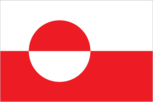
two equal horizontal bands of white (top) and red with a large disk slightly to the hoist side of center - the top half of the disk is red, the bottom half is white; the design represents the sun reflecting off a field of ice; the colors are the same as those of the Danish flag and symbolize Greenland's links to the Kingdom of Denmark
Government type
parliamentary democracy within a constitutional monarchy
Independence
none (extensive self-rule as part of the Kingdom of Denmark; foreign affairs is the responsibility of Denmark, but Greenland actively participates in international agreements relating to Greenland)
International organization participation
Arctic Council, NC, NIB, UPU
Judicial branch
High Court or Eggartuussisuuneqarfia (Landsret) (appeals can be made to the Ostre Landsret or Eastern Division of the High Court or Supreme Court in Copenhagen)
Legal system
the laws of Denmark, where applicable, apply
Legislative branch
- unicameral Parliament or Inatsisartut (Landsting) (31 seats; members elected by popular vote on the basis of proportional representation to serve four-year terms) last held on 2 June 2009 (next to be held by 2013) percent of vote by party - Inuit Community 43.7%, Forward Party 26.5%, Democratic Party 12.7%, Solidarity Party 10.9%; Candidate List 3.8%, other 2.4%; seats by party - Inuit Community 14, Forward Party 9, Democratic Party 4, Solidarity Party 3, Candidate List 1 two representatives were elected to the Danish Parliament or Folketing on 15 September 2011 (next to be held by September 2015); percent of vote by party - NA; seats by party - Siumut 1, Inuit Ataqatigiit 1 (2013)
- election results
- percent of vote by party - Inuit Community 43.7%, Forward Party 26.5%, Democratic Party 12.7%, Solidarity Party 10.9%; Candidate List 3.8%, other 2.4%; seats by party - Inuit Community 14, Forward Party 9, Democratic Party 4, Solidarity Party 3, Candidate List 1
- elections
- last held on 2 June 2009 (next to be held by 2013)
National anthem
- "Nunarput utoqqarsuanngoravit" ("Our Country, Who's Become So Old" also translated as "You Our Ancient Land") Henrik LUND/Jonathan PETERSEN adopted 1916; the government also recognizes "Nuna asiilasooq" as a secondary anthem
- lyrics/music
- Henrik LUND/Jonathan PETERSEN
- name
- "Nunarput utoqqarsuanngoravit" ("Our Country, Who's Become So Old" also translated as "You Our Ancient Land")
National holiday
June 21 (longest day)
National symbol(s)
polar bear
Political parties and leaders
Candidate List (Kattusseqatigiit) [Anthon FREDERIKSEN]; Democratic Party (Demokraatit) [Jens B. FREDERIKSEN]; Forward Party (Siumut) [Aleqa HAMMOND]; Inuit Community (Inuit Ataqatigiit) or IA [Kuupik KLEIST]; Solidarity Party (Atassut) [Gerhardt PETERSEN]
Political pressure groups and leaders
conservationists; environmentalists
Suffrage
18 years of age; universal
Economy
Agriculture - products
forage crops, garden and greenhouse vegetables; sheep, reindeer; fish
Budget
- $1.72 billion $1.68 billion (2010)
- expenditures
- $1.68 billion (2010)
- revenues
- $1.72 billion
Budget surplus (+) or deficit (-)
1.9% of GDP (2010)
Debt - external
$36.4 million (2010) $58 million (2009)
Economy - overview
The economy remains critically dependent on exports of shrimp and fish, income from resource exploration and extraction, and on a substantial subsidy from the Danish Government. The subsidy is budgeted to be about $650 million in 2012, approximately 56% of government revenues in 2012 for the year. The public sector, including publicly owned enterprises and the municipalities, plays the dominant role in Greenland's economy. Greenland's real GDP contracted about 1% in 2009 as a result of the global economic slowdown, but is estimated to have grown 2% in 2010 and 3% in 2011. The relative ease with which Greenland has weathered the economic crisis is due to increased hydrocarbon and mineral exploration and extraction activities, a high level of construction activity in the Nuuk area and the increasing price of fish and shrimp. During the last decade the Greenland Home Rule Government (GHRG) pursued conservative fiscal and monetary policies, but public pressure has increased for better schools, health care and retirement systems. The Greenlandic economy has benefited from increasing catches and exports of shrimp, Greenland halibut and, more recently, crabs. Due to Greenland's continued dependence on exports of fish - which accounted for 89% of exports in 2010 - the economy remains very sensitive to foreign developments. International consortia are increasingly active in exploring for hydrocarbon resources off Greenland's western coast, and international studies indicate the potential for oil and gas fields in northern and northeastern Greenland. In May 2007 a US aluminum producer concluded a memorandum of understanding with the Greenland Home Rule Government to build an aluminum smelter and a power generation facility, which takes advantage of Greenland's abundant hydropower potential. Within the area of mining, olivine sand continues to be produced and gold production has resumed in south Greenland, while rare-earth and iron ore mineral projects have been proposed or planned elsewhere on the island. Tourism also offers another avenue of economic growth for Greenland, with increasing numbers of cruise lines now operating in Greenland's western and southern waters during the peak summer tourism season.
Exchange rates
Danish kroner (DKK) per US dollar - 5.847 (2011) 5.6241 (2011) 5.6241 (2010) 5.361 (2009) 5.0236 (2008)
Exports
$384.3 million (2010) $358 million (2009)
Exports - commodities
fish and fish products 89%, metals 10% (2008)
Exports - partners
Denmark 63.3%, Japan 12%, China 6.4% (2011)
Fiscal year
calendar year
GDP - composition by sector
- 4% 29% 67% (2009 est.)
- agriculture
- 4%
- industry
- 29%
- services
- 67% (2009 est.)
GDP - per capita (PPP)
$37,400 (2008 est.) $36,600 (2007 est.)
GDP - real growth rate
3% (2011 est.) 2% (2010 est.) -1.2% (2009 est.)
GDP (official exchange rate)
$2.16 billion (2011 est.)
GDP (purchasing power parity)
$2.133 billion (2011 est.) $2.071 billion (2010 est.) $2.03 billion (2009 est.)
Household income or consumption by percentage share
- NA% NA%
- highest 10%
- NA%
- lowest 10%
- NA%
Imports
$814.2 million (2010) $726 million (2009)
Imports - commodities
machinery and transport equipment, manufactured goods, food, petroleum products
Imports - partners
Denmark 58.1%, Sweden 19.7%, UK 10.3% (2011)
Industrial production growth rate
NA%
Inflation rate (consumer prices)
2.8% (2011 est.) 1.7% (2010 est.)
Labor force
33,670 (2010)
Labor force - by occupation
- 4% 29% 67% (2009 est.)
- agriculture
- 4%
- industry
- 29%
- services
- 67% (2009 est.)
Population below poverty line
9.2% (2007 est.)
Taxes and other revenues
79.6% of GDP (2010)
Unemployment rate
4.9% (2011 est.) 4.2% (2010 est.)
Energy
Carbon dioxide emissions from consumption of energy
555,600 Mt (2010 est.)
Crude oil - exports
0 bbl/day (2009 est.)
Crude oil - imports
0 bbl/day (2009 est.)
Crude oil - production
0 bbl/day (2011 est.)
Crude oil - proved reserves
0 bbl (1 January 2012 est.)
Electricity - consumption
239.4 million kWh (2010 est.)
Electricity - exports
0 kWh (2010 est.)
Electricity - from fossil fuels
100% of total installed capacity (2009 est.)
Electricity - from hydroelectric plants
0% of total installed capacity (2009 est.)
Electricity - from nuclear fuels
0% of total installed capacity (2009 est.)
Electricity - from other renewable sources
0% of total installed capacity (2009 est.)
Electricity - imports
0 kWh (2010 est.)
Electricity - installed generating capacity
137,000 kW (2009 est.)
Electricity - production
276.6 million kWh (2010 est.)
Natural gas - consumption
0 cu m (2010 est.)
Natural gas - exports
0 cu m (2010 est.)
Natural gas - imports
0 cu m (2010 est.)
Natural gas - production
0 cu m (2010 est.)
Natural gas - proved reserves
0 cu m (1 January 2012 est.)
Refined petroleum products - consumption
3,897 bbl/day (2011 est.)
Refined petroleum products - exports
1,034 bbl/day (2008 est.)
Refined petroleum products - imports
5,376 bbl/day (2008 est.)
Refined petroleum products - production
0 bbl/day (2008 est.)
Communications
Broadcast media
the Greenland Broadcasting Company provides public radio and TV services throughout the island with a broadcast station and a series of repeaters; a few private local TV and radio stations; Danish public radio rebroadcasts are available (2007)
Internet country code
.gl
Internet hosts
15,645 (2012)
Internet users
36,000 (2009)
Telephone system
- adequate domestic and international service provided by satellite, cables and microwave radio relay; totally digital since 1995 microwave radio relay and satellite country code - 299; satellite earth stations - 15 (12 Intelsat, 1 Eutelsat, 2 Americom GE-2 (all Atlantic Ocean)) (2000)
- domestic
- microwave radio relay and satellite
- general assessment
- adequate domestic and international service provided by satellite, cables and microwave radio relay; totally digital since 1995
- international
- country code - 299; satellite earth stations - 15 (12 Intelsat, 1 Eutelsat, 2 Americom GE-2 (all Atlantic Ocean)) (2000)
Telephones - main lines in use
19,900 (2011)
Telephones - mobile cellular
58,700 (2011)
Transportation
Airports
15 (2012)
Airports - with paved runways
- 6 (2012)
- 1,524 to 2,437 m
- 1
- 2,438 to 3,047 m
- 2
- 914 to 1,523 m
- 1
- total
- 10
- under 914 m
- 6 (2012)
Airports - with unpaved runways
- 2 (2012)
- 1,524 to 2,437 m
- 1
- 914 to 1,523 m
- 2
- total
- 5
- under 914 m
- 2 (2012)
Merchant marine
- 1 (Denmark 1) (2010)
- registered in other countries
- 1 (Denmark 1) (2010)
Ports and terminals
Sisimiut
Roadways
- although there are short roads in towns, there are no roads between towns; inter-urban transport takes place either by sea or air (2005)
- note
- although there are short roads in towns, there are no roads between towns; inter-urban transport takes place either by sea or air (2005)
Military and Security
Manpower available for military service
- 15,280 (2010 est.)
- males age 16-49
- 15,280 (2010 est.)
Manpower fit for military service
- 10,765 11,399 (2010 est.)
- females age 16-49
- 11,399 (2010 est.)
- males age 16-49
- 10,765
Manpower reaching militarily significant age annually
- 478 (2010 est.)
- female
- 478 (2010 est.)
- male
- 488
Military - note
defense is the responsibility of Denmark
Military branches
no regular military forces
Transnational Issues
Disputes - international
managed dispute between Canada and Denmark over Hans Island in the Kennedy Channel between Canada's Ellesmere Island and Greenland; Denmark (Greenland) and Norway have made submissions to the Commission on the Limits of the Continental shelf (CLCS) and Russia is collecting additional data to augment its 2001 CLCS submission