2003 Edition
CIA World Factbook 2003 (Project Gutenberg)
Introduction
Administrative divisions
- 3 districts (landsdele); Avannaa (Nordgronland), Tunu (Ostgronland), Kitaa (Vestgronland)
- note
- there are 18 municipalities in Greenland
Age structure
0-14 years: 25.9% (male 7,463; female 7,161) 15-64 years: 68.3% (male 20,885; female 17,605) 65 years and over: 5.8% (male 1,508; female 1,763) (2003 est.)
Agriculture - products
forage crops, garden and greenhouse vegetables; sheep, reindeer; fish
Airports
14 (2002)
Airports - with paved runways
- over 3,047 m
- 1 2,438 to 3,047 m: 1 1,524 to 2,437 m: 1 914 to 1,523 m: 1
- total
- 9
- under 914 m
- 5 (2002)
Airports - with unpaved runways
- total
- 5 1,524 to 2,437 m: 1 914 to 1,523 m: 2
- under 914 m
- 2 (2002) Military Greenland
Area
- land
- 2,166,086 sq km (410,449 sq km ice-free, 1,755,637 sq km ice-covered) (2000 est.)
- total
- 2,166,086 sq km
Area - comparative
slightly more than three times the size of Texas
Background
The world's largest non-continental island, about 81% ice-capped, Greenland was granted self-government in 1978 by the Danish parliament. The law went into effect the following year. Denmark continues to exercise control of Greenland's foreign affairs. Geography Greenland
Birth rate
16.09 births/1,000 population (2003 est.)
Budget
- expenditures
- $629 million, including capital expenditures of $85 million (1999)
- revenues
- $646 million
Capital
Nuuk (Godthab)
Climate
arctic to subarctic; cool summers, cold winters
Coastline
44,087 km
Constitution
5 June 1953 (Danish constitution)
Country name
- conventional long form
- none
- conventional short form
- Greenland
- local long form
- none
- local short form
- Kalaallit Nunaat
Currency
Danish krone (DKK)
Currency code
DKK
Death rate
7.66 deaths/1,000 population (2003 est.)
Debt - external
$25 million (1999)
Dependency status
part of the Kingdom of Denmark; self-governing overseas administrative division of Denmark since 1979
Diplomatic representation from the US
none (self-governing overseas administrative division of Denmark)
Diplomatic representation in the US
none (self-governing overseas administrative division of Denmark)
Disputes - international
uncontested dispute between Canada and Denmark over Hans Island in the Kennedy Channel between Ellesmere Island and Greenland This page was last updated on 18 December, 2003
Economic aid - recipient
$380 million subsidy from Denmark
Economy - overview
The economy remains critically dependent on exports of fish and substantial support from the Danish Government, which supplies about half of government revenues. The public sector, including publicly owned enterprises and the municipalities, plays the dominant role in the economy. Despite several interesting hydrocarbon and minerals exploration activities, it will take several years before production can materialize. Tourism is the only sector offering any near-term potential, and even this is limited due to a short season and high costs.
Electricity - consumption
227.9 million kWh (2001)
Electricity - exports
0 kWh (2001)
Electricity - imports
0 kWh (2001)
Electricity - production
245 million kWh (2001)
Electricity - production by source
- fossil fuel
- 100%
- hydro
- 0%
- note
- Greenland is shifting its electricity production from fossil fuel to hydropower production (2001)
- nuclear
- 0%
- other
- 0%
Elevation extremes
- highest point
- Gunnbjorn 3,700 m
- lowest point
- Atlantic Ocean 0 m
Environment - current issues
protection of the arctic environment; preservation of the Inuit traditional way of life, including whaling and seal hunting
Ethnic groups
Greenlander 88% (Inuit and Greenland-born whites), Danish and others 12% (January 2000)
Exchange rates
Danish kroner per US dollar - 7.8947 (2002), 8.323 (2001), 8.083 (2000), 6.976 (1999), 6.701 (1998)
Executive branch
- cabinet
- Home Rule Government is elected by the Parliament (Landstinget) on the basis of the strength of parties
- chief of state
- Queen MARGRETHE II of Denmark (since 14 January 1972), represented by High Commissioner Gunnar MARTENS (since NA 1995)
- election results
- Hans ENOKSEN elected prime minister
- elections
- the monarchy is hereditary; high commissioner appointed by the monarch; prime minister is elected by Parliament (usually the leader of the majority party); election last held 3 December 2002 (next to be held NA December 2006)
- head of government
- Prime Minister Hans ENOKSEN (since 14 December 2002)
- note
- government coalition - Siumut and Inuit Ataqatigiit
Exports
$364 million f.o.b. (2001)
Exports - commodities
fish and fish products 94% (prawns 63%)
Exports - partners
Denmark 60.3%, Japan 15.5%, US 6%, Thailand 5%, Germany 4% (2002)
Fiscal year
calendar year Communications Greenland
Flag description
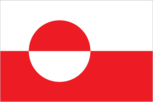
two equal horizontal bands of white (top) and red with a large disk slightly to the hoist side of center - the top half of the disk is red, the bottom half is white Economy Greenland
GDP
purchasing power parity - $1.1 billion (2001 est.)
GDP - composition by sector
- agriculture
- NA%
- industry
- NA%
- services
- NA%
GDP - per capita
purchasing power parity - $20,000 (2001 est.)
GDP - real growth rate
1.8% (2001 est.)
Geographic coordinates
72 00 N, 40 00 W
Geography - note
dominates North Atlantic Ocean between North America and Europe; sparse population confined to small settlements along coast, but close to one-quarter of the population lives in the capital, Nuuk; world's second largest ice cap People Greenland
Government type
parliamentary democracy within a constitutional monarchy
Highways
- total
- NA (there are no roads between towns) (2003)
HIV/AIDS - adult prevalence rate
NA%
HIV/AIDS - deaths
NA
HIV/AIDS - people living with HIV/AIDS
100 (1999)
Household income or consumption by percentage share
- highest 10%
- NA%
- lowest 10%
- NA%
Imports
$403 million c.i.f. (2001)
Imports - commodities
machinery and transport equipment, manufactured goods, food, petroleum products
Imports - partners
Denmark 74.6%, Norway 14.2%, Russia 2.3% (2002)
Independence
- none (part of the Kingdom of Denmark; self-governing overseas administrative division of Denmark since 1979)
- note
- foreign affairs is the responsibility of Denmark, but Greenland actively participates in international agreements relating to Greenland
Industrial production growth rate
NA%
Industries
fish processing (mainly shrimp and Greenland halibut), handicrafts, hides and skins, small shipyards, mining
Infant mortality rate
- female
- 15.47 deaths/1,000 live births (2003 est.)
- male
- 18.09 deaths/1,000 live births
- total
- 16.8 deaths/1,000 live births
Inflation rate (consumer prices)
1.6% (1999 est.)
International organization participation
NC, NIB
Internet country code
.gl
Internet Service Providers (ISPs)
1 (2000)
Internet users
20,000 (2002) Transportation Greenland
Irrigated land
NA sq km
Judicial branch
High Court or Landsret (appeals can be made to the Ostre Landsret or Eastern Division of the High Court or Supreme Court in Copenhagen)
Labor force
24,500 (1999 est.)
Land boundaries
0 km
Land use
- arable land
- 0%
- other
- 100% (1998 est.)
- permanent crops
- 0%
Languages
Greenlandic (East Inuit), Danish, English
Legal system
Danish
Legislative branch
- unicameral Parliament or Landstinget (31 seats; members are elected by popular vote on the basis of proportional representation to serve four-year terms)
- election results
- percent of vote by party - Siumut 28.7%, Inuit Ataqatigiit 25.5%, Atassut Party 20.4%, Demokratiit 15.6%, Katusseqatigiit 5.3%; seats by party - Siumut 10, Inuit Ataqatigiit 8, Atassut 7, Demokratiit 5, Katusseqatigiit 1
- elections
- last held on 3 December 2002 (next to be held by NA December 2006)
- note
- two representatives were elected to the Danish Parliament or Folketing on 20 November 2001 (next to be held no later than November 2005); percent of vote by party - NA%; seats by party - Siumut 1, Inuit Ataqatigiit 1
Life expectancy at birth
- female
- 72.65 years (2003 est.)
- male
- 65.44 years
- total population
- 69 years
Literacy
- definition
- NA
- female
- NA%
- male
- NA%
- note
- similar to Denmark proper Government Greenland
- total population
- NA%
Location
Northern North America, island between the Arctic Ocean and the North Atlantic Ocean, northeast of Canada
Map references
Arctic Region
Maritime claims
- continental shelf
- 200 NM or agreed boundaries or median line
- exclusive fishing zone
- 200 NM or agreed boundaries or median line
- territorial sea
- 3 NM
Median age
- female
- 31.7 years (2002)
- male
- 34.3 years
- total
- 33.1 years
Merchant marine
- convenience
- Denmark 1 (2002 est.)
- note
- includes a foreign-owned ship registered here as a flag of
- ships by type
- cargo 2, passenger 1
- total
- 3 ships (1,000 GRT or over) 4,593 GRT/3,640 DWT
Military - note
defense is the responsibility of Denmark Transnational Issues Greenland
National holiday
June 21 (longest day)
Nationality
- adjective
- Greenlandic
- noun
- Greenlander(s)
Natural hazards
continuous permafrost over northern two-thirds of the island
Natural resources
zinc, lead, iron ore, coal, molybdenum, gold, platinum, uranium, fish, seals, whales, hydropower, possible oil and gas
Net migration rate
-8.37 migrant(s)/1,000 population (2003 est.)
Oil - consumption
3,700 bbl/day (2001 est.)
Oil - exports
NA (2001)
Oil - imports
NA (2001)
Oil - production
0 bbl/day (2001 est.)
Political parties and leaders
Akulliit Party [Bjarne KREUTZMANN]; Atassut Party (Solidarity, a conservative party favoring continuing close relations with Denmark) [Augusta SALLING]; Demokratiit [Per BERTHELSEN]; Inuit Ataqatigiit or IA (Eskimo Brotherhood, a leftist party favoring complete independence from Denmark rather than home rule) [Josef MOTZFELDT]; Issituup (Polar Party) [Nicolai HEINRICH]; Kattusseqatigiit (Candidate List, an independent right-of-center party with no official platform [leader NA]; Siumut (Forward Party, a social democratic party advocating more distinct Greenlandic identity and greater autonomy from Denmark) [Hans ENOKSEN]
Political pressure groups and leaders
NA
Population
56,385 (July 2003 est.)
Population below poverty line
NA%
Population growth rate
0.01% (2003 est.)
Ports and harbors
Aasiaat (Egedesminde), Ilulissat (Jakobshavn), Kangerlussuaq, Nanortalik, Narsarsuaq, Nuuk (Godthab), Qaqortoq (Julianehab), Sisimiut (Holsteinsborg), Tasiilaq (March 2001)
Radio broadcast stations
AM 5, FM 12, shortwave 0 (1998)
Radios
30,000 (1998 est.)
Railways
0 km
Religions
Evangelical Lutheran
Sex ratio
- at birth
- 1.03 male(s)/female
- total population
- 1.13 male(s)/female (2003 est.)
- under 15 years
- 1.04 male(s)/female 15-64 years: 1.19 male(s)/female 65 years and over: 0.86 male(s)/female
Suffrage
18 years of age; universal
Telephone system
- domestic
- microwave radio relay and satellite
- general assessment
- adequate domestic and international service provided by satellite, cables and microwave radio relay; totally digitalized in 1995
- international
- satellite earth stations - 12 Intelsat, 1 Eutelsat, 2 Americom GE-2 (all Atlantic Ocean)
Telephones - main lines in use
25,617 (yearend 1999)
Telephones - mobile cellular
12,676 (yearend 1999)
Television broadcast stations
1 publicly-owned station, some local low-power stations, and three AFRTS (US Air Force) stations (1997)
Televisions
30,000 (1998 est.)
Terrain
flat to gradually sloping icecap covers all but a narrow, mountainous, barren, rocky coast
Total fertility rate
2.43 children born/woman (2003 est.)
Unemployment rate
10% (2000 est.)
Waterways
none