1992 Edition
CIA World Factbook 1992 (Project Gutenberg)
Geography
Climate
arctic to subarctic; cool summers, cold winters
Coastline
44,087 km
Comparative area
slightly more than three times the size of Texas
Disputes
Denmark has challenged Norway's maritime claims between Greenland and Jan Mayen
Environment
sparse population confined to small settlements along coast; continuous permafrost over northern two-thirds of the island
Exclusive fishing zone
200 nm
Land area
341,700 km2 (ice free)
Land boundaries
none
Land use
arable land 0%; permanent crops 0%; meadows and pastures 1%; forest and woodland NEGL%; other 99%
Natural resources
zinc, lead, iron ore, coal, molybdenum, cryolite, uranium, fish
Note
dominates North Atlantic Ocean between North America and Europe
Terrain
flat to gradually sloping icecap covers all but a narrow, mountainous, barren, rocky coast
Territorial sea
3 nm
Total area
2,175,600 km2
People and Society
Birth rate
19 births/1,000 population (1992)
Death rate
8 deaths/1,000 population (1992)
Ethnic divisions
Greenlander (Eskimos and Greenland-born Caucasians) 86%, Danish 14%
Infant mortality rate
27 deaths/1,000 live births (1992)
Labor force
22,800; largely engaged in fishing, hunting, sheep breeding
Languages
Eskimo dialects, Danish
Life expectancy at birth
63 years male, 69 years female (1992)
Literacy
NA% (male NA%, female NA%)
Nationality
noun - Greenlander(s); adjective - Greenlandic
Net migration rate
0 migrants/1,000 population (1992)
Organized labor
NA
Population
57,407 (July 1992), growth rate 1.1% (1992)
Religions
Evangelical Lutheran
Total fertility rate
2.2 children born/woman (1992)
Government
Administrative divisions
3 municipalities (kommuner, - singular - kommun); - Nordgronland, Ostgrnland, Vestgronland
Capital
Nuuk (Godthab)
Chief of State
Queen MARGRETHE II (since 14 January 1972), represented by High Commissioner Bent KLINTE (since NA)
Constitution
Danish
Danish Folketing
last held on 12 December 1990 (next to be held by December 1994); Greenland elects two representatives to the Folketing; results - percent of vote by party NA; seats - (2 total) Siumut 1, Atassut 1
Diplomatic representation
none (self-governing overseas administrative division of Denmark)
Executive branch
Danish monarch, high commissioner, home rule chairman, prime minister, Cabinet (Landsstyre)
Flag
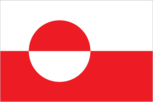
two equal horizontal bands of white (top) and red with a large disk slightly to the hoist side of center - the top half of the disk is red, the bottom half is white
Head of Government
Home Rule Chairman Lars Emil JOHANSEN (since 15 March 1991)
Independence
part of the Danish realm; self-governing overseas administrative division
Judicial branch
High Court (Landsret)
Landsting
last held on 5 March 1991 (next to be held 5 March 1995); results - percent of vote by party NA; seats - (27 total) Siumut 11, Atassut Party 8, Inuit Ataqatigiit 5, Center Party 2, Polar Party 1
Legal system
Danish
Legislative branch
unicameral Parliament (Landsting)
Long-form name
none
Member of
NC
National holiday
Birthday of the Queen, 16 April (1940)
Political parties and leaders
two-party ruling coalition - Siumut (a moderate socialist party that advocates more distinct Greenlandic identity and greater autonomy from Denmark), Lars Emil JOHANSEN, chairman; - Inuit - Ataqatigiit - (IA; - a - Marxist-Leninist party that favors complete independence from Denmark rather than home rule), leader NA; Atassut Party (a more conservative party that favors continuing close relations with Denmark), leader NA; Polar Party (conservative-Greenland nationalist), leader NA; Center Party (a new nonsocialist protest party), leader NA
Suffrage
universal at age 18
Type
part of the Danish realm; self-governing overseas administrative division
Economy
Agriculture
sector dominated by fishing and sheep raising; crops limited to forage and small garden vegetables; 1988 fish catch of 133,500 metric tons
Budget
revenues $381 million; expenditures $381 million, including capital expenditures of $36 million (1989)
Currency
Danish krone (plural - kroner); 1 Danish krone (DKr) = 100 re
Economic aid
none
Electricity
84,000 kW capacity; 176 million kWh produced, 3,180 kWh per capita (1991)
Exchange rates
Danish kroner (DKr) per US$1 - 6.447 (March 1992), 6.396 (1991), 6.189 (1990), 7.310 (1989), 6.732 (1988), 6.840 (1987)
Exports
$435 million (f.o.b., 1990 est.) commodities: fish and fish products 83%, metallic ores and concentrates 13% partners: Denmark 79%, Benelux 9%, Germany 5%
External debt
$480 million (1990 est.)
Fiscal year
calendar year
GNP
purchasing power equivalent - $500 million, per capita $9,000; real growth rate 5% (1988)
Imports
$420 million (c.i.f., 1990 est.) commodities: manufactured goods 28%, machinery and transport equipment 24%, food and live animals 12.4%, petroleum and petroleum products 12% partners: Denmark 65%, Norway 8.8%, US 4.6%, Germany 3.8%, Japan 3.8%, Sweden 2.4%
Industrial production
growth rate NA%
Industries
fish processing (mainly shrimp), potential for platinum and gold mining, handicrafts, shipyards
Inflation rate (consumer prices)
l.6% (1991)
Overview
Over the past 25 years, the economy has changed from one based on subsistence whaling, hunting, and fishing to one dependent on foreign trade. Fishing is still the most important industry, accounting for over 75% of exports and about 25% of the population's income. Maintenance of a social welfare system similar to Denmark's has given the public sector a dominant role in the economy. In 1990, the economy became critically dependent on shrimp exports and on an annual subsidy (now about $500 million) from the Danish Government because cod exports dropped off and commercial mineral production stopped. As of 1992, the government also has taken control of the health sector from Denmark. The new Home Rule government installed in March 1991 has decided to end much of the central control of the economy and to open it wider to competitive forces.
Unemployment rate
9% (1990 est.)
Communications
Airports
11 total, 8 usable; 5 with permanent-surface runways; none with runways over 3,659 m; 2 with runways 2,440-3,659 m; 2 with runways 1,220-2,439 m
Civil air
2 major transport aircraft
Highways
80 km
Merchant marine
1 refrigerated cargo (1,000 GRT or over) totaling 1,021 GRT/1,778 DWT; note - operates under the registry of Denmark
Ports
Kangerluarsoruseq (Faeringehavn), Paamiut (Frederikshaab), Nuuk (Godthaab), Sisimiut (Holsteinsborg), Julianehaab, Maarmorilik, North Star Bay
Telecommunications
adequate domestic and international service provided by cables and microwave; 17,900 telephones; broadcast stations - 5 AM, 7 (35 repeaters) FM, 4 (9 repeaters) TV; 2 coaxial submarine cables; 1 Atlantic Ocean INTELSAT earth station
Military and Security
Note
defense is responsibility of Denmark