2015 Edition
CIA World Factbook 2015 Archive (Wayback Machine ZIP)
Introduction
Background
Formed from the merger of the British colony of the Gold Coast and the Togoland trust territory, Ghana in 1957 became the first sub-Saharan country in colonial Africa to gain its independence. Ghana endured a long series of coups before Lt. Jerry RAWLINGS took power in 1981 and banned political parties. After approving a new constitution and restoring multiparty politics in 1992, RAWLINGS won presidential elections in 1992 and 1996 but was constitutionally prevented from running for a third term in 2000. John KUFUOR succeeded him and was reelected in 2004. John Atta MILLS won the 2008 presidential election and took over as head of state, but he died in July 2012 and was constitutionally succeeded by his vice president, John Dramani MAHAMA, who subsequently won the December 2012 presidential election.
Geography
Area
- land
- 227,533 sq km
- total
- 238,533 sq km
- water
- 11,000 sq km
Area - comparative
slightly smaller than Oregon
Climate
tropical; warm and comparatively dry along southeast coast; hot and humid in southwest; hot and dry in north
Coastline
539 km
Elevation extremes
- highest point
- Mount Afadjato 885 m
- lowest point
- Atlantic Ocean 0 m
Environment - current issues
recurrent drought in north severely affects agricultural activities; deforestation; overgrazing; soil erosion; poaching and habitat destruction threatens wildlife populations; water pollution; inadequate supplies of potable water
Environment - international agreements
- party to
- Biodiversity, Climate Change, Climate Change-Kyoto Protocol, Desertification, Endangered Species, Environmental Modification, Hazardous Wastes, Law of the Sea, Ozone Layer Protection, Ship Pollution, Tropical Timber 83, Tropical Timber 94, Wetlands
- signed, but not ratified
- Marine Life Conservation
Freshwater withdrawal (domestic/industrial/agricultural)
- per capita
- 48.82 cu m/yr (2000)
- total
- 0.98 cu km/yr (24%/10%/66%)
Geographic coordinates
8 00 N, 2 00 W
Geography - note
Lake Volta is the world's largest artificial lake (manmade reservoir) by surface area (8,482 sq km; 3,275 sq mi)
Irrigated land
309 sq km (2003)
Land boundaries
- border countries (3)
- Burkina Faso 602 km, Cote d'Ivoire 720 km, Togo 1,098 km
- total
- 2,420 km
Land use
- arable land 20.7%; permanent crops 11.9%; permanent pasture 36.5%
- agricultural land
- 69.1%
- forest
- 21.2%
- other
- 9.7% (2011 est.)
Location
Western Africa, bordering the Gulf of Guinea, between Cote d'Ivoire and Togo
Map references
Africa
Maritime claims
- contiguous zone
- 24 nm
- continental shelf
- 200 nm
- exclusive economic zone
- 200 nm
- territorial sea
- 12 nm
Natural hazards
dry, dusty, northeastern harmattan winds from January to March; droughts
Natural resources
gold, timber, industrial diamonds, bauxite, manganese, fish, rubber, hydropower, petroleum, silver, salt, limestone
Terrain
mostly low plains with dissected plateau in south-central area
Total renewable water resources
53.2 cu km (2011)
People and Society
Age structure
- 0-14 years
- 38.38% (male 5,076,131/female 5,027,960)
- 15-24 years
- 18.69% (male 2,449,026/female 2,472,756)
- 25-54 years
- 33.95% (male 4,338,197/female 4,598,796)
- 55-64 years
- 4.84% (male 619,516/female 654,720)
- 65 years and over
- 4.14% (male 505,056/female 585,491) (2015 est.)
Birth rate
31.09 births/1,000 population (2015 est.)
Child labor - children ages 5-14
- percentage
- 34% (2006 est.)
- total number
- 1,806,750
Children under the age of 5 years underweight
13.4% (2011)
Contraceptive prevalence rate
19.5% (2013)
Death rate
7.22 deaths/1,000 population (2015 est.)
Dependency ratios
- elderly dependency ratio
- 5.9%
- potential support ratio
- 17% (2015 est.)
- total dependency ratio
- 73%
- youth dependency ratio
- 67.2%
Drinking water source
- urban: 92.6% of population
- rural: 84% of population
- total: 88.7% of population
- urban: 7.4% of population
- rural: 16% of population
- total: 11.3% of population (2015 est.)
Education expenditures
8.1% of GDP (2011)
Ethnic groups
Akan 47.5%, Mole-Dagbon 16.6%, Ewe 13.9%, Ga-Dangme 7.4%, Gurma 5.7%, Guan 3.7%, Grusi 2.5%, Mande 1.1%, other 1.4% (2010 est.)
Health expenditures
5.4% of GDP (2013)
HIV/AIDS - adult prevalence rate
1.47% (2014 est.)
HIV/AIDS - deaths
9,200 (2014 est.)
HIV/AIDS - people living with HIV/AIDS
250,200 (2014 est.)
Hospital bed density
0.9 beds/1,000 population (2011)
Infant mortality rate
- female
- 33.23 deaths/1,000 live births (2015 est.)
- male
- 41.39 deaths/1,000 live births
- total
- 37.37 deaths/1,000 live births
Languages
- Asante 16%, Ewe 14%, Fante 11.6%, Boron (Brong) 4.9%, Dagomba 4.4%, Dangme 4.2%, Dagarte (Dagaba) 3.9%, Kokomba 3.5%, Akyem 3.2%, Ga 3.1%, other 31.2%
- note
- English is the official language (2010 est.)
Life expectancy at birth
- female
- 68.66 years (2015 est.)
- male
- 63.76 years
- total population
- 66.18 years
Literacy
- definition
- age 15 and over can read and write
- female
- 71.4% (2015 est.)
- male
- 82%
- total population
- 76.6%
Major infectious diseases
- animal contact disease
- rabies
- degree of risk
- very high
- food or waterborne diseases
- bacterial and protozoal diarrhea, hepatitis A, and typhoid fever
- note
- highly pathogenic H5N1 avian influenza has been identified in this country; it poses a negligible risk with extremely rare cases possible among US citizens who have close contact with birds (2013)
- respiratory disease
- meningococcal meningitis
- vectorborne diseases
- malaria, dengue fever, and yellow fever
- water contact disease
- schistosomiasis
Major urban areas - population
Kumasi 2.599 million; ACCRA (capital) 2.277 million (2015)
Median age
- female
- 21.4 years (2015 est.)
- male
- 20.5 years
- total
- 20.9 years
Nationality
- adjective
- Ghanaian
- noun
- Ghanaian(s)
Net migration rate
-2.02 migrant(s)/1,000 population (2015 est.)
Obesity - adult prevalence rate
10.9% (2014)
Physicians density
0.1 physicians/1,000 population (2010)
Population
- 26,327,649
- note
- estimates for this country explicitly take into account the effects of excess mortality due to AIDS; this can result in lower life expectancy, higher infant mortality, higher death rates, lower population growth rates, and changes in the distribution of population by age and sex than would otherwise be expected (July 2015 est.)
Population growth rate
2.18% (2015 est.)
Religions
Christian 71.2% (Pentecostal/Charismatic 28.3%, Protestant 18.4%, Catholic 13.1%, other 11.4%), Muslim 17.6%, traditional 5.2%, other 0.8%, none 5.2% (2010 est.)
Sanitation facility access
- urban: 20.2% of population
- rural: 8.6% of population
- total: 14.9% of population
- urban: 79.8% of population
- rural: 91.4% of population
- total: 85.1% of population (2015 est.)
School life expectancy (primary to tertiary education)
- female
- 11 years (2012)
- male
- 12 years
- total
- 12 years
Sex ratio
- 0-14 years
- 1.01 male(s)/female
- 15-24 years
- 0.99 male(s)/female
- 25-54 years
- 0.94 male(s)/female
- 55-64 years
- 0.95 male(s)/female
- 65 years and over
- 0.86 male(s)/female
- at birth
- 1.03 male(s)/female
- total population
- 0.97 male(s)/female (2015 est.)
Total fertility rate
4.06 children born/woman (2015 est.)
Urbanization
- rate of urbanization
- 3.4% annual rate of change (2010-15 est.)
- urban population
- 54% of total population (2015)
Government
Administrative divisions
10 regions; Ashanti, Brong-Ahafo, Central, Eastern, Greater Accra, Northern, Upper East, Upper West, Volta, Western
Capital
- geographic coordinates
- 5 33 N, 0 13 W
- name
- Accra
- time difference
- UTC 0 (5 hours ahead of Washington, DC, during Standard Time)
Constitution
several previous; latest drafted 31 March 1992, approved and promulgated 28 April 1992, entered into force 7 January 1993; amended 1996 (2012)
Country name
- conventional long form
- Republic of Ghana
- conventional short form
- Ghana
- former
- Gold Coast
Diplomatic representation from the US
- chief of mission
- Ambassador Gene A. CRETZ (since 11 September 2012)
- embassy
- 24 Fourth Circular Rd., Cantonments, Accra
- FAX
- [233] 30-2741-389
- mailing address
- P. O. Box 194, Accra
- telephone
- [233] 30-2741-000
Diplomatic representation in the US
- chancery
- 3512 International Drive NW, Washington, DC 20008
- chief of mission
- Ambassador Martha Ama Akyaa POBEE (since 31 July 2015)
- consulate(s) general
- New York
- FAX
- [1] (202) 686-4527
- telephone
- [1] (202) 686-4520
Executive branch
- cabinet
- Council of Ministers; nominated by the president, approved by Parliament
- chief of state
- President John Dramani MAHAMA (since 24 July 2012); Vice President Kwesi Bekoe AMISSAH-ARTHUR (since 6 August 2012); note - President MAHAMA assumed the presidency after the death of President John Atta MILLS and subsequently won the December 2012 presidential election; the president is both chief of state and head of government
- election results
- John Dramani MAHAMA elected president; percent of vote - John Dramani MAHAMA (NDC) 50.7%, Nana Addo Dankwa AKUFO-ADDO (NPP) 47.7%, other 1.6%
- elections/appointments
- president and vice president directly elected on the same ballot by absolute majority popular vote in 2 rounds if needed for a 4-year term (eligible for a second term); election last held on 8 December 2012 (next to be held in December 2016)
- head of government
- President John Dramani MAHAMA (since 24 July 2012); Vice President Kwesi Bekoe AMISSAH-ARTHUR (since 6 August 2012)
Flag description
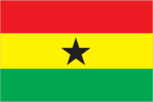
- three equal horizontal bands of red (top), yellow, and green, with a large black five-pointed star centered in the yellow band; red symbolizes the blood shed for independence, yellow represents the country's mineral wealth, while green stands for its forests and natural wealth; the black star is said to be the lodestar of African freedom
- note
- uses the popular Pan-African colors of Ethiopia; similar to the flag of Bolivia, which has a coat of arms centered in the yellow band
Government type
constitutional democracy
Independence
6 March 1957 (from the UK)
International law organization participation
has not submitted an ICJ jurisdiction declaration; accepts ICCt jurisdiction
International organization participation
ACP, AfDB, AU, C, ECOWAS, EITI (compliant country), FAO, G-24, G-77, IAEA, IBRD, ICAO, ICC (national committees), ICCt, ICRM, IDA, IFAD, IFC, IFRCS, ILO, IMF, IMO, IMSO, Interpol, IOC, IOM, IPU, ISO, ITSO, ITU, ITUC (NGOs), MIGA, MINURSO, MINUSMA, MONUSCO, NAM, OAS (observer), OIF, OPCW, UN, UNAMID, UNCTAD, UNESCO, UNHCR, UNIDO, UNIFIL, UNISFA, UNMIL, UNMISS, UNOCI, UNWTO, UPU, WCO, WFTU (NGOs), WHO, WIPO, WMO, WTO
Judicial branch
- highest court(s)
- Supreme Court (consists of a chief justice and 12 justices)
- judge selection and term of office
- chief justice appointed by the president in consultation with the Council of State (a small advisory body of prominent citizens) and with the approval of Parliament; other justices appointed by the president upon the advice of the Judicial Council (an 18-member independent body of judicial, military and police officials, and presidential nominees) and on the advice of the Council of State; justices can retire at age 60, with compulsory retirement at age 70
- subordinate courts
- Court of Appeal; High Court; Circuit Court; District Court; regional tribunals
Legal system
mixed system of English common law and customary law
Legislative branch
- description
- unicameral Parliament (275 seats; members directly elected in single-seat constituencies by simple majority vote to serve 4-year terms)
- election results
- percent of vote by party - NPP 47.5%, NDC 46.4%, PNC 0.6%, independent 2.5%, other 3.0%; seats by party - NDC 150, NPP 120, PNC 1, independent 3, other 1
- elections
- last held on 7 - 8 December 2012 (next to be held in December 2016)
National anthem
- lyrics/music
- unknown/Philip GBEHO
- name
- "God Bless Our Homeland Ghana"
- note
- music adopted 1957, lyrics adopted 1966; the lyrics were changed twice, in 1960 when a republic was declared and after a 1966 coup
National holiday
Independence Day, 6 March (1957)
National symbol(s)
black star, golden eagle: national colors: red, yellow, green, black
Political parties and leaders
- Convention People's Party or CPP [Samia NKRUMAH]
- National Democratic Congress or NDC [John Dramani MAHAMA]
- New Patriotic Party or NPP [Paul AFOKO]
- People's National Convention or PNC [Alhaji Amed RAMADAN]
- note
- listed are four of the more popular political parties as of December 2012; there are more than 20 registered parties
Political pressure groups and leaders
- Christian Aid (water rights)
- Committee for Joint Action or CJA (social and economic issues)
- National Coalition Against the Privatization of Water or CAP (water rights)
- Oxfam (water rights)
- Public Citizen (water rights)
- Students Coalition Against EPA [Kwabena Ososukene OKAI] (education reform)
- Third World Network (social and economic issues)
Suffrage
18 years of age; universal
Economy
Agriculture - products
cocoa, rice, cassava (manioc, tapioca), peanuts, corn, shea nuts, bananas; timber
Budget
- expenditures
- $11.63 billion (2014 est.)
- revenues
- $8.226 billion
Budget surplus (+) or deficit (-)
-9.6% of GDP (2014 est.)
Central bank discount rate
- 21% (31 December 2014)
- 16% (31 December 2013)
Commercial bank prime lending rate
- 30% (31 December 2014 est.)
- 25.6% (31 December 2013 est.)
Current account balance
- -$3.331 billion (2014 est.)
- -$5.704 billion (2013 est.)
Debt - external
- $12.97 billion (31 December 2014 est.)
- $11.46 billion (31 December 2013 est.)
Distribution of family income - Gini index
- 42.3 (2012-13)
- 41.9 (2005-06)
Economy - overview
Ghana's economy was strengthened by a quarter century of relatively sound management, a competitive business environment, and sustained reductions in poverty levels, but in recent years has suffered the consequences of loose fiscal policy, high budget and current account deficits, and a depreciating currency. Ghana has a market-based economy with relatively few policy barriers to trade and investment in comparison with other countries in the region. Ghana is well-endowed with natural resources. Agriculture accounts for nearly one-quarter of GDP and employs more than half of the workforce, mainly small landholders. The services sector accounts for about half of GDP. Gold and cocoa exports, and individual remittances, are major sources of foreign exchange. Expansion of Ghana’s nascent oil industry has boosted economic growth, but the recent oil price crash has reduced by half Ghana’s 2015 anticipated oil revenue. Production at Jubilee, Ghana's offshore oil field, began in mid-December 2010 and currently produces roughly 110,000 barrels per day. The country’s first gas processing plant at Atubao is also producing natural gas from the Jubilee field, providing power to several of Ghana’s thermal power plants. As of 2015, the biggest single economic issue is the lack of consistent electricity. While the MAHAMA administration is taking steps to improve the situation, it will be the third or fourth quarter of 2015 before any relief is visible. Ghana signed a $920 million extended credit facility with the IMF in April, 2015 to help it address its growing economic crisis. The IMF fiscal targets will require Ghana to reduce the fiscal deficit by cutting subsidies, decreasing the bloated public sector wage bill, strengthening revenue administration, and increasing revenues. The challenge for Ghana will come as the MAHAMA Administration approaches the 2016 election cycle facing public dissatisfaction in the midst of economic austerity.
Exchange rates
- cedis (GHC) per US dollar -
- 2.881 (2014 est.)
- 1.98 (2013 est.)
- 1.8 (2012 est.)
- 1.512 (2011 est.)
- 1.431 (2010 est.)
Exports
- $13.22 billion (2014 est.)
- $13.75 billion (2013 est.)
Exports - commodities
oil, gold, cocoa, timber, tuna, bauxite, aluminum, manganese ore, diamonds, horticultural products
Exports - partners
China 10.7%, France 9%, Netherlands 7.3%, India 7.3%, South Africa 6.6%, Italy 6.5% (2014)
Fiscal year
calendar year
GDP - composition, by end use
- (2014 est.)
- exports of goods and services
- 42.1%
- government consumption
- 17.7%
- household consumption
- 61.3%
- imports of goods and services
- -46.2%
- investment in fixed capital
- 23.6%
- investment in inventories
- 1.4%
GDP - composition, by sector of origin
- agriculture
- 22%
- industry
- 28.4%
- services
- 49.6% (2014 est.)
GDP - per capita (PPP)
- $4,100 (2014 est.)
- $4,000 (2013 est.)
- $3,700 (2012 est.)
- note
- data are in 2014 US dollars
GDP - real growth rate
- 4.2% (2014 est.)
- 7.3% (2013 est.)
- 8% (2012 est.)
GDP (official exchange rate)
$38.65 billion (2014 est.)
GDP (purchasing power parity)
- $108.3 billion (2014 est.)
- $103.9 billion (2013 est.)
- $96.84 billion (2012 est.)
- note
- data are in 2014 US dollars
Gross national saving
- 15.5% of GDP (2014 est.)
- 14.9% of GDP (2013 est.)
- 16.8% of GDP (2012 est.)
Household income or consumption by percentage share
- highest 10%
- 32.8% (2006)
- lowest 10%
- 2%
Imports
- $14.57 billion (2014 est.)
- $17.6 billion (2013 est.)
Imports - commodities
capital equipment, refined petroleum, foodstuffs
Imports - partners
China 25.5%, Nigeria 13.1%, Netherlands 8.2%, Cote dIvoire 7.2%, US 6.9%, India 4.1% (2014)
Industrial production growth rate
1% (2014 est.)
Industries
mining, lumbering, light manufacturing, aluminum smelting, food processing, cement, small commercial ship building, petroleum
Inflation rate (consumer prices)
- 17% (2014 est.)
- 13.5% (2013 est.)
Labor force
11.25 million (2014 est.)
Labor force - by occupation
- agriculture
- 44.7%
- industry
- 14.4%
- services
- 40.9% (2013 est.)
Market value of publicly traded shares
- $3.465 billion (31 December 2012 est.)
- $3.097 billion (31 December 2011)
- $3.531 billion (31 December 2010 est.)
Population below poverty line
24.2% (2013 est.)
Public debt
- 72.7% of GDP (2014 est.)
- 55.8% of GDP (2013 est.)
Reserves of foreign exchange and gold
- $5.461 billion (31 December 2014 est.)
- $5.632 billion (31 December 2013 est.)
Stock of broad money
- $10.82 billion (31 December 2014 est.)
- $12.65 billion (31 December 2013 est.)
Stock of direct foreign investment - abroad
- $16.62 billion (31 December 2013 est.)
- $109 million (31 December 2012 est.)
Stock of direct foreign investment - at home
- $19.85 billion (31 December 2013 est.)
- $11.8 billion (31 December 2012 est.)
Stock of domestic credit
- $13.32 billion (31 December 2014 est.)
- $15.1 billion (31 December 2013 est.)
Stock of narrow money
- $5.119 billion (31 December 2014 est.)
- $6.232 billion (31 December 2013 est.)
Taxes and other revenues
23.2% of GDP (2014 est.)
Unemployment rate
5.2% (2013 est.)
Energy
Carbon dioxide emissions from consumption of energy
9.098 million Mt (2012 est.)
Crude oil - exports
0 bbl/day (2010 est.)
Crude oil - imports
32,060 bbl/day (2010 est.)
Crude oil - production
110,000 bbl/day (2014 est.)
Crude oil - proved reserves
660 million bbl (1 January 2014 est.)
Electricity - consumption
10.58 billion kWh (2013 est.)
Electricity - exports
122 million kWh (2013 est.)
Electricity - from fossil fuels
45% of total installed capacity (2015 est.)
Electricity - from hydroelectric plants
54% of total installed capacity (2015 est.)
Electricity - from nuclear fuels
0% of total installed capacity (2015 est.)
Electricity - from other renewable sources
0% of total installed capacity (2015 est.)
Electricity - imports
27 million kWh (2013 est.)
Electricity - installed generating capacity
2.847 million kW (2015 est.)
Electricity - production
12.87 billion kWh (2013 est.)
Natural gas - consumption
615 million cu m (2012 est.)
Natural gas - exports
0 cu m (2013 est.)
Natural gas - imports
615 million cu m (2012 est.)
Natural gas - production
0 cu m (2014 est.)
Natural gas - proved reserves
22.65 billion cu m (1 January 2014 est.)
Refined petroleum products - consumption
66,570 bbl/day (2013 est.)
Refined petroleum products - exports
9,977 bbl/day (2010 est.)
Refined petroleum products - imports
37,240 bbl/day (2010 est.)
Refined petroleum products - production
22,130 bbl/day (2010 est.)
Communications
Broadcast media
state-owned TV station, 2 state-owned radio networks; several privately owned TV stations and a large number of privately owned radio stations; transmissions of multiple international broadcasters are accessible; several cable and satellite TV subscription services are obtainable (2007)
Internet country code
.gh
Internet users
- percent of population
- 19.6% (2014 est.)
- total
- 5 million
Radio broadcast stations
AM 0, FM 86, shortwave 3 (2007)
Telephone system
- domestic
- competition among multiple mobile-cellular providers has spurred growth with a subscribership of more than 80 per 100 persons and rising
- general assessment
- primarily microwave radio relay; wireless local loop has been installed; outdated and unreliable fixed-line infrastructure heavily concentrated in Accra
- international
- country code - 233; landing point for the SAT-3/WASC, Main One, and GLO-1 fiber-optic submarine cables that provide connectivity to South Africa, Europe, and Asia; satellite earth stations - 4 Intelsat (Atlantic Ocean); microwave radio relay link to Panaftel system connects Ghana to its neighbors (2009)
Telephones - fixed lines
- subscriptions per 100 inhabitants
- 1 (2014 est.)
- total subscriptions
- 260,000
Telephones - mobile cellular
- subscriptions per 100 inhabitants
- 118 (2014 est.)
- total
- 30.4 million
Television broadcast stations
7 (2007)
Transportation
Airports
10 (2013)
Airports - with paved runways
- 1,524 to 2,437 m
- 3
- 2,438 to 3,047 m
- 1
- 914 to 1,523 m
- 2 (2013)
- over 3,047 m
- 1
- total
- 7
Airports - with unpaved runways
- 914 to 1,523 m
- 3 (2013)
- total
- 3
Merchant marine
- by type
- petroleum tanker 1, refrigerated cargo 3
- foreign-owned
- 2 (Brazil 1, South Korea 1) (2010)
- total
- 4
Pipelines
gas 394 km; oil 20 km; refined products 361 km (2013)
Ports and terminals
- major seaport(s)
- Takoradi, Tema
Railways
- narrow gauge
- 947 km 1.067-m gauge (2014)
- total
- 947 km
Roadways
- paved
- 13,787 km
- total
- 109,515 km
- unpaved
- 95,728 km (2009)
Waterways
1,293 km (168 km for launches and lighters on Volta, Ankobra, and Tano Rivers; 1,125 km of arterial and feeder waterways on Lake Volta) (2011)
Military and Security
Manpower available for military service
- females age 16-49
- 6,194,339 (2010 est.)
- males age 16-49
- 6,268,191
Manpower fit for military service
- females age 16-49
- 4,220,761 (2010 est.)
- males age 16-49
- 4,136,406
Manpower reaching militarily significant age annually
- female
- 260,992 (2010 est.)
- male
- 267,896
Military branches
Ghana Army, Ghana Navy, Ghana Air Force (2012)
Military expenditures
- 0.56% of GDP (2014)
- 0.61% of GDP (2013)
- 0.27% of GDP (2012)
Military service age and obligation
18-26 years of age for voluntary military service, with basic education certificate; no conscription; must be HIV/AIDS negative (2012)
Transnational Issues
Disputes - international
disputed maritime border between Ghana and Cote d'Ivoire
Illicit drugs
illicit producer of cannabis for the international drug trade; major transit hub for Southwest and Southeast Asian heroin and, to a lesser extent, South American cocaine destined for Europe and the US; widespread crime and money-laundering problem, but the lack of a well-developed financial infrastructure limits the country's utility as a money-laundering center; significant domestic cocaine and cannabis use
Refugees and internally displaced persons
- refugees (country of origin)
- 9,779 (Cote d'Ivoire; flight from 2010 post-election fighting); 5,262 (Liberia) (2014)