1989 Edition
CIA World Factbook 1989 (Internet Archive)
Geography
Climate
tropical; warm and comparatively dry along southeast coast; hot and humid in southwest; hot and dry in north
Coastline
539 km
Comparative area
slightly smaller than Oregon
Contiguous zone
24 nm
Continental shelf
200 nm
Environment
recent drought in north severely affecting marginal agricultural activities; deforestation; overgrazing; soil erosion; dry, northeasterly harmattan wind (January to March)
Exclusive economic zone
200 nm
Land boundaries
2,093 km total; Burkina 548 km, Ivory Coast 668 km, Togo 877 km
Land use
5% arable land; 7% permanent crops; 1 5% meadows and pastures; 37% forest and woodland; 36% other; includes NEGL% irrigated
Natural resources
gold, timber, industrial diamonds, bauxite, manganese, fish, rubber
Note
Lake Volta is world's largest artificial lake
Terrain
mostly low plains with dissected plateau in south-central area
Territorial sea
1 2 nm
Total area
238,540 km2; land area: 230,020 km2
People and Society
Birth rate
46 births/ 1,000 population (1990)
Death rate
13 deaths/ 1,000 population (1990)
Ethnic divisions
99.8% black African (major tribes — 44% Akan, 16% MoshiDagomba, 13% Ewe, 8% Ga), 0.2% European and other
Infant mortality rate
89 deaths/ 1,000 live births (1990)
Labor force
3,700,000; 54.7% agriculture and fishing, 18.7% industry, 15.2% sales and clerical, 7.7% services, transportation, and communications, 3.7% professional; 48% of population of working age (1983)
Language
English (official); African languages include Akan, Moshi-Dagomba, Ewe, and Ga
Life expectancy at birth
52 years male, 56 years female (1990)
Literacy
53.2%
Nationality
noun — Ghanaian(s); adjective— Ghanaian
Net migration rate
— 1 migrant/ 1 ,000 population (1990)
Organized labor
467,000 (about 13% of labor force)
Population
15,165,243 (July 1990), growth rate 3.2% (1990)
Religion
38% indigenous beliefs, 30% Muslim, 24% Christian, 8% other
Total fertility rate
6.4 children born/ woman (1990)
Government
Administrative divisions
1 0 regions; Ashanti, Brong-Ahafo, Central, Eastern, Greater Accra, Northern, Upper East, Upper West, Volta, Western
Capital
Accra
Communists
a small number of Communists and sympathizers
Constitution
24 September 1979; suspended 31 December 1981
Diplomatic representation
Ambassador Eric K. OTOO; Chancery at 2460 16th Street NW, Washington DC 20009; telephone (202) 462-0761; there is a Ghanaian Consulate General in New York; US — Ambassador Raymond C. EWING; Embassy at Ring Road East, East of Danquah Circle, Accra (mailing address is P. O. Box 194, Accra); telephone 775347 through 775349
Elections
none
Executive branch
chairman of the Provisional National Defense Council (PNDC), PNDC, Cabinet
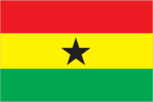
Hag
three equal horizontal bands of red (top), yellow, and green with a large black five-pointed star centered in the gold band; uses the popular pan-African colors of Ethiopia; similar to the flag of Bolivia which has a coat of arms centered in the yellow band
Independence
6 March 1957 (from UK, formerly Gold Coast)
Judicial branch
Supreme Court
Leaders
Chief of State and Head of Government— Chairman of the Provisional National Defense Council Fit. Lt. (Ret.) Jerry John RAWLINGS (since 31 December 1981) Political parties and leaders: none; political parties outlawed after 31 December 1981 coup
Legal system
based on English common law and customary law; has not accepted compulsory ICJ jurisdiction
Legislative branch
unicameral National Assembly dissolved after 3 1 December 1981 coup, and legislative powers were assumed by the Provisional National Defense Council
Long-form name
Republic of Ghana
Member of
ACP, AfDB, CCC, Commonwealth, ECA, ECOWAS, FAO, G-77, GATT, IAEA, IBA, IBRD, ICAO, ICO, IDA, IFAD, IFC, ILO, IMF, IMO, INTELSAT, INTERPOL, IRC, ISO, ITU, NAM, OAU, UN, UNESCO, UPU, WCL, WHO, WIPO, WMO, WTO
National holiday
Independence Day, 6 March (1957)
Suffrage
none
Type
military
Economy
Agriculture
accounts for more than 50% of GDP (including fishing and forestry); the major cash crop is cocoa; other principal crops — rice, coffee, cassava, peanuts, corn, shea nuts, timber; normally self-sufficient in food
Aid
US commitments, including Ex-Im (FY70-88), $424 million; Western (nonUS) countries, ODA and OOF bilateral commitments (1970-87), $1.9 billion; OPEC bilateral aid (1979-89), $78 million; Communist countries (1970-88), $84 million
Budget
revenues $769 million; expenditures $749 million, including capital expenditures of $179 million (1988 est.)
Currency
cedi (plural — cedis); 1 cedi (C) = 100 pesewas
Electricity
1,172,000 kW capacity; 4,110 million kWh produced, 280 kWh per capita (1989) Ghana (continued)
Exchange rates
cedis (C) per US$1 — 301.68 (December 1989), 270.00 (1989), 202.35 (1988), 153.73 (1987), 89.20 (1986), 54.37 (1985) Fiscal year calendar year
Exports
$977 million (f.o.b., 1987); commodities— cocoa 60%, timber, gold, tuna, bauxite, and aluminum; partners — US 23%, UK, other EC
External debt
$3.0 billion (December 1989 est.)
GNP
$5.2 billion, per capita $400; real growth rate 6% (1988)
Illicit drugs
illicit producer of cannabis for the international drug trade
Imports
$988 million (c.i.f., 1987); commodities— petroleum 16%, consumer goods, foods, intermediate goods, capital equipment; partners— US 10%, UK, FRG, France, Japan, South Korea, GDR
Industrial production
growth rate 0.5% in manufacturing (1987)
Industries
mining, lumbering, light manufacturing, fishing, aluminum, food processing
Inflation rate (consumer prices)
32.7% (1988)
Overview
Supported by substantial international assistance, Ghana has been implementing a steady economic rebuilding program since 1983. Good harvests in 1988 featured the 6% growth in GNP. Moves toward privatization and relaxation of government controls continued in 198889, although at a slower-than-expected pace. In 1988 service on the $2.8 billion debt was equivalent to 75% of export earnings. As Ghana obtains concessional loans and pays off high-interest debt, however, debt service is expected to fall below 30% of export earnings in the early 1990s. The economic rebuilding program has both helped and harmed the manufacturing sector, for example, by improving the supply of raw materials and by increasing competition from imports. The long-term outlook is favorable provided that the political structure can endure the slow pace at which living standards are improving and can manage the problems stemming from excessive population growth.
Unemployment rate
26% (April 1987)
Communications
Airports
10 total, 9 usable; 5 with permanent-surface runways; none with runways over 3,659 m; 1 with runways 2,440-3,659 m; 7 with runways 1,220-2,439 m
Branches
Army, Navy, Air Force, paramilitary Palace Guard, paramilitary People's Militia
Defense expenditures
0.9% of GNP (1987)
Highways
28,300 km total; 6,000 km concrete or bituminous surface, 22,300 km gravel, laterite, and improved earth surfaces
Inland waterways
Volta, Ankobra, and Tano Rivers provide 155 km of perennial navigation for launches and lighters; Lake Volta provides 1,125 km of arterial and feeder waterways
Merchant marine
4 cargo ships (1,000 CRT or over) totaling 52,016 CRT/ 66,627 DWT Civil air 6 major transport aircraft
Military manpower
males 15-49, 3,437,300; 1,927,817 fit for military service; 167,778 reach military age (18) annually
Pipelines
none
Ports
Tema, Takoradi
Railroads
953 km, all 1.067-meter gauge; 32 km double track; railroads undergoing major renovation
Telecommunications
poor to fair system of open-wire and cable, radio relay links; 38,000 telephones; stations — 6 AM, no FM, 9 TV; 1 Atlantic Ocean INTELSAT earth station Defense Forces