2008 Edition
CIA World Factbook 2008 (Project Gutenberg)
Introduction
Background
As Europe's largest economy and second most populous nation, Germany is a key member of the continent's economic, political, and defense organizations. European power struggles immersed Germany in two devastating World Wars in the first half of the 20th century and left the country occupied by the victorious Allied powers of the US, UK, France, and the Soviet Union in 1945. With the advent of the Cold War, two German states were formed in 1949: the western Federal Republic of Germany (FRG) and the eastern German Democratic Republic (GDR). The democratic FRG embedded itself in key Western economic and security organizations, the EC, which became the EU, and NATO, while the Communist GDR was on the front line of the Soviet-led Warsaw Pact. The decline of the USSR and the end of the Cold War allowed for German unification in 1990. Since then, Germany has expended considerable funds to bring Eastern productivity and wages up to Western standards. In January 1999, Germany and 10 other EU countries introduced a common European exchange currency, the euro.
Geography
Area
total: 357,021 sq km land: 349,223 sq km water: 7,798 sq km
Area - comparative
slightly smaller than Montana
Climate
temperate and marine; cool, cloudy, wet winters and summers; occasional warm mountain (foehn) wind
Coastline
2,389 km
Elevation extremes
lowest point: Neuendorf bei Wilster -3.54 m highest point: Zugspitze 2,963 m
Environment - current issues
emissions from coal-burning utilities and industries contribute to air pollution; acid rain, resulting from sulfur dioxide emissions, is damaging forests; pollution in the Baltic Sea from raw sewage and industrial effluents from rivers in eastern Germany; hazardous waste disposal; government established a mechanism for ending the use of nuclear power over the next 15 years; government working to meet EU commitment to identify nature preservation areas in line with the EU's Flora, Fauna, and Habitat directive
Environment - international agreements
party to: Air Pollution, Air Pollution-Nitrogen Oxides, Air Pollution-Persistent Organic Pollutants, Air Pollution-Sulfur 85, Air Pollution-Sulfur 94, Air Pollution-Volatile Organic Compounds, Antarctic-Environmental Protocol, Antarctic-Marine Living Resources, Antarctic Seals, Antarctic Treaty, Biodiversity, Climate Change, Climate Change-Kyoto Protocol, Desertification, Endangered Species, Environmental Modification, Hazardous Wastes, Law of the Sea, Marine Dumping, Ozone Layer Protection, Ship Pollution, Tropical Timber 83, Tropical Timber 94, Wetlands, Whaling signed, but not ratified: none of the selected agreements
Freshwater withdrawal (domestic/industrial/agricultural)
total: 38.01 cu km/yr (12%/68%/20%) per capita: 460 cu m/yr (2001)
Geographic coordinates
51 00 N, 9 00 E
Geography - note
strategic location on North European Plain and along the entrance to the Baltic Sea
Irrigated land
4,850 sq km (2003)
Land boundaries
total: 3,621 km border countries: Austria 784 km, Belgium 167 km, Czech Republic 646 km, Denmark 68 km, France 451 km, Luxembourg 138 km, Netherlands 577 km, Poland 456 km, Switzerland 334 km
Land use
arable land: 33.13% permanent crops: 0.6% other: 66.27% (2005)
Location
Central Europe, bordering the Baltic Sea and the North Sea, between the Netherlands and Poland, south of Denmark
Map references
Europe
Maritime claims
territorial sea: 12 nm exclusive economic zone: 200 nm continental shelf: 200-m depth or to the depth of exploitation
Natural hazards
flooding
Natural resources
coal, lignite, natural gas, iron ore, copper, nickel, uranium, potash, salt, construction materials, timber, arable land
Terrain
lowlands in north, uplands in center, Bavarian Alps in south
Total renewable water resources
188 cu km (2005)
People and Society
Age structure
0-14 years: 13.8% (male 5,826,066/female 5,524,568) 15-64 years: 66.2% (male 27,763,917/female 26,739,934) 65 years and over: 20% (male 6,892,743/female 9,622,320) (2008 est.)
Birth rate
8.18 births/1,000 population (2008 est.)
Death rate
10.8 deaths/1,000 population (2008 est.)
Education expenditures
4.6% of GDP (2004)
Ethnic groups
German 91.5%, Turkish 2.4%, other 6.1% (made up largely of Greek, Italian, Polish, Russian, Serbo-Croatian, Spanish)
HIV/AIDS - adult prevalence rate
0.1% (2001 est.)
HIV/AIDS - deaths
fewer than 1,000 (2003 est.)
HIV/AIDS - people living with HIV/AIDS
43,000 (2001 est.)
Infant mortality rate
total: 4.03 deaths/1,000 live births male: 4.46 deaths/1,000 live births female: 3.58 deaths/1,000 live births (2008 est.)
Languages
German
Life expectancy at birth
total population: 79.1 years male: 76.11 years female: 82.26 years (2008 est.)
Literacy
definition: age 15 and over can read and write total population: 99% male: 99% female: 99% (2003 est.)
Median age
total: 43.4 years male: 42.2 years female: 44.7 years (2008 est.)
Nationality
noun: German(s) adjective: German
Net migration rate
2.19 migrant(s)/1,000 population (2008 est.)
People - note
second most populous country in Europe after Russia
Population
82,369,552 (July 2008 est.)
Population growth rate
-0.044% (2008 est.)
Religions
Protestant 34%, Roman Catholic 34%, Muslim 3.7%, unaffiliated or other 28.3%
School life expectancy (primary to tertiary education)
total: 16 years male: 16 years female: 16 years (2006)
Sex ratio
at birth: 1.06 male(s)/female under 15 years: 1.06 male(s)/female 15-64 years: 1.04 male(s)/female 65 years and over: 0.72 male(s)/female total population: 0.97 male(s)/female (2008 est.)
Total fertility rate
1.41 children born/woman (2008 est.)
Government
Administrative divisions
16 states (Laender, singular - Land); Baden-Wuerttemberg, Bayern (Bavaria), Berlin, Brandenburg, Bremen, Hamburg, Hessen, Mecklenburg-Vorpommern (Mecklenburg-Western Pomerania), Niedersachsen (Lower Saxony), Nordrhein-Westfalen (North Rhine-Westphalia), Rheinland-Pfalz (Rhineland-Palatinate), Saarland, Sachsen (Saxony), Sachsen-Anhalt (Saxony-Anhalt), Schleswig-Holstein, Thueringen (Thuringia); note - Bayern, Sachsen, and Thueringen refer to themselves as free states (Freistaaten, singular - Freistaat)
Capital
name: Berlin geographic coordinates: 52 31 N, 13 24 E time difference: UTC+1 (6 hours ahead of Washington, DC during Standard Time) daylight saving time: +1hr, begins last Sunday in March; ends last Sunday in October
Constitution
23 May 1949, known as Basic Law; became constitution of the united Germany 3 October 1990
Country name
conventional long form: Federal Republic of Germany conventional short form: Germany local long form: Bundesrepublik Deutschland local short form: Deutschland former: German Empire, German Republic, German Reich
Diplomatic representation from the US
chief of mission: Ambassador William R. TIMKEN, Jr. embassy: Pariser Platz 2, 10117 Berlin; note - new embassy opened 4 July 2008 mailing address: PSC 120, Box 1000, APO AE 09265, clayallee 170, 14195 Berlin telephone: [49] (030) 2385174
Diplomatic representation in the US
chief of mission: Ambassador Klaus SCHARIOTH chancery: 4645 Reservoir Road NW, Washington, DC 20007 telephone: [1] (202) 298-4000
Executive branch
chief of state: President Horst KOEHLER (since 1 July 2004) head of government: Chancellor Angela MERKEL (since 22 November 2005) cabinet: Cabinet or Bundesminister (Federal Ministers) appointed by the president on the recommendation of the chancellor elections: president elected for a five-year term (eligible for a second term) by a Federal Convention, including all members of the Federal Assembly and an equal number of delegates elected by the state parliaments; election last held 23 May 2004 (next scheduled for 23 May 2009); chancellor elected by an absolute majority of the Federal Assembly for a four-year term; Bundestag vote for Chancellor last held 22 November 2005 (next will follow the national elections to be held by autumn 2009) election results: Horst KOEHLER elected president; received 604 votes of the Federal Convention against 589 for Gesine SCHWAN; Angela MERKEL elected chancellor; vote by Federal Assembly 397 to 202 with 12 abstentions
FAX
- [1] (202) 298-4249 consulate(s) general: Atlanta, Boston, Chicago, Houston, Los Angeles, Miami, New York, San Francisco
- [49] (030) 8305-1215 consulate(s) general: Duesseldorf, Frankfurt am Main, Hamburg, Leipzig, Munich
Flag description
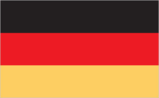
three equal horizontal bands of black (top), red, and gold
Government type
federal republic
Independence
18 January 1871 (German Empire unification); divided into four zones of occupation (UK, US, USSR, and later, France) in 1945 following World War II; Federal Republic of Germany (FRG or West Germany) proclaimed 23 May 1949 and included the former UK, US, and French zones; German Democratic Republic (GDR or East Germany) proclaimed 7 October 1949 and included the former USSR zone; unification of West Germany and East Germany took place 3 October 1990; all four powers formally relinquished rights 15 March 1991
International organization participation
ADB (nonregional members), AfDB (nonregional members), Arctic Council (observer), Australia Group, BIS, BSEC (observer), CBSS, CDB, CE, CERN, EAPC, EBRD, EIB, EMU, ESA, EU, FAO, G-5, G-7, G-8, G-10, IADB, IAEA, IBRD, ICAO, ICC, ICCt, ICRM, IDA, IEA, IFAD, IFC, IFRCS, IHO, ILO, IMF, IMO, IMSO, Interpol, IOC, IOM, IPU, ISO, ITSO, ITU, ITUC, MIGA, NAM (guest), NATO, NEA, NSG, OAS (observer), OECD, OPCW, OSCE, Paris Club, PCA, Schengen Convention, SECI (observer), UN, UNCTAD, UNESCO, UNHCR, UNIDO, UNIFIL, UNMIL, UNMIS, UNOMIG, UNRWA, UNWTO, UPU, WADB (nonregional), WCO, WEU, WFTU, WHO, WIPO, WMO, WTO, ZC
Judicial branch
Federal Constitutional Court or Bundesverfassungsgericht (half the judges are elected by the Bundestag and half by the Bundesrat)
Legal system
civil law system with indigenous concepts; judicial review of legislative acts in the Federal Constitutional Court; has not accepted compulsory ICJ jurisdiction
Legislative branch
bicameral Parliament or Parlament consists of the Federal Assembly or Bundestag (614 seats; elected by popular vote under a system combining direct and proportional representation; a party must win 5% of the national vote or three direct mandates to gain proportional representation and caucus recognition; to serve four-year terms) and the Federal Council or Bundesrat (69 votes; state governments are directly represented by votes; each has three to six votes depending on population and are required to vote as a block) elections: Bundestag - last held on 18 September 2005 (next to be held no later than autumn 2009); note - there are no elections for the Bundesrat; composition is determined by the composition of the state-level governments; the composition of the Bundesrat has the potential to change any time one of the 16 states holds an election election results: Bundestag - percent of vote by party - CDU/CSU 35.2%, SPD 34.3%, FDP 9.8%, Left 8.7%, Greens 8.1%, other 3.9%; seats by party - CDU/CSU 225, SPD 222, FDP 61, Left 53, Greens 51, independents 2
National holiday
Unity Day, 3 October (1990)
Political parties and leaders
Alliance '90/Greens [Claudia ROTH and Cem OEZDEMIR]; Christian Democratic Union or CDU [Angela MERKEL]; Christian Social Union or CSU [Horst SEEHOFER]; Free Democratic Party or FDP [Guido WESTERWELLE]; Left Party or Die Linke [Lothar BISKY and Oskar LAFONTAINE]; Social Democratic Party or SPD [Franz MUENTEFERING]
Political pressure groups and leaders
other: business associations and employers' organizations; religious, trade unions, immigrant, expellee, and veterans groups
Suffrage
18 years of age; universal
Economy
Agriculture - products
potatoes, wheat, barley, sugar beets, fruit, cabbages; cattle, pigs, poultry
Budget
revenues: $1.454 trillion expenditures: $1.453 trillion (2007 est.)
Central bank discount rate
NA
Commercial bank prime lending rate
5.96% (31 December 2007)
Currency (code)
euro (EUR)
Currency code
EUR
Current account balance
$254.5 billion (2007 est.)
Debt - external
$4.489 trillion (30 June 2007)
Distribution of family income - Gini index
28 (2005)
Economic aid - donor
ODA, $10.44 billion (2006)
Economy - overview
Germany's affluent and technologically powerful economy - the fifth largest in the world in PPP terms - showed considerable improvement in 2007 with 2.6% growth. After a long period of stagnation with an average growth rate of 0.7% between 2001-05 and chronically high unemployment, stronger growth led to a considerable fall in unemployment to about 8% near the end of 2007. Among the most important reasons for Germany's high unemployment during the past decade were macroeconomic stagnation, the declining level of investment in plant and equipment, company restructuring, flat domestic consumption, structural rigidities in the labor market, lack of competition in the service sector, and high interest rates. The modernization and integration of the eastern German economy continues to be a costly long-term process, with annual transfers from west to east amounting to roughly $80 billion. The former government of Chancellor Gerhard SCHROEDER launched a comprehensive set of reforms of labor market and welfare-related institutions. The current government of Chancellor Angela MERKEL has initiated other reform measures, such as a gradual increase in the mandatory retirement age from 65 to 67 and measures to increase female participation in the labor market. Germany's aging population, combined with high chronic unemployment, has pushed social security outlays to a level exceeding contributions, but higher government revenues from the cyclical upturn in 2006-07 and a 3% rise in the value-added tax pushed Germany's budget deficit well below the EU's 3% debt limit. Corporate restructuring and growing capital markets are setting the foundations that could help Germany meet the long-term challenges of European economic integration and globalization, although some economists continue to argue the need for change in inflexible labor and services markets. Growth may fall below 2% in 2008 as the strong euro, high oil prices, tighter credit markets, and slowing growth abroad take their toll.
Electricity - consumption
549.1 billion kWh (2006 est.)
Electricity - exports
62.51 billion kWh (2007 est.)
Electricity - imports
46.13 billion kWh (2007 est.)
Electricity - production
594.7 billion kWh (2007 est.)
Electricity - production by source
fossil fuel: 61.8% hydro: 4.2% nuclear: 29.9% other: 4.1% (2001)
Exchange rates
euros (EUR) per US dollar - 0.7345 (2007), 0.7964 (2006), 0.8041 (2005), 0.8054 (2004), 0.886 (2003)
Exports
$1.354 trillion f.o.b. (2007 est.)
Exports - commodities
machinery, vehicles, chemicals, metals and manufactures, foodstuffs, textiles
Exports - partners
France 9.7%, US 7.5%, UK 7.3%, Italy 6.7%, Netherlands 6.4%, Austria 5.4%, Belgium 5.3%, Spain 5% (2007)
Fiscal year
calendar year
GDP - composition by sector
agriculture: 0.9% industry: 30.1% services: 69% (2007 est.)
GDP - per capita (PPP)
$34,100 (2007 est.)
GDP - real growth rate
2.5% (2007 est.)
GDP (official exchange rate)
$3.322 trillion (2007 est.)
GDP (purchasing power parity)
$2.807 trillion (2007 est.)
Household income or consumption by percentage share
lowest 10%: 3.2% highest 10%: 22.1% (2000)
Imports
$1.075 trillion f.o.b. (2007 est.)
Imports - commodities
machinery, vehicles, chemicals, foodstuffs, textiles, metals
Imports - partners
Netherlands 12%, France 8.6%, Belgium 7.8%, China 6.2%, Italy 5.8%, UK 5.6%, US 4.5%, Austria 4.4% (2007)
Industrial production growth rate
5.2% (2007 est.)
Industries
among the world's largest and most technologically advanced producers of iron, steel, coal, cement, chemicals, machinery, vehicles, machine tools, electronics, food and beverages, shipbuilding, textiles
Inflation rate (consumer prices)
2.3% (2007 est.)
Investment (gross fixed)
18.5% of GDP (2007 est.)
Labor force
43.54 million (2007 est.)
Labor force - by occupation
agriculture: 2.8% industry: 33.4% services: 63.8% (1999)
Market value of publicly traded shares
$1.221 trillion (2005)
Natural gas - consumption
97.44 billion cu m (2007 est.)
Natural gas - exports
12.22 billion cu m (2007 est.)
Natural gas - imports
88.35 billion cu m (2007 est.)
Natural gas - production
17.96 billion cu m (2007 est.)
Natural gas - proved reserves
254.8 billion cu m (1 January 2008 est.)
Oil - consumption
2.456 million bbl/day (2007 est.)
Oil - exports
563,400 bbl/day (2005)
Oil - imports
3.026 million bbl/day (2005)
Oil - production
148,100 bbl/day (2007 est.)
Oil - proved reserves
367 million bbl (1 January 2008 est.)
Population below poverty line
11% (2001 est.)
Public debt
64.9% of GDP (2007 est.)
Reserves of foreign exchange and gold
$136.2 billion (31 December 2007 est.)
Stock of direct foreign investment - abroad
$1.218 trillion (2007 est.)
Stock of direct foreign investment - at home
$855.8 billion (2007 est.)
Stock of domestic credit
$5.081 trillion (31 December 2007)
Stock of money
NA note: see entry for the European Union for money supply in the Euro Area; the European Central Bank (ECB) controls monetary policy for the 15 members of the Economic and Monetary Union (EMU); individual members of the EMU do not control the quantity of money and quasi money circulating within their own borders
Stock of quasi money
NA
Unemployment rate
9% note: this is the International Labor Organization's estimated rate for international comparisons; Germany's Federal Employment Office estimated a seasonally adjusted rate of 10.8% (2007 est.)
Communications
Internet country code
.de
Internet hosts
22.606 million (2008)
Internet Service Providers (ISPs)
200 (2001)
Internet users
42.5 million (2007)
Radio broadcast stations
AM 51, FM 787, shortwave 4 (1998)
Radios
77.8 million (1997)
Telephone system
general assessment: Germany has one of the world's most technologically advanced telecommunications systems; as a result of intensive capital expenditures since reunification, the formerly backward system of the eastern part of the country, dating back to World War II, has been modernized and integrated with that of the western part domestic: Germany is served by an extensive system of automatic telephone exchanges connected by modern networks of fiber-optic cable, coaxial cable, microwave radio relay, and a domestic satellite system; cellular telephone service is widely available, expanding rapidly, and includes roaming service to many foreign countries international: country code - 49; Germany's international service is excellent worldwide, consisting of extensive land and undersea cable facilities as well as earth stations in the Inmarsat, Intelsat, Eutelsat, and Intersputnik satellite systems (2001)
Telephones - main lines in use
53.75 million (2007)
Telephones - mobile cellular
97.151 million (2007)
Television broadcast stations
373 (plus 8,042 repeaters) (1995)
Televisions
51.4 million (1998)
Transportation
Airports
550 (2007)
Airports - with paved runways
total: 331 over 3,047 m: 14 2,438 to 3,047 m: 52 1,524 to 2,437 m: 58 914 to 1,523 m: 72 under 914 m: 135 (2007)
Airports - with unpaved runways
total: 219 2,438 to 3,047 m: 1 1,524 to 2,437 m: 3 914 to 1,523 m: 34 under 914 m: 181 (2007)
Heliports
28 (2007)
Merchant marine
total: 393 by type: bulk carrier 2, cargo 43, chemical tanker 13, container 284, liquefied gas 5, passenger 5, passenger/cargo 27, petroleum tanker 11, roll on/roll off 3 foreign-owned: 11 (China 2, Cyprus 2, Denmark 1, Finland 4, Netherlands 1, Sweden 1) registered in other countries: 2,998 (Antigua and Barbuda 941, Australia 2, Bahamas 44, Bermuda 22, Brazil 6, Bulgaria 63, Burma 1, Canada 3, Cayman Islands 15, Cyprus 189, Denmark 9, Denmark 1, Estonia 1, Finland 1, France 1, Georgia 2, Gibraltar 129, Hong Kong 6, India 2, Indonesia 1, Isle of Man 56, Jamaica 4, Liberia 849, Luxembourg 5, Malaysia 1, Malta 91, Marshall Islands 235, Mongolia 4, Morocco 2, Netherlands 75, Netherlands Antilles 43, Norway 1, NZ 1, Panama 44, Portugal 2, Portugal 18, Russia 1, Saint Vincent and the Grenadines 3, Singapore 24, Slovakia 3, Spain 1, Spain 4, Sri Lanka 5, Sweden 5, Turkey 1, UK 76, US 5) (2008)
Pipelines
condensate 37 km; gas 25,094 km; oil 3,546 km; refined products 3,828 km (2007)
Ports and terminals
Bremen, Bremerhaven, Duisburg, Hamburg, Karlsruhe, Lubeck, Rostock, Wilhemshaven
Railways
total: 48,215 km standard gauge: 47,962 km 1.435-m gauge (20,278 km electrified) narrow gauge: 229 km 1.000-m gauge (16 km electrified); 24 km 0.750-m gauge (2006)
Roadways
total: 644,480 km paved: 644,480 km (includes 12,400 km of expressways) note: includes local roads (2006)
Waterways
7,467 km note: Rhine River carries most goods; Main-Danube Canal links North Sea and Black Sea (2006)
Military and Security
Federal Armed Forces (Bundeswehr)
Army (Heer), Navy (Deutsche Marine, includes naval air arm), Air Force (Luftwaffe), Central Medical Service (Zentraler Sanitaetsdienst) (2008)
Manpower available for military service
males age 16-49: 19,594,118 females age 16-49: 18,543,955 (2008 est.)
Manpower fit for military service
males age 16-49: 15,906,930 females age 16-49: 15,051,183 (2008 est.)
Manpower reaching militarily significant age annually
male: 442,972 female: 420,801 (2008 est.)
Military expenditures
1.5% of GDP (2005 est.)
Military service age and obligation
18 years of age (conscripts serve a 9-month tour of compulsory military service) (2004)
Transnational Issues
Disputes - international
none
Illicit drugs
source of precursor chemicals for South American cocaine processors; transshipment point for and consumer of Southwest Asian heroin, Latin American cocaine, and European-produced synthetic drugs; major financial center This page was last updated on 18 December, 2008