2011 Edition
CIA World Factbook 2011 Archive (HTML)
Introduction
Background
The region of present day Georgia contained the ancient kingdoms of Colchis and Kartli-Iberia. The area came under Roman influence in the first centuries A.D. and Christianity became the state religion in the 330s. Domination by Persians, Arabs, and Turks was followed by a Georgian golden age (11th-13th centuries) that was cut short by the Mongol invasion of 1236. Subsequently, the Ottoman and Persian empires competed for influence in the region. Georgia was absorbed into the Russian Empire in the 19th century. Independent for three years (1918-1921) following the Russian revolution, it was forcibly incorporated into the USSR until the Soviet Union dissolved in 1991. An attempt by the incumbent Georgian government to manipulate national legislative elections in November 2003 touched off widespread protests that led to the resignation of Eduard SHEVARDNADZE, president since 1995. New elections in early 2004 swept Mikheil SAAKASHVILI into power along with his United National Movement party. Progress on market reforms and democratization has been made in the years since independence, but this progress has been complicated by Russian assistance and support to the breakaway regions of Abkhazia and South Ossetia. After a series of Russian and separatist provocations in summer 2008, Georgian military action in South Ossetia in early August led to a Russian military response that not only occupied the breakaway areas, but large portions of Georgia proper as well. Russian troops pulled back from most occupied Georgian territory, but in late August 2008 Russia unilaterally recognized the independence of Abkhazia and South Ossetia. This action was strongly condemned by most of the world's nations and international organizations.
Geography
Area
- 69,700 sq km 69,700 sq km 0 sq km
- total
- 69,700 sq km
- water
- 0 sq km
Area - comparative
slightly smaller than South Carolina
Climate
warm and pleasant; Mediterranean-like on Black Sea coast
Coastline
310 km
Elevation extremes
- Black Sea 0 m Mt'a Shkhara 5,201 m
- highest point
- Mt'a Shkhara 5,201 m
- lowest point
- Black Sea 0 m
Environment - current issues
air pollution, particularly in Rust'avi; heavy pollution of Mtkvari River and the Black Sea; inadequate supplies of potable water; soil pollution from toxic chemicals
Environment - international agreements
- Air Pollution, Biodiversity, Climate Change, Climate Change-Kyoto Protocol, Desertification, Endangered Species, Hazardous Wastes, Law of the Sea, Ozone Layer Protection, Ship Pollution, Wetlands none of the selected agreements
- party to
- Air Pollution, Biodiversity, Climate Change, Climate Change-Kyoto Protocol, Desertification, Endangered Species, Hazardous Wastes, Law of the Sea, Ozone Layer Protection, Ship Pollution, Wetlands
- signed, but not ratified
- none of the selected agreements
Freshwater withdrawal (domestic/industrial/agricultural)
- 3.61 cu km/yr (20%/21%/59%) 808 cu m/yr (2000)
- per capita
- 808 cu m/yr (2000)
- total
- 3.61 cu km/yr (20%/21%/59%)
Geographic coordinates
42 00 N, 43 30 E
Geography - note
strategically located east of the Black Sea; Georgia controls much of the Caucasus Mountains and the routes through them
Irrigated land
4,330 sq km (2008)
Land boundaries
- 1,461 km Armenia 164 km, Azerbaijan 322 km, Russia 723 km, Turkey 252 km
- border countries
- Armenia 164 km, Azerbaijan 322 km, Russia 723 km, Turkey 252 km
- total
- 1,461 km
Land use
- 11.51% 3.79% 84.7% (2005)
- arable land
- 11.51%
- other
- 84.7% (2005)
- permanent crops
- 3.79%
Location
Southwestern Asia, bordering the Black Sea, between Turkey and Russia, with a sliver of land north of the Caucasus extending into Europe
Map references
Middle East
Maritime claims
- 12 nm 200 nm
- exclusive economic zone
- 200 nm
- territorial sea
- 12 nm
Natural hazards
earthquakes
Natural resources
timber, hydropower, manganese deposits, iron ore, copper, minor coal and oil deposits; coastal climate and soils allow for important tea and citrus growth
Terrain
largely mountainous with Great Caucasus Mountains in the north and Lesser Caucasus Mountains in the south; Kolkhet'is Dablobi (Kolkhida Lowland) opens to the Black Sea in the west; Mtkvari River Basin in the east; good soils in river valley flood plains, foothills of Kolkhida Lowland
Total renewable water resources
63.3 cu km (1997)
People and Society
Age structure
- 15.6% (male 383,856/female 333,617) 68.3% (male 1,511,844/female 1,620,727) 16% (male 293,143/female 442,687) (2011 est.)
- 0-14 years
- 15.6% (male 383,856/female 333,617)
- 15-64 years
- 68.3% (male 1,511,844/female 1,620,727)
- 65 years and over
- 16% (male 293,143/female 442,687) (2011 est.)
Birth rate
10.73 births/1,000 population (2011 est.)
Children under the age of 5 years underweight
2.3% (2005)
Death rate
9.92 deaths/1,000 population (July 2011 est.)
Drinking water source
- urban: 100% of population rural: 96% of population total: 98% of population urban: 0% of population rural: 4% of population total: 2% of population (2008)
- rural
- 4% of population
- total
- 2% of population (2008)
- urban
- 0% of population
Education expenditures
3.2% of GDP (2009)
Ethnic groups
Georgian 83.8%, Azeri 6.5%, Armenian 5.7%, Russian 1.5%, other 2.5% (2002 census)
Health expenditures
11.3% of GDP (2009)
HIV/AIDS - adult prevalence rate
0.1% (2009 est.)
HIV/AIDS - deaths
fewer than 100 (2009 est.)
HIV/AIDS - people living with HIV/AIDS
3,500 (2009 est.)
Hospital bed density
3.32 beds/1,000 population (2007)
Infant mortality rate
- 15.17 deaths/1,000 live births 17.1 deaths/1,000 live births 13.02 deaths/1,000 live births (2011 est.)
- female
- 13.02 deaths/1,000 live births (2011 est.)
- total
- 15.17 deaths/1,000 live births
Languages
Georgian (official) 71%, Russian 9%, Armenian 7%, Azeri 6%, other 7% Abkhaz is the official language in Abkhazia
Life expectancy at birth
- 77.12 years 73.8 years 80.82 years (2011 est.)
- female
- 80.82 years (2011 est.)
- total population
- 77.12 years
Literacy
- age 15 and over can read and write 100% 100% 100% (2004 est.)
- definition
- age 15 and over can read and write
- female
- 100% (2004 est.)
- male
- 100%
- total population
- 100%
Major cities - population
TBILISI (capital) 1.115 million (2009)
Maternal mortality rate
48 deaths/100,000 live births (2008)
Median age
- 39.1 years 36.6 years 41.6 years (2011 est.)
- female
- 41.6 years (2011 est.)
- male
- 36.6 years
- total
- 39.1 years
Nationality
- Georgian(s) Georgian
- adjective
- Georgian
- noun
- Georgian(s)
Net migration rate
-4.06 migrant(s)/1,000 population (2011 est.)
Physicians density
4.538 physicians/1,000 population (2007)
Population
4,585,874 (July 2011 est.)
Population growth rate
-0.326% (2011 est.)
Religions
Orthodox Christian (official) 83.9%, Muslim 9.9%, Armenian-Gregorian 3.9%, Catholic 0.8%, other 0.8%, none 0.7% (2002 census)
Sanitation facility access
- urban: 96% of population rural: 93% of population total: 95% of population urban: 4% of population rural: 7% of population total: 5% of population (2008)
- rural
- 7% of population
- total
- 5% of population (2008)
- urban
- 4% of population
School life expectancy (primary to tertiary education)
- 13 years 13 years 13 years (2009)
- female
- 13 years (2009)
- male
- 13 years
- total
- 13 years
Sex ratio
- 1.113 male(s)/female 1.15 male(s)/female 0.93 male(s)/female 0.66 male(s)/female 0.91 male(s)/female (2011 est.)
- 15-64 years
- 0.93 male(s)/female
- 65 years and over
- 0.66 male(s)/female
- at birth
- 1.113 male(s)/female
- total population
- 0.91 male(s)/female (2011 est.)
- under 15 years
- 1.15 male(s)/female
Total fertility rate
1.45 children born/woman (2011 est.)
Unemployment, youth ages 15-24
- 35.5% 32.4% 40.7% (2008)
- female
- 40.7% (2008)
- total
- 35.5%
Urbanization
- 53% of total population (2010) -0.4% annual rate of change (2010-15 est.)
- rate of urbanization
- -0.4% annual rate of change (2010-15 est.)
- urban population
- 53% of total population (2010)
Government
Administrative divisions
- 9 regions (mkharebi, singular - mkhare), 1 city (k'alak'i), and 2 autonomous republics (avtomnoy respubliki, singular - avtom respublika) Guria, Imereti, Kakheti, Kvemo Kartli, Mtskheta-Mtianeti, Racha-Lechkhumi and Kvemo Svaneti, Samegrelo and Zemo Svaneti, Samtskhe-Javakheti, Shida Kartli Tbilisi Abkhazia or Ap'khazet'is Avtonomiuri Respublika (Sokhumi), Ajaria or Acharis Avtonomiuri Respublika (Bat'umi) the administrative centers of the two autonomous republics are shown in parentheses
- autonomous republics
- Abkhazia or Ap'khazet'is Avtonomiuri Respublika (Sokhumi), Ajaria or Acharis Avtonomiuri Respublika (Bat'umi)
- city
- Tbilisi
- regions
- Guria, Imereti, Kakheti, Kvemo Kartli, Mtskheta-Mtianeti, Racha-Lechkhumi and Kvemo Svaneti, Samegrelo and Zemo Svaneti, Samtskhe-Javakheti, Shida Kartli
Capital
- T'bilisi 41 43 N, 44 47 E UTC+4 (9 hours ahead of Washington, DC during Standard Time)
- geographic coordinates
- 41 43 N, 44 47 E
- name
- T'bilisi
- time difference
- UTC+4 (9 hours ahead of Washington, DC during Standard Time)
Constitution
adopted 24 August 1995
Country name
- none Georgia none Sak'art'velo Georgian Soviet Socialist Republic
- conventional long form
- none
- conventional short form
- Georgia
- former
- Georgian Soviet Socialist Republic
- local long form
- none
- local short form
- Sak'art'velo
Diplomatic representation from the US
- Ambassador John BASS 11 George Balanchine Street, T'bilisi 0131 7060 T'bilisi Place, Washington, DC 20521-7060 [995] (32) 27-70-00 [995] (32) 53-23-10
- chief of mission
- Ambassador John BASS
- embassy
- 11 George Balanchine Street, T'bilisi 0131
- FAX
- [995] (32) 53-23-10
- mailing address
- 7060 T'bilisi Place, Washington, DC 20521-7060
- telephone
- [995] (32) 27-70-00
Diplomatic representation in the US
- Ambassador Temuri YAKOBASHVILI 2209 Massachusetts Avenue NW, Washington, DC 20008 [1] (202) 387-2390 [1] (202) 393-4537 New York
- chancery
- 2209 Massachusetts Avenue NW, Washington, DC 20008
- chief of mission
- Ambassador Temuri YAKOBASHVILI
- consulate(s) general
- New York
- FAX
- [1] (202) 393-4537
- telephone
- [1] (202) 387-2390
Executive branch
- President Mikheil SAAKASHVILI (since 25 January 2004); the president is the chief of state and serves as head of government for the power ministries of internal affairs and defense Prime Minister Nikoloz GILAURI (since 6 February 2009); the prime minister is head of government for all the ministries of government except the power ministries of internal affairs and defense Cabinet of Ministers president elected by popular vote for a five-year term (eligible for a second term); election last held on 5 January 2008 (next to be held in January 2013) Mikheil SAAKASHVILI reelected president; percent of vote - Mikheil SAAKASHVILI 53.5%, Levan GACHECHILADZE 25.7%, Badri PATARKATSISHVILI 7.1%, other 13.7%
- cabinet
- Cabinet of Ministers
- chief of state
- President Mikheil SAAKASHVILI (since 25 January 2004); the president is the chief of state and serves as head of government for the power ministries of internal affairs and defense
- election results
- Mikheil SAAKASHVILI reelected president; percent of vote - Mikheil SAAKASHVILI 53.5%, Levan GACHECHILADZE 25.7%, Badri PATARKATSISHVILI 7.1%, other 13.7%
- elections
- president elected by popular vote for a five-year term (eligible for a second term); election last held on 5 January 2008 (next to be held in January 2013)
- head of government
- Prime Minister Nikoloz GILAURI (since 6 February 2009); the prime minister is head of government for all the ministries of government except the power ministries of internal affairs and defense
Flag description
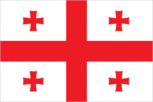
white rectangle with a central red cross extending to all four sides of the flag; each of the four quadrants displays a small red bolnur-katskhuri cross; although adopted as the official Georgian flag in 2004, the five-cross flag design appears to date back to the 14th century
Government type
republic
Independence
- 9 April 1991 (from the Soviet Union); notable earlier date: A.D. 1008 (Georgia unified under BAGRAT III)
- 9 April 1991 (from the Soviet Union); notable earlier date
- A.D. 1008 (Georgia unified under BAGRAT III)
International law organization participation
accepts compulsory ICJ jurisdiction; accepts ICCt jurisdiction
International organization participation
ADB, BSEC, CE, EAPC, EBRD, FAO, G-11, GCTU, GUAM, IAEA, IBRD, ICAO, ICC, ICRM, IDA, IFAD, IFC, IFRCS, ILO, IMF, IMO, Interpol, IOC, IOM, IPU, ISO (correspondent), ITSO, ITU, ITUC, MIGA, OAS (observer), OIF (observer), OPCW, OSCE, PFP, SECI (observer), UN, UNCTAD, UNESCO, UNIDO, UNWTO, UPU, WCO, WHO, WIPO, WMO, WTO
Judicial branch
Supreme Court (judges elected by the Supreme Council on the president's or chairman of the Supreme Court's recommendation); Constitutional Court; first and second instance courts
Legal system
civil law system
Legislative branch
- unicameral Parliament or Parlamenti (also known as Supreme Council or Umaghlesi Sabcho) (150 seats; 75 members elected by proportional representation, 75 from single-seat constituencies; members to serve four-year terms) last held on 21 May 2008 (next to be held in the spring of 2012) percent of vote by party - United National Movement 59.2%, National Council-New Rights (a Joint Opposition, nine-party bloc) 17.7%, Christian Democratic Movement 8.8%, Labor Party 7.4%, Republican Party 3.8%; seats by party - United National Movement 120, National Council-New Rights 16, Christian Democratic Movement 6, Labor Party 6, Republican Party 2
- election results
- percent of vote by party - United National Movement 59.2%, National Council-New Rights (a Joint Opposition, nine-party bloc) 17.7%, Christian Democratic Movement 8.8%, Labor Party 7.4%, Republican Party 3.8%; seats by party - United National Movement 120, National Council-New Rights 16, Christian Democratic Movement 6, Labor Party 6, Republican Party 2
- elections
- last held on 21 May 2008 (next to be held in the spring of 2012)
National anthem
- "Tavisupleba" (Liberty) Dawit MAGRADSE/Zakaria PALIASHVILI (adapted by Joseb KETSCHAKMADSE) adopted 2004; after the Rose Revolution, a new anthem with music based on the operas "Abesalom da Eteri" and "Daisi" was adopted
- lyrics/music
- Dawit MAGRADSE/Zakaria PALIASHVILI (adapted by Joseb KETSCHAKMADSE)
- name
- "Tavisupleba" (Liberty)
National holiday
Independence Day, 26 May (1918); note - 26 May 1918 was the date of independence from Soviet Russia, 9 April 1991 was the date of independence from the Soviet Union
National symbol(s)
Saint George; lion
Political parties and leaders
Christian Democratic Movement [Giorgi TARGAMADZE]; Conservative Party [Kakha KUKAVA]; Democratic Movement United Georgia [Nino BURJANADZE]; For Fair Georgia [Zurab NOGAIDELI]; Georgian Party [Sozar SUBARI]; Georgian People's Front [Nodar NATADZE]; Greens [Giorgi GACHECHILADZE]; Industry Will Save Georgia (Industrialists) or IWSG [Georgi TOPADZE]; Labor Party [Shalva NATELASHVILI]; National Democratic Party or NDP [Bachuki KARDAVA]; National Forum [Kakhaber SHARTAVA]; New Rights [David GAMKRELIDZE]; Our Georgia-Free Democrats (OGFD) [Irakli ALASANIA]; People's Party [Koba DAVITASHVILI; Republican Party [David USUPASHVILI]; Socialist Party or SPG [Irakli MINDELI]; Traditionalists [Akaki ASATIANI]; United National Movement or UNM [Mikheil SAAKASHVILI]
Political pressure groups and leaders
separatists in the breakaway regions of Abkhazia and South Ossetia
Suffrage
18 years of age; universal
Economy
Agriculture - products
citrus, grapes, tea, hazelnuts, vegetables; livestock
Budget
- $3.291 billion $4.063 billion (2010 est.)
- expenditures
- $4.063 billion (2010 est.)
- revenues
- $3.291 billion
Budget surplus (+) or deficit (-)
-6.6% of GDP (2010 est.)
Central bank discount rate
8% (25 December 2008) NA% (31 December 2007) this is the Refinancing Rate, the key monetary policy rate of the Georgian National Bank
Commercial bank prime lending rate
24.213% (31 December 2010 est.) 25.521% (31 December 2009 est.)
Current account balance
-$1.247 billion (2010 est.) -$1.319 billion (2009 est.)
Debt - external
$10.5 billion (30 June 2011) $3.381 billion (31 December 2009)
Distribution of family income - Gini index
40.8 (2009) 37.1 (1996)
Economy - overview
Georgia's economy sustained GDP growth of more than 10% in 2006-07, based on strong inflows of foreign investment and robust government spending. However, GDP growth slowed in 2008 following the August 2008 conflict with Russia, and turned negative in 2009 as foreign direct investment and workers' remittances declined in the wake of the global financial crisis, but rebounded in 2010. Georgia's main economic activities include the cultivation of agricultural products such as grapes, citrus fruits, and hazelnuts; mining of manganese and copper; and output of a small industrial sector producing alcoholic and nonalcoholic beverages, metals, machinery, aircraft and chemicals. Areas of recent improvement include growth in the construction, banking services, and mining sectors, but reduced availability of external investment and the slowing regional economy are emerging risks. The country imports nearly all its needed supplies of natural gas and oil products. It has sizeable hydropower capacity, a growing component of its energy supplies. Georgia has overcome the chronic energy shortages and gas supply interruptions of the past by renovating hydropower plants and by increasingly relying on natural gas imports from Azerbaijan instead of from Russia. The construction on the Baku-T'bilisi-Ceyhan oil pipeline, the Baku-T'bilisi-Erzerum gas pipeline, and the Kars-Akhalkalaki Railroad are part of a strategy to capitalize on Georgia's strategic location between Europe and Asia and develop its role as a transit point for gas, oil and other goods. Georgia has historically suffered from a chronic failure to collect tax revenues; however, the government, since coming to power in 2004, has simplified the tax code, improved tax administration, increased tax enforcement, and cracked down on petty corruption. However, the economic downturn of 2008-09 eroded the tax base and led to a decline in the budget surplus and an increase in public borrowing needs. The country is pinning its hopes for renewed growth on a determined effort to continue to liberalize the economy by reducing regulation, taxes, and corruption in order to attract foreign investment, but the economy faces a more difficult investment climate both domestically and internationally.
Electricity - consumption
7.08 billion kWh (2008 est.)
Electricity - exports
675 million kWh (2008 est.)
Electricity - imports
117 million kWh (2008 est.)
Electricity - production
8.292 billion kWh (2008 est.)
Exchange rates
laris (GEL) per US dollar - 1.8009 (2010) 1.6705 (2009) 1.47 (2008) 1.7 (2007) 1.78 (2006)
Exports
$2.46 billion (2010 est.) $1.894 billion (2009 est.)
Exports - commodities
scrap metal, wine, mineral water, ores, vehicles, fruits and nuts
Exports - partners
Turkey 14.1%, Azerbaijan 11.2%, Bulgaria 10%, US 9.8%, UK 9%, Canada 6.7%, Ukraine 6.1% (2010)
GDP - composition by sector
- 10.4% 28.7% 60.9% (2010 est.)
- agriculture
- 10.4%
- industry
- 28.7%
- services
- 60.9% (2010 est.)
GDP - per capita (PPP)
$4,900 (2010 est.) $4,600 (2009 est.) $4,700 (2008 est.) data are in 2010 US dollars
GDP - real growth rate
6.4% (2010 est.) -3.8% (2009 est.) 2.4% (2008 est.)
GDP (official exchange rate)
$11.67 billion (2010 est.)
GDP (purchasing power parity)
$22.44 billion (2010 est.) $21.1 billion (2009 est.) $21.93 billion (2008 est.) data are in 2010 US dollars
Household income or consumption by percentage share
- 2% 31.3% (2008)
- highest 10%
- 31.3% (2008)
- lowest 10%
- 2%
Imports
$5.027 billion (2010 est.) $4.293 billion (2009 est.)
Imports - commodities
fuels, vehicles, machinery and parts, grain and other foods, pharmaceuticals
Imports - partners
Turkey 15%, Ukraine 9.2%, Azerbaijan 8.5%, Russia 6.5%, Germany 6.1%, US 5.9%, China 5.4% (2010)
Industrial production growth rate
4% (2010 est.)
Industries
steel, aircraft, machine tools, electrical appliances, mining (manganese and copper), chemicals, wood products, wine
Inflation rate (consumer prices)
7.1% (2010 est.) 1.7% (2009 est.)
Investment (gross fixed)
15.4% of GDP (2010 est.)
Labor force
1.918 million (2007 est.)
Labor force - by occupation
- 55.6% 8.9% 35.5% (2006 est.)
- agriculture
- 55.6%
- industry
- 8.9%
- services
- 35.5% (2006 est.)
Market value of publicly traded shares
$1.06 billion (31 December 2010) $733.3 million (31 December 2009) $327.3 million (31 December 2008)
Natural gas - consumption
1.71 billion cu m (2009 est.)
Natural gas - exports
0 cu m (2009 est.)
Natural gas - imports
1.7 billion cu m (2009 est.)
Natural gas - production
10 million cu m (2009 est.)
Natural gas - proved reserves
8.495 billion cu m (1 January 2011 est.)
Oil - consumption
13,000 bbl/day (2010 est.)
Oil - exports
445 bbl/day (2009 est.)
Oil - imports
17,840 bbl/day (2009 est.)
Oil - production
984 bbl/day (2010 est.)
Oil - proved reserves
35 million bbl (1 January 2011 est.)
Population below poverty line
31% (2006)
Reserves of foreign exchange and gold
$2.264 billion (31 December 2010 est.) $2.11 billion (31 December 2009 est.)
Stock of broad money
$3.546 billion (31 December 2010 est.) $2.755 billion (31 December 2009 est.)
Stock of domestic credit
$3.96 billion (31 December 2010 est.) $3.536 billion (31 December 2009 est.)
Stock of narrow money
$1.174 billion (31 December 2010 est.) $1.112 billion (31 December 2009 est.)
Taxes and other revenues
28.2% of GDP (2010 est.)
Unemployment rate
16.4% (2009 est.) 13.6% (2006 est.)
Communications
Broadcast media
1 state-owned public television station in Tbilisi and 8 privately-owned TV stations; state-run public broadcaster operates 2 networks; dozens of cable TV operators and several major commercial TV stations are operating; state-owned public radio broadcaster operates 2 networks; several dozen private stations broadcast (2008)
Internet country code
.ge
Internet hosts
110,680 (2010)
Internet users
1.3 million (2009)
Telephone system
- fixed-line telecommunications network has only limited coverage outside Tbilisi; long list of people waiting for fixed line connections; multiple mobile-cellular providers provide services to an increasing subscribership throughout the country cellular telephone networks cover the entire country; mobile-cellular teledensity roughly 60 per 100 people; urban fixed-line telephone density is about 20 per 100 people; rural telephone density is about 4 per 100 people; intercity facilities include a fiber-optic line between T'bilisi and K'ut'aisi; nationwide pager service is available country code - 995; the Georgia-Russia fiber optic submarine cable provides connectivity to Russia; international service is available by microwave, landline, and satellite through the Moscow switch; international electronic mail and telex service are available
- domestic
- cellular telephone networks cover the entire country; mobile-cellular teledensity roughly 60 per 100 people; urban fixed-line telephone density is about 20 per 100 people; rural telephone density is about 4 per 100 people; intercity facilities include a fiber-optic line between T'bilisi and K'ut'aisi; nationwide pager service is available
- general assessment
- fixed-line telecommunications network has only limited coverage outside Tbilisi; long list of people waiting for fixed line connections; multiple mobile-cellular providers provide services to an increasing subscribership throughout the country
- international
- country code - 995; the Georgia-Russia fiber optic submarine cable provides connectivity to Russia; international service is available by microwave, landline, and satellite through the Moscow switch; international electronic mail and telex service are available
Telephones - main lines in use
597,000 (2010)
Telephones - mobile cellular
3.193 million (2010)
Transportation
Airports
22 (2010)
Airports - with paved runways
- 2 (2010)
- 1,524 to 2,437 m
- 4
- 2,438 to 3,047 m
- 7
- 914 to 1,523 m
- 4
- over 3,047 m
- 1
- total
- 18
- under 914 m
- 2 (2010)
Airports - with unpaved runways
- 2 (2010)
- 914 to 1,523 m
- 2
- total
- 4
- under 914 m
- 2 (2010)
Heliports
3 (2010)
Merchant marine
- bulk carrier 18, cargo 151, carrier 1, chemical tanker 3, container 2, liquefied gas 1, passenger/cargo 3, petroleum tanker 3, refrigerated cargo 2, roll on/roll off 7, vehicle carrier 2 132 (China 11, Denmark 1, Egypt 11, Germany 4, Greece 3, Hong Kong 4, Israel 1, Italy 2, Latvia 1, Lebanon 1, Pakistan 1, Romania 7, Russia 7, Syria 35, Turkey 22, UAE 1, UK 4, Ukraine 15, US 1) 1 (unknown 1) (2010)
- foreign-owned
- 132 (China 11, Denmark 1, Egypt 11, Germany 4, Greece 3, Hong Kong 4, Israel 1, Italy 2, Latvia 1, Lebanon 1, Pakistan 1, Romania 7, Russia 7, Syria 35, Turkey 22, UAE 1, UK 4, Ukraine 15, US 1)
- registered in other countries
- 1 (unknown 1) (2010)
- total
- 193
Pipelines
gas 1,596 km; oil 1,258 km (2010)
Ports and terminals
Bat'umi, P'ot'i
Railways
- 1,612 km 1,575 km 1.520-m gauge (1,575 electrified) 37 km 0.912-m gauge (37 electrified) (2009)
- narrow gauge
- 37 km 0.912-m gauge (37 electrified) (2009)
- total
- 1,612 km
Roadways
- 20,329 km 19,123 km (includes 13 km of expressways) 1,206 km (2007)
- total
- 20,329 km
- unpaved
- 1,206 km (2007)
Transportation - note
large parts of transportation network are in poor condition because of lack of maintenance and repair
Military and Security
Manpower available for military service
- 1,080,840 1,122,031 (2010 est.)
- females age 16-49
- 1,122,031 (2010 est.)
- males age 16-49
- 1,080,840
Manpower fit for military service
- 893,003 931,683 (2010 est.)
- females age 16-49
- 931,683 (2010 est.)
- males age 16-49
- 893,003
Manpower reaching militarily significant age annually
- 29,723 27,242 (2010 est.)
- female
- 27,242 (2010 est.)
- male
- 29,723
Military branches
- Georgian Armed Forces: Land Forces (include Air and Air Defense Forces); separatist Abkhazia Armed Forces: Ground Forces, Air Forces; separatist South Ossetia Armed Forces (2011)
- Georgian Armed Forces
- Land Forces (include Air and Air Defense Forces); separatist Abkhazia Armed Forces: Ground Forces, Air Forces; separatist South Ossetia Armed Forces (2011)
Military expenditures
1.9% of GDP (2010 est.)
Military service age and obligation
18 to 34 years of age for compulsory and voluntary active duty military service; conscript service obligation - 18 months (2005)
Transnational Issues
Disputes - international
Russia's military support and subsequent recognition of Abkhazia and South Ossetia independence in 2008 continue to sour relations with Georgia; Georgia continues to restrain the return of Meshkhetian Turks dispersed by Stalin; ethnic Armenian groups in Javakheti region of Georgia seek greater autonomy from the Georgian government; local border forces struggle to control the illegal transit of goods and people across the porous, undemarcated Armenian, Azerbaijani, and Georgian borders
Illicit drugs
limited cultivation of cannabis and opium poppy, mostly for domestic consumption; used as transshipment point for opiates via Central Asia to Western Europe and Russia
Refugees and internally displaced persons
- 1,100 (Russia) 220,000-240,000 (displaced from Abkhazia and South Ossetia) (2007)
- IDPs
- 220,000-240,000 (displaced from Abkhazia and South Ossetia) (2007)
- refugees (country of origin)
- 1,100 (Russia)