1999 Edition
CIA World Factbook 1999 (Internet Archive)
Introduction
Background
Beset by ethnic and civil strife since independence from the Soviet Union in December 1991, Georgia began to stabilize in 1994. Political settlements for separatist conflicts in South Ossetia and Abkhazia remain elusive. The conflict in South Ossetia has been dormant since spring 1994, but sporadic violence continues between Abkhaz forces and Georgian partisans in western Georgia. Russian peacekeepers are deployed in both regions and a UN Observer Mission is operating in Abkhazia. As a result of these conflicts, Georgia still has about 250,000 internally displaced people. In 1995, Georgia adopted a new constitution and conducted generally free and fair nationwide presidential and parliamentary elections. In 1996, the government focused its attention on implementing an ambitious economic reform program and professionalizing its parliament. Violence and organized crime were sharply curtailed in 1995 and 1996, but corruption remains rife. Georgia has taken some steps to reduce its dependence on Russia, acquiring coastal patrol boats in 1997 to replace Russian border units along the Black Sea coast. In 1998, Georgia assumed control of its Black Sea coast and about half of its land border with Turkey in line with a June 1998 agreement with Russia. Since 1997, Georgia's parliament has sharpened its rhetoric against Russia's continued military presence on Georgian territory. In February 1998 an assassination attempt was made against President SHEVARDNADZE by supporters of the late former president Zviad GAMSAKHURDIA. In October 1998, a disaffected military officer led a failed mutiny in western Georgia; the armed forces continue to feel the ripple effect of the uprising. Georgia faces parliamentary elections this fall, and presidential elections next spring. After two years of robust growth, the economy, hurt by the financial crisis in Russia, slowed in 1998.
Geography
Area
total: 69,700 sq km land: 69,700 sq km water: 0 sq km
Area--comparative
slightly smaller than South Carolina
Climate
warm and pleasant; Mediterranean-like on Black Sea coast
Coastline
310 km
Elevation extremes
lowest point: Black Sea 0 m highest point: Mt'a Mqinvartsveri (Gora Kazbek) 5,048 m
Environment--current issues
air pollution, particularly in Rust'avi; heavy pollution of Mtkvari River and the Black Sea; inadequate supplies of potable water; soil pollution from toxic chemicals
Environment--international agreements
party to: Air Pollution, Biodiversity, Climate Change, Law of the Sea, Ozone Layer Protection, Ship Pollution, Wetlands signed, but not ratified: Desertification
Geographic coordinates
42 00 N, 43 30 E
Irrigated land
4,000 sq km (1993 est.)
Land boundaries
total: 1,461 km border countries: Armenia 164 km, Azerbaijan 322 km, Russia 723 km, Turkey 252 km
Land use
arable land: 9% permanent crops: 4% permanent pastures: 25% forests and woodland: 34% other: 28% (1993 est.)
Location
Southwestern Asia, bordering the Black Sea, between Turkey and Russia
Map references
Commonwealth of Independent States
Maritime claims
NA
Natural hazards
earthquakes
Natural resources
forests, hydropower, manganese deposits, iron ore, copper, minor coal and oil deposits; coastal climate and soils allow for important tea and citrus growth
Terrain
largely mountainous with Great Caucasus Mountains in the north and Lesser Caucasus Mountains in the south; Kolkhet'is Dablobi (Kolkhida Lowland) opens to the Black Sea in the west; Mtkvari River Basin in the east; good soils in river valley flood plains, foothills of Kolkhida Lowland
People and Society
Age structure
0-14 years: 21% (male 544,055; female 522,491) 15-64 years: 67% (male 1,628,993; female 1,753,527) 65 years and over: 12% (male 236,124; female 381,309) (1999 est.)
Birth rate
11.64 births/1,000 population (1999 est.)
Death rate
14.3 deaths/1,000 population (1999 est.)
Ethnic groups
Georgian 70.1%, Armenian 8.1%, Russian 6.3%, Azeri 5.7%, Ossetian 3%, Abkhaz 1.8%, other 5%
Infant mortality rate
52.01 deaths/1,000 live births (1999 est.)
Languages
Georgian 71% (official), Russian 9%, Armenian 7%, Azeri 6%, other 7% note: Abkhaz (official in Abkhazia)
Life expectancy at birth
total population: 64.63 years male: 61.13 years female: 68.32 years (1999 est.)
Literacy
definition: age 15 and over can read and write total population: 99% male: 100% female: 98% (1989 est.)
Nationality
noun: Georgian(s) adjective: Georgian
Net migration rate
-4.69 migrant(s)/1,000 population (1999 est.)
Population
5,066,499 (July 1999 est.)
Population growth rate
-0.74% (1999 est.)
Religions
Christian Orthodox 75% (Georgian Orthodox 65%, Russian Orthodox 10%), Muslim 11%, Armenian Apostolic 8%, unknown 6%
Sex ratio
at birth: 1.05 male(s)/female under 15 years: 1.04 male(s)/female 15-64 years: 0.93 male(s)/female 65 years and over: 0.62 male(s)/female total population: 0.91 male(s)/female (1999 est.)
Total fertility rate
1.53 children born/woman (1999 est.)
Government
Administrative divisions
53 rayons (raionebi, singular--raioni), 9 cities* (k'alak'ebi, singular--k'alak'i), and 2 autonomous republics** (avtomnoy respubliki, singular--avtom respublika); Abashis, Abkhazia or Ap'khazet'is Avtonomiuri Respublika** (Sokhumi), Adigenis, Ajaria or Acharis Avtonomiuri Respublika** (Bat'umi), Akhalgoris, Akhalk'alak'is, Akhalts'ikhis, Akhmetis, Ambrolauris, Aspindzis, Baghdat'is, Bolnisis, Borjomis, Chiat'ura*, Ch'khorotsqus, Ch'okhatauris, Dedop'listsqaros, Dmanisis, Dushet'is, Gardabanis, Gori*, Goris, Gurjaanis, Javis, K'arelis, Kaspis, Kharagaulis, Khashuris, Khobis, Khonis, K'ut'aisi*, Lagodekhis, Lanch'khut'is, Lentekhis, Marneulis, Martvilis, Mestiis, Mts'khet'is, Ninotsmindis, Onis, Ozurget'is, P'ot'i*, Qazbegis, Qvarlis, Rust'avi*, Sach'kheris, Sagarejos, Samtrediis, Senakis, Sighnaghis, T'bilisi*, T'elavis, T'erjolis, T'et'ritsqaros, T'ianet'is, Tqibuli*, Ts'ageris, Tsalenjikhis, Tsalkis, Tsqaltubo*, Vanis, Zestap'onis, Zugdidi*, Zugdidis note: administrative divisions have the same names as their administrative centers (exceptions have the administrative center name following in parentheses)
Capital
T'bilisi
Constitution
adopted 17 October 1995
Country name
conventional long form: none conventional short form: Georgia local long form: none local short form: Sak'art'velo former: Georgian Soviet Socialist Republic
Data code
GG
Executive branch
chief of state: President Eduard Amvrosiyevich SHEVARDNADZE (previously elected chairman of the Government Council 10 March 1992, Council has since been disbanded; previously elected chairman of Parliament 11 October 1992; president since 26 November 1995; note--the president is both the chief of state and head of government head of government: President Eduard Amvrosiyevich SHEVARDNADZE (previously elected chairman of the Government Council 10 March 1992, Council has since been disbanded; previously elected chairman of Parliament 11 October 1992; president since 26 November 1995; note--the president is both the chief of state and head of government cabinet: Cabinet of Ministers elections: president elected by popular vote for a five-year term; election last held 5 November 1995 (next to be held NA 2000) election results: Eduard SHEVARDNADZE elected president; percent of vote--Eduard SHEVARDNADZE 74%
Flag description
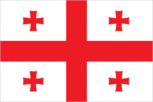
maroon field with small rectangle in upper hoist side corner; rectangle divided horizontally with black on top, white below
Government type
republic
Independence
9 April 1991 (from Soviet Union)
International organization participation
BSEC, CCC, CE (guest), CIS, EAPC, EBRD, ECE, FAO, IAEA, IBRD, ICAO, IDA, IFAD, IFC, IFRCS, ILO, IMF, IMO, Inmarsat, Interpol, IOC, IOM (observer), ISO (correspondent), ITU, OPCW, OSCE, PFP, UN, UNCTAD, UNESCO, UNIDO, UPU, WHO, WIPO, WMO, WToO, WTrO (applicant) Diplomatic representation in the US: chief of mission: Ambassador Tedo JAPARIDZE chancery: Suite 300, 1615 New Hampshire Avenue NW, Washington, DC 20009 Diplomatic representation from the US: chief of mission: Ambassador Kenneth S. YALOWITZ embassy: #25 Antoneli Street, T'bilisi 380026 mailing address: use embassy street address
Judicial branch
Supreme Court, judges elected by the Supreme Council on the president's recommendation; Constitutional Court Political parties and leaders: Citizen's Union of Georgia or CUG groups: Democratic Union of Georgia or DUG, Political Association "Georgian Proprietors"--Electoral Association "T'bilisi", Political Union of Young Democrats "Our Choice", Political Union Tanadgoma) Political pressure groups and leaders: supporters of the late ousted President Zviad GAMSAKHURDYA remain a source of opposition; separatist elements in the breakaway region of Abkhazia; Georgian refugees from Abkhazia (Abkhaz faction in Georgian Parliament)
Legal system
based on civil law system
Legislative branch
unicameral Supreme Council (commonly referred to as Parliament) or Umaghiesi Sabcho (235 seats; members are elected by popular vote to serve four-year terms) elections: last held 5 November 1995 (next to be held NA 1999) election results: percent of vote by party--CUG 24%, NDP 8%, AGUR 7%, all other parties received less than 5% each; seats by party--CUG 107, NDP 34, AGUR 32, Progress Bloc 4, SPG 4, others 9, Abkazian deputies 12, independents 29, not filled 4
National holiday
Independence Day, 26 May (1991)
Suffrage
18 years of age; universal
Economy
Agriculture--products
citrus, grapes, tea, vegetables, potatoes; livestock
Budget
revenues: $364 million expenditures: $568 million, including capital expenditures of $NA (1998)
Currency
lari introduced September 1995 replacing the coupon
Debt--external
$1.3 billion (1996 est.)
Economic aid--recipient
$212.7 million (1995)
Economy--overview
Georgia's economy has traditionally revolved around Black Sea tourism; cultivation of citrus fruits, tea, and grapes; mining of manganese and copper; and output of a small industrial sector producing wine, metals, machinery, chemicals, and textiles. The country imports the bulk of its energy needs, including natural gas and oil products. Its only sizable internal energy resource is hydropower. Despite the severe damage the economy has suffered due to civil strife, Georgia, with the help of the IMF and World Bank, made substantial economic gains since 1995, increasing GDP growth and slashing inflation. The Georgian economy suffered some setbacks in late 1998, including a large budget deficit due to a failure to collect tax revenue and to the impact of the Russian economic crisis. Georgia also still suffers from energy shortages; it privatized the distribution network in 1998, and deliveries are steadily improving. Georgia is pinning its hopes for long-term recovery on the development of an international transportation corridor through the key Black Sea ports of P'ot'i and Bat'umi. The construction of a Caspian oil pipeline through Georgia--scheduled to open in early 1999--should spur greater Western investment in the economy. The global economic slowdown, a growing trade deficit, continuing problems with corruption, and political uncertainties cloud the short-term economic picture.
Electricity--consumption
6.949 billion kWh (1996)
Electricity--exports
300 million kWh (1996)
Electricity--imports
404 million kWh (1996)
Electricity--production
6.845 billion kWh (1996)
Electricity--production by source
fossil fuel: 29.88% hydro: 70.12% nuclear: 0% other: 0% (1996)
Exchange rates
lari per US$1 (end of period)--1.82 (December 1998), 1.32 (December 1997), 1.28 (December 1996), 1.24 (December 1995)
Exports
$230 million (f.o.b., 1997 est.)
Exports--commodities
citrus fruits, tea, wine, other agricultural products; diverse types of machinery; ferrous and nonferrous metals; textiles; chemicals; fuel reexports
Exports--partners
Russia, Turkey, Azerbaijan, Ukraine, Armenia, Bulgaria, Turkey, US, UK, Italy, Germany, Romania (1997)
Fiscal year
calendar year
GDP
purchasing power parity--$11.2 billion (1998 est.)
GDP--composition by sector
agriculture: 29% industry: 16% services: 55% (1997 est.)
GDP--per capita
purchasing power parity?$2,200 (1998 est.)
GDP--real growth rate
4% (1998 est.)
Household income or consumption by percentage share
lowest 10%: NA% highest 10%: NA%
Imports
$931 million (c.i.f., 1997 est.)
Imports--commodities
fuel, grain and other foods, machinery and parts, transport equipment
Imports--partners
Russia, Turkey, Azerbaijan (1996); note?EU and US send humanitarian food shipments
Industrial production growth rate
-0.3% (1998 est.)
Industries
steel, aircraft, machine tools, foundry equipment, electric locomotives, tower cranes, electric welding equipment, machinery for food preparation and meat packing, electric motors, process control equipment, trucks, tractors, textiles, shoes, chemicals, wood products, wine
Inflation rate (consumer prices)
10.5% (1998 est.)
Labor force
3.08 million (1997)
Labor force--by occupation
industry and construction 31%, agriculture and forestry 25%, other 44% (1990)
Population below poverty line
NA%
Unemployment rate
16% (1996 est.)
Communications
Radio broadcast stations
AM NA, FM NA, shortwave NA; note 2 national broadcast stations, 3 regional broadcast stations
Radios
NA
Telephone system
domestic: local--T'bilisi and K'ut'aisi have cellular telephone networks with about 10,000 customers total; urban areas 20 telephones/100 people; rural areas 4 phones/100 people; intercity--a fiber-optic line connects T'bilisi to K'ut'aisi (Georgia's second largest city); nationwide pager service international: Georgia and Russia are working on a fiber-optic line between P'ot'i and Sochi (Russia); present international service is available by microwave, land line, and satellite through the Moscow switch; international electronic mail and telex service available
Telephones
760,000 (1996 est.)
Television broadcast stations
3
Televisions
NA
Transportation
Airports
28 (1994 est.) Airports--with paved runways: total: 14 over 3,047 m: 1 2,438 to 3,047 m: 7 1,524 to 2,437 m: 4 914 to 1,523 m: 1 under 914 m: 1 (1994 est.) Airports--with unpaved runways: total: 14 over 3,047 m: 1 2,438 to 3,047 m: 1 1,524 to 2,437 m: 1 914 to 1,523 m: 5 under 914 m: 6 (1994 est.)
Highways
total: 20,700 km paved: 19,354 km unpaved: 1,346 km (1996 est.)
Merchant marine
total: 8 ships (1,000 GRT or over) totaling 86,667 GRT/121,679 DWT ships by type: cargo 2, oil tanker 5, short-sea passenger 1 (1998 est.)
Pipelines
crude oil 370 km; refined products 300 km; natural gas 440 km (1992) Ports and harbors: Bat'umi, P'ot'i, Sokhumi
Railways
total: 1,583 km in common carrier service; does not include industrial lines broad gauge: 1,583 km 1.520-m gauge (1993)
Transportation--note
transportation network is in poor condition and disrupted by ethnic conflict, criminal activities, and fuel shortages; network lacks maintenance and repair
Military and Security
Military branches
Ground Forces, Navy, Air Force, Air Defense Forces, National Guard, Republic Security Forces (internal and border troops)
Military expenditures--dollar figure
$57 million (1998)
Military expenditures--percent of GDP
1% (1998)
Military manpower--availability
males age 15-49: 1,287,225 (1999 est.) Military manpower--fit for military service: males age 15-49: 1,018,309 (1999 est.)
Military manpower--military age
18 years of age
Military manpower--reaching military age annually
males: 40,604 (1999 est.)
Military--note
a CIS peacekeeping force consisting of Russian troops is deployed in the Abkhazia region of Georgia together with a UN military observer group; a Russian peacekeeping battalion is deployed in South Ossetia
Transnational Issues
Disputes--international
none
Illicit drugs
limited cultivation of cannabis and opium poppy, mostly for domestic consumption; used as transshipment point for opiates via Central Asia to Western Europe