1992 Edition
CIA World Factbook 1992 (Project Gutenberg)
Geography
Climate
warm and pleasant; Mediterranean-like on Black Sea coast
Coastline
310 km
Comparative area
slightly larger than South Carolina
Contiguous zone
NA nm
Continental Shelf
NA meter depth
Disputes
none
Environment
air pollution, particularly in Rustavi; heavy pollution of Kura River, Black Sea
Exclusive economic zone
NA nm
Exclusive fishing zone
NA nm
Land area
69,700 km2
Land boundaries
1,461 km; Armenia 164 km, Azerbaijan 322 km, Russia 723 km, Turkey 252 km
Land use
NA% arable land; NA% permanent crops; NA% meadows and pastures; NA% forest and woodland; NA% other; includes 200,000 hectares irrigated
Natural resources
forest lands, hydropower, manganese deposits, iron ores, copper, minor coal and oil deposits; coastal climate and soils allow for important tea and citrus growth
Terrain
largely mountainous with Great Caucasus Mountains in the north and Lesser Caucasus Mountains in the south; Colchis lowland opens to the Black Sea in the west; Kura River Basin in the east; good soils in river valley flood plains, foothills of Colchis lowland
Territorial sea
NA nm, Georgian claims unknown; 12 nm in 1973 USSR-Turkish Protocol concerning the sea boundary between the two states in the Black Sea
Total area
69,700 km2
People and Society
Birth rate
17 births/1,000 population (1992)
Death rate
9 deaths/1,000 population (1992)
Ethnic divisions
Georgian 68.8%, Armenian 9.0%, Russian Azari 5.1%, Ossetian 3.2%, Abkhaz 1.7%, other 4.8%
Infant mortality rate
34 deaths/1,000 live births (1992)
Labor force
2,834,000; agriculture 29.1% (1988), government NA%, industry 17.8%, other 53.1%
Languages
Georgian (official language) 71%, Russian 9%, other 20% - Armenian 7%, Azerbaijani 6%
Life expectancy at birth
67 years male, 75 years female (1992)
Literacy
NA% (male NA%, female NA%) age 15 and over can read and write
Nationality
noun - Georgian(s); adjective - Georgian
Net migration rate
1 migrant/1,000 population (1992)
Organized labor
NA
Population
5,570,978 (July 1992), growth rate 0.8% (1992)
Religions
Russian Orthodox 10%, Georgian Orthodox 65%, Armenian Orthodox 8%, Muslim 11%, unknown 6%
Total fertility rate
2.2 children born/woman (1992)
Government
Administrative divisions
2 autonomous republics (avtomnoy respubliki, singular - avtom respublika); Abkhazia (Sukhumi), Ajaria (Batumi); note - the administrative centers of the autonomous republics are included in parentheses; there are no oblasts - the rayons around T'bilisi are under direct republic jurisdiction; also included is the South Ossetia Autonomous Oblast
Capital
T'bilisi (Tbilisi)
Chief of State
Chairman of State Council Eduard SHEVARDNADZE (since March 1992)
Constitution
adopted NA, effective NA
Diplomatic representation
Ambassador NA, Chancery at NA NW, Washington, DC 200__; telephone (202) NA US: Ambassador NA; Embassy at NA (mailing address is APO New York 09862)
Executive branch
State Council, chairman of State Council, Council of Ministers, prime minister
Flag
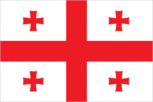
maroon field with small rectangle in upper left corner; rectangle divided horizontally with black on top, white below
Georgian Parliament
last held November 1990; results - 7-party coalition Round Table - Free Georgia 62%, other 38%; seats - (250) Round Table - Free Georgia 155, other 95
Head of Government
Acting Prime Minister Tengiz SIGUA (since January 1992); First Deputy Prime Minister Otar KVILITAYA (since January 1992); First Deputy Prime Minister Tengiz KITOVANI (since March 1992)
Independence
9 April 1991 (from Soviet Union); formerly Georgian Soviet Socialist Republic
Judicial branch
Supreme Court
Legal system
NA
Legislative branch
unicameral Supreme Soviet
Long-form name
Republic of Georgia
Member of
CSCE, IMF, World Bank
National holiday
Independence Day, 9 April 1991
Other political or pressure groups
NA
Political parties and leaders
All-Georgian Merab Kostava Society, Vazha ADAMIA, chairman; All-Georgian Tradionalists' Union, Akakiy ASATIANI, chairman; Georgian National Front - Radical Union, Ruslan GONGADZE, chairman; Social-Democratic Party, Guram MUCHAIDZE, chairman; All-Georgian Rustaveli Society, Akakiy BAKRADZE, chairman; Georgian Monarchists' Party, Teymur JORJOLIANI, chairman; Georgian Popular Front, Nodar NATADZE, chairman; National Democratic Party, Georgiy CHANTURIA, chairman; National Independence Party, Irakliy TSERETELI, chairman; Charter 1991 Party, Tedo PAATASHVILI, chairman; Democratic Georgia Party, Georgiy SHENGELAYA, Chairman
President
Zviad GAMSAKHURDIYA, 87% of vote
Suffrage
universal at age 18
Type
republic
Economy
Agriculture
accounted for 97% of former USSR citrus fruits and 93% of former USSR tea; berries and grapes; sugar; vegetables, grains, and potatoes; cattle, pigs, sheep, goats, and poultry
Budget
revenues $NA; expenditures $NA, including capital expenditures of $NA million (1991)
Currency
as of May 1992, retaining ruble as currency
Economic aid
US commitments, including Ex-Im (FY70-87), $NA billion; Western (non-US) countries, ODA and OOF bilateral commitments (1970-86), $NA million; Communist countries (1971-86), $NA million
Electricity
4,575,000 kW capacity; 15,300 million kWh produced, about 2,600 kWh per capita (1991)
Exchange rates
NA
Exports
$176 million (f.o.b., 1990) commodities: citrus fruits, tea, other agricultural products; diverse types of machinery; ferrous and nonferrous metals; textiles partners: NA
External debt
$650 million (1991 est.)
Fiscal year
calendar year
GDP
purchasing power equivalent - $NA; per capita $NA; real growth rate - 23% (1991)
Illicit drugs
illicit producers of cannabis and opium; mostly for domestic consumption; status of government eradication programs unknown; used as transshipment points for illicit drugs to Western Europe
Imports
$1.5 billion (c.i.f., 1990) commodities: machinery and parts, fuel, transport equipment, textiles partners: NA
Industrial production
growth rate - 19% (1991)
Industries
Heavy industrial products include raw steel, rolled steel, cement, lumber; machine tools, foundry equipment, electric mining locomotives, tower cranes, electric welding equipment, machinery for food preparation, meat packing, dairy, and fishing industries; air-conditioning electric motors up to 100 kW in size, electric motors for cranes, magnetic starters for motors; devices for control of industrial processes; trucks, tractors, and other farm machinery; light industrial products, including cloth, hosiery, and shoes
Inflation rate (consumer prices)
approximately 90% (1991)
Overview
Among the former Soviet republics, Georgia is noted for its Black Sea tourist industry, its large output of citrus fruits and tea, and the amazing diversity of an industrial sector that accounted, however, for less than 2% of the USSR's output. Another salient characteristic of the economy has been a flourishing private sector (compared with the other republics). Almost 30% of the labor force is employed in agriculture and 18% in industry. Mineral resources consist of manganese and copper, and, to a lesser extent, molybdenum, arsenic, tungsten, and mercury. Except for very small quantities of domestic oil, gas, and coal, fuel must be imported from neighboring republics. Oil and its products are delivered by pipeline from Azerbaijan to the port of Batumi for export and local refining. Gas is supplied in pipelines from Krasnodar and Stavropol'. Georgia is nearly self-sufficient in electric power, thanks to abundant hydropower stations as well as some thermal power stations. The dismantling of central economic controls is being delayed by political factionalism, marked by armed struggles between the elected government and the opposition, and industrial output seems to have fallen more steeply in Georgia in 1991 than in any other of the former Soviet republics. To prevent further economic decline, Georgia must establish domestic peace and must maintain economic ties to the other former Soviet republics while developing new links to the West.
Unemployment rate
NA%
Communications
Airports
NA total, NA usable; NA with permanent-surface runways; NA with runways over 3,659 m; NA with runways 2,440-3,659 m; NA with runways 1,220-2,439 m
Civil air
NA major transport aircraft
Highways
33,900 km total; 29,500 km hard surfaced, 4,400 km earth (1990)
Inland waterways
NA km perennially navigable
Merchant marine
54 ships (1,000 GRT or over) totaling 715,802 GRT/1,108,068 DWT; includes 16 bulk cargo, 34 oil tanker, 2 chemical tanker, and 2 specialized liquid carrier
Pipelines
crude oil NA km, refined products NA km, natural gas NA km
Ports
maritime - Batumi, Poti; inland - NA
Railroads
1,570 km, does not include industrial lines (1990)
Telecommunications
poor telephone service; 339,000 unsatisfied applications for telephones (31 January 1992); international links via landline to CIS members and Turkey; low capacity satellite earth station and leased international connections via the Moscow international gateway switch
Military and Security
Branches
Republic Security Forces (internal and border troops), National Guard; CIS Forces (Ground, Navy, Air, and Air Defense)
Defense expenditures
$NA, NA% of GNP
Manpower availability
males 15-49, NA fit for military service; NA reach military age (18) annually