2023 Edition
CIA World Factbook 2023 (factbook.json @ 0d4fa4984ecb)
Introduction
Background
Gabon, a sparsely populated country known for its dense rainforests and vast petroleum reserves, is one of the most prosperous and stable countries in central Africa. Approximately 40 ethnic groups are represented, the largest of which is the Fang, a group that covers the northern third of Gabon and expands north into Equatorial Guinea and Cameroon. From about the early 1300s, various kingdoms emerged in and surrounding present-day Gabon, including the Kingdoms of Loango and Orungu. Because most early Bantu languages spoken in these kingdoms did not have a written form, historical traditions were passed on orally, resulting in much of Gabon's early history being lost over time. Portuguese traders who arrived in the mid-1400s gave the area its name of Gabon. At that time, indigenous trade networks began to engage with European traders, exchanging goods such as ivory and wood. For a century beginning in the 1760s, trade came to focus mostly on enslaved people. While many groups in Gabon participated in the slave trade, the Fang were a notable exception. As the slave trade declined in the late 1800s, France colonized the country and directed a widespread extraction of Gabonese resources. Anti-colonial rhetoric by Gabon’s educated elites increased significantly in the early 1900s, but no widespread rebellion materialized. French decolonization following World War II led to the country’s independence in 1960. Within a year of independence, the government changed from a parliamentary to a presidential system, and Leon M’BA won the first presidential election in 1961. El Hadj Omar BONGO Ondimba - one of the longest ruling heads of state in history - was M’BA’s vice president and assumed the presidency after M’BA’s death in 1967. BONGO went on to dominate the country's political scene for four decades (1967-2009). In 1968, he declared Gabon a single-party state and created the Parti Democratique Gabonais (PDG), which remains the predominant party in Gabonese politics today. In the early 1990s, he reintroduced a multiparty system under a new constitution after he was confronted with growing political opposition. He was reelected by wide margins in 1995, 1998, 2002, and 2005 against a divided opposition and amidst allegations of fraud. Following President BONGO's death in 2009, a new election brought his son, Ali BONGO Ondimba, to power. President Ali BONGO Ondimba was reelected in 2016 in a close election against a united opposition. Gabon’s Constitutional Court reviewed the contested election results and ruled in his favor. President Ali BONGO Ondimba won a third term in Gabon’s 26 August 2023 election, but he was overthrown in a military coup on 30 August 2023. Gen. Brice OLIGUI Nguema led a military group called the Committee for the Transition and Restoration of Institutions that arrested and detained President BONGO, canceled the election results, and dissolved state institutions. On 4 September 2023, Gen. OLIGUI was sworn in as transitional president of Gabon.
Geography
Area
- land
- 257,667 sq km
- total
- 267,667 sq km
- water
- 10,000 sq km
Area - comparative
slightly smaller than Colorado
Climate
tropical; always hot, humid
Coastline
885 km
Elevation
- highest point
- Mont Bengoue 1,050 m
- lowest point
- Atlantic Ocean 0 m
- mean elevation
- 377 m
Geographic coordinates
1 00 S, 11 45 E
Geography - note
a small population and oil and mineral reserves have helped Gabon become one of Africa's wealthier countries; in general, these circumstances have allowed the country to maintain and conserve its pristine rain forest and rich biodiversity
Irrigated land
40 sq km (2012)
Land boundaries
- border countries
- Cameroon 349 km; Republic of the Congo 2,567 km; Equatorial Guinea 345 km
- total
- 3,261 km
Land use
- agricultural land
- 19% (2018 est.)
- agricultural land: arable land
- arable land: 1.2% (2018 est.)
- agricultural land: permanent crops
- permanent crops: 0.6% (2018 est.)
- agricultural land: permanent pasture
- permanent pasture: 17.2% (2018 est.)
- forest
- 81% (2018 est.)
- other
- 0% (2018 est.)
Location
Central Africa, bordering the Atlantic Ocean at the Equator, between Republic of the Congo and Equatorial Guinea
Major aquifers
Congo Basin
Major watersheds (area sq km)
Atlantic Ocean drainage: Congo (3,730,881 sq km)
Map references
Africa
Maritime claims
- contiguous zone
- 24 nm
- exclusive economic zone
- 200 nm
- territorial sea
- 12 nm
Natural hazards
none
Natural resources
petroleum, natural gas, diamond, niobium, manganese, uranium, gold, timber, iron ore, hydropower
Population distribution
the relatively small population is spread in pockets throughout the country; the largest urban center is the capital of Libreville, located along the Atlantic coast in the northwest as shown in this population distribution map
Terrain
narrow coastal plain; hilly interior; savanna in east and south
People and Society
Age structure
- 0-14 years
- 35.04% (male 424,741/female 415,342)
- 15-64 years
- 60.76% (male 765,729/female 690,931)
- 65 years and over
- 4.2% (2023 est.) (male 50,920/female 49,705)
Alcohol consumption per capita
- beer
- 5.31 liters of pure alcohol (2019 est.)
- other alcohols
- 0.04 liters of pure alcohol (2019 est.)
- spirits
- 0.5 liters of pure alcohol (2019 est.)
- total
- 6.47 liters of pure alcohol (2019 est.)
- wine
- 0.62 liters of pure alcohol (2019 est.)
Birth rate
25.9 births/1,000 population (2023 est.)
Children under the age of 5 years underweight
6.4% (2019/20)
Contraceptive prevalence rate
31.1% (2012)
Current health expenditure
3.4% of GDP (2020)
Currently married women (ages 15-49)
49.7% (2023 est.)
Death rate
5.6 deaths/1,000 population (2023 est.)
Demographic profile
Gabon’s oil revenues have given it one of the highest per capita income levels in Sub-Saharan Africa, but the wealth is not evenly distributed and poverty is widespread. Unemployment is especially prevalent among the large youth population; more than 60% of the population is under the age of 25 as of 2020. With a fertility rate still averaging more than 3 children per woman, the youth population will continue to grow and further strain the mismatch between Gabon’s supply of jobs and the skills of its labor force. Gabon has been a magnet to migrants from neighboring countries since the 1960s because of the discovery of oil, as well as the country’s political stability and timber, mineral, and natural gas resources. Nonetheless, income inequality and high unemployment have created slums in Libreville full of migrant workers from Senegal, Nigeria, Cameroon, Benin, Togo, and elsewhere in West Africa. In 2011, Gabon declared an end to refugee status for 9,500 remaining Congolese nationals to whom it had granted asylum during the Republic of the Congo’s civil war between 1997 and 2003. About 5,400 of these refugees received permits to reside in Gabon.
Dependency ratios
- elderly dependency ratio
- 6.5
- potential support ratio
- 15.3 (2021 est.)
- total dependency ratio
- 67.6
- youth dependency ratio
- 61
Drinking water source
- improved: rural
- rural: 55.3% of population
- improved: total
- total: 93.1% of population
- improved: urban
- urban: 97.2% of population
- unimproved: rural
- rural: 44.7% of population
- unimproved: total
- total: 6.9% of population (2020 est.)
- unimproved: urban
- urban: 2.8% of population
Education expenditures
3.2% of GDP (2020 est.)
Ethnic groups
Gabonese-born 80.1% (includes Fang 23.2%, Shira-Punu/Vili 18.9%, Nzabi-Duma 11.3%, Mbede-Teke 6.9%, Myene 5%, Kota-Kele 4.9%, Okande-Tsogo 2.1%, Pygmy 0.3%, other 7.5%), Cameroonian 4.6%, Malian 2.4%, Beninese 2.1%, acquired Gabonese nationality 1.6%, Togolese 1.6%, Senegalese 1.1%, Congolese (Brazzaville) 1%, other 5.5% (includes Congolese (Kinshasa), Equatorial Guinean, Nigerian) (2012 est.)
Gross reproduction rate
1.61 (2023 est.)
Hospital bed density
6.3 beds/1,000 population
Infant mortality rate
- female
- 24.7 deaths/1,000 live births
- male
- 30.6 deaths/1,000 live births
- total
- 27.7 deaths/1,000 live births (2023 est.)
Languages
French (official), Fang, Myene, Nzebi, Bapounou/Eschira, Bandjabi
Life expectancy at birth
- female
- 71.8 years
- male
- 68.3 years
- total population
- 70 years (2023 est.)
Literacy
- definition
- age 15 and over can read and write
- female
- 84.7% (2021)
- male
- 86.2%
- total population
- 85.5%
Major infectious diseases
- animal contact diseases
- rabies
- degree of risk
- very high (2023)
- food or waterborne diseases
- bacterial diarrhea, hepatitis A, and typhoid fever
- vectorborne diseases
- malaria and dengue fever
- water contact diseases
- schistosomiasis
Major urban areas - population
870,000 LIBREVILLE (capital) (2023)
Maternal mortality ratio
227 deaths/100,000 live births (2020 est.)
Median age
- female
- 21.3 years
- male
- 22.2 years
- total
- 21.8 years (2023 est.)
Mother's mean age at first birth
- 19.6 years (2012 est.)
- note
- note: data represents median age at first birth among women 20-49
Nationality
- adjective
- Gabonese
- noun
- Gabonese (singular and plural)
Net migration rate
3.6 migrant(s)/1,000 population (2023 est.)
Obesity - adult prevalence rate
15% (2016)
Physicians density
0.65 physicians/1,000 population (2018)
Population
2,397,368 (2023 est.)
Population distribution
the relatively small population is spread in pockets throughout the country; the largest urban center is the capital of Libreville, located along the Atlantic coast in the northwest as shown in this population distribution map
Population growth rate
2.39% (2023 est.)
Religions
Roman Catholic 42.3%, Protestant 12.3%, other Christian 27.4%, Muslim 9.8%, animist 0.6%, other 0.5%, none/no answer 7.1% (2012 est.)
Sanitation facility access
- improved: rural
- rural: 55.1% of population
- improved: total
- total: 78.7% of population
- improved: urban
- urban: 81.3% of population
- unimproved: rural
- rural: 44.9% of population
- unimproved: total
- total: 21.3% of population (2020 est.)
- unimproved: urban
- urban: 18.7% of population
Sex ratio
- 0-14 years
- 1.02 male(s)/female
- 15-64 years
- 1.11 male(s)/female
- 65 years and over
- 1.02 male(s)/female
- at birth
- 1.03 male(s)/female
- total population
- 1.07 male(s)/female (2023 est.)
Total fertility rate
3.26 children born/woman (2023 est.)
Urbanization
- rate of urbanization
- 2.27% annual rate of change (2020-25 est.)
- urban population
- 91% of total population (2023)
Government
Administrative divisions
9 provinces; Estuaire, Haut-Ogooue, Moyen-Ogooue, Ngounie, Nyanga, Ogooue-Ivindo, Ogooue-Lolo, Ogooue-Maritime, Woleu-Ntem
Capital
- etymology
- original site settled by freed slaves and the name means "free town" in French; named in imitation of Freetown, the capital of Sierra Leone
- geographic coordinates
- 0 23 N, 9 27 E
- name
- Libreville
- time difference
- UTC+1 (6 hours ahead of Washington, DC, during Standard Time)
Citizenship
- citizenship by birth
- no
- citizenship by descent only
- at least one parent must be a citizen of Gabon
- dual citizenship recognized
- no
- residency requirement for naturalization
- 10 years
Constitution
- amendments
- proposed by the president of the republic, by the Council of Ministers, or by one third of either house of Parliament; passage requires Constitutional Court evaluation, at least two-thirds majority vote of two thirds of the Parliament membership convened in joint session, and approval in a referendum; constitutional articles on Gabon’s democratic form of government cannot be amended; amended several times, last in 2023 (presidential term reduced to 5 years and election reduced to a single vote)
- history
- previous 1961; latest drafted May 1990, adopted 15 March 1991, promulgated 26 March 1991
Country name
- conventional long form
- Gabonese Republic
- conventional short form
- Gabon
- etymology
- name originates from the Portuguese word "gabao" meaning "cloak," which is roughly the shape that the early explorers gave to the estuary of the Komo River by the capital of Libreville
- local long form
- Republique Gabonaise
- local short form
- Gabon
Diplomatic representation from the US
- chief of mission
- Ambassador (vacant); Chargé d'Affaires Ellen B. THORBURN (since 27 October 2022); note - also accredited to Sao Tome and Principe
- email address and website
- ACSLibreville@state.govhttps://ga.usembassy.gov/
- embassy
- Sabliere, B.P. 4000, Libreville
- FAX
- [241] 011-45-71-05
- mailing address
- 2270 Libreville Place, Washington, DC 20521-2270
- telephone
- [241] 011-45-71-00
Diplomatic representation in the US
- chancery
- 2034 20th Street NW, Suite 200, Washington, DC 20009
- chief of mission
- Ambassador Noel Nelson MESSONE (12 December 2022)
- email address and website
- info@gaboneembassyusa.orghttps://gabonembassyusa.org/en/
- FAX
- [1] (301) 332-0668
- telephone
- [1] (202) 797-1000
Executive branch
- cabinet
- formerly the Council of Ministers, appointed by the prime minister in consultation with the president
- chief of state
- Transitional President Gen. Brice OLIGUI Nguema (since 4 September 2023); note - on 30 August 2023, Gen. Brice OLIGUI Nguema led a military group called the Committee for the Transition and Restoration of Institutions in a coup in which President Ali BONGO Ondimba was arrested and detained, election results were canceled, and state institutions dissolved; on 4 September 2023, Gen. OLIGUI was sworn in as transitional presidentnote- the military government announced on 13 November 2023 that presidential and legislative elections will be held in August 2025
- election results
- 2016: Ali BONGO Ondimba reelected president; percent of vote - Ali BONGO Ondimba (PDG) 49.8%, Jean PING (UFC) 48.2%, other 2.0%2009: Ali BONGO Ondimba elected president; percent of vote - Ali BONGO Ondimba (PDG) 41.7%, Andre MBA OBAME (independent) 25.9%, Pierre MAMBOUNDOU (UPG) 25.2%, Zacharie MYBOTO (UGDD) 3.9%, other 3.3%
- elections/appointments
- formerly, the president directly elected by plurality vote for a 5-year term (no term limits); election last held on 26 August 2023; prime minister appointed by the president; note - on 30 August 2023, Gen. Brice OLIGUI Nguema led a military group called Committee for the Transition and Restoration of Institutions in a coup in which President Ali BONGO Ondimba was arrested and detained, election results were canceled, and state institutions dissolved; on 4 September 2023, OLIGUI was sworn in as transitional president; a general election is planned for August 2025
- head of government
- Interim Prime Minister Raymond Ndong SIMA (since 8 September 2023)
Flag description
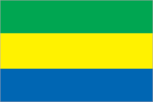
three equal horizontal bands of green (top), yellow, and blue; green represents the country's forests and natural resources, gold represents the equator (which transects Gabon) as well as the sun, blue represents the sea
Government type
presidential republic
Independence
17 August 1960 (from France)
International law organization participation
has not submitted an ICJ jurisdiction declaration; accepts ICCt jurisdiction
International organization participation
ACP, AfDB, AU (suspended), BDEAC, CEMAC, FAO, FZ, G-24, G-77, IAEA, IBRD, ICAO, ICCt, ICRM, IDA, IDB, IFAD, IFC, IFRCS, ILO, IMF, IMO, IMSO, Interpol, IOC, IOM, IPU, ISO, ITSO, ITU, ITUC (NGOs), MIGA, MINUSCA, NAM, OIC, OIF, OPCW, UN, UNCTAD, UNESCO, UNHRC, UNIDO, UNWTO, UPU, WCO, WHO, WIPO, WMO, WTO
Judicial branch
- highest court(s)
- Supreme Court (consists of 4 permanent specialized supreme courts - Supreme Court or Cour de Cassation, Administrative Supreme Court or Conseil d'Etat, Accounting Supreme Court or Cour des Comptes, Constitutional Court or Cour Constitutionnelle, and the non-permanent Court of State Security, initiated only for cases of high treason by the president and criminal activity by executive branch officials)
- judge selection and term of office
- appointment and tenure of Supreme, Administrative, Accounting, and State Security courts NA; Constitutional Court judges appointed - 3 by the national president, 3 by the president of the Senate, and 3 by the president of the National Assembly; judges serve single renewable 7-year terms
- subordinate courts
- Courts of Appeal; county courts; military courts
Legal system
mixed legal system of French civil law and customary law
Legislative branch
- description
- Transitional Parliament (formerly the bicameral Parliament) consists of:Senate (70 seats; members appointed by Transitional president; member term NA)National Assembly (98 seats; members appointed by the Transitional president; member term NA) note - all members represent legally recognized political parties or leading political figures, civil society, and defense and security forces
- election results
- all members of the Transitional Parliament appointed by the Transitional president
- elections
- on 11 September 2023, Transitional President Gen. Brice OLIGUI Nguema appointed 168 members to the Transitional Parliament; elections for a permanent legislature reportedly to follow 2-year transition; note - the military government announced on 13 November 2023 that presidential and legislative elections will be held in August 2025
National anthem
- lyrics/music
- Georges Aleka DAMAS
- name
- "La Concorde" (The Concorde)
- note
- note: adopted 1960
National heritage
- selected World Heritage Site locales
- Ecosystem and Relict Cultural Landscape of Lopé-Okanda (m); Ivindo National Park (n)
- total World Heritage Sites
- 2 (1 natural, 1 mixed)
National holiday
Independence Day, 17 August (1960)
National symbol(s)
black panther; national colors: green, yellow, blue
Political parties and leaders
- Gabonese Democratic Party or PDG [Ali BONGO Ondimba]Restoration of Republican Values or RVThe Democrats or LD [Guy NZOUBA-NDAMA]
- note
- Paul Mba Abessole
Suffrage
18 years of age; universal
Economy
Agricultural products
plantains, cassava, sugar cane, yams, taro, vegetables, maize, groundnuts, game meat, rubber
Budget
- expenditures
- $2.937 billion (2019 est.)
- revenues
- $3.296 billion (2019 est.)
Budget surplus (+) or deficit (-)
-1.9% (of GDP) (2017 est.)
Credit ratings
- Fitch rating
- CCC (2020)
- Moody's rating
- Caa1 (2018)
- note
- note: The year refers to the year in which the current credit rating was first obtained.
- Standard & Poors rating
- N/A (2016)
Current account balance
- Current account balance 2016
- -$1.389 billion (2016 est.)
- Current account balance 2017
- -$725 million (2017 est.)
Debt - external
- Debt - external 31 December 2016
- $5.321 billion (31 December 2016 est.)
- Debt - external 31 December 2017
- $6.49 billion (31 December 2017 est.)
Economic overview
natural resource-rich, upper-middle-income, Central African economy; sparsely populated but high urbanization; young labor force; oil, manganese, and rubber exporter; foreign investment dependent; data integrity issue on poverty and income
Exchange rates
- Currency
- Cooperation Financiere en Afrique Centrale francs (XAF) per US dollar -
- Exchange rates 2017
- 580.657 (2017 est.)
- Exchange rates 2018
- 555.446 (2018 est.)
- Exchange rates 2019
- 585.911 (2019 est.)
- Exchange rates 2020
- 575.586 (2020 est.)
- Exchange rates 2021
- 554.531 (2021 est.)
Exports
- Exports 2017
- $9.145 billion (2017 est.)
- Exports 2018
- $9.533 billion (2018 est.)
- Exports 2019
- $10.8 billion (2019 est.)
Exports - commodities
crude petroleum, manganese, lumber, veneer sheeting, refined petroleum (2021)
Exports - partners
China 63%, Singapore 5% (2019)
Fiscal year
calendar year
GDP - composition, by end use
- exports of goods and services
- 46.7% (2017 est.)
- government consumption
- 14.1% (2017 est.)
- household consumption
- 37.6% (2017 est.)
- imports of goods and services
- -26.8% (2017 est.)
- investment in fixed capital
- 29% (2017 est.)
- investment in inventories
- -0.6% (2016 est.)
GDP - composition, by sector of origin
- agriculture
- 5% (2017 est.)
- industry
- 44.7% (2017 est.)
- services
- 50.4% (2017 est.)
GDP (official exchange rate)
$16.064 billion (2019 est.)
Gini Index coefficient - distribution of family income
- Gini Index coefficient - distribution of family income 2017
- 38 (2017 est.)
Household income or consumption by percentage share
- highest 10%
- 32.7% (2005)
- lowest 10%
- 2.5%
Imports
- Imports 2017
- $4.749 billion (2017 est.)
- Imports 2018
- $4.722 billion (2018 est.)
- Imports 2019
- $5.02 billion (2019 est.)
Imports - commodities
poultry meats, excavation machinery, packaged medicines, cars, rice (2019)
Imports - partners
France 22%, China 17%, Belgium 6%, United States 6%, United Arab Emirates 5% (2019)
Industrial production growth rate
3.2% (2021 est.)
Industries
petroleum extraction and refining; manganese, gold; chemicals, ship repair, food and beverages, textiles, lumbering and plywood, cement
Inflation rate (consumer prices)
- Inflation rate (consumer prices) 2018
- 4.75% (2018 est.)
- Inflation rate (consumer prices) 2019
- 2.46% (2019 est.)
- Inflation rate (consumer prices) 2020
- 1.18% (2020 est.)
Labor force
718,400 (2021 est.)
Population below poverty line
33.4% (2017 est.)
Public debt
- Public debt 2016
- 64.2% of GDP (2016 est.)
- Public debt 2017
- 62.7% of GDP (2017 est.)
Real GDP (purchasing power parity)
- note
- note: data are in 2017 dollars
- Real GDP (purchasing power parity) 2019
- $32.471 billion (2019 est.)
- Real GDP (purchasing power parity) 2020
- $31.874 billion (2020 est.)
- Real GDP (purchasing power parity) 2021
- $32.34 billion (2021 est.)
Real GDP growth rate
- Real GDP growth rate 2019
- 3.92% (2019 est.)
- Real GDP growth rate 2020
- -1.84% (2020 est.)
- Real GDP growth rate 2021
- 1.46% (2021 est.)
Real GDP per capita
- note
- note: data are in 2017 dollars
- Real GDP per capita 2019
- $14,500 (2019 est.)
- Real GDP per capita 2020
- $13,900 (2020 est.)
- Real GDP per capita 2021
- $13,800 (2021 est.)
Reserves of foreign exchange and gold
- Reserves of foreign exchange and gold 31 December 2017
- $965.054 million (31 December 2017 est.)
- Reserves of foreign exchange and gold 31 December 2018
- $1.321 billion (31 December 2018 est.)
- Reserves of foreign exchange and gold 31 December 2019
- $1.372 billion (31 December 2019 est.)
Taxes and other revenues
11.48% (of GDP) (2019 est.)
Unemployment rate
- Unemployment rate 2019
- 20.74% (2019 est.)
- Unemployment rate 2020
- 21.97% (2020 est.)
- Unemployment rate 2021
- 22.26% (2021 est.)
Youth unemployment rate (ages 15-24)
- female
- 44.4%
- male
- 33.7%
- total
- 38.4% (2021 est.)
Energy
Carbon dioxide emissions
- from coal and metallurgical coke
- 0 metric tonnes of CO2 (2019 est.)
- from consumed natural gas
- 626,000 metric tonnes of CO2 (2019 est.)
- from petroleum and other liquids
- 2.025 million metric tonnes of CO2 (2019 est.)
- total emissions
- 2.651 million metric tonnes of CO2 (2019 est.)
Coal
- consumption
- 0 metric tons (2020 est.)
- exports
- 0 metric tons (2020 est.)
- imports
- 0 metric tons (2020 est.)
- production
- 0 metric tons (2020 est.)
- proven reserves
- 0 metric tons (2019 est.)
Electricity
- consumption
- 3.134 billion kWh (2019 est.)
- exports
- 0 kWh (2019 est.)
- imports
- 511 million kWh (2019 est.)
- installed generating capacity
- 784,000 kW (2020 est.)
- transmission/distribution losses
- 389 million kWh (2019 est.)
Electricity access
- electrification - rural areas
- 26.7% (2021)
- electrification - total population
- 91.8% (2021)
- electrification - urban areas
- 98.6% (2021)
- population without electricity
- (2020) less than 1 million
Electricity generation sources
- biomass and waste
- 0.3% of total installed capacity (2020 est.)
- fossil fuels
- 40.6% of total installed capacity (2020 est.)
- geothermal
- 0% of total installed capacity (2020 est.)
- hydroelectricity
- 59% of total installed capacity (2020 est.)
- nuclear
- 0% of total installed capacity (2020 est.)
- solar
- 0.1% of total installed capacity (2020 est.)
- tide and wave
- 0% of total installed capacity (2020 est.)
- wind
- 0% of total installed capacity (2020 est.)
Energy consumption per capita
- Total energy consumption per capita 2019
- 26.786 million Btu/person (2019 est.)
Natural gas
- consumption
- 319.102 million cubic meters (2019 est.)
- exports
- 0 cubic meters (2021 est.)
- imports
- 0 cubic meters (2021 est.)
- production
- 319.102 million cubic meters (2019 est.)
- proven reserves
- 25.995 billion cubic meters (2021 est.)
Petroleum
- crude oil and lease condensate exports
- 178,400 bbl/day (2018 est.)
- crude oil and lease condensate imports
- 0 bbl/day (2018 est.)
- crude oil estimated reserves
- 2 billion barrels (2021 est.)
- refined petroleum consumption
- 14,400 bbl/day (2019 est.)
- total petroleum production
- 175,000 bbl/day (2021 est.)
Refined petroleum products - exports
4,662 bbl/day (2015 est.)
Refined petroleum products - imports
10,680 bbl/day (2015 est.)
Refined petroleum products - production
16,580 bbl/day (2017 est.)
Communications
Broadband - fixed subscriptions
- subscriptions per 100 inhabitants
- 2 (2020 est.)
- total
- 44,607 (2020 est.)
Broadcast media
state owns and operates 2 TV stations and 2 radio broadcast stations; a few private radio and TV stations; transmissions of at least 2 international broadcasters are accessible; satellite service subscriptions are available
Internet country code
.ga
Internet users
- percent of population
- 72% (2021 est.)
- total
- 1.656 million (2021 est.)
Telecommunication systems
- domestic
- fixed-line 1 per 100 subscriptions; mobile cellular subscriptions are 134 per 100 persons (2021)
- general assessment
- the telecom market was liberalized in 1999 when the government awarded three mobile telephony licenses and two ISP licenses and established an independent regulatory authority; in contrast with the mobile market, Gabon’s fixed-line and internet sectors have remained underdeveloped due to a lack of competition and high prices; the country has sufficient international bandwidth on the SAT-3/WASC/SAFE submarine cable; the arrival of the ACE submarine cable, combined with progressing work on the CAB cable, has increased back haul capacity supporting mobile data traffic (2022)
- international
- country code - 241; landing points for the SAT-3/WASC, ACE and Libreville-Port Gentil Cable fiber-optic submarine cable that provides connectivity to Europe and West Africa; satellite earth stations - 3 Intelsat (Atlantic Ocean) (2019)
Telephones - fixed lines
- subscriptions per 100 inhabitants
- 1 (2021 est.)
- total subscriptions
- 31,708 (2021 est.)
Telephones - mobile cellular
- subscriptions per 100 inhabitants
- 134 (2021 est.)
- total subscriptions
- 3,144,609 (2021 est.)
Transportation
Airports
44 (2021)
Airports - with paved runways
- 14
- note
- note: paved runways have a concrete or asphalt surface but not all have facilities for refueling, maintenance, or air traffic control; the length of a runway required for aircraft to safely operate depends on a number of factors including the type of aircraft, the takeoff weight (including passengers, cargo, and fuel), engine types, flap settings, landing speed, elevation of the airport, and average maximum daily air temperature; paved runways can reach a length of 5,000 m (16,000 ft.), but the “typical” length of a commercial airline runway is between 2,500-4,000 m (8,000-13,000 ft.)
Airports - with unpaved runways
- 30
- note
- note: unpaved runways have a surface composition such as grass or packed earth and are most suited to the operation of light aircraft; unpaved runways are usually short, often less than 1,000 m (3,280 ft.) in length; airports with unpaved runways often lack facilities for refueling, maintenance, or air traffic control
Civil aircraft registration country code prefix
TR
Merchant marine
- by type
- bulk carrier 2, general cargo 19, oil tanker 20, other 30
- total
- 71 (2022)
National air transport system
- inventory of registered aircraft operated by air carriers
- 8
- number of registered air carriers
- 3 (2020)
Pipelines
807 km gas, 1,639 km oil, 3 km water (2013)
Ports and terminals
- major seaport(s)
- Libreville, Owendo, Port-Gentil
- oil terminal(s)
- Gamba, Lucina
Railways
- standard gauge
- 649 km (2014) 1.435-m gauge
- total
- 649 km (2014)
Roadways
- paved
- 900 km (2001)
- total
- 14,300 km (2001)
- unpaved
- 13,400 km (2001)
Waterways
1,600 km (2010) (310 km on Ogooue River)
Military and Security
Military - note
the Gabonese military is a small and lightly-armed force that is responsible for both external and internal security; in August 2023, it seized control of the government in a coup; some members of the military attempted a failed coup in 2019; the Army’s core forces are the Republican Guard and an airborne infantry battalion, which are supported by several small regionally-based infantry units; the Gendarmerie has regionally-based “legions,” as well as mobile forces, a national parks security unit, and a special intervention group; the Air Force has a small number of older French-made fighter aircraft and some combat helicopters, also mostly of French origin; the Navy has a small force of patrol boats (2023)
Military and security forces
- Gabonese Armed Forces (Force Armées Gabonaise or FAG; aka Gabonese Defense and Security Forces): Land Forces (Army), National Navy, Air Force, National Gendarmerie (includes Coast Guard), Corps of Firemen; Republican Guard (2023)
- note
- note: the National Police Forces, under the Ministry of Interior, and the National Gendarmerie, under the Ministry of Defense, are responsible for law enforcement and public security; elements of the armed forces and the Republican Guard, an elite unit that protects the president under his direct authority, sometimes perform internal security functions
Military and security service personnel strengths
approximately 6,500 active-duty troops including the Republican Guard and Gendarmerie (2023)
Military equipment inventories and acquisitions
the Gabonese military is lightly armed with a mix of equipment from a variety of suppliers including Brazil, China, France, Germany, and South Africa (2023)
Military expenditures
- Military Expenditures 2018
- 1.6% of GDP (2018 est.)
- Military Expenditures 2019
- 1.6% of GDP (2019 est.)
- Military Expenditures 2020
- 1.8% of GDP (2020 est.)
- Military Expenditures 2021
- 1.7% of GDP (2021 est.)
- Military Expenditures 2022
- 1.3% of GDP (2022 est.)
Military service age and obligation
18-26 years of age for voluntary military service; no conscription (2023)
Transnational Issues
Disputes - international
dispute with Equatorial Guinea over Mbane Island and lesser islands in the Corisco Bay submitted to ICJ in 2016
Trafficking in persons
- tier rating
- Tier 2 Watch List — Gabon does not fully meet the minimum standards for the elimination of trafficking but is making significant efforts to do so; officials increased funding and capacity at an NGO-run shelter for victims, and also increased prosecutions and convictions of alleged traffickers; however, the government did not demonstrate overall increasing efforts, compared to the previous year, to expand its anti-trafficking capacity; authorities did not report any referrals of victims to services and did not report efforts to identify, protect, or provide justice for adult victims—potential efforts that have been inadequate for several years; for the fourth consecutive year, the government did not adopt its anti-trafficking National Action Plan and lacked inter-ministerial coordination; officials did not report investigating allegations of judicial corruption related to trafficking crimes; therefore, Gabon remained on Tier 2 Watch List for the second consecutive year (2023)
- trafficking profile
- human traffickers exploit domestic and foreign victims in Gabon, as well as victims from Gabon abroad; Gabon is a primary destination and transit country for West and Central African men, women, and children subjected to forced labor and sex trafficking; poverty continues to represent a key risk factor in forced labor and sex trafficking; girls are exploited in forced labor in domestic service, markets, or roadside restaurants, and boys are forced to work as street vendors, mechanics, and laborers in the fishing sector; West African women are coerced into domestic servitude or commercial sex within Gabon; criminals may exploit children in illegal gold mines and wildlife trafficking; Gabonese labor recruiters associated with large agricultural firms exploit English-speaking Cameroonians displaced by violence and insecurity in Cameroon’s Northwest and Southwest regions, forcing some Cameroonians to work on rubber and palm oil plantations in northern Gabon; West African traffickers reportedly exploit children from other countries to work in markets and urban centers in Gabon; smugglers who assist foreign adults migrating to or through Gabon subject them to forced labor or commercial sex; some families willingly give children to intermediaries promising education or employment who instead subject the children to forced labor; women are exploited in sex trafficking at roadside bars, and brothel owners reportedly conduct child sex trafficking; traffickers often operate outside the capital to avoid detection and take advantage of Gabon’s porous borders and unguarded beaches to import victims by car or boat (2023)
Space
Space agency/agencies
Gabonese Studies and Space Observations Agency (Agence Gabonaise d’Etudes et d’Observations Spatiales or AGEOS; established 2015) (2023)
Space program overview
- has a small space program focused on the acquisition, processing, analysis, and furnishing of data from foreign remote sensing (RS) satellites for environmental management, mapping, natural resources, land use planning, and maritime surveillance, as well as research and innovation; has relationships with Brazil, China, the European Space Agency (ESA) and its member states (particularly France), Kenya, Niger, Rwanda, South Africa, and the US; shares RS data with neighboring countries (2023)
- note
- note: further details about the key activities, programs, and milestones of the country’s space program, as well as government spending estimates on the space sector, appear in Appendix S
Environment
Air pollutants
- carbon dioxide emissions
- 5.32 megatons (2016 est.)
- methane emissions
- 1.13 megatons (2020 est.)
- particulate matter emissions
- 26.29 micrograms per cubic meter (2019 est.)
Climate
tropical; always hot, humid
Environment - current issues
deforestation (the forests that cover three-quarters of the country are threatened by excessive logging); burgeoning population exacerbating disposal of solid waste; oil industry contributing to water pollution; wildlife poaching
Environment - international agreements
- party to
- Biodiversity, Climate Change, Climate Change-Kyoto Protocol, Climate Change-Paris Agreement, Comprehensive Nuclear Test Ban, Desertification, Endangered Species, Hazardous Wastes, Law of the Sea, Marine Dumping-London Convention, Nuclear Test Ban, Ozone Layer Protection, Ship Pollution, Tropical Timber 2006, Wetlands, Whaling
- signed, but not ratified
- none of the selected agreements
Land use
- agricultural land
- 19% (2018 est.)
- agricultural land: arable land
- arable land: 1.2% (2018 est.)
- agricultural land: permanent crops
- permanent crops: 0.6% (2018 est.)
- agricultural land: permanent pasture
- permanent pasture: 17.2% (2018 est.)
- forest
- 81% (2018 est.)
- other
- 0% (2018 est.)
Major aquifers
Congo Basin
Major watersheds (area sq km)
Atlantic Ocean drainage: Congo (3,730,881 sq km)
Revenue from coal
0% of GDP (2018 est.)
Revenue from forest resources
2.6% of GDP (2018 est.)
Total renewable water resources
166 billion cubic meters (2020 est.)
Total water withdrawal
- agricultural
- 40 million cubic meters (2020 est.)
- industrial
- 10 million cubic meters (2020 est.)
- municipal
- 80 million cubic meters (2020 est.)
Urbanization
- rate of urbanization
- 2.27% annual rate of change (2020-25 est.)
- urban population
- 91% of total population (2023)
Waste and recycling
- municipal solid waste generated annually
- 238,102 tons (1995 est.)