2009 Edition
CIA World Factbook 2009 (Project Gutenberg)
Introduction
Background
Until recently, only two autocratic presidents had ruled Gabon since its independence from France in 1960. The recent president of Gabon, El Hadj Omar BONGO Ondimba -one of the longest-serving heads of state in the world - had dominated the country's political scene for four decades. President BONGO introduced a nominal multiparty system and a new constitution in the early 1990s. However, allegations of electoral fraud during local elections in 2002-03 and the presidential elections in 2005 exposed the weaknesses of formal political structures in Gabon. President BONGO died in June 2009 and was replaced in accordance with the constitution by Rose Francine ROGOMBE, the president of the Senate. New elections are planned for the summer of 2009. This will be the first Gabonese elections in which BONGO is not participating. Despite political conditions, a small population, abundant natural resources, and considerable foreign support have helped make Gabon one of the more prosperous and stable African countries.
Geography
Area
total: 267,667 sq km country comparison to the world: 76 land: 257,667 sq km water: 10,000 sq km
Area - comparative
slightly smaller than Colorado
Climate
tropical; always hot, humid
Coastline
885 km
Elevation extremes
lowest point: Atlantic Ocean 0 m highest point: Mont Iboundji 1,575 m
Environment - current issues
deforestation; poaching
Environment - international agreements
party to: Biodiversity, Climate Change, Climate Change-Kyoto Protocol, Desertification, Endangered Species, Hazardous Wastes, Law of the Sea, Marine Dumping, Ozone Layer Protection, Ship Pollution, Tropical Timber 83, Tropical Timber 94, Wetlands, Whaling signed, but not ratified: none of the selected agreements
Freshwater withdrawal (domestic/industrial/agricultural)
total: 0.12 cu km/yr (50%/8%/42%) per capita: 87 cu m/yr (2000)
Geographic coordinates
1 00 S, 11 45 E
Geography - note
a small population and oil and mineral reserves have helped Gabon become one of Africa's wealthier countries; in general, these circumstances have allowed the country to maintain and conserve its pristine rain forest and rich biodiversity
Irrigated land
70 sq km (2003)
Land boundaries
total: 2,551 km border countries: Cameroon 298 km, Republic of the Congo 1,903 km, Equatorial Guinea 350 km
Land use
arable land: 1.21% permanent crops: 0.64% other: 98.15% (2005)
Location
Western Africa, bordering the Atlantic Ocean at the Equator, between Republic of the Congo and Equatorial Guinea
Map references
Africa
Maritime claims
territorial sea: 12 nm contiguous zone: 24 nm exclusive economic zone: 200 nm
Natural hazards
NA
Natural resources
petroleum, natural gas, diamond, niobium, manganese, uranium, gold, timber, iron ore, hydropower
Terrain
narrow coastal plain; hilly interior; savanna in east and south
Total renewable water resources
164 cu km (1987)
People and Society
Age structure
0-14 years: 42.1% (male 320,414/female 318,027) 15-64 years: 53.9% (male 407,461/female 409,633) 65 years and over: 3.9% (male 24,799/female 34,659) (2009 est.)
Birth rate
35.57 births/1,000 population (2009 est.) country comparison to the world: 35
Death rate
12.76 deaths/1,000 population (July 2009 est.) country comparison to the world: 32
Education expenditures
3.8% of GDP (2000) country comparison to the world: 118
Ethnic groups
Bantu tribes, including four major tribal groupings (Fang, Bapounou, Nzebi, Obamba); other Africans and Europeans, 154,000, including 10,700 French and 11,000 persons of dual nationality
HIV/AIDS - adult prevalence rate
5.9% (2007 est.) country comparison to the world: 13
HIV/AIDS - deaths
2,300 (2007 est.) country comparison to the world: 57
HIV/AIDS - people living with HIV/AIDS
49,000 (2007 est.) country comparison to the world: 65
Infant mortality rate
total: 51.78 deaths/1,000 live births country comparison to the world: 48 male: 60.17 deaths/1,000 live births female: 43.15 deaths/1,000 live births (2009 est.)
Languages
French (official), Fang, Myene, Nzebi, Bapounou/Eschira, Bandjabi
Life expectancy at birth
total population: 53.11 years country comparison to the world: 198 male: 52.19 years female: 54.05 years (2009 est.)
Literacy
definition: age 15 and over can read and write total population: 63.2% male: 73.7% female: 53.3% (1995 est.)
Major infectious diseases
degree of risk: very high food or waterborne diseases: bacterial diarrhea, hepatitis A, and typhoid fever vectorborne disease: malaria and chikungunya water contact disease: schistosomiasis animal contact disease: rabies (2009)
Median age
total: 18.6 years male: 18.4 years female: 18.9 years (2009 est.)
Nationality
noun: Gabonese (singular and plural) adjective: Gabonese
Net migration rate
-3.48 migrant(s)/1,000 population (2009 est.) country comparison to the world: 154
Population
1,514,993 country comparison to the world: 151 note: estimates for this country explicitly take into account the effects of excess mortality due to AIDS; this can result in lower life expectancy, higher infant mortality, higher death rates, lower population growth rates, and changes in the distribution of population by age and sex than would otherwise be expected (July 2009 est.)
Population growth rate
1.934% (2009 est.) country comparison to the world: 65
Religions
Christian 55%-75%, animist, Muslim less than 1%
Sex ratio
at birth: 1.03 male(s)/female under 15 years: 1.01 male(s)/female 15-64 years: 1 male(s)/female 65 years and over: 0.72 male(s)/female total population: 0.99 male(s)/female (2009 est.)
Total fertility rate
4.65 children born/woman (2009 est.) country comparison to the world: 36
Urbanization
urban population: 85% of total population (2008) rate of urbanization: 2.1% annual rate of change (2005-10 est.)
Government
Administrative divisions
9 provinces; Estuaire, Haut-Ogooue, Moyen-Ogooue, Ngounie, Nyanga, Ogooue-Ivindo, Ogooue-Lolo, Ogooue-Maritime, Woleu-Ntem
Capital
name: Libreville geographic coordinates: 0 23 N, 9 27 E time difference: UTC+1 (6 hours ahead of Washington, DC during Standard Time)
Constitution
adopted 14 March 1991
Country name
conventional long form: Gabonese Republic conventional short form: Gabon local long form: Republique Gabonaise local short form: Gabon
Diplomatic representation from the US
chief of mission: Ambassador Eunice S. REDDICK embassy: Boulevard du Bord de Mer, Libreville mailing address: Centre Ville, B. P. 4000, Libreville; pouch:2270 Libreville Place, Washington, DC 20521-2270 telephone: [241] 76 20 03 through 76 20 04, after hours - 07380171
Diplomatic representation in the US
chief of mission: Ambassador Carlos BOUNGOU chancery: Suite 200, 2034 20th Street NW, Washington, DC 20009 telephone: [1] (202) 797-1000
Executive branch
chief of state: President Ali BONGO Ondimba (since 16 October 2009) head of government: Prime Minister Paul BIYOGHE MBA (since 15 July 2009) cabinet: Council of Ministers appointed by the prime minister in consultation with the president elections: president elected by popular vote for a seven-year term (no term limits); election last held 30 August 2009 (next to be held in 2016); prime minister appointed by the president election results: President Ali BONGO Ondimba elected; percent of vote - Ali BONGO Ondimba 41.7%, Andre MBA OBAME 25.9%, Pierre MAMBOUNDOU 25.2%, Zacharie MYBOTO 3.9%, other 3.3% note: President BONGO died on 8 June 2009 after serving as president for 32 years, in accordance with the constitution he was replaced on an interim basis by the president of the Senate, Rose Francine ROGOMBE on 10 June 2009, new elections where held on 30 August 2009 and the son of the former president, Ali BONGO Ondimba, was elected president
FAX
- [1] (202) 332-0668 consulate(s): New York
- [241] 74 55 07
Flag description
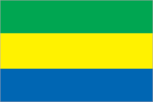
three equal horizontal bands of green (top), yellow, and blue
Government type
republic; multiparty presidential regime
Independence
17 August 1960 (from France)
International organization participation
ACCT, ACP, AfDB, AU, BDEAC, CEMAC, FAO, FZ, G-24, G-77, IAEA, IBRD, ICAO, ICCt, ICRM, IDA, IDB, IFAD, IFC, IFRCS, ILO, IMF, IMO, IMSO, Interpol, IOC, IOM, IPU, ISO (correspondent), ITSO, ITU, ITUC, MIGA, MINURCAT, NAM, OIC, OIF, OPCW, UN, UNAMID, UNCTAD, UNESCO, UNIDO, UNMIS, UNWTO, UPU, WCL, WCO, WFTU, WHO, WIPO, WMO, WTO
Judicial branch
Supreme Court or Cour Supreme consisting of three chambers - Judicial, Administrative, and Accounts; Constitutional Court; Courts of Appeal; Court of State Security; County Courts
Legal system
based on French civil law system and customary law; judicial review of legislative acts in Constitutional Chamber of the Supreme Court; has not accepted compulsory ICJ jurisdiction
Legislative branch
bicameral legislature consists of the Senate (102 seats; members elected by members of municipal councils and departmental assemblies to serve six-year terms) and the National Assembly or Assemblee Nationale (120 seats; members are elected by direct, popular vote to serve five-year terms) elections: Senate - last held 18 January 2009 (next to be held in January 2015); National Assembly - last held 17 and 24 December 2006 (next to be held in December 2011) election results: Senate - percent of vote by party - NA; seats by party - PDG 75, GPR 6, UGDD 3, CLR 2, PGCI 2, UPG 2, ADERE 1, independents 9; National Assembly - percent of vote by party - NA; seats by party - PDG 82, RPG 8, UPG 8, UGDD 4, ADERE 3, CLR 2, PGP-Ndaot 2, PSD 2, independents 4, others 5
National holiday
Independence Day, 17 August (1960)
Political parties and leaders
Circle of Liberal Reformers or CLR [General Jean Boniface ASSELE]; Congress for Democracy and Justice or CDJ [Jules Aristide Bourdes OGOULIGUENDE]; Democratic and Republican Alliance or ADERE [Divungui-di-Ndinge DIDJOB]; Gabonese Democratic Party or PDG (former sole party) [Simplice Nguedet MANZELA]; Gabonese Party for Progress or PGP [Benoit Mouity NZAMBA]; Gabonese Union for Democracy and Development or UGDD [Zacherie MYBOTO]; National Rally of Woodcutters or RNB; National Rally of Woodcutters-Rally for Gabon or RNB-RPG (Bucherons) [Fr. Paul M'BA-ABESSOLE]; Party of Development and Social Solidarity or PDS [Seraphin Ndoat REMBOGO]; People's Unity Party or PUP [Louis Gaston MAYILA]; Social Democratic Party or PSD [Pierre Claver MAGANGA-MOUSSAVOU]; Union for Democracy and Social Integration or UDIS; Union of Gabonese Patriots or UPG [Pierre MAMBOUNDOU]
Political pressure groups and leaders
NA
Suffrage
21 years of age; universal
Economy
Agriculture - products
cocoa, coffee, sugar, palm oil, rubber; cattle; okoume (a tropical softwood); fish
Budget
revenues: $4.511 billion expenditures: $2.932 billion (2008 est.)
Central bank discount rate
4.75% (31 December 2008) country comparison to the world: 83 5.25% (31 December 2007)
Commercial bank prime lending rate
NA% (31 December 2008) country comparison to the world: 43 15% (31 December 2007)
Current account balance
$2.727 billion (2008 est.) country comparison to the world: 39 $1.549 billion (2007 est.)
Debt - external
$2.986 billion (31 December 2008 est.) country comparison to the world: 128 $4.895 billion (31 December 2007 est.)
Economy - overview
Gabon enjoys a per capita income four times that of most sub-Saharan African nations, but because of high income inequality, a large proportion of the population remains poor. Gabon depended on timber and manganese until oil was discovered offshore in the early 1970s. The oil sector now accounts for more than 50% of GDP. Gabon continues to face fluctuating prices for its oil, timber, and manganese exports. Despite the abundance of natural wealth, poor fiscal management hobbles the economy. In 1997, an IMF mission to Gabon criticized the government for overspending on off-budget items, overborrowing from the central bank, and slipping on its schedule for privatization and administrative reform. The rebound of oil prices since 1999 have helped growth, but drops in production have hampered Gabon from fully realizing potential gains, and will continue to temper the gains for most of this decade. In December 2000, Gabon signed a new agreement with the Paris Club to reschedule its official debt. A follow-up bilateral repayment agreement with the US was signed in December 2001. Gabon signed a 14-month Stand-By Arrangement with the IMF in May 2007, and received Paris Club debt rescheduling later that year.
Electricity - consumption
1.446 billion kWh (2007 est.) country comparison to the world: 140
Electricity - exports
0 kWh (2008 est.)
Electricity - imports
0 kWh (2008 est.)
Electricity - production
1.774 billion kWh (2007 est.) country comparison to the world: 137
Exchange rates
Cooperation Financiere en Afrique Centrale francs (XAF) per US dollar - 447.81 (2008 est.), 481.83 (2007), 522.89 (2006), 527.47 (2005), 528.29 (2004) note: since 1 January 1999, the Central African CFA franc (XAF) has been pegged to the euro at a rate of 655.957 CFA francs per euro; Central African CFA franc (XAF) coins and banknotes are not accepted in countries using West African CFA francs (XOF), and vice versa, even though the two currencies trade at par
Exports
$9.333 billion (2008 est.) country comparison to the world: 90 $7.046 billion (2007 est.)
Exports - commodities
crude oil 70%, timber, manganese, uranium (2001)
Exports - partners
US 25.4%, China 19.1%, Japan 10.2%, France 5.4%, Spain 4% (2008)
GDP - composition by sector
agriculture: 5.6% industry: 57.8% services: 36.6% (2008 est.)
GDP - per capita (PPP)
$14,200 (2008 est.) country comparison to the world: 81 $14,200 (2007 est.) $13,800 (2006 est.) note: data are in 2008 US dollars
GDP - real growth rate
2% (2008 est.) country comparison to the world: 163 5.6% (2007 est.) 1.2% (2006 est.)
GDP (official exchange rate)
$14.54 billion (2008 est.)
GDP (purchasing power parity)
$21.16 billion (2008 est.) country comparison to the world: 120 $20.74 billion (2007 est.) $19.64 billion (2006 est.) note: data are in 2008 US dollars
Household income or consumption by percentage share
lowest 10%: NA% highest 10%: NA%
Imports
$2.577 billion (2008 est.) country comparison to the world: 143 $2.2 billion (2007 est.)
Imports - commodities
machinery and equipment, foodstuffs, chemicals, construction materials
Imports - partners
France 32.2%, US 11.1%, China 5.4%, Belgium 4.7%, Cameroon 4.4%, Netherlands 4.2% (2008)
Industrial production growth rate
1% (2008 est.) country comparison to the world: 124
Industries
petroleum extraction and refining; manganese, gold; chemicals, ship repair, food and beverages, textiles, lumbering and plywood, cement
Inflation rate (consumer prices)
5.3% (2008 est.) country comparison to the world: 91 5% (2007 est.)
Investment (gross fixed)
27.3% of GDP (2008 est.) country comparison to the world: 34
Labor force
581,000 (2008 est.) country comparison to the world: 151
Labor force - by occupation
agriculture: 60% industry: 15% services: 25% (2000 est.)
Market value of publicly traded shares
$NA
Natural gas - consumption
90 million cu m (2008 est.) country comparison to the world: 103
Natural gas - exports
0 cu m (2008) country comparison to the world: 175
Natural gas - imports
0 cu m (2008 est.) country comparison to the world: 178
Natural gas - production
90 million cu m (2008 est.) country comparison to the world: 80
Natural gas - proved reserves
28.32 billion cu m (1 January 2009 est.) country comparison to the world: 71
Oil - consumption
14,000 bbl/day (2008 est.) country comparison to the world: 138
Oil - exports
227,300 bbl/day (2007 est.) country comparison to the world: 50
Oil - imports
4,185 bbl/day (2007 est.) country comparison to the world: 164
Oil - production
247,800 bbl/day (2008 est.) country comparison to the world: 39
Oil - proved reserves
2 billion bbl (1 January 2009 est.) country comparison to the world: 33
Population below poverty line
NA%
Public debt
24.7% of GDP (2008 est.) country comparison to the world: 83 29.3% of GDP (2004 est.)
Reserves of foreign exchange and gold
$1.925 billion (31 December 2008 est.) country comparison to the world: 111 $1.238 billion (31 December 2007 est.)
Stock of domestic credit
$NA (31 December 2008) $359.8 million (31 December 2007)
Stock of money
$NA (31 December 2008) $1.547 billion (31 December 2007)
Stock of quasi money
$NA (31 December 2008) $799.3 million (31 December 2007)
Unemployment rate
21% (2006 est.) country comparison to the world: 168
Communications
Internet country code
.ga
Internet hosts
91 (2009) country comparison to the world: 199
Internet users
90,000 (2008) country comparison to the world: 158
Radio broadcast stations
AM 6, FM 7 (plus 11 repeaters), shortwave 4 (2001)
Telephone system
general assessment: adequate service by African standards and improving with the help of a growing mobile cell network system with multiple providers; mobile-cellular subscribership reached nearly 90 per 100 persons in 2008 domestic: adequate system of cable, microwave radio relay, tropospheric scatter, radiotelephone communication stations, and a domestic satellite system with 12 earth stations international: country code - 241; landing point for the SAT-3/WASC fiber-optic submarine cable that provides connectivity to Europe and Asia; satellite earth stations - 3 Intelsat (Atlantic Ocean) (2008)
Telephones - main lines in use
26,500 (2008) country comparison to the world: 182
Telephones - mobile cellular
1.3 million (2008) country comparison to the world: 137
Television broadcast stations
4 (plus 4 repeaters) (2001)
Transportation
Airports
44 (2009) country comparison to the world: 98
Airports - with paved runways
total: 13 over 3,047 m: 1 2,438 to 3,047 m: 1 1,524 to 2,437 m: 9 914 to 1,523 m: 1 under 914 m: 1 (2009)
Airports - with unpaved runways
total: 31 1,524 to 2,437 m: 6 914 to 1,523 m: 11 under 914 m: 14 (2009)
Merchant marine
registered in other countries: 2 (Cambodia 1, Panama 1) (2008) country comparison to the world: 143
Pipelines
gas 240 km; oil 723 km (2008)
Ports and terminals
Gamba, Libreville, Lucinda, Port-Gentil
Railways
total: 814 km country comparison to the world: 100 standard gauge: 814 km 1.435-m gauge (2008)
Roadways
total: 9,170 km country comparison to the world: 138 paved: 937 km unpaved: 8,233 km (2004)
Waterways
1,600 km (310 km on Ogooue River) (2008) country comparison to the world: 51
Military and Security
Manpower available for military service
males age 16-49: 331,181 females age 16-49: 332,498 (2008 est.)
Manpower fit for military service
males age 16-49: 195,519 females age 16-49: 190,519 (2009 est.)
Manpower reaching militarily significant age annually
male: 16,933 female: 16,942 (2009 est.)
Military branches
Army, Navy, Air Force, National Gendarmerie, National Police
Military expenditures
3.4% of GDP (2005 est.) country comparison to the world: 38
Military service age and obligation
20 years of age for compulsory and voluntary military service (2007)
Transnational Issues
Disputes - international
UN urges Equatorial Guinea and Gabon to resolve the sovereignty dispute over Gabon-occupied Mbane Island and lesser islands and to establish a maritime boundary in hydrocarbon-rich Corisco Bay
Refugees and internally displaced persons
refugees (country of origin): 7,178 (Republic of Congo) (2007)
Trafficking in persons
current situation: Gabon is predominantly a destination country for children trafficked from other African countries for the purpose of forced labor; girls are primarily trafficked for domestic servitude, forced market vending, forced restaurant labor, and sexual exploitation, while boys are trafficked for forced street hawking and forced labor in small workshops tier rating: Tier 2 Watch List - Gabon is on the Tier 2 Watch List for its failure to provide evidence of increasing efforts to combat human trafficking in 2007, particularly in terms of efforts to convict and punish trafficking offenders; the government has not reported the convictions or sentences of any trafficking offenders; the government did not take steps to reduce demand for commercial sex acts (2008) page last updated on November 11, 2009