1999 Edition
CIA World Factbook 1999 (Internet Archive)
Geography
Area
total: 267,670 sq km land: 257,670 sq km water: 10,000 sq km
Area--comparative
slightly smaller than Colorado
Climate
tropical; always hot, humid
Coastline
885 km
Elevation extremes
lowest point: Atlantic Ocean 0 m highest point: Mont Iboundji 1,575 m
Environment--current issues
deforestation; poaching
Environment--international agreements
party to: Biodiversity, Climate Change, Desertification, Endangered Species, Law of the Sea, Marine Dumping, Nuclear Test Ban, Ozone Layer Protection, Ship Pollution, Tropical Timber 83, Tropical Timber 94, Wetlands signed, but not ratified: none of the selected agreements
Geographic coordinates
1 00 S, 11 45 E
Irrigated land
40 sq km (1993 est.)
Land boundaries
total: 2,551 km border countries: Cameroon 298 km, Republic of the Congo 1,903 km, Equatorial Guinea 350 km
Land use
arable land: 1% permanent crops: 1% permanent pastures: 18% forests and woodland: 77% other: 3% (1993 est.)
Location
Western Africa, bordering the Atlantic Ocean at the Equator, between Republic of the Congo and Equatorial Guinea
Map references
Africa
Maritime claims
contiguous zone: 24 nm exclusive economic zone: 200 nm territorial sea: 12 nm
Natural hazards
NA
Natural resources
petroleum, manganese, uranium, gold, timber, iron ore
Terrain
narrow coastal plain; hilly interior; savanna in east and south
People and Society
Age structure
0-14 years: 33% (male 205,076; female 205,198) 15-64 years: 61% (male 376,181; female 370,479) 65 years and over: 6% (male 34,078; female 34,841) (1999 est.)
Birth rate
27.89 births/1,000 population (1999 est.)
Death rate
13.07 deaths/1,000 population (1999 est.)
Ethnic groups
Bantu tribes including four major tribal groupings (Fang, Eshira, Bapounou, Bateke), other Africans and Europeans 154,000, including 6,000 French and 11,000 persons of dual nationality
Infant mortality rate
83.1 deaths/1,000 live births (1999 est.)
Languages
French (official), Fang, Myene, Bateke, Bapounou/Eschira, Bandjabi
Life expectancy at birth
total population: 56.98 years male: 53.98 years female: 60.08 years (1999 est.)
Literacy
definition: age 15 and over can read and write total population: 63.2% male: 73.7% female: 53.3% (1995 est.)
Nationality
noun: Gabonese (singular and plural) adjective: Gabonese
Net migration rate
0 migrant(s)/1,000 population (1999 est.)
Population
1,225,853 (July 1999 est.)
Population growth rate
1.48% (1999 est.)
Religions
Christian 55%-75%, Muslim less than 1%, animist
Sex ratio
at birth: 1.03 male(s)/female under 15 years: 1 male(s)/female 15-64 years: 1.02 male(s)/female 65 years and over: 0.98 male(s)/female total population: 1.01 male(s)/female (1999 est.)
Total fertility rate
3.77 children born/woman (1999 est.)
Government
Administrative divisions
9 provinces; Estuaire, Haut-Ogooue, Moyen-Ogooue, Ngounie, Nyanga, Ogooue-Ivindo, Ogooue-Lolo, Ogooue-Maritime, Woleu-Ntem
Capital
Libreville
Constitution
adopted 14 March 1991
Country name
conventional long form: Gabonese Republic conventional short form: Gabon local long form: Republique Gabonaise local short form: Gabon
Data code
GB
Executive branch
chief of state: President El Hadj Omar BONGO (since 2 December 1967) head of government: Prime Minister Jean-Francois NTOUTOUME-EMANE (since 23 January 1999) cabinet: Council of Ministers appointed by the prime minister in consultation with the president elections: president elected by popular vote for a seven-year term; election last held 6 December 1998 (next to be held NA 2005); prime minister appointed by the president election results: President El Hadj Omar BONGO reelected; percent of vote--El Hadj Omar BONGO 66%, Pierre MAMBOUNDOU 17%, Fr. Paul M'BA-ABESSOLE 13%
Flag description
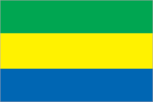
three equal horizontal bands of green (top), yellow, and blue
Government type
republic; multiparty presidential regime (opposition parties legalized 1990)
Independence
17 August 1960 (from France)
International organization participation
ACCT, ACP, AfDB, BDEAC, CCC, CEEAC, ECA, FAO, FZ, G-24, G-77, IAEA, IBRD, ICAO, ICFTU, IDA, IDB, IFAD, IFC, IFRCS (associate), ILO, IMF, IMO, Inmarsat, Intelsat, Interpol, IOC, ITU, MINURCA, NAM, OAU, OIC, OPCW, UDEAC, UN, UN Security Council (temporary), UNCTAD, UNESCO, UNIDO, UPU, WCL, WHO, WIPO, WMO, WToO, WTrO Diplomatic representation in the US: chief of mission: Ambassador Paul BOUNDOUKOU-LATHA chancery: Suite 200, 2034 20th Street NW, Washington, DC 20009 consulate(s): New York Diplomatic representation from the US: chief of mission: Ambassador James V. LEDESMA embassy: Boulevard de la Mer, Libreville mailing address: B. P. 4000, Libreville
Judicial branch
Supreme Court or Cour Supreme consisting of three chambers--Judicial, Administrative, and Accounts; Constitutional Court; Courts of Appeal; Court of State Security; County Courts Political parties and leaders: African Forum for Reconstruction NA]
Legal system
based on French civil law system and customary law; judicial review of legislative acts in Constitutional Chamber of the Supreme Court; compulsory ICJ jurisdiction not accepted
Legislative branch
bicameral legislature consists of the Senate (91 seats) and the National Assembly or Assemblee Nationale (120 seats); members are elected by direct popular vote to serve five-year terms elections: National Assembly--last held in December 1996 (next to be held NA December 2001); Senate--last held 12 January 1997 (next to be held in January 2002) election results: National Assembly--percent of vote by party--NA; seats by party--PDG 100, Morena-Bucherons/RNB 8, PUP 3, CLR 3, FAR 1, UPG 1, USG 2, PGP 2; Senate--percent of vote by party--NA; seats by party--PDG 51, RNB 17, PGP 4, ADERE 3, RDP 1, others 15
National holiday
Independence Day, 17 August (1960) (Gabon granted full independence from France)
Suffrage
21 years of age; universal
Economy
Agriculture--products
cocoa, coffee, sugar, palm oil, rubber; cattle; okoume (a tropical softwood); fish
Budget
revenues: $1.5 billion expenditures: $1.3 billion, including capital expenditures of $302 million (1996 est.)
Currency
1 Communaute Financiere Africaine franc (CFAF) = 100 centimes
Debt--external
$4.1 billion (1997)
Economic aid--recipient
$331 million (1995)
Economy--overview
Gabon enjoys a per capita income four times that of most nations of sub-Saharan Africa. This has supported a sharp decline in extreme poverty; yet because of high income inequality a large proportion of the population remains poor. Gabon depended on timber and manganese until oil was discovered offshore in the early 1970s. The oil sector now accounts for 50% of GDP. Gabon continues to face fluctuating prices for its oil, timber, manganese, and uranium exports. Despite the abundance of natural wealth, the economy is hobbled by poor fiscal management. In 1992, the fiscal deficit widened to 2.4% of GDP, and Gabon failed to settle arrears on its bilateral debt, leading to a cancellation of rescheduling agreements with official and private creditors. Devaluation of its Francophone currency by 50% on 12 January 1994 sparked a one-time inflationary surge, to 35%; the rate dropped to 6% in 1996. The IMF provided a one-year standby arrangement in 1994-95 and a three-year Enhanced Financing Facility (EFF) at near commercial rates beginning in late 1995. Those agreements mandate progress in privatization and fiscal discipline. France provided additional financial support in January 1997 after Gabon had met IMF targets for mid-1996. In 1997, an IMF mission to Gabon criticized the government for overspending on off-budget items, overborrowing from the central bank, and slipping on its schedule for privatization and administrative reform. Growth in 1999 will depend mainly on how world oil prices move.
Electricity--consumption
930 million kWh (1996)
Electricity--exports
0 kWh (1996)
Electricity--imports
0 kWh (1996)
Electricity--production
930 million kWh (1996)
Electricity--production by source
fossil fuel: 22.04% hydro: 77.96% nuclear: 0% other: 0% (1996)
Exchange rates
Communaute Financiere Africaine francs (CFAF) per US$1--577.61 (January 1999), 589.95 (1998), 583.67 (1997), 511.55 (1996), 499.15 (1995), 555.20 (1994)
Exports
$2.1 billion (f.o.b., 1998 est.)
Exports--commodities
crude oil 81%, timber 12%, manganese 5%, uranium (1996)
Exports--partners
US 67%, China 9%, France 8%, Japan 3% (1997)
Fiscal year
calendar year
GDP
purchasing power parity--$7.7 billion (1998 est.)
GDP--composition by sector
agriculture: 8% industry: 67% services: 25% (1997 est.)
GDP--per capita
purchasing power parity?$6,400 (1998 est.)
GDP--real growth rate
1.7% (1998 est.)
Household income or consumption by percentage share
lowest 10%: NA% highest 10%: NA%
Imports
$890 million (f.o.b., 1998 est.)
Imports--commodities
machinery and equipment, foodstuffs, chemicals, petroleum products, construction materials
Imports--partners
France 38%, US 8%, Cameroon 5%, Netherlands 4%, Cote d'Ivoire, Japan (1997)
Industrial production growth rate
2.3% (1995)
Industries
food and beverage; textile; lumbering and plywood; cement; petroleum extraction and refining; manganese, uranium, and gold mining; chemicals; ship repair
Inflation rate (consumer prices)
1% (1998 est.)
Labor force
NA
Labor force--by occupation
agriculture 65%, industry and commerce, services
Population below poverty line
NA%
Unemployment rate
21% (1997 est.)
Communications
Radio broadcast stations
AM 6, FM 6, shortwave 0
Radios
250,000 (1993 est.)
Telephone system
domestic: adequate system of cable, microwave radio relay, tropospheric scatter, radiotelephone communication stations, and a domestic satellite system with 12 earth stations international: satellite earth stations--3 Intelsat (Atlantic Ocean)
Telephones
22,000 (1991 est.)
Television broadcast stations
4 (in addition, there are five low-power repeaters) (1997)
Televisions
40,000 (1993 est.)
Transportation
Airports
62 (1998 est.) Airports--with paved runways: total: 10 over 3,047 m: 1 2,438 to 3,047 m: 1 1,524 to 2,437 m: 7 914 to 1,523 m: 1 (1998 est.) Airports--with unpaved runways: total: 52 1,524 to 2,437 m: 10 914 to 1,523 m: 16 under 914 m: 26 (1998 est.)
Highways
total: 7,670 km paved: 629 km (including 30 km of expressways) unpaved: 7,041 km (1996 est.)
Merchant marine
total: 2 ships (1,000 GRT or over) totaling 13,613 GRT/22,599 DWT (1998 est.) ships by type: bulk 1, cargo 1 (1998 est.)
Pipelines
crude oil 270 km; petroleum products 14 km Ports and harbors: Cap Lopez, Kango, Lambarene, Libreville, Mayumba, Owendo, Port-Gentil
Railways
total: 649 km Gabon State Railways (OCTRA) standard gauge: 649 km 1.435-m gauge; single track (1994)
Waterways
1,600 km perennially navigable
Military and Security
Military branches
Army, Navy, Air Force, Republican Guard (charged with protecting the president and other senior officials), National Gendarmerie, National Police
Military expenditures--dollar figure
$91 million (1996)
Military expenditures--percent of GDP
1.6% (1996)
Military manpower--availability
males age 15-49: 280,719 (1999 est.) Military manpower--fit for military service: males age 15-49: 144,133 (1999 est.)
Military manpower--military age
20 years of age
Military manpower--reaching military age annually
males: 11,392 (1999 est.)
Transnational Issues
Disputes--international
maritime boundary dispute with Equatorial Guinea because of disputed sovereignty over islands in Corisco Bay