1993 Edition
CIA World Factbook 1993 (Project Gutenberg)
Geography
Area
total area: 267,670 km2 land area: 257,670 km2 comparative area: slightly smaller than Colorado
Climate
tropical; always hot, humid
Coastline
885 km
Environment
deforestation
International disputes
maritime boundary dispute with Equatorial Guinea because of disputed sovereignty over islands in Corisco Bay
Irrigated land
NA km2
Land boundaries
total 2,551 km, Cameroon 298 km, Congo 1,903 km, Equatorial Guinea 350 km
Land use
arable land: 1% permanent crops: 1% meadows and pastures: 18% forest and woodland: 78% other: 2%
Location
Western Africa, bordering the Atlantic Ocean at the Equator between the Congo and Equatorial Guinea
Map references
Africa, Standard Time Zones of the World
Maritime claims
contiguous zone: 24 nm exclusive economic zone: 200 nm territorial sea: 12 nm
Natural resources
petroleum, manganese, uranium, gold, timber, iron ore
Terrain
narrow coastal plain; hilly interior; savanna in east and south
People and Society
Birth rate
28.63 births/1,000 population (1993 est.)
Death rate
14.08 deaths/1,000 population (1993 est.)
Ethnic divisions
Bantu tribes including four major tribal groupings (Fang, Eshira, Bapounou, Bateke), Africans and Europeans 100,000, including 27,000 French
Infant mortality rate
97.3 deaths/1,000 live births (1993 est.)
Labor force
120,000 salaried by occupation: agriculture 65.0%, industry and commerce 30.0%, services 2.5%, government 2.5% note: 58% of population of working age (1983)
Languages
French (official), Fang, Myene, Bateke, Bapounou/Eschira, Bandjabi
Life expectancy at birth
total population: 54.19 years male: 51.46 years female: 57.01 years (1993 est.)
Literacy
age 15 and over can read and write (1990) total population: 61% male: 74% female: 48%
Nationality
noun: Gabonese (singular and plural) adjective: Gabonese
Net migration rate
0 migrant(s)/1,000 population (1993 est.)
Population
1,122,550 (July 1993 est.)
Population growth rate
1.45% (1993 est.)
Religions
Christian 55-75%, Muslim less than 1%, animist
Total fertility rate
4.02 children born/woman (1993 est.)
Government
Administrative divisions
9 provinces; Estuaire, Haut-Ogooue, Moyen-Ogooue, Ngounie, Nyanga, Ogooue-Ivindo, Ogooue-Lolo, Ogooue-Maritime, Woleu-Ntem
Capital
Libreville
Chief of State
President El Hadj Omar BONGO (since 2 December 1967)
Constitution
21 February 1961, revised 15 April 1975
Digraph
GB
Diplomatic representation in US
chief of mission: (vacant) chancery: 2034 20th Street NW, Washington, DC 20009 telephone: (202) 797-1000
Executive branch
president, prime minister, Cabinet
FAX
[241] 745-507
Flag
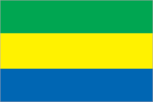
three equal horizontal bands of green (top), yellow, and blue
Head of Government
Prime Minister Casimir OYE-MBA (since 3 May 1990)
Independence
17 August 1960 (from France)
Judicial branch
Supreme Court (Cour Supreme)
Legal system
based on French civil law system and customary law; judicial review of legislative acts in Constitutional Chamber of the Supreme Court; compulsory ICJ jurisdiction not accepted
Legislative branch
unicameral National Assembly (Assemblee Nationale)
Member of
ACCT, ACP, AfDB, BDEAC, CCC, CEEAC, ECA, FAO, FZ, G-24, G-77, GATT, IAEA, IBRD, ICAO, ICC, IDA, IDB, IFAD, IFC, ILO, IMF, IMO, INMARSAT, INTELSAT, INTERPOL, IOC, ITU, LORCS (associate), NAM, OAU, OIC, OPEC, UDEAC, UN, UNCTAD, UNESCO, UNIDO, UPU, WCL, WHO, WIPO, WMO, WTO
Names
conventional long form: Gabonese Republic conventional short form: Gabon local long form: Republique Gabonaise local short form: Gabon
National Assembly
last held on 28 October 1990 (next to be held by NA); results - percent of vote NA; seats - (120 total, 111 elected) PDG 62, National Recovery Movement - Lumberjacks (Morena-Bucherons) 19, PGP 18, National Recovery Movement (Morena-Original) 7, APSG 6, USG 4, CRP 1, independents 3
National holiday
Renovation Day, 12 March (1968) (Gabonese Democratic Party established)
Political parties and leaders
Gabonese Democratic Party (PDG, former sole party), El Hadj Omar BONGO, president; National Recovery Movement - Lumberjacks (Morena-Bucherons); Gabonese Party for Progress (PGP); National Recovery Movement (Morena-Original); Association for Socialism in Gabon (APSG); Gabonese Socialist Union (USG); Circle for Renewal and Progress (CRP); Union for Democracy and Development (UDD)
President
last held on 9 November 1986 (next to be held December 1993); results - President Omar BONGO was reelected without opposition
Suffrage
21 years of age; universal
Type
republic; multiparty presidential regime (opposition parties legalized 1990)
US diplomatic representation
chief of mission: Ambassador John C. WILSON IV embassy: Boulevard de la Mer, Libreville mailing address: B. P. 4000, Libreville telephone: (241) 762003/4, or 743492
Economy
Agriculture
accounts for 10% of GDP (including fishing and forestry); cash crops - cocoa, coffee, palm oil; livestock not developed; importer of food; small fishing operations provide a catch of about 20,000 metric tons; okoume (a tropical softwood) is the most important timber product
Budget
revenues $1.4 billion; expenditures $1.4 billion, including capital expenditures of $247 million (1990 est.)
Currency
1 CFA franc (CFAF) = 100 centimes
Economic aid
US commitments, including Ex-Im (FY70-90), $68 million; Western (non-US) countries, ODA and OOF bilateral commitments (1970-90), $2,342 million; Communist countries (1970-89), $27 million
Electricity
315,000 kW capacity; 995 million kWh produced, 920 kWh per capita (1991)
Exchange rates
Communaute Financiere Africaine francs (CFAF) per US$1 - 274.06 (January 1993), 264.69 (1992), 282.11 (1991), 272.26 (1990), 319.01 (1989), 297.85 (1988)
Exports
$2.2 billion (f.o.b., 1991) commodities: crude oil 80%, manganese 7%, wood 7%, uranium 2% partners: France 48%, US 15%, Germany 2%, Japan 2%
External debt
$4.4 billion (1991)
Fiscal year
calendar year
Imports
$702 million (c.i.f., 1991 est.) commodities: foodstuffs, chemical products, petroleum products, construction materials, manufactures, machinery partners: France 64%, African countries 7%, US 5%, Japan 3%
Industrial production
growth rate - 10% (1988 est.); accounts for 45% of GDP, including petroleum
Industries
petroleum, food and beverages, lumbering and plywood, textiles, mining - manganese, uranium, gold, cement
Inflation rate (consumer prices)
0.7% (1991 est.)
National product
GDP - exchange rate conversion - $4.6 billion (1991)
National product per capita
$4,200 (1991 est.)
National product real growth rate
13% (1990 est.)
Overview
The economy, dependent on timber and manganese until the early 1970s, is now dominated by the oil sector. In 1981-85, oil accounted for about 45% of GDP, 80% of export earnings, and 65% of government revenues on average. The high oil prices of the early 1980s contributed to a substantial increase in per capita national income, stimulated domestic demand, reinforced migration from rural to urban areas, and raised the level of real wages to among the highest in Sub-Saharan Africa. The subsequent slide of Gabon's economy, which began with falling oil prices in 1985, was reversed in 1989-90, but debt servicing obligations continue to limit prospects for further domestic development. Real growth in 1991-92 was weak because of a combination of an overstaffed bureaucracy, a large budget deficit, and the continued underdevelopment of the whole economy outside the petroleum sector.
Unemployment rate
NA%
Communications
Airports
total: 68 usable: 56 with permanent-surface runways: 10 with runways over 3,659 m: 0 with runways 2,440-3,659 m: 2 with runways 1,220-2,439 m: 22
Highways
7,500 km total; 560 km paved, 960 km laterite, 5,980 km earth
Inland waterways
1,600 km perennially navigable
Merchant marine
2 cargo ships (1,000 GRT or over) totaling 18,563 GRT/25,330 DWT
Pipelines
crude oil 270 km; petroleum products 14 km
Ports
Owendo, Port-Gentil, Libreville
Railroads
649 km 1.437-meter standard-gauge single track (Transgabonese Railroad)
Telecommunications
adequate system of cable, radio relay, tropospheric scatter links and radiocommunication stations; 15,000 telephones; broadcast stations - 6 AM, 6 FM, 3 (5 repeaters) TV; satellite earth stations - 3 Atlantic Ocean INTELSAT and 12 domestic satellite
Military and Security
Branches
Army, Navy, Air Force, Presidential Guard, National Gendarmerie, National Police
Defense expenditures
exchange rate conversion - $102 million, 3.2% of GDP (1990 est.)
Manpower availability
males age 15-49 269,066; fit for military service 135,836; reach military age (20) annually 9,680 (1993 est.)