1990 Edition
CIA World Factbook 1990 (Project Gutenberg)
Geography
Climate
generally cool winters and mild summers, but mild winters and hot summers along the Mediterranean
Coastline
3,427 km (includes Corsica, 644 km)
Comparative area
slightly more than twice the size of Colorado
Contiguous zone
12-24 nm;
Disputes
maritime boundary dispute with Canada (St. Pierre and Miquelon); Madagascar claims Bassas da India, Europa Island, Glorioso Islands, Juan de Nova Island, and Tromelin Island; Comoros claims Mayotte; Mauritius claims Tromelin Island; Seychelles claims Tromelin Island; Suriname claims part of French Guiana; territorial claim in Antarctica (Adelie Land)
Environment
most of large urban areas and industrial centers in Rhone, Garonne, Seine, or Loire River basins; occasional warm tropical wind known as mistral
Extended economic zone
200 nm;
Land boundaries
2,892.4 km total; Andorra 60 km, Belgium 620 km, FRG 451 km, Italy 488 km, Luxembourg 73 km, Monaco 4.4 km, Spain 623 km, Switzerland 573 km
Land use
32% arable land; 2% permanent crops; 23% meadows and pastures; 27% forest and woodland; 16% other; includes 2% irrigated
Natural resources
coal, iron ore, bauxite, fish, timber, zinc, potash
Note
largest West European nation
Terrain
mostly flat plains or gently rolling hills in north and west; remainder is mountainous, especially Pyrenees in south, Alps in east
Territorial sea
12 nm
Total area
547,030 km2; land area: 545,630 km2; includes Corsica and the rest of metropolitan France, but excludes the overseas administrative divisions
People and Society
Birth rate
14 births/1,000 population (1990)
Death rate
9 deaths/1,000 population (1990)
Ethnic divisions
Celtic and Latin with Teutonic, Slavic, North African, Indochinese, and Basque minorities
Infant mortality rate
6 deaths/1,000 live births (1990)
Labor force
24,170,000; 61.5% services, 31.3% industry, 7.3% agriculture
Language
French (100% of population); rapidly declining regional dialects (Provencal, Breton, Alsatian, Corsican, Catalan, Basque, Flemish)
Life expectancy at birth
73 years male, 82 years female (1990)
Literacy
99%
Nationality
noun--Frenchman(men), Frenchwoman(women); adjective--French
Net migration rate
0 migrants/1,000 population (1990)
Organized labor
20% of labor force (est.)
Population
56,358,331 (July 1990), growth rate 0.4% (1990)
Religion
90% Roman Catholic, 2% Protestant, 1% Jewish, 1% Muslim (North African workers), 6% unaffiliated
Total fertility rate
1.8 children born/woman (1990)
Government
Administrative divisions
metropolitan France--22 regions (regions, singular--region); Alsace, Aquitaine, Auvergne, Basse-Normandie, Bourgogne, Bretagne, Centre, Champagne-Ardenne, Corse, Franche-Comte, Haute-Normandie, Ile-de-France, Languedoc-Roussillon, Limousin, Lorraine, Midi-Pyrenees, Nord-Pas-de-Calais, Pays de la Loire, Picardie, Poitou-Charentes, Provence-Alpes-Cote d'Azur, Rhone-Alpes; note--the 22 regions are subdivided into 96 departments; see separate entries for the overseas departments (French Guiana, Guadeloupe, Martinique, Reunion) and the territorial collectivities (Mayotte, St. Pierre and Miquelon)
Capital
Paris
Communists
700,000 claimed but probably closer to 150,000; Communist voters, 2.8 million in 1988 election
Constitution
28 September 1958, amended concerning election of president in 1962
Dependent areas
Bassas da India, Clipperton Island, Europa Island, French Polynesia, French Southern and Antarctic Lands, Glorioso Islands, Juan de Nova Island, New Caledonia, Tromelin Island, Wallis and Futuna
Diplomatic representation
Ambassador Jacques ANDREANI; Chancery at 4101 Reservoir Road NW, Washington DC 20007; telephone (202) 944-6000; there are French Consulates General in Boston, Chicago, Detroit, Houston, Los Angeles, New Orleans, Miami, New York, San Francisco, and San Juan (Puerto Rico); US--Ambassador Walter J. P. CURLEY; Embassy at 2 Avenue Gabriel, 75382 Paris Cedex 08 (mailing address is APO New York 09777); telephone [33] (1) 42-96-12-02 or 42-61-80-75; there are US Consulates General in Bordeaux, Lyon, Marseille, and Strasbourg
Elections
President--last held 8 May 1988 (next to be held May 1995); results--Second Ballot Francois Mitterrand 54%, Jacques Chirac 46%; Senate--last held 24 September 1989 (next to be held September 1992); results--percent of vote by party NA; seats--(321 total; 296 metropolitan France, 13 for overseas departments and territories, and 12 for French nationals abroad) RPR 93, UDF 143 (PR 53, CDS 65, RAD 25), PS 64, PCF 16, independents 2, unknown 3; National Assembly--last held 5 and 12 June 1988 (next to be held June 1993); results--Second Ballot PS-MRG 48.7%, RPR 23.1%, UDF 21%, PCF 3.4%, other 3.8%; seats--(577 total) PS 275, RPR 132, UDF 90, UDC 40, PCF 25, independents 15
Executive branch
president, prime minister, Council of Ministers
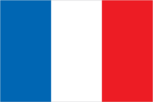
Flag
three equal vertical bands of blue (hoist side), white, and red; known as the French Tricouleur (Tricolor); the design and colors have been the basis for a number of other flags, including those of Belgium, Chad, Ireland, Ivory Coast, and Luxembourg; the official flag for all French dependent areas
Independence
unified by Clovis in 486, First Republic proclaimed in 1792
Judicial branch
Court of Cassation (Cour de Cassation)
Leaders
Chief of State--President Francois MITTERRAND (since 21 May 1981); Head of Government--Prime Minister Michel ROCARD (since 10 March 1988)
Legal system
civil law system with indigenous concepts; review of administrative but not legislative acts
Legislative branch
bicameral Parliament (Parlement) consists of an upper house or Senate (Senat) and a lower house or National Assembly
Long-form name
French Republic
Member of
ADB, CCC, Council of Europe, DAC, EC, EIB, EMS, ESA, ESCAP, FAO, GATT, IAEA, IATP, IBRD, ICAC, ICAO, ICES, ICO, IDA, IDB--Inter-American Development Bank, IFAD, IFC, IHO, ILO, ILZSG, IMF, IMO, INTELSAT, INTERPOL, IOOC, IPU, IRC, ISO, ITC, ITU, IWC--International Whaling Commission, NATO (signatory), OAS (observer), OECD, SPC, UN, UNESCO, UPU, WEU, WFTU, WHO, WIPO, WMO, WSG, WTO
National holiday
Taking of the Bastille, 14 July (1789)
Other political or pressure groups
Communist-controlled labor union (Confederation Generale du Travail) nearly 2.4 million members (claimed); Socialist-leaning labor union (Confederation Francaise Democratique du Travail or CFDT) about 800,000 members est.; independent labor union (Force Ouvriere) about 1,000,000 members est.; independent white-collar union (Confederation Generale des Cadres) 340,000 members (claimed); National Council of French Employers (Conseil National du Patronat Francais--CNPF or Patronat)
Political parties and leaders
Rally for the Republic (RPR, formerly UDR), Jacques Chirac; Union for French Democracy (UDF, federation of PR, CDS, and RAD), Valery Giscard d'Estaing; Republicans (PR), Francois Leotard; Center for Social Democrats (CDS), Pierre Mehaignerie; Radical (RAD), Yves Gallard; Socialist Party (PS), Pierre Mauroy; Left Radical Movement (MRG), Yves Collin; Communist Party (PCF), Georges Marchais; National Front (FN), Jean-Marie Le Pen
Suffrage
universal at age 18
Type
republic
Economy
Agriculture
accounts for 4% of GNP (including fishing and forestry); one of the world's top five wheat producers; other principal products--beef, dairy products, cereals, sugar beets, potatoes, wine grapes; self-sufficient for most temperate-zone foods; shortages include fats and oils and tropical produce, but overall net exporter of farm products; fish catch of 850,000 metric tons ranks among world's top 20 countries and is all used domestically
Aid
donor--ODA and OOF commitments (1970-87), $59.8 billion
Budget
revenues $197.0 billion; expenditures $213.4 billion, including capital expenditures of $NA (1989 est.)
Currency
French franc (plural--francs); 1 French franc (F) = 100 centimes
Electricity
109,972,000 kW capacity; 403,570 million kWh produced, 7,210 kWh per capita (1989)
Exchange rates
French francs (F) per US$1--5.7598 (January 1990), 6.3801 (1989), 5.9569 (1988), 6.0107 (1987), 6.9261 (1986), 8.9852 (1985)
Exports
$183.1 billion (f.o.b., 1989 est.); commodities--machinery and transportation equipment, chemicals, foodstuffs, agricultural products, iron and steel products, textiles and clothing; partners--FRG 15.8%, Italy 12.2%, UK 9.8%, Belgium-Luxembourg 8.9%, Netherlands 8.7%, US 6.7%, Spain 5.6%, Japan 1.8%, USSR 1.3% (1989 est.)
External debt
$59.3 billion (December 1987)
Fiscal year
calendar year
GDP
$819.6 billion, per capita $14,600; real growth rate 3.4%
Imports
$194.5 billion (c.i.f., 1989 est.); commodities--crude oil, machinery and equipment, agricultural products, chemicals, iron and steel products; partners--FRG 19.4%, Italy 11.5%, Belgium-Luxembourg 9.2%, US 7.7%, UK 7.2%, Netherlands 5.2%, Spain 4.4%, Japan 4.1%, USSR 2.1% (1989 est.)
Industrial production
growth rate 4.4% (1989 est.)
Industries
steel, machinery, chemicals, automobiles, metallurgy, aircraft, electronics, mining, textiles, food processing, and tourism
Inflation rate (consumer prices)
3.5% (1989 est.)
Overview
One of the world's most developed economies, France has substantial agricultural resources and a highly diversified modern industrial sector. Large tracts of fertile land, the application of modern technology, and subsidies have combined to make it the leading agricultural producer in Western Europe. France is largely self-sufficient in agricultural products and is a major exporter of wheat and dairy products. The industrial sector generates about one-third of GDP and employs about one-third of the work force. During the period 1982-86 economic growth was sluggish, averaging only 1.4% annually. This trend was reversed by late 1987, however, with a strong expansion of consumer demand, followed by a surge in investment. The economy has had difficulty generating enough jobs for new entrants into the labor force, resulting in a high unemployment rate, but the upward trend in growth recently pushed the jobless rate below 10%. The steadily advancing economic integration within the European Community is a major force affecting the fortunes of the various economic sectors.
Unemployment rate
9.7% (1989 est.)
Communications
Airports
470 total, 460 usable; 204 with permanent-surface runways; 3 with runways over 3,659 m; 34 with runways 2,440-3,659 m; 133 with runways 1,220-2,439 m
Civil air
355 major transport aircraft (1982)
Highways
1,551,400 km total; 33,400 km national highway; 347,000 km departmental highway; 421,000 km community roads; 750,000 km rural roads; 5,401 km of controlled-access divided autoroutes; about 803,000 km paved
Inland waterways
14,932 km; 6,969 km heavily traveled
Merchant marine
153 ships (1,000 GRT or over) totaling 3,671,645 GRT/5,950,785 DWT; includes 10 short-sea passenger, 19 cargo, 19 container, 1 multifunction large-load carrier, 30 roll-on/roll-off cargo, 37 petroleum, oils, and lubricants (POL) tanker, 9 chemical tanker, 6 liquefied gas, 4 specialized tanker, 17 bulk, 1 combination bulk; note--France also maintains a captive register for French-owned ships in the Kerguelen Islands (French Southern and Antarctic Lands) and French Polynesia
Pipelines
crude oil, 3,059 km; refined products, 4,487 km; natural gas, 24,746 km
Ports
maritime--Bordeaux, Boulogne, Brest, Cherbourg, Dunkerque, Fos-Sur-Mer, Le Havre, Marseille, Nantes, Rouen, Sete, Toulon; inland--42
Railroads
French National Railways (SNCF) operates 34,568 km 1.435-meter standard gauge; 11,674 km electrified, 15,132 km double or multiple track; 2,138 km of various gauges (1.000-meter to 1.440-meter), privately owned and operated
Telecommunications
highly developed system provides satisfactory telephone, telegraph, radio and TV broadcast services; 39,110,000 telephones; stations--42 AM, 138 (777 relays) FM, 215 TV (8,900 relays); 25 submarine coaxial cables; communication satellite earth stations operating in INTELSAT, 3 Atlantic Ocean and 2 Indian Ocean, EUTELSAT, MARISAT, and domestic systems
Military and Security
Branches
Army, Navy, Air Force, National Gendarmerie
Defense expenditures
3.8% of GDP, or $31.1 billion (1989 est.)
Military manpower
males 15-49, 14,285,904; 12,042,731 fit for military service; 409,544 reach military age (18) annually