2000 Edition
CIA World Factbook 2000 (Project Gutenberg)
Introduction
Background
Fiji became independent in 1970, after nearly a century as a British colony. Democratic rule was interrupted by two military coups in 1987, caused by concern over a government perceived as dominated by the Indian community (descendants of contract laborers brought to the islands by the British in the 19th century). A 1990 constitution favored native Melanesian control of Fiji, but led to heavy Indian emigration; the population loss resulted in economic difficulties, but ensured that Melanesians became the majority. Amendments enacted in 1997 made the constitution more equitable. Free and peaceful elections in 1999 resulted in a government led by an Indo-Fijian. Fiji has been a major contributor to UN peacekeeping missions in various parts of the world.
Geography
Area
- land
- 18,270 sq km
- total
- 18,270 sq km
- water
- 0 sq km
Area - comparative
slightly smaller than New Jersey
Climate
tropical marine; only slight seasonal temperature variation
Coastline
1,129 km
Elevation extremes
- highest point
- Tomanivi 1,324 m
- lowest point
- Pacific Ocean 0 m
Environment - current issues
deforestation; soil erosion
Environment - international agreements
- party to
- Biodiversity, Climate Change, Climate Change-Kyoto Protocol, Desertification, Endangered Species, Law of the Sea, Marine Life Conservation, Nuclear Test Ban, Ozone Layer Protection, Tropical Timber 83, Tropical Timber 94 signed, but not ratified: none of the selected agreements
Geographic coordinates
18 00 S, 175 00 E
Geography - note
includes 332 islands of which approximately 110 are inhabited
Irrigated land
10 sq km (1993 est.)
Land boundaries
0 km
Land use
- arable land
- 10%
- forests and woodland
- 65%
- other
- 11% (1993 est.)
- permanent crops
- 4%
- permanent pastures
- 10%
Location
Oceania, island group in the South Pacific Ocean, about two-thirds of the way from Hawaii to New Zealand
Map references
Oceania
Maritime claims
- measured from claimed archipelagic baselines
- continental shelf
- 200-m depth or to the depth of exploitation; rectilinear shelf claim added
- exclusive economic zone
- 200 nm
- territorial sea
- 12 nm
Natural hazards
cyclonic storms can occur from November to January
Natural resources
timber, fish, gold, copper, offshore oil potential, hydropower
Terrain
mostly mountains of volcanic origin
People and Society
Age structure
0-14 years: 33% (male 141,779; female 136,212) 15-64 years: 63% (male 263,127; female 262,686) 65 years and over: 4% (male 13,405; female 15,285) (2000 est.)
Birth rate
23.48 births/1,000 population (2000 est.)
Death rate
5.78 deaths/1,000 population (2000 est.)
Ethnic groups
Fijian 51% (predominantly Melanesian with a Polynesian admixture), Indian 44%, European, other Pacific Islanders, overseas Chinese, and other 5% (1998 est.)
Infant mortality rate
14.45 deaths/1,000 live births (2000 est.)
Languages
English (official), Fijian, Hindustani
Life expectancy at birth
- female
- 70.45 years (2000 est.)
- male
- 65.54 years
- total population
- 67.94 years
Literacy
- definition
- age 15 and over can read and write
- female
- 89.3% (1995 est.)
- male
- 93.8%
- total population
- 91.6%
Nationality
- adjective
- Fijian
- noun
- Fijian(s)
Net migration rate
-3.6 migrant(s)/1,000 population (2000 est.)
Population
832,494 (July 2000 est.)
Population growth rate
1.41% (2000 est.)
Religions
- Christian 52% (Methodist 37%, Roman Catholic 9%), Hindu 38%, Muslim 8%, other 2%
- note
- Fijians are mainly Christian, Indians are Hindu, and there is a Muslim minority (1986)
Sex ratio
- at birth
- 1.05 male(s)/female under 15 years: 1.04 male(s)/female 15-64 years: 1 male(s)/female 65 years and over: 0.88 male(s)/female
- total population
- 1.01 male(s)/female (2000 est.)
Total fertility rate
2.89 children born/woman (2000 est.)
Government
Administrative divisions
4 divisions and 1 dependency*; Central, Eastern, Northern, Rotuma*, Western
Capital
Suva
Constitution
10 October 1970 (suspended 1 October 1987); a new constitution was proposed on 23 September 1988 and promulgated on 25 July 1990; amended 25 July 1997 to allow nonethnic Fijians greater say in government and to make multiparty government mandatory; entered into force 28 July 1998; note - the May 1999 election was the first test of the amended constitution and introduced open voting - not racially prescribed - for the first time at the national level
Country name
- conventional long form
- Republic of the Fiji Islands
- conventional short form
- Fiji
Data code
FJ
Diplomatic representation from the US
- chief of mission
- Ambassador Osman SIDDIQUE
- embassy
- 31 Loftus Street, Suva
- mailing address
- P. O. Box 218, Suva
- telephone
- 314466
Diplomatic representation in the US
- chancery
- Suite 240, 2233 Wisconsin Avenue NW, Washington, DC 20007
- chief of mission
- Ambassador "Ratu" Napolioni MASIREWA
- telephone
- (202) 337-8320
Executive branch
- cabinet
- Cabinet appointed by the prime minister from among the members of Parliament and is responsible to Parliament
- chief of state
- President Ratu Sir Kamisese MARA (acting president since 15 December 1993, president since 12 January 1994); Vice President Ratu Josefa Iloilo ULUIVUDA (since 18 January 1999)
- election results
- Ratu Sir Kamisese MARA elected president; percent of Great Council of Chiefs vote - NA
- elections
- president elected by the Great Council of Chiefs for a five-year term; prime minister appointed by the president
- head of government
- Prime Minister Mahendra CHAUDHRY (since 18 May 1999); Deputy Prime Ministers Tupeni BABA (since NA 1999) and Adi Kuini Vuikaba SPEED (since NA 1999)
- note
- there is also a Presidential Council that advises the president on matters of national importance and a Great Council of Chiefs which consists of the highest ranking members of the traditional chiefly system
FAX
- (202) 337-1996
- 300081
Flag description
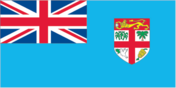
light blue with the flag of the UK in the upper hoist-side quadrant and the Fijian shield centered on the outer half of the flag; the shield depicts a yellow lion above a white field quartered by the cross of Saint George featuring stalks of sugarcane, a palm tree, bananas, and a white dove
Government type
- republic
- note
- military coup leader Maj. Gen. Sitiveni RABUKA formally declared Fiji a republic on 6 October 1987
Independence
10 October 1970 (from UK)
International organization participation
ACP, AsDB, C, CCC, CP, ESCAP, FAO, G-77, IBRD, ICAO, ICFTU, ICRM, IDA, IFAD, IFC, IFRCS, IHO, ILO, IMF, IMO, Intelsat, Interpol, IOC, ISO (subscriber), ITU, OPCW, PCA, Sparteca, SPC, SPF, UN, UNCTAD, UNESCO, UNIDO, UNIFIL, UNIKOM, UNMIBH, UNMIK, UPU, WFTU, WHO, WIPO, WMO, WToO, WTrO
Judicial branch
Supreme Court, judges are appointed by the president
Legal system
based on British system
Legislative branch
- bicameral Parliament consists of the Senate (32 seats; 14 appointed by the Great Council of Chiefs, nine appointed by the prime minister, eight appointed by the leader of the opposition, and one appointed by the council of Rotuma) and the House of Representatives (71 seats; 23 reserved for ethnic Fijians, 19 reserved for ethnic Indians, three reserved for other ethnic groups, one reserved for the Rotuman constituency encompassing the whole of Fiji, and 25 open; members serve five-year terms)
- election results
- House of Representatives - percent of vote by party - NA; seats by party - Fiji Labor Party 37, others 34
- elections
- House of Representatives - last held 11 May 1999 (next to be held NA May 2004)
National holiday
Independence Day, 10 October (1970)
Political parties and leaders
- Christian Fellowship Party (Veitokani ni Lewenivanua Vakarisito Party) or VLV (primarily Methodist Fijian) ; Conservative Party of Fiji or CPF ; Fiji Conservative Party or FCP ; Fiji Independent Labor (Muslim) ; Fiji Indian Congress Party ; Fiji Indian Liberal Party ; Fiji Labor Party or FLP [Mahendra CHAUDHRY]; Fijian Association Party or FAP ; Fijian Nationalist Party or FNP ; Fijian Political Party or SVT (primarily Fijian) ; Four Corners Party ; General Electors' Association ; General Voters Party or GVP ; National Federation Party or NFP (primarily Indian) ; National Unity Party [Apisai TORA]
- note
- in early 1995, ethnic Fijian members of the All National Congress or ANC merged with the Fijian Association or FA; the remaining members of the ANC have renamed their party the General Electors' Association
Suffrage
21 years of age; universal
Economy
Agriculture - products
sugarcane, coconuts, cassava (tapioca), rice, sweet potatoes, bananas; cattle, pigs, horses, goats; fish
Budget
- expenditures
- $742.65 million, including capital expenditures of $NA (1997 est.)
- revenues
- $540.65 million
Currency
1 Fijian dollar (F$) = 100 cents
Debt - external
$213 million (1997)
Economic aid - recipient
$40.3 million (1995)
Economy - overview
Fiji, endowed with forest, mineral, and fish resources, is one of the most developed of the Pacific island economies, though still with a large subsistence sector. Sugar exports and a growing tourist industry are the major sources of foreign exchange. Sugar processing makes up one-third of industrial activity. Roughly 300,000 tourists visit each year, including thousands of Americans following the start of regularly scheduled non-stop air service from Los Angeles. Fiji's growth slowed in 1997 because the sugar industry suffered from low world prices and rent disputes between farmers and landowners. Drought in 1998 further damaged the sugar industry, but its recovery in 1999 contributed to robust GDP growth. Long-term problems include low investment and uncertain property rights.
Electricity - consumption
512 million kWh (1998)
Electricity - exports
0 kWh (1998)
Electricity - imports
0 kWh (1998)
Electricity - production
550 million kWh (1998)
Electricity - production by source
- fossil fuel
- 20%
- hydro
- 80%
- nuclear
- 0%
- other
- 0% (1998)
Exchange rates
Fijian dollars (F$) per US$1 - 1.9654 (January 2000), 1.9696 (1999), 1.9868 (1998), 1.4437 (1997), 1.4033 (1996), 1.4063 (1995)
Exports
$393 million (f.o.b., 1998)
Exports - commodities
sugar 32%, clothing, gold, processed fish, lumber
Exports - partners
Australia 34%, UK 18%, other Pacific island countries 11%, US 11%, NZ 5%, Japan 5% (1997)
Fiscal year
calendar year
GDP
purchasing power parity - $5.9 billion (1999 est.)
GDP - composition by sector
- agriculture
- 16.5%
- industry
- 25.5%
- services
- 58% (1998 est.)
GDP - per capita
purchasing power parity - $7,300 (1999 est.)
GDP - real growth rate
7.8% (1999 est.)
Household income or consumption by percentage share
lowest 10%: NA% highest 10%: NA%
Imports
$612 million (f.o.b., 1998)
Imports - commodities
machinery and transport equipment, petroleum products, food, chemicals
Imports - partners
Australia 45%, NZ 15%, Japan 7%, US 5%, Singapore 4% (1997)
Industrial production growth rate
2.9% (1995)
Industries
tourism, sugar, clothing, copra, gold, silver, lumber, small cottage industries
Inflation rate (consumer prices)
0% (1999 est.)
Labor force
235,000
Labor force - by occupation
subsistence agriculture 67%, wage earners 18%, salary earners 15% (1987)
Population below poverty line
NA%
Unemployment rate
6% (1997 est.)
Communications
Internet Service Providers (ISPs)
2 (1999)
Radio broadcast stations
AM 13, FM 40, shortwave 0 (1998)
Radios
500,000 (1997)
Telephone system
- modern local, interisland, and international (wire/radio integrated) public and special-purpose telephone, telegraph, and teleprinter facilities; regional radio communications center
- domestic
- NA
- international
- access to important cable links between US and Canada as well as between NZ and Australia; satellite earth station - 1 Intelsat (Pacific Ocean)
Telephones - main lines in use
65,000 (1995)
Telephones - mobile cellular
4,300 (1998)
Television broadcast stations
NA
Televisions
21,000 (1997)
Transportation
Airports
25 (1999 est.)
Airports - with paved runways
- total
- 3 over 3,047 m: 1 1,524 to 2,437 m: 1 914 to 1,523 m: 1 (1999 est.)
Airports - with unpaved runways
- total
- 22 914 to 1,523 m: 5 under 914 m: 17 (1999 est.)
Highways
- paved
- 1,692 km
- total
- 3,440 km
- unpaved
- 1,748 km (1996 est.)
Merchant marine
- ships by type
- chemical tanker 2, passenger 1, petroleum tanker 1, roll-on/roll-off 1, specialized tanker 1 (1999 est.)
- total
- 6 ships (1,000 GRT or over) totaling 11,870 GRT/14,787 DWT
Ports and harbors
Labasa, Lautoka, Levuka, Savusavu, Suva
Railways
- narrow gauge
- 597 km 0.610-m gauge (1995)
- total
- 597 km; note - belongs to the government-owned Fiji Sugar Corporation
Waterways
203 km; 122 km navigable by motorized craft and 200-metric-ton barges
Military and Security
Military branches
Republic of Fiji Military Forces (RFMF; includes ground and naval forces)
Military expenditures - dollar figure
$24 million (FY98)
Military expenditures - percent of GDP
1.1% (FY98)
Military manpower - availability
males age 15-49: 223,496 (2000 est.)
Military manpower - fit for military service
males age 15-49: 123,051 (2000 est.)
Military manpower - military age
18 years of age
Military manpower - reaching military age annually
- males
- 9,426 (2000 est.)
Transnational Issues
Disputes - international
- none
- FINLAND