2010 Edition
CIA World Factbook 2010 (Project Gutenberg)
Introduction
Background
Following the two devastating World Wars in the first half of the 20th century, a number of European leaders in the late 1940s became convinced that the only way to establish a lasting peace was to unite the two chief belligerent nations - France and Germany - both economically and politically. In 1950, the French Foreign Minister Robert SCHUMAN proposed an eventual union of all Europe, the first step of which would be the integration of the coal and steel industries of Western Europe. The following year the European Coal and Steel Community (ECSC) was set up when six members, Belgium, France, West Germany, Italy, Luxembourg, and the Netherlands, signed the Treaty of Paris. The ECSC was so successful that within a few years the decision was made to integrate other parts of the countries' economies. In 1957, the Treaties of Rome created the European Economic Community (EEC) and the European Atomic Energy Community (Euratom), and the six member states undertook to eliminate trade barriers among themselves by forming a common market. In 1967, the institutions of all three communities were formally merged into the European Community (EC), creating a single Commission, a single Council of Ministers, and the European Parliament. Members of the European Parliament were initially selected by national parliaments, but in 1979 the first direct elections were undertaken and they have been held every five years since. In 1973, the first enlargement of the EC took place with the addition of Denmark, Ireland, and the United Kingdom. The 1980s saw further membership expansion with Greece joining in 1981 and Spain and Portugal in 1986. The 1992 Treaty of Maastricht laid the basis for further forms of cooperation in foreign and defense policy, in judicial and internal affairs, and in the creation of an economic and monetary union - including a common currency. This further integration created the European Union (EU). In 1995, Austria, Finland, and Sweden joined the EU, raising the membership total to 15. A new currency, the euro, was launched in world money markets on 1 January 1999; it became the unit of exchange for all of the EU states except the United Kingdom, Sweden, and Denmark. In 2002, citizens of the 12 euro-area countries (the European Monetary Union or EMU) began using the euro banknotes and coins. Ten new countries joined the EU in 2004 - Cyprus, the Czech Republic, Estonia, Hungary, Latvia, Lithuania, Malta, Poland, Slovakia, and Slovenia - and in 2007 Bulgaria and Romania joined, bringing the current membership to 27. In order to ensure that the EU can continue to function efficiently with an expanded membership, the Treaty of Nice (in force as of 1 February 2003) set forth rules streamlining the size and procedures of EU institutions. An effort to establish an EU constitution, begun in October 2004, failed to attain unanimous ratification. A new effort, undertaken in June 2007, created an Intergovernmental Conference to formulate a political agreement - initially known as the Reform Treaty but subsequently referred to as the Treaty of Lisbon - which would serve as a constitution. Unlike the constitution, however, the Treaty of Lisbon sought to amend existing treaties rather than replace them. In October 2009, an Irish referendum approved the Treaty (overturning a previous rejection) and cleared the way for an ultimate unanimous endorsement - the Czech Republic signed on soon after. Treaty implementation began on 1 December 2009. In 2010, the prospect of a Greek default on its euro-denominated debt created severe strains within the EMU and raised the question of whether a member country might be removed.
Preliminary statement
- The evolution of the European Union (EU) from a regional economic agreement among six neighboring states in 1951 to today's supranational organization of 27 countries across the European continent stands as an unprecedented phenomenon in the annals of history. Dynastic unions for territorial consolidation were long the norm in Europe. On a few occasions even country-level unions were arranged - the Polish-Lithuanian Commonwealth and the Austro-Hungarian Empire were examples - but for such a large number of nation-states to cede some of their sovereignty to an overarching entity is truly unique. Although the EU is not a federation in the strict sense, it is far more than a free-trade association such as ASEAN, NAFTA, or Mercosur, and it has many of the attributes associated with
- independent nations
- its own flag, anthem, founding date, and currency, as well as an incipient common foreign and security policy in its dealings with other nations. In the future, many of these nation-like characteristics are likely to be expanded. Thus, inclusion of basic intelligence on the EU has been deemed appropriate as a new, separate entity in The World Factbook. However, because of the EU's special status, this description is placed after the regular country entries.
Geography
Area
- total
- 4,324,782 sq km
Area - comparative
less than one-half the size of the US
Climate
cold temperate; potentially subarctic in the north to temperate; mild wet winters; hot dry summers in the south
Coastline
65,992.9 km
Elevation extremes
- highest point
- Mont Blanc 4,807 m; note - situated on the border between France and Italy
- lowest point
- Lammefjord, Denmark -7 m; Zuidplaspolder, Netherlands -7 m
Environment - current issues
NA
Environment - international agreements
- party to
- Air Pollution, Air Pollution-Nitrogen Oxides, Air Pollution-Persistent Organic Pollutants, Air Pollution-Sulphur 94, Antarctic-Marine Living Resources, Biodiversity, Climate Change, Climate Change-Kyoto Protocol, Desertification, Hazardous Wastes, Law of the Sea, Ozone Layer Protection, Tropical Timber 83, Tropical Timber 94
- signed but not ratified
- Air Pollution-Volatile Organic Compounds
Irrigated land
168,050 sq km (2003 est.)
Land boundaries
- border countries
- Albania 282 km, Andorra 120.3 km, Belarus 1,050 km, Croatia 999 km, Holy See 3.2 km, Liechtenstein 34.9 km, Macedonia 394 km, Moldova 450 km, Monaco 4.4 km, Norway 2,348 km, Russia 2,257 km, San Marino 39 km, Serbia 945 km, Switzerland 1,811 km, Turkey 446 km, Ukraine 1,257 km note: data for European Continent only
- total
- 12,440.8 km
Land use
- arable land
- NA
- other
- NA
- permanent crops
- NA
Location
Europe between the North Atlantic Ocean in the west and Russia, Belarus, and Ukraine to the east
Map references
Europe
Maritime claims
NA
Natural hazards
flooding along coasts; avalanches in mountainous area; earthquakes in the south; volcanic eruptions in Italy; periodic droughts in Spain; ice floes in the Baltic
Natural resources
iron ore, natural gas, petroleum, coal, copper, lead, zinc, bauxite, uranium, potash, salt, hydropower, arable land, timber, fish
Terrain
fairly flat along the Baltic and Atlantic coast; mountainous in the central and southern areas
People and Society
Age structure
0-14 years: 15.44% (male 38,992,677/female 36,940,450) 15-64 years: 67.23% (male 166,412,403/female 164,295,636) 65 years and over: 17.33% (male 35,376,333/female 49,853,361) (2009 est.)
Birth rate
9.83 births/1,000 population (2010 est.)
Death rate
10.33 deaths/1,000 population (July 2010 est.)
HIV/AIDS - adult prevalence rate
note - see individual country entries of member states
HIV/AIDS - deaths
note - see individual country entries of member states
HIV/AIDS - people living with HIV/AIDS
note - see individual country entries of member states
Infant mortality rate
- female
- 4.93 deaths/1,000 live births (2010 est.)
- male
- 6.26 deaths/1,000 live births
- total
- 5.61 deaths/1,000 live births
Languages
Bulgarian, Czech, Danish, Dutch, English, Estonian, Finnish, French, Gaelic, German, Greek, Hungarian, Italian, Latvian, Lithuanian, Maltese, Polish, Portuguese, Romanian, Slovak, Slovene, Spanish, Swedish note: only official languages are listed; German, the major language of Germany, Austria, and Switzerland, is the most widely spoken mother tongue - over 19% of the EU population; English is the most widely spoken language - about 49% of the EU population is conversant with it (2007)
Life expectancy at birth
- female
- 82.13 years (2010 est.)
- male
- 75.7 years
- total population
- 78.82 years
Median age
note - see individual country entries of member states (2009 est.)
Net migration rate
1.48 migrant(s)/1,000 population (2010 est.)
Population
492,387,344 (July 2010 est.)
Population growth rate
0.098 % (2010 est.)
Religions
Roman Catholic, Protestant, Orthodox, Muslim, Jewish
Sex ratio
- at birth
- 1.06 male(s)/female under 15 years: 1.06 male(s)/female 15-64 years: 1 male(s)/female 65 years and over: 0.68 male(s)/female
- total population
- 0.92 male(s)/female (2009 est.)
Total fertility rate
1.51 children born/woman (2010 est.)
Government
Capital
- daylight saving time
- +1hr, begins last Sunday in March; ends last Sunday in October note: the Council of the European Union meets in Brussels, Belgium; the European Parliament meets in Brussels and Strasbourg, France; the Court of Justice of the European Communities meets in Luxembourg
- geographic coordinates
- 50 50 N, 4 20 E
- name
- Brussels (Belgium), Strasbourg (France), Luxembourg
- time difference
- UTC+1 (6 hours ahead of Washington, DC during Standard Time)
Constitution
none note: based on a series of treaties: the Treaty of Paris, which set up the European Coal and Steel Community (ECSC) in 1951; the Treaties of Rome, which set up the European Economic Community (EEC) and the European Atomic Energy Community (Euratom) in 1957; the Single European Act in 1986; the Treaty on European Union (Maastricht) in 1992; the Treaty of Amsterdam in 1997; and the Treaty of Nice in 2003; note - a new draft Constitutional Treaty, signed on 29 October 2004 in Rome, gave member states two years for ratification either by parliamentary vote or national referendum before it was scheduled to take effect on 1 November 2006; defeat in French and Dutch referenda in May-June 2005 dealt a severe setback to the ratification process; in June 2007, the European Council agreed on a clear and concise mandate for an Intergovernmental Conference to form a political agreement and put it into legal form; this agreement, known as the Reform Treaty, would have served as a constitution and was presented to the European Council in October 2007 for individual country ratification; it was rejected by Irish voters in June 2008, again stalling the ratification process; the Reform Treaty, more recently known as the Treaty of Lisbon, was again circulated for ratification, and by November 2009 was approved by all 27 countries; it came into effect on 1 December 2009
Diplomatic representation from the US
- chief of mission
- Ambassador (vacant); Charge d'Affaires Christopher MURRAY
- embassy
- 13 Zinnerstraat/Rue Zinner, B-1000 Brussels
- FAX
- [32] (2) 508-2063
- mailing address
- same as above
- telephone
- [32] (2) 508-2111
Diplomatic representation in the US
- chancery
- 2300 M Street, NW, Washington, DC 20037
- chief of mission
- Ambassador Joao P. Castanheira do VALE DE ALMEIDA
- FAX
- [1] (202) 429-1766
- telephone
- [1] (202) 862-9500
Executive branch
- cabinet
- European Commission (composed of 27 members, one from each member country; each commissioner responsible for one or more policy areas) (For more information visit the World Leaders website )
- chief of union
- President of the European Commission Jose Manuel BARROSO (since 2004)
- elections
- the president of the European Commission designated by member governments and confirmed by the European Parliament; working from member state recommendations, the Commission president then assembles a "college" of Commission members; the European Parliament confirms the entire Commission for a five-year term; the next confirmation process will likely be held in January 2015 note: the European Council brings together heads of state and government and the president of the European Commission and meets at least four times a year; its aim is to provide the impetus for the major political issues relating to European integration and to issue general policy guidelines; leaders of the EU member states appointed then Belgian Prime Minister Herman VAN ROMPUY to be the first full-time president of the European Council in November 2009; he took office on 1 December 2009 and will serve a two-and-one-half-year term, renewable once; his core responsibilities include chairing the four summits each year and providing continuity beyond the rotating, six-month presidencies of the Council of the EU
Flag description
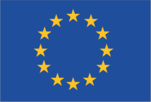
a blue field with 12 five-pointed gold stars arranged in a circle in the center; blue represents the sky of the Western world, the stars are the peoples of Europe in a circle, a symbol of unity; the number of stars is fixed
Independence
7 February 1992 (Maastricht Treaty signed establishing the EU); 1 November 1993 (Maastricht Treaty entered into force)
International organization participation
- European Central Bank
- BIS
- European Commission
- Australian Group, CBSS, CERN, EBRD, FATF, G-10, IEA, LAIA WTO, ZC (observer)
- European Investment Bank
- EBRD
- European Union
- ARF (dialogue member), ASEAN (dialogue member), FAO, G-8, G-20, IDA, OAS (observer), PIF (partner), SAARC (observer), UN (observer), WTO
Judicial branch
Court of Justice of the European Communities (ensures that the treaties are interpreted and applied uniformly throughout the EU; resolve constitutional issues among the EU institutions) - 27 justices (one from each member state) appointed for a six-year term; note - for the sake of efficiency, the court can sit with 13 justices known as the "Grand Chamber"; Court of First Instance - 27 justices appointed for a six-year term
Legal system
comparable to the legal systems of member states; first supranational law system
Legislative branch
- two legislative bodies consisting of the Council of the European Union (27 member-state ministers having 345 votes; the number of votes is roughly proportional to member-states' population) and the European Parliament (736 seats; seats allocated among member states in proportion to population; members elected by direct universal suffrage for a five-year term); note - the Council is the main decision-making body of the EU; leaders of the EU member states appointed UK Baroness Catherine Ashton to be the first High Representative of the Union for Foreign Affairs and Security Policy; Ashton took office on 1 December 2009; her concurrent appointment as Vice President of the European Commission - both of which are subject to confirmation by the European Parliament - endows her position with the policymaking influence of the Council of the EU and the budgetary influence of the European Commission
- election results
- percent of vote - EPP 36%, S&D 25%, ALDE 11.4%, Greens/EFA 7.5%, ECR 7.3%, GUE/NGL 4.8%, EFD 4.3%, independents 3.7%; seats by party - EPP 265, S&D 184, ALDE 84, Greens/EFA 55, ECR 54, GUE/NGL 35, EFD 32, independents 27
- elections
- last held on 4-7 June 2009 (next to be held in June 2014)
Member states
- 27 countries: Austria, Belgium, Bulgaria, Cyprus, Czech Republic, Denmark, Estonia, Finland, France, Germany, Greece, Hungary, Ireland, Italy, Latvia, Lithuania, Luxembourg, Malta, Netherlands, Poland, Portugal, Romania, Slovakia, Slovenia, Spain, Sweden, UK;
- note - candidate countries
- Croatia, Iceland, Macedonia, Montenegro, Turkey
National anthem
- lyrics/music
- none/Ludwig VON BEETHOVEN, arranged by Herbert VON KARAJAN note: adopted 1972, not in use until 1986; according to the European Union, the song is meant to represent all of Europe rather than just the organization; the song also serves as the anthem for the Council of Europe
- name
- "Ode to Joy""
National holiday
Europe Day 9 May (1950); note - a Union-wide holiday, the day that Robert SCHUMAN proposed the creation of the European Coal and Steel Community to achieve an organized Europe
Political parties and leaders
Confederal Group of the European United Left-Nordic Green Left or GUE/NGL [Lothar BISKY]; Europe of Freedom and Democracy Group or EFD [Nigel FARAGE and Francesco SPERONI]; European Conservatives and Reformists Group or ECR [Michael KAMINSKI]; Group of Greens/European Free Alliance or Greens/EFA [Rebecca HARMS and Daniel COHN-BENDIT]; Group of the Alliance of Liberals and Democrats for Europe or ALDE [Guy VERHOFSTADT]; Group of the European People's Party or EPP [Joseph DAUL]; Group of the Progressive Alliance of Socialists and Democrats in the European Parliament or S&D [Martin SCHULZ]
Political structure
a hybrid intergovernmental and supranational organization
Suffrage
18 years of age; universal
Union name
- abbreviation
- EU
- conventional long form
- European Union
Economy
Agriculture - products
wheat, barley, oilseeds, sugar beets, wine, grapes; dairy products, cattle, sheep, pigs, poultry; fish
Central bank discount rate
1.75% (31 December 2009) 3% (31 December 2008) note: this is the European Central Bank's rate on the marginal lending facility, which offers overnight credit to banks in the euro area
Commercial bank prime lending rate
7.52% (31 December 2009 est.) 8.58% (31 December 2008 est.)
Current account balance
$NA (2009) $51.4 billion (2009 est.)
Debt - external
$13.72 trillion (30 June 2010); This is the external debt for the euro area only; it excludes the external debt of the non-euro-area members of the EU
Distribution of family income - Gini index
31 (2005 est.) 31.2 (1996 est.)
Economy - overview
Internally, the EU has abolished trade barriers, adopted a common currency, and is striving toward convergence of living standards. Internationally, the EU aims to bolster Europe's trade position and its political and economic power. Because of the great differences in per capita income among member states (from $7,000 to $78,000) and in national attitudes toward issues like inflation, debt, and foreign trade, the EU faces difficulties in devising and enforcing common policies. In the wake of the global economic crisis, the European Commission projected that the EU's economy would shrink by 4% in 2009 and 0.1% in 2010. The EU has recovered from the crisis faster than expected, however, and the Commission estimates 2010 growth at 1.8%. Significant risks to growth nevertheless remain, including, high official debts and deficits, aging populations, over-regulation of non-financial businesses, and doubts about the sustainability of European Economic and Monetary Union (EMU). In June 2010, prompted by the Greek financial crisis, the EU and the IMF set up a $1 trillion bailout fund to rescue any EMU member in danger of default, but it has not calmed market jitters that have diminished the value of the euro. Eleven established EU member states introduced the euro as their common currency on 1 January 1999 (Greece did so two years later), but the UK and Denmark have 'opt-outs' that allow them to keep their national currencies, and Sweden has not taken the steps needed to participate. Between 2004 and 2007, the EU admitted 12 countries that are, in general, less advanced economically than the other 15. Of the 12 most recent member states, only Slovenia (1 January 2007), Cyprus and Malta (1 January 2008), Slovakia (1 January 2009), and Estonia (1 January 2011) have adopted the euro; the remaining states other than the UK and Denmark are legally required to adopt the currency upon meeting EU's fiscal and monetary convergence criteria.
Electricity - consumption
2.906 trillion kWh (2007 est.)
Electricity - exports
NA kWh
Electricity - imports
NA kWh
Electricity - production
3.08 trillion kWh (2007 est.)
Exchange rates
euros per US dollar - 0.7715 (2010), 0.7338 (2009), 0.6827 (2008), 0.7345 (2007), 0.7964 (2006)
Exports
$1.952 trillion (2007) $1.33 trillion (2005) note: external exports, excluding intra-EU trade
Exports - commodities
machinery, motor vehicles, aircraft, plastics, pharmaceuticals and other chemicals, fuels, iron and steel, nonferrous metals, wood pulp and paper products, textiles, meat, dairy products, fish, alcoholic beverages.
GDP - composition by sector
- agriculture
- 1.8%
- industry
- 25.2%
- services
- 72.9% (2010 est.)
GDP - per capita (PPP)
$32,900 (2010 est.) $32,400 (2009 est.) $33,900 (2008 est.) note: data are in 2010 US dollars
GDP - real growth rate
1.7% (2010 est.) -4% (2009 est.) 0.6% (2008 est.)
GDP (official exchange rate)
$15.9 trillion (2010 est.)
GDP (purchasing power parity)
$14.89 trillion (2010 est.) $14.64 trillion (2009 est.) $15.27 trillion (2008 est.) note: data are in 2010 US dollars
Household income or consumption by percentage share
lowest 10%: 2.9% highest 10%: 25.6% (2002 est.)
Imports
$1.69 trillion (2007) $1.466 trillion (2005) note: external imports, excluding intra-EU trade
Imports - commodities
machinery, vehicles, aircraft, plastics, crude oil, chemicals, textiles, metals, foodstuffs, clothing
Industrial production growth rate
3.8% (2010 est.)
Industries
- among the world's largest and most technologically advanced, the EU
- industrial base includes
- ferrous and non-ferrous metal production and processing, metal products, petroleum, coal, cement, chemicals, pharmaceuticals, aerospace, rail transportation equipment, passenger and commercial vehicles, construction equipment, industrial equipment, shipbuilding, electrical power equipment, machine tools and automated manufacturing systems, electronics and telecommunications equipment, fishing, food and beverage processing, furniture, paper, textiles, tourism
Inflation rate (consumer prices)
1.7% (2010 est.) 1.8% (2009 est.)
Investment (gross fixed)
18.6% of GDP (2010 est.)
Labor force
225.2 million (2010 est.)
Labor force - by occupation
- agriculture
- 5.6%
- industry
- 27.7%
- services
- 66.7% (2007 est.)
Market value of publicly traded shares
$NA (31 December 2009 est.) $7.564 trillion (31 December 2008) $15.57 trillion (31 December 2007 est.)
Natural gas - consumption
489.4 billion cu m (2009 est.)
Natural gas - exports
NA cu m
Natural gas - imports
NA cu m
Natural gas - production
181.6 billion cu m (2009 est.)
Natural gas - proved reserves
2.242 trillion cu m (1 January 2010 est.)
Oil - consumption
13.68 million bbl/day (2009 est.)
Oil - exports
2.196 million bbl/day (2008 est.)
Oil - imports
8.613 million bbl/day (2008 est.)
Oil - production
2.383 million bbl/day (2009 est.)
Oil - proved reserves
5.414 billion bbl (1 January 2010 est.)
Population below poverty line
note - see individual country entries of member states
Reserves of foreign exchange and gold
$NA
Stock of broad money
$11.17 trillion (31 December 2008 est.) $10.83 trillion (31 December 2007 est.) note: this is the quantity of quasi money, M2-M1, for the euro area, converted into US dollars at the exchange rate for the date indicated; it excludes the stock of quasi money carried by non-euro-area members of the European Union
Stock of direct foreign investment - at home
$NA
Stock of domestic credit
$22.65 trillion (31 December 2009 est.) $21.24 trillion (31 December 2008 est.) note: this figure refers to the euro area only; it excludes credit data for non-euro-area members of the EU
Stock of narrow money
$5.542 trillion (31 December 2008) $5.649 trillion (31 December 2007) note: this is the quantity of money, M1, for the euro area, converted into US dollars at the exchange rate for the date indicated; it excludes the stock of money carried by non-euro-area members of the European Union
Unemployment rate
9.5% (2010 est.) 9% (2009 est.)
Communications
Internet country code
.eu; note - see country entries of member states for individual country codes
Internet hosts
140,277; note - this sum reflects the number of internet hosts assigned the .eu internet country code (2010)
Internet users
247 million (2006)
Telephone system
note - see individual country entries of member states
Telephones - main lines in use
238 million (2005)
Telephones - mobile cellular
466 million (2005)
Transportation
Airports
3,383 (2010)
Airports - with paved runways
- total
- 1,992 over 3,047 m: 116 2,438 to 3,047 m: 340 1,524 to 2,437 m: 546 914 to 1,523 m: 422 under 914 m: 568 (2010)
Airports - with unpaved runways
- total
- 1,391 over 3,047 m: 2 2,438 to 3,047 m: 1 1,524 to 2,437 m: 22 914 to 1,523 m: 254 under 914 m: 1,112 (2010)
Heliports
99 (2010)
Ports and terminals
Antwerp (Belgium), Barcelona (Spain), Braila (Romania), Bremen (Germany), Burgas (Bulgaria), Constanta (Romania), Copenhagen (Denmark), Galati (Romania), Gdansk (Poland), Hamburg (Germany), Helsinki (Finland), Las Palmas (Canary Islands, Spain), Le Havre (France), Lisbon (Portugal), London (UK), Marseille (France), Naples (Italy), Peiraiefs or Piraeus (Greece), Riga (Latvia), Rotterdam (Netherlands), Stockholm (Sweden), Talinn (Estonia), Tulcea (Romania), Varna (Bulgaria)
Railways
- total
- 229,450 km (2008)
Roadways
- total
- 5,919,704 km (2008)
Waterways
52,332 km (2006)
Military and Security
Military - note
the five-nation Eurocorps - created in 1992 by France, Germany, Belgium, Spain, and Luxembourg - has deployed troops and police on peacekeeping missions to Bosnia-Herzegovina, Macedonia, and the Democratic Republic of the Congo and assumed command of the ISAF in Afghanistan in August 2004; Eurocorps directly commands the 5,000-man Franco-German Brigade, the Multinational Command Support Brigade, and EUFOR in Bosnia and Herzegovina; in November 2004, the EU Council of Ministers formally committed to creating 13 1,500-man battle groups by the end of 2007, to respond to international crises on a rotating basis; 22 of the EU's 27 nations have agreed to supply troops; France, Italy, and the UK formed the first of three battle groups in 2005; Norway, Sweden, Estonia, and Finland established the Nordic Battle Group effective 1 January 2008; nine other groups are to be formed; a rapid-reaction naval EU Maritime Task Group was stood up in March 2007 (2007)
Transnational Issues
Disputes - international
as a political union, the EU has no border disputes with neighboring countries, but Estonia has no land boundary agreements with Russia, Slovenia disputes its land and maritime boundaries with Croatia, and Spain has territorial and maritime disputes with Morocco and with the UK over Gibraltar; the EU has set up a Schengen area - consisting of 22 EU member states that have signed the convention implementing the Schengen agreements or "acquis" (1985 and 1990) on the free movement of persons and the harmonization of border controls in Europe; these agreements became incorporated into EU law with the implementation of the 1997 Treaty of Amsterdam on 1 May 1999; in addition, non-EU states Iceland and Norway (as part of the Nordic Union) have been included in the Schengen area since 1996 (full members in 2001), and Switzerland since 2008 bringing the total current membership to 25; the UK (since 2000) and Ireland (since 2002) take part in only some aspects of the Schengen area, especially with respect to police and criminal matters; nine of the 12 new member states that joined the EU since 2004 joined Schengen on 21 December 2007; of the three remaining EU states, Cyprus is expected to join by 2009, while Romania and Bulgaria continue to enhance their border security systems page last updated on January 20, 2011 ======================================================================