1999 Edition
CIA World Factbook 1999 (Internet Archive)
Introduction
Background
On 28 May 1991 the Ethiopian People's Revolutionary Democratic Front (EPRDF) toppled the authoritarian government of MENGISTU Haile-Mariam and took control in Addis Ababa. A new constitution was promulgated in December 1994 and national and regional popular elections were held in May and June 1995.
Geography
Area
total: 1,127,127 sq km land: 1,119,683 sq km water: 7,444 sq km
Area--comparative
slightly less than twice the size of Texas
Climate
tropical monsoon with wide topographic-induced variation
Coastline
0 km (landlocked)
Elevation extremes
lowest point: Denakil -125 m highest point: Ras Dashen Terara 4,620 m
Environment--current issues
deforestation; overgrazing; soil erosion; desertification
Environment--international agreements
party to: Biodiversity, Climate Change, Desertification, Endangered Species, Ozone Layer Protection signed, but not ratified: Environmental Modification, Law of the Sea, Nuclear Test Ban
Geographic coordinates
8 00 N, 38 00 E
Geography--note
landlocked?entire coastline along the Red Sea was lost with the de jure independence of Eritrea on 24 May 1993
Irrigated land
1,900 sq km (1993 est.)
Land boundaries
total: 5,311 km border countries: Djibouti 337 km, Eritrea 912 km, Kenya 830 km, Somalia 1,626 km, Sudan 1,606 km
Land use
arable land: 12% permanent crops: 1% permanent pastures: 40% forests and woodland: 25% other: 22% (1993 est.)
Location
Eastern Africa, west of Somalia
Map references
Africa
Maritime claims
none (landlocked)
Natural hazards
geologically active Great Rift Valley susceptible to earthquakes, volcanic eruptions; frequent droughts
Natural resources
small reserves of gold, platinum, copper, potash, natural gas
Terrain
high plateau with central mountain range divided by Great Rift Valley
People and Society
Age structure
0-14 years: 46% (male 13,787,810; female 13,703,546) 15-64 years: 51% (male 15,398,123; female 15,141,892) 65 years and over: 3% (male 745,737; female 903,275) (1999 est.)
Birth rate
44.34 births/1,000 population (1999 est.)
Death rate
21.43 deaths/1,000 population (1999 est.)
Ethnic groups
Oromo 40%, Amhara and Tigrean 32%, Sidamo 9%, Shankella 6%, Somali 6%, Afar 4%, Gurage 2%, other 1%
Infant mortality rate
124.57 deaths/1,000 live births (1999 est.)
Languages
Amharic, Tigrinya, Orominga, Guaraginga, Somali, Arabic, English (major foreign language taught in schools)
Life expectancy at birth
total population: 40.46 years male: 39.22 years female: 41.73 years (1999 est.)
Literacy
definition: age 15 and over can read and write total population: 35.5% male: 45.5% female: 25.3% (1995 est.)
Nationality
noun: Ethiopian(s) adjective: Ethiopian
Net migration rate
-1.3 migrant(s)/1,000 population (1999 est.) note: repatriation of Ethiopians who fled to Sudan, Kenya, and Somalia for refuge from war and famine in earlier years, is expected to continue slowly in 1998; small numbers of Sudanese and Somali refugees, who fled to Ethiopia from the fighting in their own countries, began returning to their homes in 1998
Population
59,680,383 (July 1999 est.)
Population growth rate
2.16% (1999 est.)
Religions
Muslim 45%-50%, Ethiopian Orthodox 35%-40%, animist 12%, other 3%-8%
Sex ratio
at birth: 1.03 male(s)/female under 15 years: 1.01 male(s)/female 15-64 years: 1.02 male(s)/female 65 years and over: 0.83 male(s)/female total population: 1.01 male(s)/female (1999 est.)
Total fertility rate
6.81 children born/woman (1999 est.)
Government
Administrative divisions
9 states and 2 chartered cities*: Addis Ababa*; Afar; Amhara; Benshangul/Gumuz (Benishangul-Gumaz); Dire Dawa*; Gambela (Gambella); Harari (Harar); Oromia (Oromiya); Somalia (Somali); Southern Nations, Nationalities, and Peoples (SNNP); Tigray (Tigre)
Capital
Addis Ababa
Constitution
promulgated December 1994
Country name
conventional long form: Federal Democratic Republic of Ethiopia conventional short form: Ethiopia local long form: YeItyop'iya Federalawi Demokrasiyawi Ripeblik local short form: YeItyop'iya abbreviation: FDRE
Data code
ET
Executive branch
chief of state: President NEGASSO Gidada (since 22 August 1995) head of government: Prime Minister MELES Zenawi (since August 1995) cabinet: Council of Ministers as provided in the December 1994 constitution; ministers are selected by the prime minister and approved by the House of People's Representatives elections: president elected by the House of People's Representatives for a six-year term; election last held June 1995 (next to be held NA 2001); prime minister designated by the party in power following legislative elections election results: NEGASSO Gidada elected president; percent of vote by the House of People's Representatives--NA
Flag description
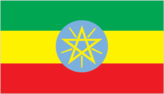
three equal horizontal bands of green (top), yellow, and red with a yellow pentagram and single yellow rays emanating from the angles between the points on a light blue disk centered on the three bands; Ethiopia is the oldest independent country in Africa, and the colors of her flag were so often adopted by other African countries upon independence that they became known as the pan-African colors
Government type
federal republic
Independence
oldest independent country in Africa and one of the oldest in the world--at least 2,000 years
International organization participation
ACP, AfDB, CCC, ECA, FAO, G-24, G-77, IAEA, IBRD, ICAO, ICRM, IDA, IFAD, IFC, IFRCS, IGAD, ILO, IMF, IMO, Intelsat, Interpol, IOC, ISO, ITU, NAM, OAU, OPCW, UN, UNCTAD, UNESCO, UNHCR, UNIDO, UNU, UPU, WFTU, WHO, WIPO, WMO, WToO Diplomatic representation in the US: chief of mission: Ambassador BERHANE Gebre-Christos chancery: 2134 Kalorama Road NW, Washington, DC 20008 Diplomatic representation from the US: chief of mission: Ambassador David H. SHINN embassy: Entoto Street, Addis Ababa mailing address: P. O. Box 1014, Addis Ababa
Judicial branch
Federal Supreme Court; the president and vice president of the Federal Supreme Court are recommended by the prime minister and appointed by the House of People's Representatives; for other federal judges, the prime minister submits candidates selected by the Federal Judicial Administrative Council to the House of People's Representatives for appointment Political parties and leaders: Ethiopian People's Revolutionary Political pressure groups and leaders: Oromo Liberation Front or OLF; All Amhara People's Organization; Southern Ethiopia People's Democratic Coalition; numerous small, ethnically-based groups have formed since former President MENGISTU'S defeat, including several Islamic militant groups
Legal system
currently transitional mix of national and regional courts
Legislative branch
bicameral Parliament consists of the House of Federation or upper chamber (117 seats; members are chosen by state assemblies to serve five-year terms) and the House of People's Representatives or lower chamber (548 seats; members are directly elected by popular vote from single-member districts to serve five-year terms) elections: regional and national popular elections were held in May and June 1995 (next to be held NA 2000) election results: percent of vote--NA; seats--NA; note--EPRDF won nearly all seats
National holiday
National Day, 28 May (1991) (defeat of MENGISTU regime)
Suffrage
18 years of age; universal
Economy
Agriculture--products
cereals, pulses, coffee, oilseed, sugarcane, potatoes; hides, cattle, sheep, goats
Budget
revenues: $1 billion expenditures: $1.48 billion, including capital expenditures of $415 million (FY96/97)
Currency
1 birr (Br) = 100 cents
Debt--external
$10 billion (1996)
Economic aid--recipient
$367 million (FY95/96)
Economy--overview
Ethiopia remains one of the least developed countries in the world. Its economy is based on agriculture, which accounts for more than half of GDP, 90% of exports, and 80% of total employment; coffee generates 60% of export earnings. The agricultural sector suffers from frequent periods of drought, poor cultivation practices, and deterioration of internal security conditions. The manufacturing sector is heavily dependent on inputs from the agricultural sector. Over 90% of large-scale industry, but less than 10% of agriculture, is state-run. The government is considering selling off a portion of state-owned plants and is implementing reform measures that are gradually liberalizing the economy. A major medium-term problem is the improvement of roads, water supply, and other parts of an infrastructure badly neglected during years of civil strife. Renewed fighting with Eritrea dims economic prospects for 1999.
Electricity--consumption
1.32 billion kWh (1996)
Electricity--exports
0 kWh (1996)
Electricity--imports
0 kWh (1996)
Electricity--production
1.32 billion kWh (1996)
Electricity--production by source
fossil fuel: 7.58% hydro: 87.12% nuclear: 0% other: 5.3% (1996)
Exchange rates
birr (Br) per US$1 (end of period)--7.58 (January 1999), 6.8640 (1997), 6.4260 (1996), 6.3200 (1995), 5.9500 (1994) note: since May 1993, the birr market rate has been determined in an interbank market supported by weekly wholesale auction; prior to that date, the official rate was pegged to US$1 = 5.000 birr
Exports
$550 million (f.o.b., 1998)
Exports--commodities
coffee, leather products, gold, oilseeds (1995)
Exports--partners
Germany 26%, Japan 11%, Italy 10%, UK 8%, Djibouti, Saudi Arabia (1996 est.)
Fiscal year
8 July--7 July
GDP
purchasing power parity--$32.9 billion (1998 est.)
GDP--composition by sector
agriculture: 55% industry: 12% services: 33% (1995 est.)
GDP--per capita
purchasing power parity?$560 (1998 est.)
GDP--real growth rate
6% (1998 est.)
Household income or consumption by percentage share
lowest 10%: NA% highest 10%: NA%
Imports
$1.3 billion (f.o.b., 1998 est.)
Imports--commodities
food and live animals, petroleum and petroleum products, chemicals, machinery, motor vehicles and aircraft (1994)
Imports--partners
Italy 11%, US 11%, Germany 7%, Saudi Arabia 4% (1996 est.)
Industrial production growth rate
NA%
Industries
food processing, beverages, textiles, chemicals, metals processing, cement
Inflation rate (consumer prices)
3.9% (1998 est.)
Labor force
NA
Labor force--by occupation
agriculture and animal husbandry 80%, government and services 12%, industry and construction 8% (1985)
Population below poverty line
NA%
Unemployment rate
NA%
Communications
Radio broadcast stations
AM 5, FM 0, shortwave 1
Radios
9 million (1998 est.)
Telephone system
open wire and microwave radio relay system adequate for government use domestic: open wire and microwave radio relay international: open wire to Sudan and Djibouti; microwave radio relay to Kenya and Djibouti; satellite earth stations--3 Intelsat (1 Atlantic Ocean and 2 Pacific Ocean)
Telephones
100,000 (1983 est.)
Television broadcast stations
25 (1998)
Televisions
150,000 (1998 est.)
Transportation
Airports
84 (1998 est.) Airports--with paved runways: total: 11 over 3,047 m: 3 2,438 to 3,047 m: 5 1,524 to 2,437 m: 2 914 to 1,523 m: 1 (1998 est.) Airports--with unpaved runways: total: 73 over 3,047 m: 2 2,438 to 3,047 m: 8 1,524 to 2,437 m: 9 914 to 1,523 m: 36 under 914 m: 18 (1998 est.)
Highways
total: 28,500 km paved: 4,275 km unpaved: 24,225 km (1996 est.) Ports and harbors: none; Ethiopia is landlocked and was by agreement with Eritrea using the ports of Assab and Massawa, but since the border dispute with Eritrea flared, Ethiopia has used the port of Djibouti
Merchant marine
total: 11 ships (1,000 GRT or over) totaling 71,264 GRT/94,489 DWT ships by type: cargo 7, oil tanker 1, roll-on/roll-off cargo 3 (1998 est.)
Railways
total: 681 km (Ethiopian segment of the Addis Ababa-Djibouti railroad) narrow gauge: 681 km 1.000-m gauge note: in April 1998, Djibouti and Ethiopia announced plans to revitalize the century-old railroad that links their capitals
Military and Security
Military branches
Ground Forces, Air Force, Police note: Ethiopia is landlocked and has no navy; following the de jure independence of Eritrea, Ethiopian naval facilities remained in Eritrean possession and ships which belonged to the former Ethiopian Navy and based at Djibouti have been sold
Military expenditures--dollar figure
$138 million (FY98/99)
Military expenditures--percent of GDP
2.5% (FY98/99)
Military manpower--availability
males age 15-49: 13,520,302 (1999 est.) Military manpower--fit for military service: males age 15-49: 7,052,710 (1999 est.)
Military manpower--military age
18 years of age
Military manpower--reaching military age annually
males: 655,290 (1999 est.)
Transnational Issues
Disputes--international
most of the southern half of the boundary with Somalia is a Provisional Administrative Line; territorial dispute with Somalia over the Ogaden; dispute over alignment of boundary with Eritrea led to armed conflict in 1998, which is still unresolved despite arbitration efforts
Illicit drugs
transit hub for heroin originating in Southwest and Southeast Asia and destined for Europe and North America as well as cocaine destined for markets in southern Africa; cultivates qat (chat) for local use and regional export