1995 Edition
CIA World Factbook 1995 (Project Gutenberg)
Geography
Area
total area: 1,127,127 sq km land area: 1,119,683 sq km comparative area: slightly less than twice the size of Texas
Climate
tropical monsoon with wide topographic-induced variation
Coastline
none - landlocked
Environment
current issues: deforestation; overgrazing; soil erosion; desertification; famine natural hazards: geologically active Great Rift Valley susceptible to earthquakes, volcanic eruptions; frequent droughts international agreements: party to - Biodiversity, Climate Change, Endangered Species, Ozone Layer Protection; signed, but not ratified - Desertification, Environmental Modification, Law of the Sea, Nuclear Test Ban
International disputes
southern half of the boundary with Somalia is a Provisional Administrative Line; territorial dispute with Somalia over the Ogaden
Irrigated land
1,620 sq km (1989 est.)
Land boundaries
total 5,311 km, Djibouti 337 km, Eritrea 912 km, Kenya 830 km, Somalia 1,626 km, Sudan 1,606 km
Land use
arable land: 12% permanent crops: 1% meadows and pastures: 41% forest and woodland: 24% other: 22%
Location
Eastern Africa, west of Somalia
Map references
Africa
Maritime claims
none; landlocked
Natural resources
small reserves of gold, platinum, copper, potash
Note
landlocked - entire coastline along the Red Sea was lost with the de jure independence of Eritrea on 27 April 1993
Terrain
high plateau with central mountain range divided by Great Rift Valley
People and Society
Age structure
0-14 years: 46% (female 12,782,345; male 12,802,187) 15-64 years: 52% (female 14,352,059; male 14,511,342) 65 years and over: 2% (female 815,974; male 715,111) (July 1995 est.)
Birth rate
46.68 births/1,000 population (1995 est.)
Death rate
15.77 deaths/1,000 population (1995 est.)
Ethnic divisions
Oromo 40%, Amhara and Tigrean 32%, Sidamo 9%, Shankella 6%, Somali 6%, Afar 4%, Gurage 2%, other 1%
Infant mortality rate
120.6 deaths/1,000 live births (1995 est.)
Labor force
18 million by occupation: agriculture and animal husbandry 80%, government and services 12%, industry and construction 8% (1985)
Languages
Amharic (official), Tigrinya, Orominga, Guaraginga, Somali, Arabic, English (major foreign language taught in schools)
Life expectancy at birth
total population: 50 years male: 48.28 years female: 51.78 years (1995 est.)
Literacy
age 10 and over can read and write (1984) total population: 24% male: 33% female: 16%
Nationality
noun: Ethiopian(s) adjective: Ethiopian
Net migration rate
NA migrant(s)/1,000 population (1995 est.) note: repatriation of Ethiopian refugees from Sudan, Kenya and Somalia, where they had taken refuge from war and famine in earlier years, is expected to continue in 1995; additional influxes of Sudanese and Somalis fleeing fighting in their countries can be expected in 1995
Population
55,979,018 (July 1995 est.) note: Ethiopian demographic data, except population and population growth rate, include Eritrea
Population growth rate
3.09% (1995 est.)
Religions
Muslim 45%-50%, Ethiopian Orthodox 35%-40%, animist 12%, other 5%
Total fertility rate
7.07 children born/woman (1995 est.)
Government
Administrative divisions
14 ethnically-based administrative regions (astedader akababiwach, singular - astedader akababi) Addis Ababa, Afar, Amhara, Benishangul, Gambela, Gurage-Hadiya-Kambata, Hareri, Kefa, Omo, Oromo, Sidama, Somali, Tigray, Wolayta note: the following named four administrative regions may have been abolished and their territories distributed among the remaining ten regions: Kefa, Omo, Sidama, and Wolayta
Capital
Addis Ababa
Constituent Assembly
elections were held on 5 June 1994; results - government parties swept almost all seats; in December 1994 the Constituent Assembly ratified the new constitution with few changes; the new constitution prescribes two chambers for the new National Assembly - one which is elected by popular vote and one which represents the ethnic interests of the regional governments
Constitution
new constitution promulgated in December 1994
Digraph
ET
Diplomatic representation in US
chief of mission: Ambassador BERHANE Gebre-Christos chancery: 2134 Kalorama Road NW, Washington, DC 20008 telephone: [1] (202) 234-2281, 2282
Executive branch
chief of state: President MELES Zenawi (since 1 June 1991); appointed by the Council of Representatives following the military defeat of the MENGISTU government; following the elections to the National Assembly scheduled for May 1995 the lower house of the National Assembly will nominate a new president head of government: Prime Minister TAMIRAT Layne (since 6 June 1991); a new prime minister will be designated by the party in power following the elections to the General Assembly in May 1995 cabinet: Council of Ministers; presently designated by the chairman of the Council of Representatives; under the new constitution and following the elections in May 1995 the cabinet officers will be selected by the prime minister
FAX
- [1] (202) 328-7950
- [251] (1) 552191
Flag
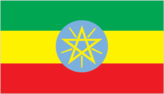
three equal horizontal bands of green (top), yellow, and red; Ethiopia is the oldest independent country in Africa, and the colors of her flag were so often adopted by other African countries upon independence that they became known as the pan-African colors
Independence
oldest independent country in Africa and one of the oldest in the world - at least 2,000 years
Judicial branch
Supreme Court
Legal system
NA
Member of
ACP, AfDB, CCC, ECA, FAO, G-24, G-77, IAEA, IBRD, ICAO, ICRM, IDA, IFAD, IFC, IFRCS, IGADD, ILO, IMF, IMO, INTELSAT, INTERPOL, IOC, ISO, ITU, NAM, OAU, UN, UNCTAD, UNESCO, UNHCR, UNIDO, UNU, UPU, WFTU, WHO, WMO, WTO
Names
conventional long form: none conventional short form: Ethiopia local long form: none local short form: Ityop'iya
National holiday
National Day, 28 May (1991) (defeat of Mengistu regime)
Other political or pressure groups
Oromo Liberation Front (OLF); All Amhara People's Organization; Southern Ethiopia People's Democratic Coalition; numerous small, ethnic-based groups have formed since Mengistu's resignation, including several Islamic militant groups
Political parties and leaders
Ethiopian People's Revolutionary Democratic Front (EPRDF), MELES Zenawi;
Suffrage
18 years of age; universal
Type
transitional government note: on 28 May 1991 the Ethiopian People's Revolutionary Democratic Front (EPRDF) toppled the authoritarian government of MENGISTU Haile-Mariam and took control in Addis Ababa; a new constitution was promulgated in December 1994 and national and regional elections are scheduled for May 1995; the administrative regions will elect regional assemblies by popular vote; the National Assembly will have two chambers - one elected by popular vote and the other selected as representatives by the regional assemblies; the lower house of the National Assembly will select or confirm the president, the prime minister and the cabinet officers and judges; the prime minister will be the chief executive officer and the duties of the president will be mostly ceremonial
US diplomatic representation
chief of mission: Ambassador Irvin HICKS embassy: Entoto Street, Addis Ababa mailing address: P. O. Box 1014, Addis Ababa telephone: [251] (1) 550666
Economy
Agriculture
accounts for 45% of GDP; export crops of coffee and oilseeds are grown partly on state farms; estimated 50% of agricultural production is at subsistence level; principal crops and livestock - cereals, pulses, coffee, oilseeds, sugarcane, potatoes and other vegetables, hides and skins, cattle, sheep, goats
Budget
revenues: $1.2 billion expenditures: $1.7 billion, including capital expenditures of $707 million (FY93/94)
Currency
1 birr (Br) = 100 cents
Economic aid
recipient: US commitments, including Ex-Im (FY70-89), $504 million; Western (non-US) countries, ODA and OOF bilateral commitments (1970-89), $3.4 billion; OPEC bilateral aid (1979-89), $8 million; Communist countries (1970-89), $2 billion
Electricity
capacity: 460,000 kW production: 1.3 billion kWh consumption per capita: 23 kWh (1993)
Exchange rates
birr (Br) per US$1 - 5.9500 (January 1995), 5.9500 (1994), 5.0000 (fixed rate 1992-93); fixed at 2.070 before 1992; note - official rate pegged to the US$
Exports
$219.8 million (f.o.b., 1993 est.) commodities: coffee, leather products, gold partners: Germany, Japan, Saudi Arabia, France, Italy
External debt
$3.7 billion (1993 est.)
Fiscal year
8 July - 7 July
Illicit drugs
transit hub for heroin originating in Southwest and Southeast Asia and destined for Europe and North America as well as cocaine destined for southern African markets; cultivates qat (chat) for local use and regional export
Imports
$1.04 billion (c.i.f., 1993 est.) commodities: capital goods, consumer goods, fuel partners: US, Germany, Italy, Saudi Arabia, Japan
Industrial production
growth rate -3.3% (FY91/92); accounts for 12% of GDP
Industries
food processing, beverages, textiles, chemicals, metals processing, cement
Inflation rate (consumer prices)
10% (FY93/94)
National product
GDP - purchasing power parity - $20.3 billion (1993 est.)
National product per capita
$380 (1993 est.)
National product real growth rate
3% (1994 est.)
Overview
With the independence of Eritrea on 27 April 1993, Ethiopia continues to face difficult economic problems as one of the poorest and least developed countries in Africa. Its economy is based on agriculture, which accounts for about 45% of GDP, 90% of exports, and 80% of total employment; coffee generates 60% of export earnings. The agricultural sector suffers from frequent periods of drought, poor cultivation practices, and deterioration of internal security conditions. The manufacturing sector is heavily dependent on inputs from the agricultural sector. Over 90% of large-scale industry, but less than 10% of agriculture, is state run. The government is considering selling off a portion of state-owned plants, and is implementing reform measures that are gradually liberalizing the economy. A major medium-term problem is the improvement of roads, water supply, and other parts of an infrastructure badly neglected during years of civil strife.
Unemployment rate
NA%
Communications
Radio
broadcast stations: AM 4, FM 0, shortwave 0 radios: 9 million
Telephone system
NA telephones; open-wire and radio relay system adequate for government use local: NA intercity: open wire and microwave radio relay links international: open-wire to Sudan and Djibouti; microwave radio relay to Kenya and Djibouti; 3 INTELSAT (1 Atlantic Ocean and 2 Pacific Ocean) earth stations
Television
broadcast stations: 1 televisions: 100,000
Transportation
Airports
total: 98 with paved runways over 3,047 m: 2 with paved runways 2,438 to 3,047 m: 3 with paved runways 1,524 to 2,437 m: 2 with paved runways 914 to 1,523 m: 1 with paved runways under 914 m: 24 with unpaved runways over 3,047 m: 4 with unpaved runways 2,438 to 3,047 m: 6 with unpaved runways 1,524 to 2,438 m: 14 with unpaved runways 914 to 1,523 m: 42
Highways
total: 24,127 km paved: 3,289 km unpaved: gravel 6,664 km; improved earth 1,652 km; unimproved earth 12,522 km (1993)
Merchant marine
total: 12 ships (1,000 GRT or over) totaling 62,627 GRT/88,909 DWT ships by type: cargo 8, livestock carrier 1, oil tanker 2, roll-on/roll-off cargo 1
Ports
none
Railroads
total: 681 km (Ethiopian segment of the Addis Ababa-Djibouti railroad) narrow gauge: 681 km 1.000-m gauge
Military and Security
Branches
Transitional Government of Ethiopia Forces, Air Force, Police
Defense expenditures
exchange rate conversion - $140 million, 4.1% of GDP (FY94/95) ________________________________________________________________________ EUROPA ISLAND (possession of France)
Manpower availability
males age 15-49 12,658,084; males fit for military service 6,569,759; males reach military age (18) annually 565,976 (1995 est.)